

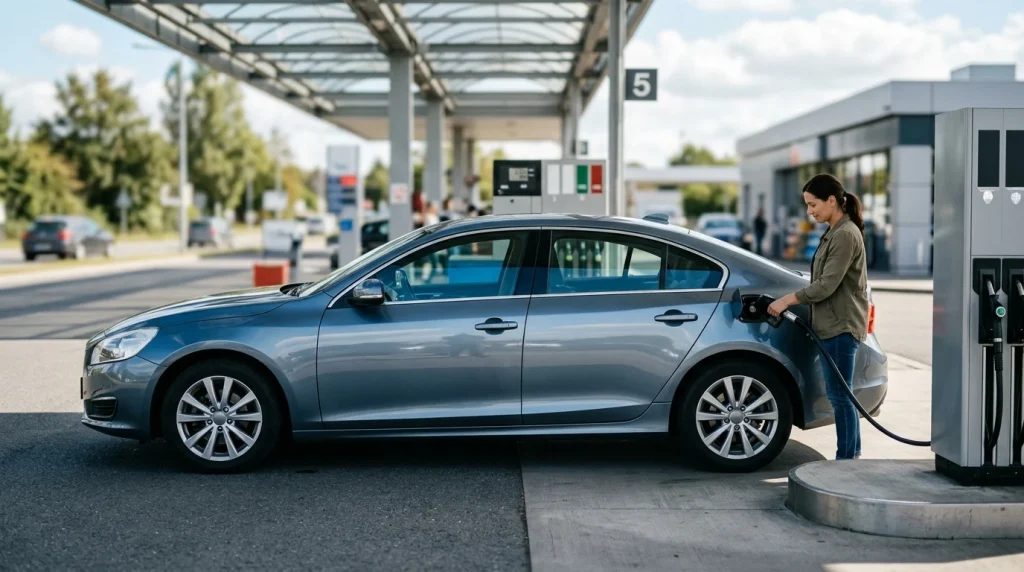
Quick answer: The average passenger car holds between 12 and 16 gallons of gasoline, but capacity varies significantly based on vehicle size and design. Small compact cars typically hold 11 to 14 gallons, midsize sedans range from 14 to 16 gallons, crossover SUVs contain 14 to 18 gallons, and large SUVs or full-size pickup trucks hold 20 to 35+ gallons.
Key takeaways:
- Most passenger vehicles carry 12 to 16 gallons of fuel to achieve an average driving range of 300 to 450 miles per fill-up.
- Crossovers and compact SUVs average 14 to 18 gallons, while full-size trucks can carry up to 36 gallons or more.
- The low-fuel light illuminates when a reserve buffer of 1 to 2.5 gallons remains, which is not a separate physical tank.
- Hybrid vehicles often feature smaller gas tanks than standard models to allocate chassis space for battery packs.
Average Gas Tank Sizes by Vehicle Class
Fuel tank capacity directly scales with a vehicle’s weight, engine size, and fuel consumption rate. According to automotive data compiled by Edmunds, manufacturers size fuel tanks to ensure that almost any passenger vehicle can achieve a highway driving range of 300 to 450 miles between refuels.
Vehicles with lower fuel economy require larger tanks to avoid forcing drivers to stop frequently. For example, a heavy-duty truck towing a trailer may get under 10 miles per gallon (MPG). Without an extended fuel tank, its driving range would be severely limited.
The table below outlines the average gas tank sizes across different vehicle classes, featuring typical capacities and real-world examples:
| Vehicle Class | Average Tank Size (Gallons) | Average Tank Size (Liters) | Model Example | Tank Capacity (Gallons) |
|---|---|---|---|---|
| Compact / Subcompact Cars | 11 – 14 | 41 – 53 | Honda Civic | 12.4 |
| Midsize Sedans | 14 – 16 | 53 – 60 | Toyota Camry | 13.0 – 15.8 |
| Compact Crossovers / SUVs | 14 – 18 | 53 – 68 | Toyota RAV4 | 14.5 |
| Midsize / Full-Size SUVs | 18 – 28 | 68 – 106 | Chevrolet Tahoe | 24.0 |
| Light-Duty Pickup Trucks | 22 – 36 | 83 – 136 | Ford F-150 | 23.0 – 36.0 |
According to fuel data analysis by Kelley Blue Book, understanding your vehicle class average helps set realistic expectations for refueling costs and trip planning. When buying a vehicle for long-distance travel, matching the tank size to the vehicle’s MPG rating is crucial.
How to Determine Your Specific Vehicle’s Fuel Capacity
Guessing your tank size based on the amount of fuel you purchase at a gas station is inaccurate because tanks are rarely filled from absolute empty, and pump nozzles click off before the physical volume is entirely saturated. If you want to know the exact physical capacity of your vehicle’s fuel tank, utilize the following reliable methods:
- Consult the Owner’s Manual: Navigate to the “Capacities and Specifications” section at the back of your manual. This index lists the exact fluid specifications, including fuel, motor oil, and coolant capacities.
- Perform a VIN Lookup: Using a free online vehicle identification number (VIN) decoder is the most accurate way to retrieve your vehicle’s specific build sheet. This is especially helpful for pickup trucks, which frequently offer optional “extended range” fuel tanks from the factory.
- Review the Monroney Label: If you still have the vehicle’s original window sticker, the fuel tank capacity will be printed under the technical specifications or standard equipment list.
- Check Manufacturer Spec Sheets: For newer vehicle models, the official manufacturer website lists detailed technical specifications, including fuel capacity, under the “Specs” or “Dimensions” tab for each trim level.
Understanding the “Reserve Tank” and Low Fuel Light
Most modern vehicles do not have a separate, physical “reserve tank.” Instead, the reserve fuel is simply the remaining gasoline at the bottom of the main tank after the dashboard fuel gauge reads empty or the low-fuel warning light illuminates.
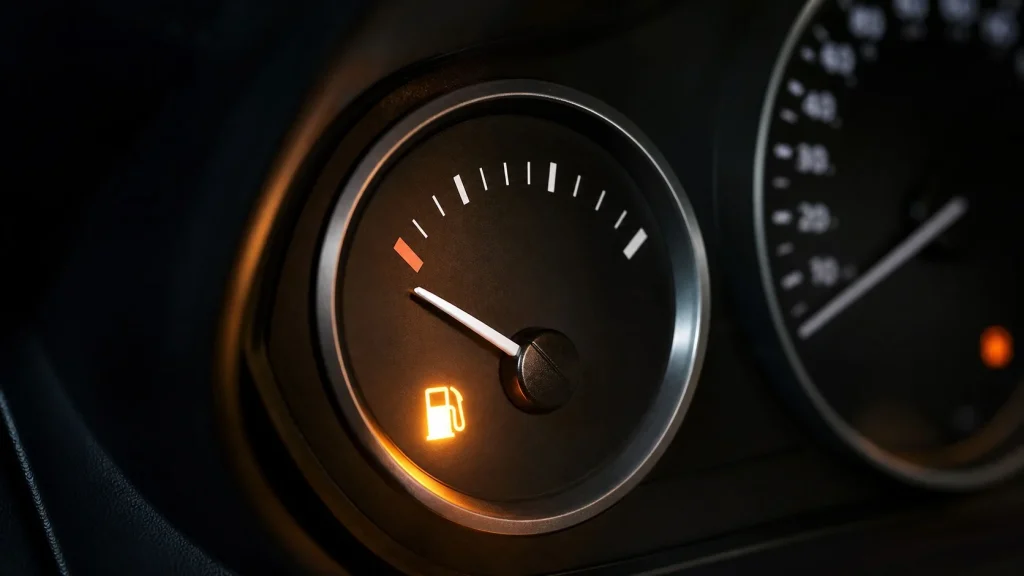
The low-fuel warning light typically activates when the fuel level drops to approximately 10% to 15% of the tank’s total capacity. For a standard passenger car, this leaves a reserve buffer of roughly 1 to 2.5 gallons (about 4 to 10 liters).
Analysis: Automakers intentionally calibrate the fuel gauge to display “empty” before the tank is physically dry to protect both the driver and the vehicle’s mechanical components. The electric fuel pump is submerged at the bottom of the tank, relying on the surrounding gasoline to cool and lubricate the motor during operation. If the fuel level drops too low, the pump draws in air, overheats, and accelerates wear.
Note: Driving on a near-empty tank can draw settled debris and sediment from the bottom of the tank into the fuel filter, potentially clogging the system. According to repair data from AAA, replacing a damaged fuel pump can cost between $500 and $1,400 depending on the vehicle’s make and model. If your engine stalls due to fuel starvation, you may need to learn how to start a car with a bad fuel pump as a temporary emergency measure before obtaining a replacement.
David Bennett, the repair systems manager for AAA, warns that letting your fuel level drop below one-eighth of a tank increases the risk of fuel system damage. To maintain vehicle reliability, automotive experts recommend refueling when your tank drops to one-quarter full rather than waiting for the warning light to flash.
How Hybrid Powertrains Impact Gas Tank Size
Hybrid vehicles often feature smaller gas tanks than standard, gasoline-only models in the same size class. This design choice is necessary because manufacturers must clear physical chassis space to accommodate the high-voltage battery pack and electric motors without increasing the vehicle’s total weight excessively.
Despite having smaller fuel capacities, hybrids usually match or exceed the driving range of gas-powered cars because they achieve superior fuel economy, particularly in stop-and-go city driving.
- Standard Gasoline Model: A standard gasoline-powered Honda Accord features a 14.8-gallon tank. With an EPA-estimated 32 combined MPG, it offers a total range of approximately 473 miles.
- Hybrid Model: The Honda Accord Hybrid uses a smaller 12.8-gallon tank. However, because it achieves an EPA-estimated 48 combined MPG, its total driving range extends to approximately 614 miles despite holding two fewer gallons of fuel.
When shopping for a hybrid, evaluate the total driving range rather than the tank capacity alone. Multiply the tank size by the vehicle’s EPA combined MPG rating to find how far the vehicle can travel on a single fill-up.
Frequently Asked Questions about Fuel Tank Capacity
How far can you drive when the gas light comes on?
Once the low-fuel warning light activates, most passenger vehicles can travel an additional 30 to 50 miles. However, this range depends heavily on your real-time fuel efficiency, driving speed, and road conditions. Pushing your vehicle to this limit is not recommended due to the risk of leaving you stranded and damaging the electric fuel pump.
Do larger cars always have bigger gas tanks?
Yes, larger and heavier vehicles like full-size SUVs and pickup trucks require larger gas tanks. Because these vehicles require more energy to overcome aerodynamic drag and inertia, their fuel consumption rate is higher. A larger tank, often exceeding 25 gallons, is necessary to maintain a practical driving range between refueling stops.
Can you overfill your gas tank by topping off?
Yes, continuing to pump fuel after the gas station nozzle clicks off can damage your vehicle’s Evaporative Emission Control (EVAP) system. Modern cars use a charcoal canister to capture harmful fuel vapors. Topping off the tank can force liquid gasoline into this canister, leading to system failure, increased emissions, and a dashboard check engine light.

