

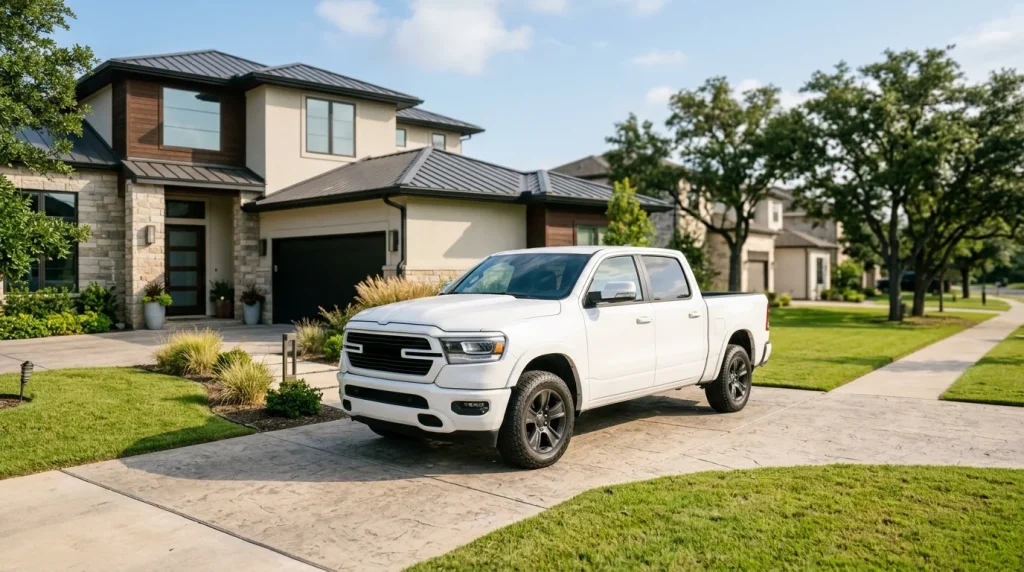
On a truck, a 4×2 drivetrain indicates four total wheel positions with engine torque delivered exclusively to two wheels, typically the rear axle. When asking what does 4×2 mean on a truck, it refers to a two-wheel drive platform that eliminates heavy front driveline hardware, saving 200 to 400 pounds of curb weight compared to 4×4 systems. This mechanical layout delivers higher payload ratings, lower initial purchase costs, and 1 to 2 MPG better highway fuel economy.
Key takeaways:
- A 4×2 truck delivers engine torque exclusively to one axle, while the non-driven axle handles steering.
- Eliminating front-drive hardware saves 200 to 400 pounds of curb weight, directly increasing maximum payload capacity.
- Selecting a 4×2 model reduces upfront MSRP by $3,000 to $4,500 and improves highway fuel economy by 1 to 2 MPG.
- While 4×2 excels in highway towing and pavement hauling, 4×4 remains necessary for deep snow, mud, and unpaved terrain.
Understanding 4×2 Truck Axle Configurations and Power Delivery
In automotive engineering, the numerical designation 4×2 describes the relationship between the total number of wheel ends on a vehicle and the number of those wheel ends that receive driving torque from the engine. The first number represents the total wheel positions on the chassis, counting a pair of dual rear tires as a single wheel position. The second number specifies how many of those wheel positions are actively powered by the powertrain. Consequently, a 4×2 pickup truck possesses four total wheel positions, with power transmitted exclusively to two of them.
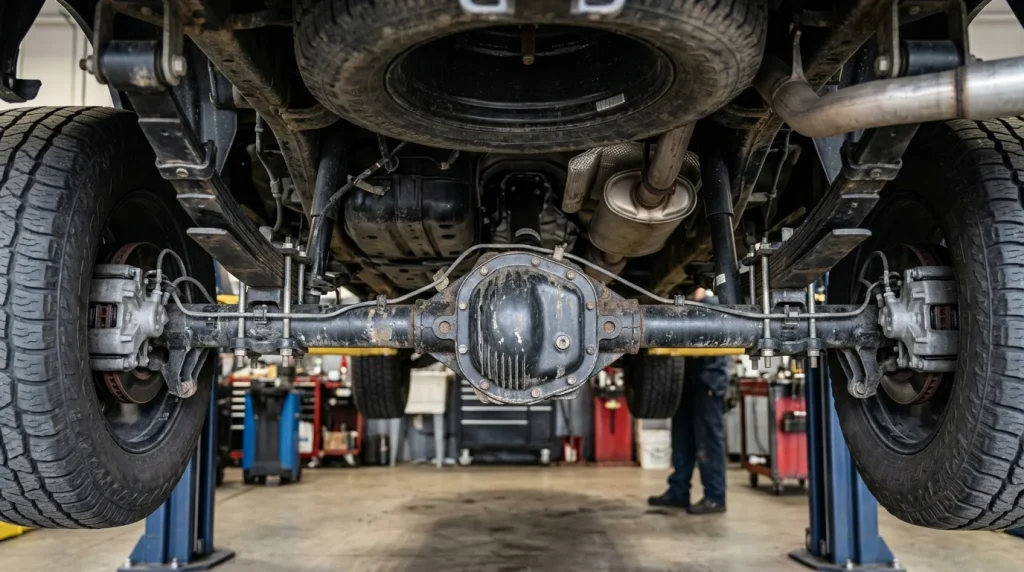
On nearly all full-size and mid-size pickup trucks, a 4×2 setup functions as a front-engine, rear-wheel drive (RWD) platform. Rotational force generated by the engine travels through the transmission into a longitudinal driveshaft. This driveshaft connects to a rear differential assembly housed inside a rigid or independent rear axle. The differential splits the incoming torque between the left and right rear axle shafts, driving the rear tires to propel the truck forward. Meanwhile, the front wheels rotate freely on unpowered spindles, dedicated entirely to steering and lateral directional control.
Modern electronic management systems monitor this mechanical power transfer continuously. When electronic wheel speed sensors detect rotational slippage or transmission anomalies, onboard computers can trigger a drivetrain malfunction warning or illuminate a dashboard exclamation point warning to notify the operator before physical gear damage occurs.
Open Differential vs. Limited-Slip and Locking Differentials
The specific type of differential installed on a 4×2 truck rear axle dictates how effectively the vehicle transfers torque to the road when surface grip decreases. Base model 4×2 trucks generally come equipped with an open differential. An open differential uses internal spider gears to allow outside and inside tires to rotate at different speeds during cornering, preventing tire scrubbing on dry asphalt. However, an open differential naturally directs torque along the path of least resistance. If one rear wheel encounters ice, wet grass, or loose sand, that single wheel spins freely while the opposite wheel with solid traction receives virtually zero rotational force.
To mitigate this operational vulnerability, truck manufacturers offer upgraded traction hardware:
- Limited-Slip Differential (LSD): Uses mechanical clutch packs or helical gears to resist extreme speed differences between the two rear axle shafts. When one tire begins slipping, the internal mechanism transfers a portion of available engine torque to the gripping wheel, restoring forward momentum without driver intervention.
- Electronic Locking Differential (E-Locker): Features a selectable electromagnetic or pneumatic collar that physically binds both axle shafts together. When activated via a dashboard switch, both rear wheels turn at identical speeds regardless of surface traction, providing maximum propulsion on slick boat ramps or graded gravel roads.
- Brake-Based Traction Control: Employs the anti-lock braking system (ABS) to pulse the brake caliper on a spinning wheel. This creates artificial resistance that forces an open differential to route torque across the axle to the stationary wheel.
4×2 vs. 4×4: Key Drivetrain Differences and Mechanical Hardware
Choosing between a two-wheel drive and a four-wheel drive truck involves balancing mechanical capability against complexity, weight, and financial investment. While a 4×2 pickup routes power through a single driveshaft and axle, a four-wheel drive (4×4) platform incorporates dedicated hardware to distribute torque to all four wheel positions simultaneously or on demand.
In contrast to specialized performance layouts like a BMW M4 twin-turbo engine designed for track agility, standard truck powertrains prioritize continuous torque delivery under substantial mechanical stress. Much like how vehicle trim codes such as the Audi TT naming origin specify exact chassis configurations, truck badging clearly distinguishes 4×2 from 4×4 systems to communicate capability to commercial buyers and retail consumers alike.
Transfer Case, Front Differential, and Weight Penalties
A 4×4 truck incorporates several heavy mechanical components that are completely absent in a 4×2 chassis:
- Transfer Case: Positioned directly behind the transmission, the transfer case splits rotational torque between the front and rear driveshafts. In traditional part-time systems, it provides selectable drive modes, including 2H (two-wheel drive high), 4H (four-wheel drive high), and 4L (four-wheel drive low range, which uses planetary reduction gears to multiply engine torque for crawling over severe obstacles).
- Front Differential and Half-Shafts: A secondary differential mounted beneath the engine sends torque to the front wheels via constant velocity (CV) axle shafts.
- Front Driveshaft: A secondary rotating steel or aluminum shaft linking the transfer case output flange to the front differential pinion.
This supplemental hardware adds between 200 and 400 pounds of dead curb weight to the chassis. Furthermore, the rotating front driveline assemblies introduce parasitic frictional drag, which impacts fuel consumption even when operating in two-wheel drive high mode.
Drivetrain Comparison Matrix
| Specification and Feature | 4×2 Truck (2WD Platform) | 4×4 Truck (4WD Platform) |
|---|---|---|
| Driven Wheel Positions | 2 (Almost exclusively rear wheels) | 4 (Front and rear axles powered) |
| Core Driveline Hardware | Single driveshaft, rear differential | Transfer case, 2 driveshafts, 2 differentials, front CV axles |
| Average Curb Weight | Baseline chassis weight (Lighter) | Adds 200 to 400 lbs of mechanical hardware |
| Combined Fuel Economy | 1 to 2 MPG higher on highway cycles | 1 to 2 MPG lower due to friction and mass |
| Upfront Purchase Price | Baseline MSRP | $3,000 to $4,500 factory option premium |
| Maximum Payload Rating | Higher (Lighter curb weight increases capacity) | Lower (Heavier chassis reduces payload rating) |
| Paved Road Performance | Exceptional agility and low rolling resistance | Excellent, but carries higher unsprung mass |
| Severe Weather Capability | Moderate (Requires ballast and good tires) | Superior (All-wheel power for snow, ice, and mud) |
Impact on Payload Capacity, Towing Dynamics, and Fuel Economy
A widespread misunderstanding among prospective truck buyers is the assumption that four-wheel drive configurations automatically provide superior hauling and towing ratings. In automotive engineering practice, the exact opposite is frequently true. A vehicle’s Gross Vehicle Weight Rating (GVWR) is an absolute structural limit established by the manufacturer, representing the maximum permissible total weight of the truck, including its own curb weight, onboard passengers, fuel, accessories, and cargo.
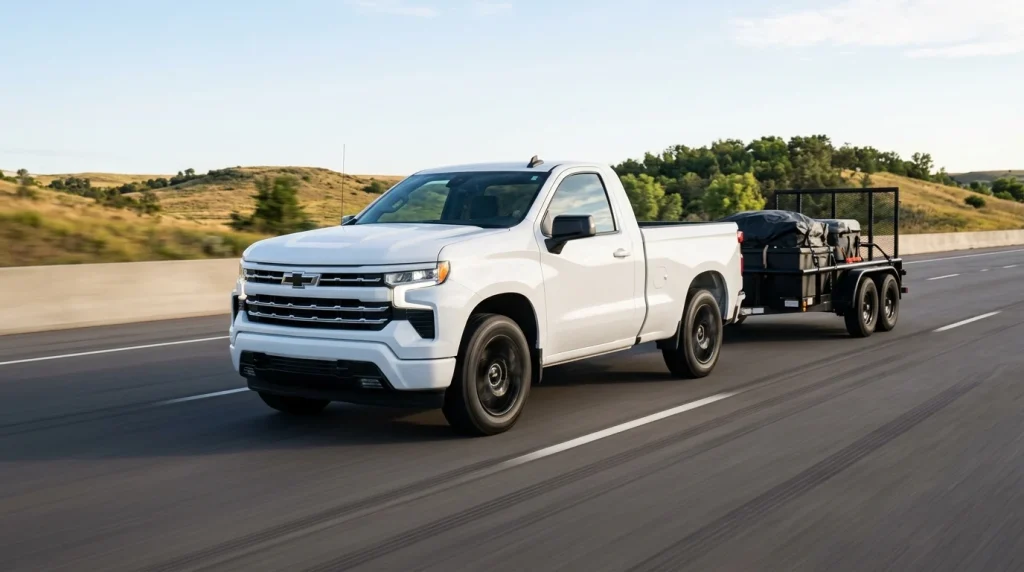
Because a 4×2 truck eliminates the heavy front transfer case, front axle assembly, and front driveshaft, its unladen curb weight is significantly lower. Under identical chassis and engine specifications, every pound shaved off the curb weight converts directly into additional legal payload capacity inside the cargo bed.
The Curb Weight Advantage: Why 4×2 Trucks Often Haul More
According to SAE International J2807 towing standards, towing and payload limits are calculated through standardized vehicle testing procedures that account for structural rigidity, thermal cooling capacity, braking distances, and total mass.
On popular light-duty trucks like the Ford F-150, Chevrolet Silverado 1500, and Ram 1500, the maximum payload ratings across the entire product lineup are consistently achieved by regular cab, long-bed 4×2 configurations. For instance, a 4×2 full-size truck might boast a maximum payload rating of 2,440 pounds, whereas the identically powered 4×4 counterpart sees its payload limit reduced to approximately 2,150 pounds purely due to the additional weight of the front driveline hardware.
When towing heavy trailers on paved highways, 4×2 trucks also benefit from a higher Gross Combined Weight Rating (GCWR) efficiency. The lighter vehicle mass requires less energy to accelerate from a complete stop, reducing strain on transmission clutch packs and torque converters during long distance highway transport.
EPA Fuel Economy Ratings and Annual Fuel Cost Savings
Fuel economy represents another measurable advantage for two-wheel drive trucks. According to official U.S. EPA Fuel Economy data, a 4×2 pickup truck typically achieves 1 to 2 miles per gallon (MPG) higher in combined driving cycles compared to an equivalent 4×4 model fitted with the same displacement engine and axle ratio.
This efficiency advantage stems from two physical factors:
- Reduced Inertial Mass: Accelerating a lighter vehicle requires less thermal energy from combusted fuel.
- Lower Parasitic Driveline Drag: In a 4×2 setup, the engine does not have to overcome the internal mechanical friction of turning front differential ring gears or transfer case chains.
Maintaining optimal combustion efficiency by adhering to manufacturer recommended fuel octane ratings, reviewing specific Civic Type R fuel recommendations when comparing fleet passenger support vehicles, and ensuring unrestricted engine air filter airflow helps preserve these baseline fuel savings over the lifespan of the vehicle. For a fleet driver accumulating 20,000 miles annually at $3.60 per gallon, a 2 MPG improvement saves between $350 and $550 in annual fuel expenditures per truck. Fleet operational data confirms that for vehicles running primarily on paved routes, a 4×2 drivetrain minimizes both unscheduled maintenance events and ongoing fuel expenditures over extended multi-year duty cycles.
Traction Mechanics and Real-World Driving Conditions
Understanding how a 4×2 pickup interacts with various road surfaces allows operators to maximize safety while avoiding situations where two-wheel drive reaches its physical limits. Unlike passenger sedans with front-wheel drive that position the heavy engine and transaxle directly over the driven front wheels, pickup trucks exhibit an uneven front-to-rear weight distribution when empty.
A typical unladen pickup carries approximately 60 percent of its total mass over the front steering axle and only 40 percent over the rear drive axle. Without cargo in the bed, the rear tires exert lower downward contact patch pressure on the pavement, increasing the likelihood of wheel spin when accelerating on low-friction surfaces.
Driving on Pavement, Rain, Snow, and Moderate Terrain
Under dry and wet pavement conditions, modern 4×2 trucks perform reliably. Advanced electronic stability control (ESC) and multi-channel traction control systems continuously monitor wheel rotation speeds, automatically attenuating engine throttle and applying individual wheel brakes to prevent fishtailing or spinouts during sharp turns. Modern trucks also integrate active occupant restraint systems that work in tandem with electronic chassis stability controls to safeguard vehicle occupants during rapid deceleration maneuvers.
However, when road surfaces transition to unplowed winter snow, packed ice, deep mud, or loose beach sand, a 4×2 truck faces significant hurdles. Because only two tires provide driving force, if both rear tires lose traction simultaneously, the truck loses all forward momentum. In contrast, a 4×4 vehicle can distribute engine torque to the front tires, which pull the front end through ruts and over slippery crests.
Winter Ballast and Weight Distribution Strategies
Drivers operating 4×2 trucks in cold weather regions can substantially enhance winter driving traction by adopting proven ballasting techniques:
- Traction Ballast: Placing 200 to 300 pounds of dedicated weight, such as sealed sandbags or rubberized ballast plates, in the cargo bed directly over or slightly ahead of the rear axle centerline. This additional weight increases downward tire contact pressure, improving frictional grip on packed snow and ice.
- Winter Tire Compounds: Installing dedicated winter tires featuring specialized silica compounds and dense siping patterns. Premium winter tires on a 4×2 truck often provide superior braking and cornering control compared to worn all-season tires on a 4×4 truck.
- Tire Pressure Calibration: Ensuring rear tire pressures match manufacturer cold inflation specifications without overinflating, preserving the optimal tire footprint size.
Operating two-wheel drive work trucks across harsh rural environments will eventually accelerate chassis bushing wear, reaching critical breakdown mileage thresholds where suspension links and ball joints require rebuilding, though maintenance remains far simpler than servicing front drive axles.
Note: When operating a rear-wheel drive pickup in sub-freezing conditions, placing 200 to 300 pounds of traction ballast directly above the rear axle helps counteract front-heavy weight bias without exceeding gross axle ratings.
Maintenance Schedules and Long-Term Operating Costs
The mechanical simplicity of a 4×2 drivetrain translates directly into reduced maintenance overhead and higher long-term reliability. With fewer mechanical components subjected to torsional stress, heat, and fluid degradation, two-wheel drive trucks experience lower component failure rates over extended duty cycles.
Standard vehicle upkeep such as monitoring vehicle engine coolant chemistry and replacing a worn automotive HVAC blower motor follows identical procedures regardless of drivetrain. However, underneath the chassis, the maintenance requirements diverge dramatically.
Fluid Service Intervals and Mechanical Simplicity
A 4×2 truck features a streamlined underbody layout that eliminates several routine fluid changes and inspection procedures mandated on 4×4 vehicles:
- Rear Differential Servicing: The rear differential requires a gear oil flush and inspection typically every 30,000 to 50,000 miles, depending on whether the truck performs frequent heavy towing.
- Zero Front Driveline Upkeep: Because there is no front differential or transfer case, 4×2 owners never incur costs for transfer case fluid flushes, front differential oil replacements, front CV joint boot inspections, or front axle seal repairs.
- Simplified Front Suspension: The front steering knuckle and suspension assembly on a 4×2 truck operates without drive axles passing through the center of the wheel hubs. This design allows for durable, cost-effective wheel bearing hub assemblies that are easier and faster to replace when worn.
Total Cost of Ownership: Fleet and Commercial Evidence
According to fleet research published by Government Fleet life-cycle analysis and benchmarking data from Utilimarc, light-duty 4×2 service trucks achieve consistent reductions in scheduled servicing overhead and drivetrain component wear compared to four-wheel drive configurations.
Commercial fleet operating data confirms that the combination of reduced initial acquisition costs, lower tire friction, and eliminated front driveline servicing delivers measurable long-term budget advantages. Over a five-year operating lifecycle, maintaining a two-wheel drive fleet minimizes unexpected mechanical downtime while delivering predictable maintenance expenditures for municipal and highway transport operations.
When to Choose a 4×2 Truck: Practical Buying Guide
Selecting the appropriate drivetrain requires evaluating your geographic location, expected payload demands, road surface conditions, and total ownership budget. While automotive marketing heavily emphasizes four-wheel drive adventure capability, millions of truck owners achieve optimal utility and financial value by selecting a two-wheel drive model.
Ideal Operating Profiles for Two-Wheel Drive Pickups
A 4×2 truck is the most practical and economical choice under the following conditions:
- Paved Highway and Urban Driving: If more than 95 percent of your driving occurs on paved roads, highways, and well-maintained suburban streets, a 4×2 truck provides a quieter ride, lighter steering response, and superior fuel economy.
- Dedicated Highway Towing: If you tow campers, car haulers, or horse trailers along interstate routes and well-paved staging areas, the higher payload and towing limits of a 4×2 chassis make it the ideal tow vehicle.
- Warm and Moderate Climates: Drivers residing in the Southern United States, coastal regions, or desert climates that rarely or never experience significant snowfall do not require the costly winter traction benefits of a 4×4 transfer case.
- Commercial Fleet and Delivery Operations: Businesses focused on minimizing total cost per mile maximize profitability through lower acquisition costs, reduced tire wear, and fewer mechanical failure points. Running thorough vehicle ownership expense comparisons across different vehicle classes demonstrates how choosing two-wheel drive platforms cuts ongoing lifecycle depreciation.
When acquiring pre-owned commercial trucks or retired municipal utility vehicles, prospective buyers should review past fleet maintenance logs and understand applicable used vehicle consumer protection statutes to verify that the drivetrain was properly serviced before finalizing a purchase.
Conversely, a 4×4 truck becomes essential if your daily operations involve driving on unplowed winter roads, navigating muddy construction sites, traversing loose agricultural fields, or pulling heavy boats up slippery, algae-covered launch ramps.
Key Drivetrain Terminology and Engineering Definitions
- Drivetrain: The group of mechanical components that generate power and deliver it to the road surface, including the engine, transmission, driveshafts, differentials, and drive axles.
- Axle Ratio: The ratio of driveshaft revolutions to axle shaft revolutions, determined by the ring and pinion gears inside the differential. A higher numerical ratio (such as 3.73:1 vs 3.31:1) provides greater towing torque at the expense of highway fuel economy.
- GVWR (Gross Vehicle Weight Rating): The maximum allowable total weight of the truck when fully loaded with fuel, passengers, and cargo.
- GCWR (Gross Combined Weight Rating): The maximum allowable combined weight of the fully loaded truck and its attached loaded trailer.
- Payload Capacity: The maximum cargo weight a truck can carry inside its cab and bed, calculated as GVWR minus the vehicle’s unladen curb weight.
Frequently Asked Questions About 4×2 Trucks
Is a 4×2 truck the same as a 2WD truck?
Yes, a 4×2 truck is functionally identical to a two-wheel drive (2WD) truck. The notation indicates four total wheel ends with two powered wheel ends. In full-size and mid-size pickup trucks, this almost universally denotes a rear-wheel drive configuration where the engine powers the rear axle.
Can a 4×2 truck tow more than an equivalent 4×4 model?
In many configurations, yes. Because a 4×2 truck eliminates between 200 and 400 pounds of front drivetrain hardware, its lower curb weight leaves more available capacity under the manufacturer Gross Combined Weight Rating (GCWR), often resulting in higher maximum payload and towing ratings than an identically equipped 4×4 trim.
Are 4×2 trucks safe to drive in rainy conditions?
Yes, modern 4×2 pickup trucks handle wet paved roads safely due to standard anti-lock braking systems, active electronic stability control, and traction control. Maintaining adequate tire tread depth and exercising smooth throttle modulation on wet pavement ensures stable directional control.
Is it possible to convert a 4×2 truck to a 4×4 system?
While mechanically feasible, converting a factory 4×2 truck to a functional 4×4 system is economically impractical. The conversion requires installing a transfer case, front driveshaft, front differential, custom wiring harnesses, electronic shift modules, and compatible front suspension components, frequently exceeding $6,000 to $9,000 in parts and specialized labor.
How does a 4×2 truck handle steep highway grades?
On paved roads, a 4×2 truck climbs steep mountain grades without difficulty. Proper gear selection and maintaining engine cooling systems allow the rear-wheel drive platform to deliver consistent torque without wheel slip on dry asphalt surfaces.

