

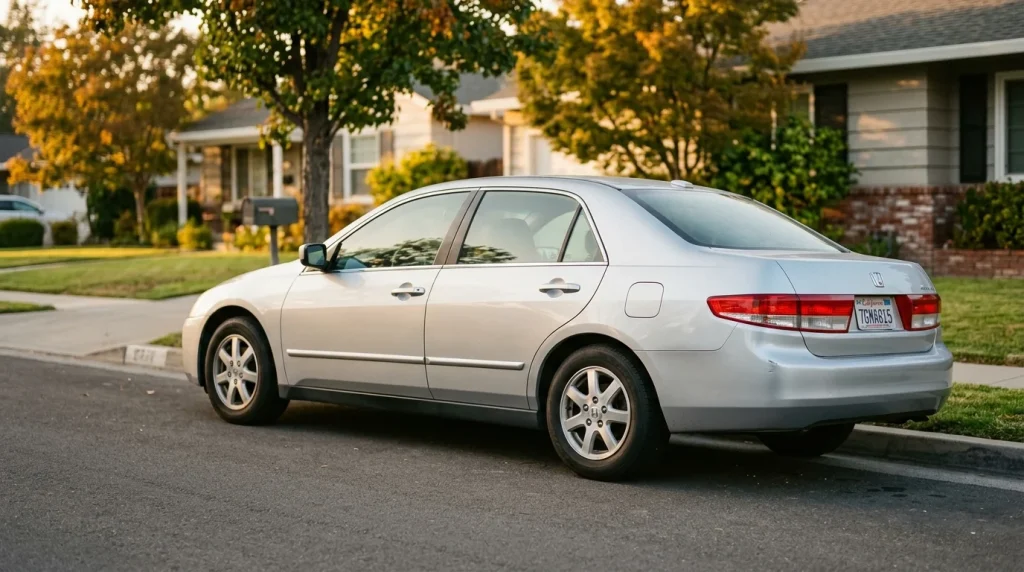
When evaluating what years of Honda Accord to avoid, used car buyers should bypass the 1998-2005, 2008-2009, 2013, and 2018 model years. The 1998-2005 V6 models suffer from widespread automatic transmission breakdowns costing an average of $2,700 to $2,900 to replace, while 2008-2009 models burn excessive engine oil due to faulty cylinder deactivation. The 2013 redesign year is prone to starter motor failures and early CVT shudder, and the 2018 model experiences fuel dilution in its 1.5L turbo engine. For maximum dependability, target the 2006-2007, 2011-2012, 2015-2017, or 2019-2022 model years.
Key takeaways:
- The 1998-2005 Accords, particularly V6 models, carry severe automatic gearbox failure risks clustering between 95,000 and 110,000 miles.
- The 2008-2009 models suffer from heavy oil consumption linked to Variable Cylinder Management and rapid rear brake wear.
- Redesign years like 2013 and 2018 exhibit first-year production defects, including starter motor binding and 1.5T engine oil dilution.
- Late-generation models (2006-2007, 2011-2012, 2015-2017, and 2019-2022) offer the lowest repair costs and highest dependability.
Generational Overview and Why Model Years Vary
The Honda Accord has built a strong reputation as a durable midsize sedan, but reliability varies significantly across production cycles. Major mechanical failures cluster around two distinct patterns: first-year redesign bugs and powertrain design flaws that Honda corrected only in late-cycle updates.
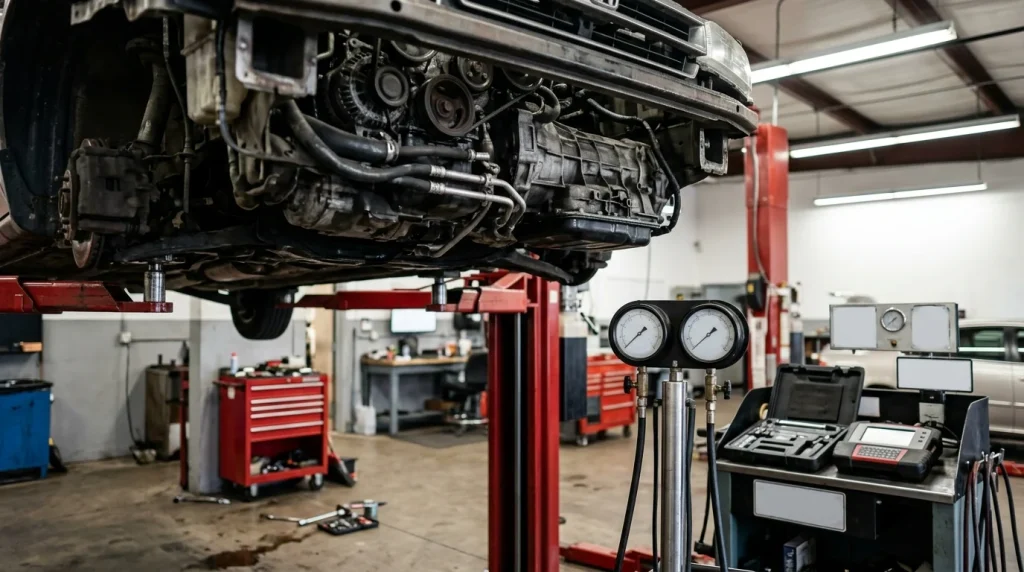
When Honda introduces a new generation, the early model years frequently carry untested electronic modules, revised transmission programming, or brand-new engine architectures that develop unexpected problems under daily driving conditions. In contrast, mid-cycle refreshes and late-generation production runs benefit from revised part numbers, updated factory software, and improved manufacturing tolerances.
Across six major generations, reliability patterns divide cleanly along mechanical architecture:
- Sixth Generation (1998-2002): Transition to 4-speed automatic transmissions paired with 3.0L V6 engines resulted in chronic fluid overheating.
- Seventh Generation (2003-2007): Debut of 5-speed automatic gearboxes brought peak failure rates in 2003-2004 before hydraulic revisions stabilized 2006-2007 models.
- Eighth Generation (2008-2012): Introduction of Variable Cylinder Management (VCM-2) caused oil consumption issues that required updated piston rings for 2011-2012.
- Ninth Generation (2013-2017): Launch of Earth Dreams direct injection and CVTs created starter motor and belt shudder concerns in 2013 before reaching class-leading reliability by 2015.
- Tenth Generation (2018-2022): Shift to small-displacement turbocharged engines produced cold-climate oil dilution on 1.5T models, whereas the 2.0T 10-speed configuration proved exceptionally robust.
- Eleventh Generation (2023-Present): Centralized hybrid powertrain electronics required large-scale software updates for module communication stability.
Comparing mainstream sedan reliability trends against luxury benchmark studies such as whether BMW or Mercedes is more reliable illustrates how mass-market Japanese sedans generally offer lower long-term maintenance frequency. In contrast to high-end European platforms analyzed in guides examining what mileage European cars break down, mature Accord production runs routinely exceed 200,000 miles when fundamental fluid schedules are observed. Understanding these generational boundaries helps buyers steer clear of expensive repairs.
Year-by-Year Problem Hotspots Grouped by Generation
Sixth and Seventh Generation Transmission Defects (1998-2005)
The late sixth-generation (1998-2002) and early seventh-generation (2003-2005) Accords represent the most severe mechanical era in the model’s history. Automatic transmissions paired with the 3.0L V6 engine were prone to internal fluid starvation, which led to excessive friction, overheating, and complete clutch pack disintegration.
According to defect records compiled by CarComplaints, the 2003 Honda Accord accumulated 1,703 complaints, with complete transmission failure ranked as the single worst defect across the entire model line. For the 2003 model year, transmission failures occur at an average of 98,000 miles with repair costs averaging $2,700, followed by the 2004 model averaging $2,900 at 110,000 miles and the 2002 model averaging $2,400 at 95,000 miles.
On earlier 2001-2002 4-speed automatic units, fluid starvation starved the second gear clutch pack of cooling oil. Federal regulators at NHTSA oversaw Safety Recall 04V-176 (Honda Campaign P30/P31/P32/P38/P42) covering 1.09 million vehicles to install an external oil jet kit directing ATF onto the second gear, but units with preexisting friction disc wear still experienced sudden lockup.
Beyond gearbox failure, these model years suffered from secondary defects:
- Clear Coat Delamination: Premature peeling of clear coat on the roof, hood, and trunk lid.
- Front Engine Mount Failure: Vacuum-assisted hydraulic front engine mounts deteriorated prematurely, causing heavy cabin vibration at idle ($250 to $400 replacement).
- EGR Valve Clogging: Carbon buildup inside Exhaust Gas Recirculation passages triggered hesitation and Diagnostic Trouble Code (DTC) P0401.
Buyers who purchase an affected sedan from an independent lot without a documented warranty face high out-of-pocket costs, with limited consumer recourse under statutes such as the Texas lemon law for used cars once the vehicle passes beyond original manufacturer coverage limits.
Eighth Generation Oil Consumption and Brake Wear (2008-2009)
The launch of the eighth generation in 2008 resolved the earlier transmission fluid bottlenecks but introduced persistent engine oil consumption. Models equipped with the 3.5L V6 engine used an aggressive Variable Cylinder Management (VCM) system to deactivate two or three cylinders during steady highway cruising.
This cylinder deactivation created a vacuum in the inactive cylinders, drawing motor oil past the piston rings and into the combustion chamber. Over time, the burned oil fouled spark plugs on cylinders 1 through 4, degraded oxygen sensors, and caused engine misfires, often consuming one quart of oil every 1,000 to 1,200 miles. Following a nationwide class-action lawsuit settlement, Honda issued TSB 13-078 and TSB 13-080, extending powertrain warranty coverage to 8 years with unlimited mileage for piston ring replacement and ECU software updates. For used buyers today, out-of-warranty engine ring overhauls range from $2,000 to $3,800.
On 2.4L four-cylinder engines (K24Z2 and K24Z3), stuck oil control rings documented in Honda TSB 12-087 produced similar oil burning symptoms of one quart per 1,000 to 1,500 miles. Furthermore, the electronic brake proportioning system applied excessive rear bias to prevent front-end dive, wearing out rear brake pads every 15,000 to 20,000 miles (two to three times the normal wear rate, costing $400 to $600 per service). Cabin materials also suffered, with armrest vinyl bubbling, center console lids cracking down to plastic backing, and dashboards delaminating above the passenger airbag seam in high-heat climates.
Ninth Generation Starter Motor and CVT Hesitation (2013)
The 2013 Accord debuted Honda’s Earth Dreams direct-injected powertrains and continuously variable transmissions (CVTs). As a first-year production run, the 2013 model suffered from frequent starter motor failures between 60,000 and 80,000 miles.
Under Honda Technical Service Bulletin 16-002, engineers identified an improper clearance between the starter drive gear and the engine flywheel / torque converter ring gear. This misalignment caused gear tooth grinding, intermittent no-crank conditions, and premature starter motor burnout, requiring starter replacement and flywheel rotation costing $550 to $800.
Early 2013 continuously variable transmissions also exhibited belt shudder and sluggish low-speed throttle response. Honda issued TSB 13-053 requiring Powertrain Control Module (PCM) software reprogramming and fresh CVT Fluid HCF-2. A full CVT replacement on a neglected 2013 model costs between $3,800 and $5,200. Additionally, the factory-installed Group 51R battery provided only 410 to 500 Cold Cranking Amps, struggling to support the parasitic draw of the dual-screen infotainment system and leaving vehicles discharged after 48 to 72 hours of sitting idle.
Tenth Generation Turbo Oil Dilution and Emergency Braking (2018)
The redesigned tenth-generation Accord moved to an all-turbocharged lineup in 2018. The base 1.5L turbocharged engine (L15BE) suffered from engine oil dilution, particularly in cold climates with ambient temperatures below 32°F (0°C). During short winter trips, unburned gasoline sprayed by direct injectors washed past cold cylinder walls and drained into the engine oil pan.
This fuel wash degraded motor oil viscosity below its SAE 0W-20 rating, elevating fluid levels on the dipstick by 10 to 25 millimeters above the upper fill hole and producing a strong odor of raw gasoline. On high-mileage 1.5T engines past 100,000 to 120,000 miles, head gasket failure between cylinders 2 and 3 has emerged as an additional concern, triggering DTC P0300/P0303 misfire codes and requiring repairs costing $2,200 to $3,200. In contrast, the optional 2.0L Turbo (K20C4) paired with a 10-speed planetary automatic transmission avoided both fuel dilution and CVT issues.
Safety systems also required government scrutiny. Federal regulators at the National Highway Traffic Safety Administration launched defect investigations (PE22-003 and EA24-002) covering over 1.7 million Honda vehicles, including 2018-2019 Accords, after receiving hundreds of owner reports regarding false activation of the Collision Mitigation Braking System (CMBS). Radar sensors misidentified metal road plates or overhead signs and applied emergency braking unexpectedly at highway speeds. Modern electronic driver aids operate alongside active restraint systems in cars to protect passengers, but unprompted sensor braking created rear-end collision hazards on open roadways.
Eleventh Generation Hybrid Powertrain Software Recall (2023-2025)
The eleventh-generation Accord introduced a refined dual-motor hybrid powertrain as its primary volume configuration. While mechanically robust, modern hybrid models rely on complex electronic control units that require active software maintenance.
According to a formal safety announcement from the Honda Newsroom, American Honda recalled approximately 256,000 model-year 2023-2025 Accord Hybrid sedans under NHTSA Recall 25V-785 (Honda Campaign PB1). A supplier software programming error inside the Integrated Control Module (ICM) could trigger an unexpected processor reset while driving, resulting in a momentary or complete loss of motive drive power. Honda dealerships resolve this defect through a free electronic control unit software reflash. Used car shoppers evaluating 2023 through 2025 hybrids must verify this campaign on the NHTSA portal before purchasing.
What to Check When Shopping for a Used Honda Accord
Inspecting a used Accord requires evaluating specific mechanical checkpoints rather than relying on exterior appearance alone. Because cosmetic condition rarely reflects internal transmission or piston ring health, buyers should conduct a structured physical evaluation with specific diagnostic thresholds.
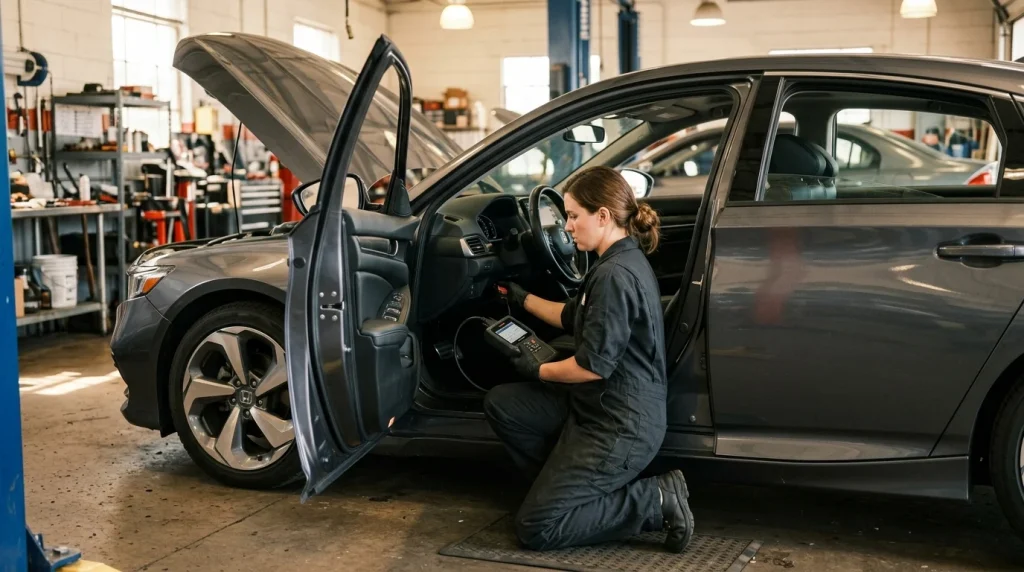
Start by examining the engine bay when the vehicle is completely cold. On 2018 or newer 1.5T models, pull the engine oil dipstick and check both the level and odor. An oil level sitting more than 10 millimeters above the upper full mark or carrying a distinct raw gasoline odor indicates active fuel wash dilution requiring immediate oil service and software verification. On 2008 to 2012 models, check the exhaust pipe tips for oily black soot buildup and inspect cylinders 1 through 4 for fouled spark plugs, which indicate persistent oil consumption from VCM cylinder deactivation.
During the cabin inspection, ensure all climate controls and ventilation fans blow strongly across every speed setting. A whining sound from behind the glove box often points to a worn car blower motor that requires replacement. Inspecting the engine bay also gives insight into maintenance diligence: checking whether the intake tract and the car air filter are clean reveals whether previous owners adhered to scheduled service intervals. Waiting for a mid-generation refresh substantially reduces ownership risk compared to purchasing first-year redesign models.
Note: A complete service record proving automatic transmission fluid changes every 30,000 miles is the most critical document for any 1998-2007 Accord. Without this proof, assume the transmission requires professional hydraulic pressure testing.
| Inspection Checkpoint | Target Component / Symptom | Verification Method & Threshold |
|---|---|---|
| VIN Recall Check | Open safety campaigns and software updates | Search VIN on official NHTSA database for open 25V-785 or airbag recalls |
| Cold-Start Evaluation | Starter drive gear binding or VTC actuator rattle | Listen during cold crank for a 1-2 second metallic grind (TSB 16-002, 09-010) |
| Oil Dipstick Inspection | Fuel dilution or abnormal level elevation | Verify oil level sits within hatched area; smell for raw gas on 1.5T engines |
| Transmission Shift Test | Delayed engagement or low-speed shudder | Time P -> R -> D engagement (normal is under 1.5s; >2.0s indicates clutch slippage) |
| Rear Brake Thickness | Premature friction material wear | Measure rear pad friction material (minimum 3.0mm; replace if under 2.0mm) |
| OBD-II Diagnostic Scan | Pending misfire codes or transmission circuit faults | Scan OBD-II port for DTC P0740, P0300-P0304, P0420, and P0401 codes |
How to Verify Recalls and Service Bulletins
Before negotiating price, obtain the vehicle identification number (VIN) and run it through the official NHTSA recall search portal. Every safety recall, including the 2023-2025 Hybrid ICM update and older Takata airbag inflator campaigns, must be completed by a certified dealership at zero cost to the owner.
During the initial ignition cycle, confirm that all instrument cluster warning lights illuminate briefly and turn off once the engine starts. If a persistent exclamation point warning light on a car remains lit on the dashboard, the vehicle may have an active fault in its tire pressure monitoring or vehicle stability assist system.
What to Consider if a Car Has a Prior Recall Fix
When purchasing a vehicle that underwent past recall repairs, verify that the service was performed by an authorized dealership rather than an uncertified repair shop. Review the title history through an independent reporting service to confirm the vehicle holds a clean title. If an accident caused severe structural damage in the past, understanding what happens when a car is totaled but still drivable helps buyers avoid purchasing rebuilt sedans with hidden electronic harness defects.
Recalls and Reliability Data by Year (Summary Table)
The table below summarizes the primary mechanical concerns, recall frequency, and historical reliability ratings across major Honda Accord model years:
| Model Year Range | Generation | Primary Mechanical Concern | Severity Level | Recommended Action |
|---|---|---|---|---|
| 1998-2002 | 6th Gen | 4-speed automatic transmission failure | High | Avoid V6 automatics |
| 2003-2004 | 7th Gen | 5-speed automatic transmission clutch burnout | Critical | Avoid entirely |
| 2005 | 7th Gen | Transmission slippage, minor electrical faults | Moderate | Inspect fluid records |
| 2006-2007 | 7th Gen | Minor power steering leaks, clear coat peeling | Low | Safe budget buy |
| 2008-2009 | 8th Gen | VCM oil consumption, rapid rear brake wear | High | Avoid |
| 2010 | 8th Gen | Moderate oil burning, interior trim wear | Moderate | Check oil levels |
| 2011-2012 | 8th Gen | Refined piston rings, minor accessory wear | Low | Recommended buy |
| 2013 | 9th Gen | Starter motor grinding, early CVT shudder | Moderate | Inspect starter & CVT |
| 2014 | 9th Gen | Minor infotainment screen glitches | Low | Safe purchase |
| 2015-2017 | 9th Gen | Rare battery drain issues | Very Low | Highly recommended |
| 2018 | 10th Gen | 1.5T oil dilution, CMBS phantom braking | Moderate | Prefer 2.0T engine |
| 2019-2022 | 10th Gen | Refined engine software, solid 10-speed auto | Low | Highly recommended |
| 2023-2025 | 11th Gen | Hybrid ICM power loss software recall | Low (Resolved) | Verify recall fix |
External Authority Comparisons
Long-term reliability data from automotive consumer indexes demonstrates that when buyers select mature Accord model years, ownership expenses remain among the lowest in the midsize sedan category. When calculating long-term ownership costs against the average maintenance costs for premium brands, a dependable Accord model year delivers substantial savings in routine upkeep and replacement parts.
Furthermore, when evaluating wheel and tire fitments on larger trims or heavier hybrid models, ensuring proper load ratings and understanding what XL means on a tire ensures that replacement tires support the vehicle curb weight safely.
Frequently Asked Questions About Honda Accord Years to Avoid
What is the single worst year for the Honda Accord?
The 2003 Honda Accord is the worst model year overall. It generated more severe consumer complaints than any other Accord model year, driven by catastrophic 5-speed automatic transmission failures on V6 models that commonly occurred around 98,000 miles.
Which Honda Accord generations are the most reliable?
The late ninth generation (2015-2017) and the late tenth generation (2019-2022) are the most dependable Accord generations. The 2015-2017 models feature mature Earth Dreams engines with refined CVTs, while the 2019-2022 2.0T models paired with the 10-speed automatic offer exceptional long-term durability.
Are older Honda Accords from the 2000s still reliable?
Yes, but buyers must select the correct production years. The 2006 and 2007 model years from the seventh generation received updated transmission lubrication circuits that resolved the early failure epidemic, making them dependable budget commuter cars.
Do modern Honda Accord CVTs have widespread problems?
No. Aside from low-speed shuddering in early 2013 models, Honda’s modern continuously variable transmissions have proven dependable over hundreds of thousands of miles when the transmission fluid is replaced every 30,000 to 50,000 miles.
Is a high-mileage Honda Accord worth buying?
A high-mileage Accord with 120,000 to 150,000 miles is an excellent purchase if it belongs to a recommended model year (such as 2006-2007, 2011-2012, or 2015-2017) and includes complete maintenance records. Avoid high-mileage 2003, 2008, or 2013 models lacking verified repair histories.

