

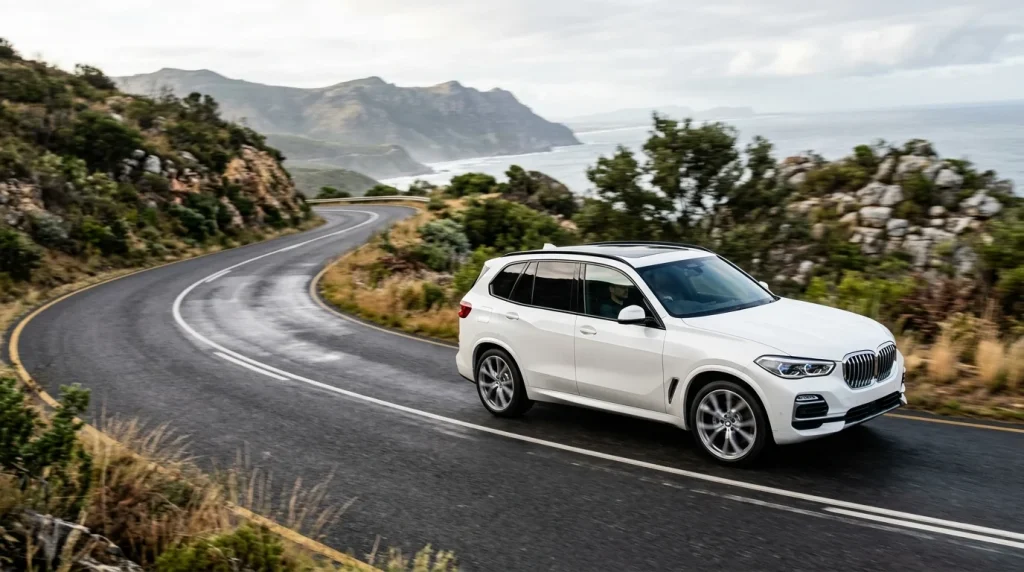
For current 2024 to 2026 models in North America, the BMW X5 comes exclusively as a five-passenger vehicle with no factory third-row option. BMW previously offered an optional two-seat rear bench on select petrol and diesel trims across the E70, F15, and early G05 generations (2019 to 2021), but discontinued that package (Option Code 4UB) in early 2022. Drivers seeking a brand-new seven-passenger BMW SUV must choose the larger BMW X7.
Key takeaways:
- Current 2024 to 2026 BMW X5 models come strictly in a standard five-passenger configuration.
- Optional 5+2 seating was available on previous generations (E70, F15) and early G05 builds (2019 to 2021) under Option Code 4UB.
- Plug-in hybrid variants (xDrive40e, xDrive45e, xDrive50e) omitted third-row seating due to underfloor battery packaging, while high-performance X5 M models excluded it due to dedicated M chassis bracing, sport suspension, rear differential, and exhaust packaging.
- The former rear jump seats provided tight legroom between 23 and 31 inches, making them practical primarily for children on brief journeys.
- The larger BMW X7 provides standard three-row capacity for up to seven occupants with 33.3 inches of rearmost legroom.
BMW X5 Third-Row Seating Across Generations
Seven-passenger capability in the BMW X5 has evolved significantly across four production cycles. Understanding these generational milestones helps used car shoppers identify specific builds equipped for extra passengers.
Generation-by-Generation Analysis
The first-generation BMW X5 (E53, 1999 to 2006) arrived strictly as a five-seat sports activity vehicle. BMW prioritized athletic handling and chassis rigidity over multi-passenger capacity, leaving seven-seat duties to traditional minivans and full-size truck-based SUVs of that era.
The second-generation BMW X5 (E70, 2007 to 2013) introduced an optional pop-up rear seat for the first time. This 5+2 layout accommodated two extra occupants in the cargo area, paired with a sliding and folding mid-cabin bench. The upgrade gained popularity among suburban families needing occasional transport for children.
The third-generation BMW X5 (F15, 2014 to 2018) retained optional extra seating on mainstream petrol and diesel models, including the sDrive35i, xDrive35i, xDrive35d, and xDrive50i. However, the plug-in hybrid xDrive40e excluded rear jump seats entirely because its high-voltage traction battery occupied the underfloor compartment where seats normally folded flat.
The fourth-generation BMW X5 (G05, 2019 to present) initially offered a 5+2 seating package (Option Code 4UB) for the 2019 through 2021 model years. That equipment bundled power-sliding second-row adjusters and mandated a two-axle air suspension setup. BMW phased out Option 4UB during 2022 amid supply constraints and shifting demand, leaving the refreshed 2024 to 2026 lineup exclusively in a five-seat configuration.
Region and Model Specifics
Market availability and mechanical packaging determined how vehicles were configured. In North America, extra seating was popular on gasoline models equipped with convenience and luxury packages. Buyers evaluating factory equipment bundles can review features included in the BMW Premium Package to understand how comfort and interior options were paired. In European and Asian markets, lower-output diesel variants occasionally offered manual folding jump seats, though global production standardized on dedicated five-passenger layouts by 2022.
Mechanical architecture also dictated specific trim exclusions across generations. While plug-in hybrid variants (xDrive40e, xDrive45e, and xDrive50e) could not accommodate jump seats because their high-voltage traction batteries occupied the cargo subfloor, high-performance BMW X5 M models (F85 and pre-LCI F95 generations powered by gasoline twin-turbo V8 engines, and the refreshed 2024+ F95 LCI with its 48V mild-hybrid powertrain) lacked a high-voltage battery pack in the luggage compartment. Instead, X5 M models strictly excluded third-row seating due to structural M chassis bracing, sport suspension components, the active M rear differential, and quad exhaust routing.
Interior Space and Practicality Comparison
Choosing between a five-seat and seven-seat luxury vehicle requires balancing passenger capacity against cargo flexibility. In the standard five-seat layout, the current G05 BMW X5 provides 33.9 cubic feet of cargo volume behind the rear bench and expands to 72.3 cubic feet with seats folded flat, as published in Car and Driver technical specifications.
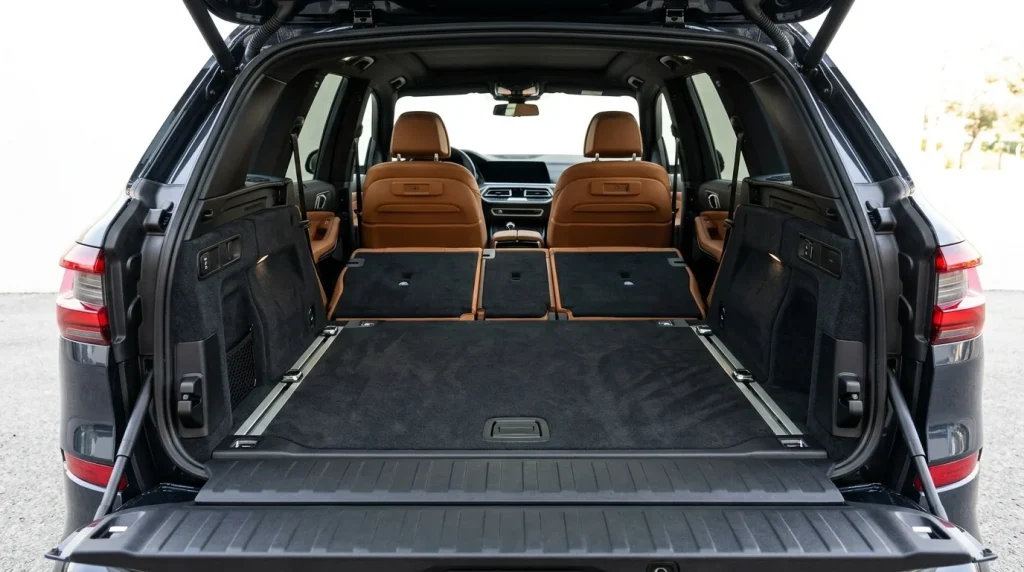
On earlier models configured with pop-up rearmost seats, upright capacity shrank to roughly 10.5 cubic feet, leaving space only for soft bags or compact luggage. Shoppers who do not require extra seating often find that 2026 BMW X3 review and dimensions showcase how dedicated two-row packaging delivers everyday utility without excess bulk.
| Measurement / Feature | BMW X5 (Standard 5-Seat) | Former BMW X5 (7-Seat Deployed) | BMW X7 (Standard 3-Row) |
|---|---|---|---|
| Seating Capacity | 5 passengers | 7 passengers | 6 or 7 passengers |
| Rearmost Legroom | Not Applicable | 23.0 to 31.2 inches | 33.3 inches |
| Rearmost Headroom | Not Applicable | 32.0 inches | 36.6 inches |
| Cargo Behind Back Seats | Not Applicable | ~10.5 cubic feet | 12.8 cubic feet |
| Cargo Behind Middle Seats | 33.9 cubic feet | 33.9 cubic feet (folded flat) | 48.6 cubic feet |
| Maximum Cargo Capacity | 72.3 cubic feet | ~72.0 cubic feet | 90.4 cubic feet |
How to Identify If Your X5 Has a Third Row
Because fold-flat jump seats tuck flush into the luggage floor, identifying whether a pre-owned BMW X5 carries seven seats requires checking several physical markers before buying.
First, inspect the window sticker or original build sheet for Option Code 4UB (3rd Row Seating). Second, examine the cargo floor. A seven-passenger model features dual backrest release latches in the rear deck, molded side-panel cup holders near the D-pillars, and ceiling-mounted seatbelt guides. Third, check the mid-cabin bench. Models built with factory 5+2 seating feature power tilt-and-slide switches on the outer shoulder of the middle backrests for easy rear ingress. Finally, running the vehicle identification number (VIN) through an online build decoder confirms original factory configuration. Inspecting the cargo deck floor and checking for power shoulder switches on the middle seats remain the fastest physical checks when browsing pre-owned inventory.
Real-World Ownership Insights
Owner feedback indicates that the former X5 rearmost seating functioned primarily as an emergency jump seat. With approximately 23 inches of usable legroom when middle seats remained in standard position, the space suited young children and booster seats. Taller passengers experienced elevated knees and shallow footwells, making journeys over thirty minutes uncomfortable.
From a maintenance perspective, prospective buyers of a 5+2 equipped G05 must account for chassis upkeep. Factory multi-seat packages mandated the two-axle air suspension (Option 2VR) to manage extra passenger payload and self-level the rear axle. As vehicles pass 80,000 miles, rubber air springs and compressor seals can degrade, leading to repair expenses between $2,000 and $4,000. Factoring in average BMW maintenance costs helps owners budget accurately for long-term luxury vehicle ownership.
Note: Pre-owned models ordered with factory Option 4UB depend on the two-axle air suspension; buyers should test compressor operation and check for sagging air springs during pre-purchase inspections.
Competitive Landscape: 7-Seat SUVs vs BMW X5
Midsize luxury SUV shoppers who require family transport have several alternatives in the market. While BMW reserves dedicated multi-passenger accommodations for the larger X7, key competitors offer optional or standard seven-passenger seating within midsize body dimensions.
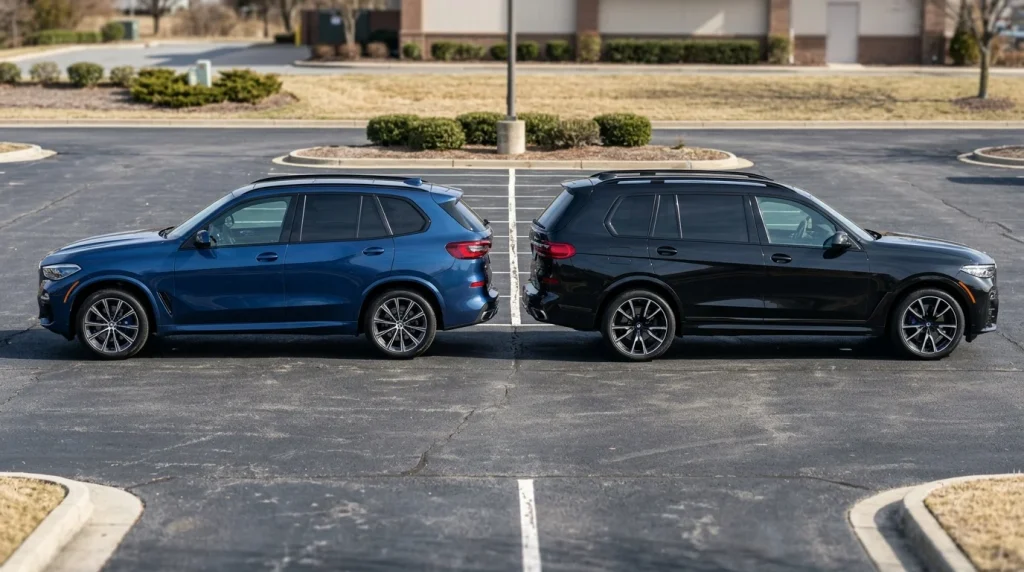
According to road tests and editorial analysis from Car and Driver, the former optional jump seat served primarily for children or occasional use, making the purpose-built X7 a much more practical choice for growing families.
| Luxury SUV Model | Starting MSRP (2026 Reference) | Standard Seating | Rearmost Legroom | Overall Length |
|---|---|---|---|---|
| BMW X5 (G05) | $70,600 | 5 passengers | Not Available | 194.2 inches |
| BMW X7 (G07) | $87,500 | 7 passengers | 33.3 inches | 203.3 inches |
| Mercedes-Benz GLE | $62,000 (+$2,100 Option) | 5 or 7 passengers | 28.7 inches | 194.3 inches |
| Audi Q7 | $62,000 | 7 passengers | 29.2 inches | 199.3 inches |
| Volvo XC90 | $62,345 | 6 or 7 passengers | 31.9 inches | 195.0 inches |
| Land Rover Discovery | $64,900 | 7 passengers | 33.5 inches | 195.1 inches |
The Mercedes-Benz GLE provides an optional two-seat rear bench comparable to the former X5 setup. Competitors like the Audi Q7 and Volvo XC90 feature standard seven-passenger capacity, offering family-oriented space at an accessible entry price. Buyers cross-shopping luxury European nameplates can consult the BMW and Mercedes reliability comparison and evaluate BMW vs Mercedes ownership costs to compare dealership service pricing.
What Do Official BMW Resources Say?
According to BMW USA official vehicle specifications, current production models are engineered exclusively as two-row executive crossovers. BMW repositioned its midsize lineup following the launch of the flagship X7, directing buyers who require full-size three-row seating toward the larger vehicle.
Factory technical resources also highlight how digital features interface with climate and seating modules. Keeping vehicle systems current through latest BMW software updates ensures optimal electronic calibration for seating comfort and climate control.
Frequently Asked Questions
Do all BMW X5 trims include third-row seating?
No BMW X5 variant produced for the 2024 to 2026 model years includes rear jump seats. In older model years (2007 to 2021), extra seating was an optional add-on on select petrol and diesel trims, but it was never standard factory equipment.
How much cargo space does the X5 have with and without extra seating?
The standard five-passenger BMW X5 provides 33.9 cubic feet of luggage capacity behind the second row, expanding to 72.3 cubic feet when rear seats fold flat. On older models with the rearmost seats upright, cargo volume shrank to roughly 10.5 cubic feet.
Are the rear jump seats comfortable for adult passengers?
The rearmost seats on older X5 models were proportioned primarily for children. With restricted legroom (23 to 31 inches) and a low seat cushion height, adults will find the back tight on journeys lasting longer than a quick commute.
Conclusion
The BMW X5 does not offer third-row seating in its current 2024 to 2026 lineup. For shoppers seeking a new German luxury SUV with seven-passenger capability, the larger BMW X7 serves as the brand’s dedicated three-row solution, delivering adult-friendly comfort and generous cargo room. Drivers specifically looking for a seven-seat X5 should browse the pre-owned market for well-kept 2007 to 2021 models fitted with factory Option Code 4UB.

