

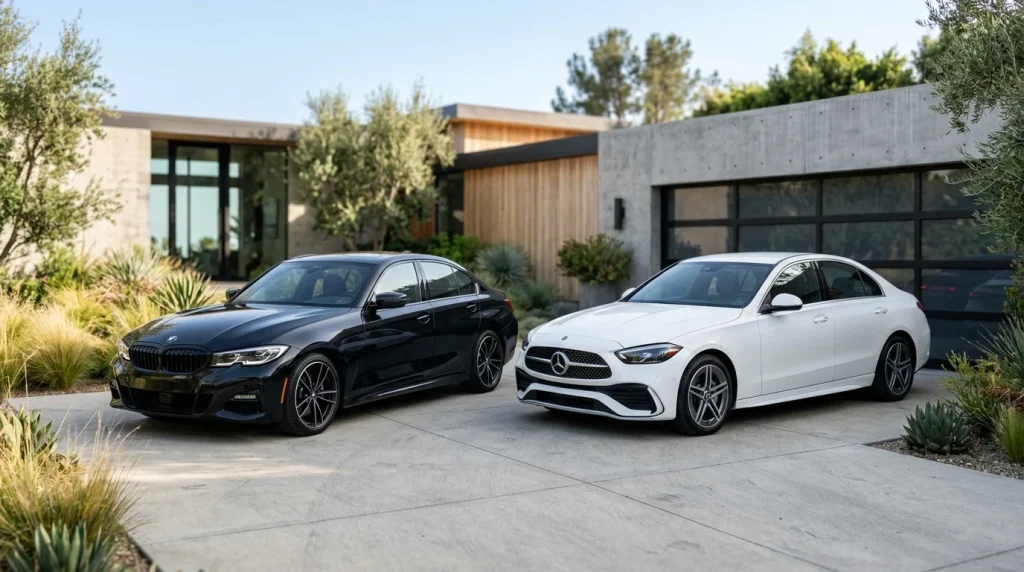
When evaluating what is more expensive, BMW or Mercedes, the answer depends on upfront purchase price versus long-term ownership costs. Mercedes-Benz vehicles cost more to buy at the dealership, but BMW models are more expensive to maintain over a ten-year period. In the United States automotive market, Mercedes-Benz buyers face an average transaction price of $75,886 compared to $70,792 for BMW. However, BMW leads in long-term service fees, averaging $16,021 in ten-year maintenance and unscheduled repair costs versus $12,942 for Mercedes-Benz.
Key takeaways:
- Mercedes-Benz carries an average purchase price premium of $5,094 over BMW across comparable model segments ($75,886 versus $70,792).
- BMW ownership costs $3,079 more in maintenance and repairs over a ten-year window ($16,021 compared to $12,942 for Mercedes-Benz).
- Annual auto insurance costs lean in favor of BMW ($1,463) versus Mercedes-Benz ($1,875) due to cheaper replacement front sensors.
- Mercedes-Benz holds its value slightly better over five years, losing roughly 50 percent of initial MSRP compared to 55 percent for BMW.
- Short-term drivers (under four years) save money with BMW, while long-term owners (past year seven) achieve lower total expenses with Mercedes-Benz.
MSRP and Model Pricing Dynamics
When evaluating whether BMW or Mercedes-Benz is more expensive, the initial purchase price provides the first major point of comparison. Mercedes-Benz consistently positions itself with higher starting Manufacturer Suggested Retail Prices (MSRP) across standard luxury sedans and executive coupes. This pricing structure reflects the brand’s emphasis on prestige, cabin insulation, and standard comfort equipment.
In the entry-level executive category, the BMW 3 Series starts at an MSRP of approximately $49,350, while the Mercedes-Benz C-Class begins near $51,000. Moving into mid-size executive sedans, the BMW 5 Series starts around $61,950 compared to $65,250 for the Mercedes-Benz E-Class. The flagship segment demonstrates the widest gap: a base BMW 7 Series starts near $99,300, whereas a base Mercedes-Benz S-Class commands $120,900, creating an initial price difference of $21,600.
| Vehicle Segment | BMW Representative Model & MSRP | Mercedes-Benz Representative Model & MSRP | Initial Price Difference |
|---|---|---|---|
| Entry Luxury Sedan | BMW 3 Series: $49,350 | Mercedes-Benz C-Class: $51,000 | Mercedes-Benz costs $1,650 more |
| Compact Luxury SUV | BMW X3: $51,300 | Mercedes-Benz GLC 300: $51,550 | Mercedes-Benz costs $250 more |
| Mid-Size Executive Sedan | BMW 5 Series: $61,950 | Mercedes-Benz E-Class: $65,250 | Mercedes-Benz costs $3,300 more |
| Mid-Size Luxury SUV | BMW X5: $68,300 | Mercedes-Benz GLE 350: $62,250 | BMW costs $6,050 more |
| Flagship Luxury Sedan | BMW 7 Series: $99,300 | Mercedes-Benz S-Class: $120,900 | Mercedes-Benz costs $21,600 more |
The mid-size luxury SUV segment stands as an exception to this pattern. The base BMW X5 starts higher than the Mercedes-Benz GLE 350 because BMW includes a turbocharged inline-six cylinder engine as standard equipment. In contrast, the entry GLE 350 uses a turbocharged four-cylinder engine. Beyond powertrains, evaluating BMW X5 exterior dimensions and sizing shows how cabin utility and chassis scale justify price positioning against competitors.
Factory option packages also alter the bottom line. Mercedes-Benz charges premium rates for standalone styling packages and digital lighting systems. BMW packages technology bundles into comprehensive groupings, such as the BMW Premium Package features and options, which include head-up displays and remote engine start capabilities for a bundled fee. Base MSRP figures tell only half the story. Mercedes-Benz dealerships typically discount flagship sedans less aggressively than BMW retailers during seasonal sales events, meaning real-world transaction prices for Mercedes-Benz vehicles often stay closer to full window sticker values.
Ownership Cost Drivers Beyond Sticker Price
Evaluating vehicle expense requires examining the major cost drivers that accumulate after leaving the dealership showroom floor: depreciation, routine upkeep, fuel consumption, and insurance premiums.
Total Ownership Cost = Purchase Depreciation + Routine Upkeep + Unscheduled Repairs + Insurance Premiums + Fuel Expenses
Fuel efficiency and grade requirements represent a continuous operational expense. Both manufacturers engineer high-compression turbocharged powerplants that mandate premium unleaded fuel. To maintain proper engine timing and prevent pre-ignition knock, owners must follow the recommended octane ratings for BMW engines, which require 91 to 93 AKI fuel. Fuel economy ratings across comparable 2.0-liter turbocharged four-cylinder engines remain virtually identical, with both brands averaging 25 miles per gallon in city driving and 33 to 35 miles per gallon on highway routes.
Auto insurance premiums create a measurable divergence between the two brands. According to national insurance rate aggregators, insuring a Mercedes-Benz costs an average of $1,875 annually, compared to $1,463 for an equivalent BMW. Insurance underwriters attribute this $412 annual difference to three specific factors:
- Front bumper radar sensors: Mercedes-Benz integrates complex driver-assist radar arrays directly behind the grille star emblem, increasing front-end collision repair bills.
- Glass replacement costs: Acoustic laminated windshields with head-up display coatings on Mercedes-Benz models command higher replacement and camera recalibration fees.
- Higher baseline MSRP: Insurers face larger comprehensive payout caps if a vehicle experiences a total loss event.
Maintenance and Long-Term Repair Expenses
Routine maintenance costs differ sharply between the initial factory warranty phase and post-warranty ownership. During the first three years or 36,000 miles, BMW includes its Ultimate Care program, covering engine oil changes, brake fluid flushes, and engine air filter replacements at zero out-of-pocket cost to the original buyer. Mercedes-Benz requires customers to purchase prepaid maintenance packages (Star Service Prepaid Maintenance) or pay retail service rates per visit.
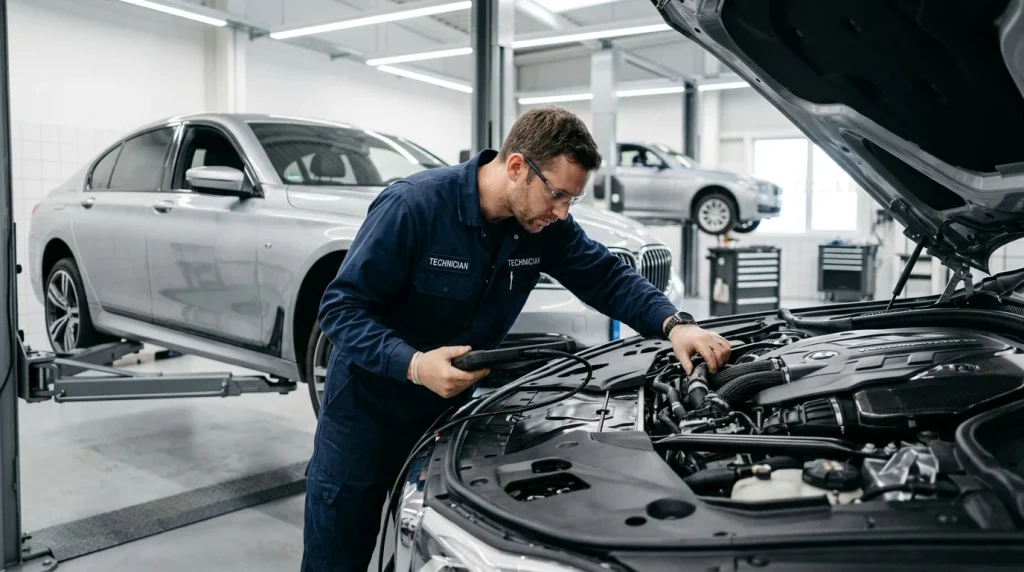
Once vehicles cross into post-warranty territory (after four years or 50,000 miles), BMW service expenses escalate. According to RepairPal brand reliability data, annual routine maintenance and unscheduled repairs average $968 for BMW compared to $908 for Mercedes-Benz. Over a full decade, automotive cost research firm CarEdge calculates that BMW models accumulate $16,021 in maintenance and repair fees, whereas Mercedes-Benz models average $12,942, as documented in CarEdge 10-year vehicle maintenance projections.
| Ownership Timeframe | BMW Projected Maintenance Cost | Mercedes-Benz Projected Maintenance Cost | Cost Difference |
|---|---|---|---|
| Years 1 to 3 (Warranty Period) | $0 to $350 (BMW Ultimate Care included) | $1,200 to $1,800 (Prepaid or retail pay) | BMW saves ~$1,200 |
| Years 4 to 5 (Early Post-Warranty) | $2,200 to $2,800 | $1,800 to $2,200 | Mercedes-Benz saves ~$400 |
| Years 6 to 10 (Aging Mechanicals) | $13,471 | $9,542 | Mercedes-Benz saves $3,929 |
| Total 10-Year Ownership Cost | $16,021 | $12,942 | Mercedes-Benz saves $3,079 |
The primary driver behind higher long-term BMW service fees is the extensive use of composite plastic materials in high-temperature engine bay zones. Over 60,000 to 90,000 miles, heat cycling causes plastic coolant expansion tanks, thermostat housings, and oil filter housing gaskets to become brittle and leak. Reviewing detailed data on long-term BMW maintenance expenses reveals that labor hours required to disassemble intake manifolds for gasket access elevate repair invoices. In addition, maintaining approved BMW coolant formulations helps prevent cooling system corrosion and preserves fragile radiator and housing seals.
Note: Independent European specialty repair shops typically charge 30 to 45 percent lower labor rates than franchised dealerships ($140 to $180 per hour versus $220 to $280 per hour). Utilizing certified independent mechanics significantly reduces the out-of-warranty ownership gap between both German brands.
Five-Year Total Cost of Ownership Case Study: BMW 330i vs Mercedes C 300
To illustrate how purchase price, maintenance, insurance, and resale value interact in real terms, consider a five-year ownership scenario comparing the BMW 330i rear-wheel-drive sedan with the Mercedes-Benz C 300 rear-wheel-drive sedan. This calculation assumes 15,000 annual driving miles and standard maintenance schedules.

| Ownership Cost Component | BMW 330i Sedan | Mercedes-Benz C 300 Sedan | Cost Advantage |
|---|---|---|---|
| Starting Purchase Price (MSRP Reference) | $49,350 | $51,000 | BMW (Saves $1,650 upfront) |
| Estimated 5-Year Maintenance and Repairs | $2,550 | $3,400 | BMW (Saves $850) |
| Estimated 5-Year Auto Insurance | $7,315 ($1,463/yr) | $9,375 ($1,875/yr) | BMW (Saves $2,060) |
| Estimated 5-Year Fuel Cost (75,000 miles @ $4.20/gal) | $10,500 | $10,500 | Neutral ($0 difference) |
| Vehicle Depreciation (5-Year Value Loss) | $27,142 (55% depreciation) | $25,500 (50% depreciation) | Mercedes-Benz (Saves $1,642) |
| 5-Year Total Cost of Ownership (TCO) | $47,507 | $48,775 | BMW saves $1,268 over 5 years |
Over a five-year period, the BMW 330i holds an overall cost advantage of $1,268 ($47,507 versus $48,775 for the Mercedes-Benz C 300). BMW achieves lower five-year ownership costs by saving $2,060 on insurance premiums and $850 on scheduled maintenance through three years of complimentary BMW Ultimate Care. Although Mercedes-Benz retains its resale value slightly better over five years (saving $1,642 in lower depreciation loss), this equity advantage is offset by higher annual insurance rates and out-of-pocket routine maintenance during the initial factory warranty phase. Routine scheduled items such as oil services and following the BMW microfilter replacement guide keep introductory maintenance expenses low during this initial ownership window.
As ownership extends into years six through ten, the financial advantage shifts toward Mercedes-Benz. Understanding mileage milestones where BMW components wear out explains why out-of-warranty cooling, suspension, and gasket repairs increase to an average of $2,500 to $3,000 per year, allowing Mercedes-Benz models with more durable core mechanicals to deliver a lower cumulative cost past the 100,000-mile mark.
Reliability Ratings and Resale Value Trends
Reliability scores directly affect resale value and out-of-pocket repair frequency. Independent testing organizations show significant differences in how both automakers perform under rigorous testing.
In the Consumer Reports automotive brand reliability scorecard, BMW earned 5th place overall across the global automotive market, standing as the highest-ranking European luxury manufacturer. Consumer Reports noted that BMW’s entire core lineup scored average or better in predicted dependability, driven by the refinement of its B48 four-cylinder and B58 six-cylinder turbocharged engines. In contrast, Mercedes-Benz ranked 19th overall, hindered by complex central touchscreen software glitches and electronic control module communication faults.
The J.D. Power U.S. Initial Quality Study measures problems per 100 vehicles (PP100) experienced during the first 90 days of ownership. In the study:
- BMW recorded a score of 178 PP100, securing six individual segment awards.
- Mercedes-Benz recorded a score of 182 PP100.
- The overall luxury segment average was 190 PP100.
In the J.D. Power Vehicle Dependability Study (VDS), which evaluates vehicles after three full years of service, BMW consistently scored above the industry average, while Mercedes-Benz tracked below average due to infotainment system updates and sensor recalibrations. For deeper data on mechanical dependability, drivers can review the comparative reliability analysis of BMW versus Mercedes to evaluate long-term powertrain durability.
When mechanical issues do occur, diagnosing dashboard warnings promptly prevents cascading engine damage. Responding quickly to BMW drivetrain malfunction alerts ensures minor sensor errors or valvetrain faults do not escalate into expensive turbocharger or transmission failure.
In-Car Technology, Software, and Connected Services
Modern luxury vehicles generate ongoing expenses through software subscriptions, feature activation packages, and data connectivity plans. Both BMW and Mercedes-Benz have transitioned toward digital ecosystems that require annual or monthly service renewals.
BMW uses its iDrive operating system, which includes complimentary remote software updates over the air for the duration of the original factory warranty. Owners tracking new digital features can consult guides on over-the-air BMW software updates to determine feature availability by model year. Smartphone mirroring has also evolved; reviewing the timeline of BMW Apple CarPlay compatibility confirms that BMW eliminated its earlier annual subscription fee for CarPlay in 2019, making standard phone integration free on all current models.
Mercedes-Benz equips vehicles with its Mercedes-Benz User Experience (MBUX) system, offering augmented reality navigation and steering-wheel capacitive touch controls. While standard navigation remains active, optional features such as advanced dashcam recording, live traffic telemetry, and rear-axle steering angle expansion on select electric models require active Mercedes me Connect annual subscriptions ranging from $150 to $250 per year.
Expert Viewpoints and Clear Purchase Verdict
Automotive testing authorities agree that choosing between BMW and Mercedes-Benz requires matching the vehicle’s financial profile with your planned ownership timeframe.
Consumer Reports Director of Auto Testing Jake Fisher highlighted in recent luxury vehicle evaluations that BMW has systematically engineered greater mechanical reliability into its core platforms over the past decade, stating that BMW models have demonstrated consistent powertrain dependability that outpaces most luxury competitors. Meanwhile, industry analysts at Kelley Blue Book observe that Mercedes-Benz commands higher brand prestige in the secondary market for flagship models, allowing the S-Class and G-Class to retain loyal buyer demand despite higher initial MSRPs. Understanding how each company developed its engineering philosophy can be explored through BMW early history as an aircraft engine builder, which shaped the brand’s focus on high-revving performance powertrains.
Who Should Buy BMW
- Short-term lease customers: Drivers leasing within the 3-year factory maintenance window benefit from lower starting MSRPs, competitive lease rates, and zero out-of-pocket scheduled maintenance through BMW Ultimate Care.
- Performance enthusiasts: Drivers prioritizing dedicated sports coupes and sedans can evaluate the performance dynamics of the BMW M3 versus M4 to see how BMW delivers balanced 50:50 chassis weight distribution and high horsepower-per-dollar ratios.
- Drivers seeking lower insurance rates: Annual insurance premiums for BMW average roughly $400 lower than comparable Mercedes-Benz vehicles.
Who Should Buy Mercedes-Benz
- Long-term owners: Drivers planning to keep their vehicle past year six or seven benefit from lower cumulative 10-year repair expenses ($12,942 versus $16,021 for BMW), which gradually offsets the higher initial purchase premium.
- Flagship and prestige buyers: The Mercedes-Benz S-Class and executive lines provide industry-benchmark ride comfort, interior soundproofing, and luxury prestige.
- Resale equity priority: Across mid-tier and specialty segments, Mercedes-Benz retains approximately 50 percent of its value at five years compared to 45 percent for comparable BMW models.
Frequently Asked Questions About BMW vs Mercedes Costs
What makes Mercedes-Benz MSRP higher than BMW?
Mercedes-Benz positions its vehicle lineup with higher standard luxury content, premium interior materials, and advanced driver assistance hardware. These engineering choices, combined with strong global brand prestige, allow Mercedes-Benz to establish higher baseline sticker prices across sedans and SUVs.
Why does BMW cost more to maintain over 10 years?
BMW vehicles utilize composite plastic cooling components, valve cover gaskets, and oil filter housing seals that degrade under high engine bay heat cycles past 60,000 miles. Replacing these aging seals requires intensive labor, leading to higher cumulative repair invoices ($16,021 over a decade versus $12,942 for Mercedes-Benz).
Is insurance significantly more expensive for Mercedes than BMW?
Yes. On average, Mercedes-Benz vehicles cost approximately $1,875 per year to insure, compared to $1,463 for BMW models. Insurance providers charge higher premiums for Mercedes-Benz due to expensive grille-mounted radar sensors and higher total replacement payout limits.
Does BMW or Mercedes hold its resale value better after 5 years?
Mercedes-Benz generally holds its value slightly better. Industry data shows an average five-year depreciation rate of 50 percent for Mercedes-Benz compared to 55 percent for BMW. However, high-performance BMW M models and Mercedes G-Class SUVs represent notable exceptions that retain higher equity.
Which brand provides better warranty coverage and complimentary maintenance?
Both manufacturers provide a 4-year or 50,000-mile limited new vehicle warranty in the United States. BMW offers superior introductory coverage by including 3 years or 36,000 miles of complimentary scheduled maintenance under its BMW Ultimate Care program, while Mercedes-Benz requires customer-funded maintenance from day one.

