

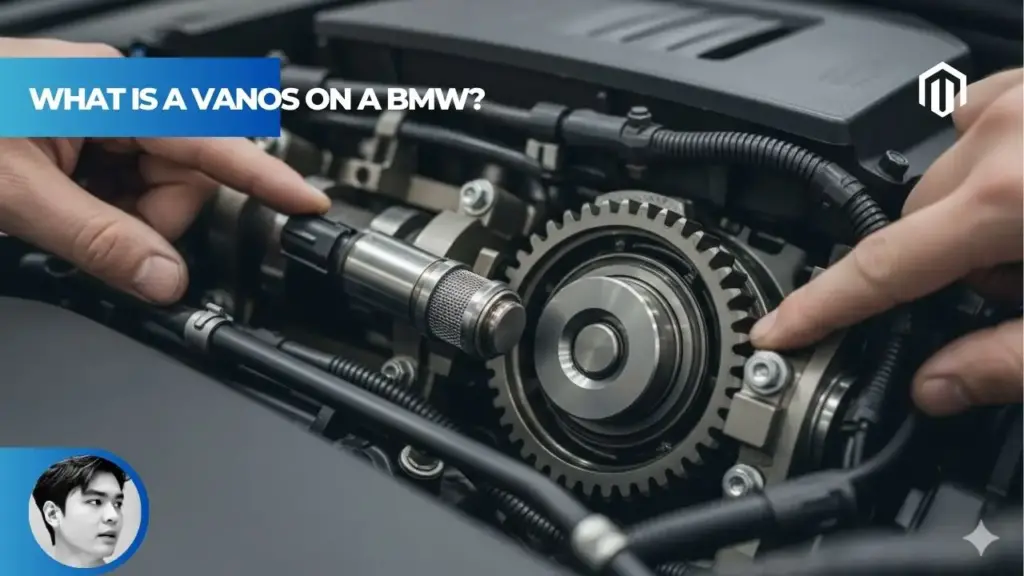
For drivers asking what is a VANOS on a BMW, it refers to BMW’s electro-hydraulic variable camshaft timing system that continuously adjusts the rotation of the intake and exhaust camshafts relative to the crankshaft. By changing when the engine valves open and close based on engine speed and throttle load, VANOS increases low-end torque, maximizes high-RPM horsepower, improves fuel efficiency, and reduces exhaust emissions.
Key takeaways:
- VANOS stands for Variable Nockenwellensteuerung, which translates from German to variable camshaft control.
- Single VANOS adjusts only the intake camshaft, while Double VANOS controls both the intake and exhaust camshafts independently.
- The system relies on pressurized engine oil directed by electronic solenoids to rotate camshaft phasers.
- Common failure symptoms include sluggish low-RPM acceleration, rough idling, rattling noises, and diagnostic trouble codes such as 2A82 or 2A87.
- Regular oil changes every 5,000 to 7,500 miles using BMW Longlife-certified synthetic oil provide the most effective protection against solenoid clogging and seal degradation.
How VANOS Works in BMW Engines
Internal combustion engines require different valve timing depending on operating speed. At low engine speeds, opening the intake valves later minimizes valve overlap to prevent residual exhaust gases from reverting into the intake manifold and diluting the fresh air-fuel mixture, stabilizing the idle. At mid-range speeds, opening intake valves earlier boosts cylinder filling and low-end torque. At high RPM, adjusting valve timing allows the incoming air charge to overcome inertia, maximizing peak horsepower.
VANOS solves this compromise through variable valve timing. Traditional fixed camshafts lock valve opening and closing events to a static mechanical relationship with the crankshaft via the timing chain. BMW engineered VANOS to alter this rotational angle dynamically while the engine runs.
BMW introduced the first generation, known as Single VANOS, in 1992 on the M50TU inline-six engine. Single VANOS operated on the intake camshaft only, switching between two discrete timing positions before evolving into continuously variable adjustment. In 1996, BMW launched Double VANOS on the high-performance S50B32 engine, expanding to series production in 1998 on the M52TU engine. Double VANOS continuously regulates both the intake and exhaust camshafts across the entire RPM range.
As documented in SAE International technical papers on variable camshaft timing, adjusting the exhaust camshaft allows precise control over valve overlap, the brief moment when both intake and exhaust valves remain open simultaneously. Controlled valve overlap acts as an internal exhaust gas recirculation system. By drawing a calculated amount of inert exhaust gas back into the combustion chamber, the engine lowers peak combustion temperatures, reducing harmful nitrogen oxide emissions without requiring an external EGR valve.
Understanding how VANOS integrates into BMW 328i engine configurations across generations illustrates how BMW transitioned from early Single VANOS M52 units to refined Double VANOS N52 inline-six powerplants.
Key Components of VANOS
The VANOS system combines mechanical gears, hydraulic passages, and digital electronics into a closed-loop control system. The primary components include:
- Camshaft Phasers (Actuators): Mounted at the front of each camshaft. In older designs (such as the M54 and S54), the phaser uses a helical gear cup and hydraulic piston to rotate the camshaft. Modern BMW engines (such as the N52, N55, and B58) use compact rotary vane phasers mounted directly inside the timing chain sprockets.
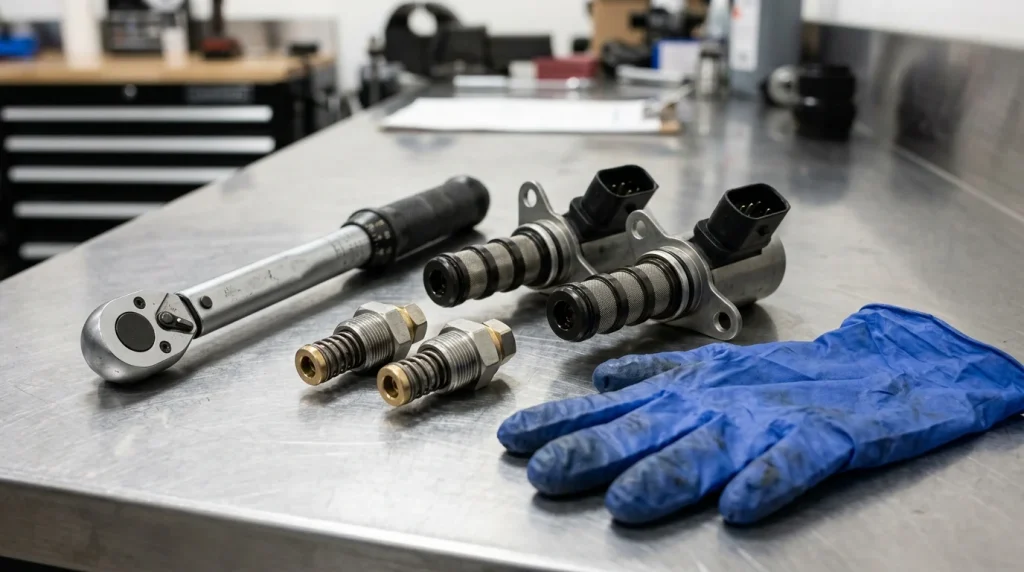
- Solenoid Valves: Electromagnetic proportional valves threaded into the cylinder head or timing cover. These solenoids receive electrical pulses from the engine computer to direct high-pressure engine oil into advance or retard oil chambers inside the phaser.
- Non-Return Check Valves and Mesh Screens: Small check valves prevent oil from draining out of the cylinder head when the engine is turned off, ensuring immediate hydraulic pressure upon startup. Fine metal mesh screens filter debris before oil enters the solenoids.
- Camshaft Position Sensors: Hall-effect sensors positioned at the rear or front of each camshaft monitor exact rotational angles in real time, reporting back to the Digital Motor Electronics control unit.
- Sealing Rings: High-temperature seals that maintain hydraulic pressure between moving pistons and stationary housings.
The table below outlines the evolution and mechanical differences across BMW VANOS generations:
| Generation | Introduced | Camshafts Controlled | Operating Mechanism | Representative Engine Families |
|---|---|---|---|---|
| Single VANOS | 1992 | Intake camshaft only | 2-position / continuous helical gear cup | M50TU, M52, S50US, S52 |
| Double VANOS (Helical) | 1996 | Intake and exhaust camshafts | Dual continuous helical piston gears | S50B32, M52TU, M54, S54, S62, S85 |
| Double VANOS (Vane-Type) | 2004 | Intake and exhaust camshafts | Compact rotary vane phasers | N52, N54, N55, N63, S65 |
| Modern Double VANOS + Valvetronic | Present | Intake and exhaust camshafts | Central-bolt vane phasers with variable valve lift | B48, B58, S58, S68 |
High-performance models like the high-performance S58 twin-turbo inline-six use reinforced Double VANOS systems capable of rapid phase adjustments under extreme cylinder pressures and high engine speeds.
Integration with Engine Control
The Digital Motor Electronics control unit acts as the command center for VANOS operation. The computer continuously processes inputs from the crankshaft position sensor, camshaft position sensors, mass airflow sensor, throttle pedal position, and engine oil temperature sensor.
Using programmed engine timing maps, the computer calculates the ideal camshaft angle for any given millisecond. It sends a pulse-width modulated electrical signal to the intake and exhaust solenoids. The solenoids open internal oil ports, routing pressurized oil into the advance or retard chambers of the phaser. When the camshaft position sensor confirms the target angle is reached, the solenoid modulates oil pressure to hold that exact position. While VANOS adjusts valve timing by changing when valves open and close, BMW Valvetronic adjusts valve lift by altering how far the intake valves open. Operating in unison on modern engines, VANOS and Valvetronic eliminate the need for a traditional throttle butterfly during normal driving, minimizing pumping losses and sharpening throttle response.
Benefits and Limitations of VANOS
BMW implemented variable valve timing across its entire gasoline engine lineup because the functional benefits improve daily drivability and regulatory compliance. However, relying on hydraulic oil pressure within tight mechanical tolerances introduces specific maintenance vulnerabilities over time.
Major Advantages
- Broader Torque Curve: Advancing intake valve timing at low-to-mid RPM fills cylinders more completely, eliminating the sluggish low-end response typical of fixed high-performance camshafts.
- Peak Power Delivery: Retarding intake timing at higher RPM takes advantage of incoming air velocity, allowing the engine to produce maximum horsepower near redline.
- Improved Fuel Economy: Optimizing valve overlap reduces pumping losses, meaning the engine expends less mechanical energy pulling fresh air through the intake tract during light cruising.
- Lower Emissions: Internal exhaust gas recirculation cools combustion temperatures and decreases tailpipe emissions, helping vehicles meet stringent worldwide environmental standards.
- Stable Idle Quality: Minimizing valve overlap during idling prevents exhaust gas reversion, delivering a smooth idle with minimal vibration.
System Limitations and Vulnerabilities
The primary limitation of VANOS is its strict dependence on engine oil condition and hydraulic pressure. Engine oil serves dual duties as both a mechanical lubricant and a hydraulic fluid. When oil degrades, forms sludge, or drops in pressure, VANOS operation degrades immediately.
Furthermore, thermal cycling inside the cylinder head causes internal rubber seals to harden and lose elasticity over years of driving. Tracking mileage intervals where BMW components require attention reveals that VANOS components often require proactive inspection between 70,000 and 100,000 miles.
Common VANOS Faults and Symptoms
When a VANOS system malfunctions, the engine can no longer match valve timing to operating conditions. Drivers usually notice drivability symptoms before the check engine light illuminates.
Typical Failure Symptoms
- Loss of Low-End Power and Torque: The vehicle feels sluggish and unresponsive below 3,000 RPM, requiring more throttle input to pull away from stops.
- Rough or Surging Idle: Valve timing stuck in an advanced position causes rough idling, stumbling during cold starts, and occasional engine stalling when coming to a halt.
- Reduced Fuel Efficiency: Imprecise valve timing increases pumping losses and forces the engine to burn more fuel to maintain cruising speeds, resulting in a 10% to 20% drop in MPG.
- Engine Hesitation and Flat Spots: Sticking solenoids cause sudden dips or flat spots in acceleration as the engine transitions through mid-range RPM.
- Metallic Rattling Noise: Worn internal bearings, loose splined gears, or degraded phaser springs produce a distinctive rattling sound from the front of the valve cover, commonly described as marbles shaking in a metal can.
- Drivetrain Malfunction Alert: Modern BMW models display a BMW drivetrain malfunction warning message on the iDrive screen when the computer detects camshaft timing correlation errors.
The table below breaks down common diagnostic trouble codes, their standard interpretations, and likely mechanical causes:
| OBD-II Code | BMW Hex Code | Description | Primary Root Cause |
|---|---|---|---|
| P0011 | 2A82 | Intake Camshaft Position Timing Over-Advanced (Bank 1) | Sticking intake solenoid, clogged filter screen, or low oil pressure |
| P0012 | 2A83 | Intake Camshaft Position Timing Over-Retarded (Bank 1) | Leaking intake phaser seals, stuck solenoid, or worn camshaft bearings |
| P0014 | 2A87 | Exhaust Camshaft Position Timing Over-Advanced (Bank 1) | Sticking exhaust solenoid, dirty oil passages, or faulty check valve |
| P0015 | 2A88 | Exhaust Camshaft Position Timing Over-Retarded (Bank 1) | Exhaust phaser mechanical failure, sludge accumulation, or seal wear |
| P0016 / P0017 | 2A98 / 2A99 | Crankshaft to Camshaft Correlation Error | Stretched timing chain, jumped timing tooth, or broken phaser bolts |
How to Diagnose VANOS Issues
Diagnosing a suspected VANOS problem requires a systematic approach to avoid replacing expensive parts unnecessarily:
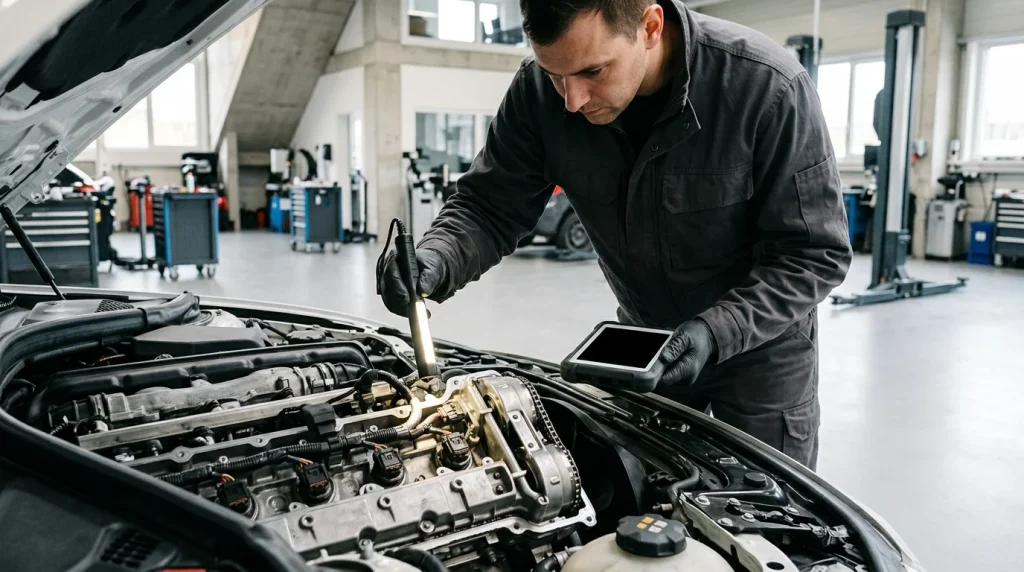
- Step 1: Scan for Diagnostic Trouble Codes: Connect an OBD-II scanner capable of reading manufacturer-specific BMW hex codes. Note whether the fault specifies intake, exhaust, or timing correlation.
- Step 2: Solenoid Swap Test: On engines with identical intake and exhaust solenoids (such as the N52, N54, and N55), remove both solenoids, clean them, and swap their positions. Clear the trouble codes and road test the vehicle. If the fault code shifts from intake (2A82) to exhaust (2A87), the solenoid itself is defective. If the code remains on the original camshaft, the issue lies in the oil check valves, phaser mechanics, or oil pressure supply.
- Step 3: Inspect Check Valves and Solenoid Screens: Remove the cylinder head check valves and inspect the miniature mesh screens for debris, varnish, or metallic particles. Clean clogged screens using electrical contact cleaner or brake parts cleaner.
- Step 4: Verify Engine Oil Condition and Pressure: Check engine oil level and verify that the correct viscosity was installed. Test oil pressure at the oil filter housing with a mechanical pressure gauge to confirm the engine oil pump produces adequate pressure.
Maintenance, Replacement, and Repair Considerations
Preventative maintenance is significantly less expensive than repairing internal cylinder head components. Because VANOS functions hydraulically, engine oil quality dictates system longevity.
Maintenance Recommendations
To prevent premature VANOS failure, follow these best practices:
- Shorten Oil Change Intervals: While factory condition-based service indicators suggest intervals up to 15,000 miles, independent BMW specialists recommend changing engine oil every 5,000 to 7,500 miles. Frequent changes prevent oil breakdown, sludge accumulation, and varnish formation on solenoid plungers.
- Use Certified Engine Oil: Always fill with BMW Longlife-01 certified engine oil or LL-04/LL-12FE depending on engine generation. Certified oils contain high-grade detergent and dispersant additive packages that keep micro-passages clean.
- Clean Solenoids and Check Valves Proactively: Remove and clean VANOS solenoids and cylinder head non-return check valves every 50,000 to 60,000 miles. Soaking the metal ends in solvent and cycling the plunger with a 12-volt power source removes stubborn varnish deposits.
- Address Oil Filter Housing Leaks Promptly: A failing oil filter housing gasket or a broken oil filter cage bypass valve can cause oil pressure drops that directly impair VANOS response.
When performing DIY maintenance on the cylinder head or valve cover, using specialized Torx and E-socket wrenches for BMW engines ensures clean disassembly without stripping delicate fasteners.
Note: Replace single-use aluminum valve cover bolts whenever servicing magnesium valve covers on early N52 engines. Modern BMW engines with composite valve covers (including the N55, B48, and B58) use reusable steel bolts, though perimeter rubber gaskets must always be replaced to prevent oil leaks.
What to Expect During Replacement
The scope and cost of VANOS repairs depend on which specific component has failed:
- Solenoid Replacement: Replacing external solenoids is an accessible DIY repair requiring 30 to 45 minutes. OEM solenoids cost between $120 and $250 each.
- Seal Rebuilding (Older Helical Units): On M52TU, M54, and S54 engines, the original Buna-N rubber O-rings degrade and flatten over time. Aftermarket seal repair kits use high-temperature Viton O-rings and Teflon wear rings, restoring full hydraulic sealing for approximately $60 in parts and 4 to 5 hours of labor.
- Camshaft Phaser Replacement (Modern Vane Units): Replacing worn vane phasers on N52, N55, or B58 engines requires removing the valve cover and locking the engine at top dead center using specialized camshaft timing alignment tools. The repair takes 4 to 7 hours of shop labor, with total costs ranging from $1,200 to $2,500 at independent specialty repair facilities.
Frequently Asked Questions About BMW VANOS
What does VANOS stand for?
VANOS is an acronym for Variable Nockenwellensteuerung, the German automotive term for variable camshaft control. It represents BMW’s proprietary variable valve timing technology.
What is the difference between Single VANOS and Double VANOS?
Single VANOS controls the valve timing of the intake camshaft only, operating either as a two-position switch on early engines or continuously variable on later revisions. Double VANOS controls both the intake and exhaust camshafts independently and continuously across the entire operating RPM range, improving torque, fuel economy, and emissions.
What are the earliest symptoms of a failing BMW VANOS?
The earliest symptoms include a noticeable lack of low-end throttle response below 3,000 RPM, engine hesitation during acceleration, a rough idle during cold starts, and a slight decrease in overall fuel mileage.
Can I drive my BMW with a bad VANOS solenoid?
Yes, you can drive short distances with a malfunctioning VANOS solenoid, but the vehicle will suffer from reduced engine power and poor fuel efficiency. Operating with incorrect valve timing over extended periods can cause increased carbon buildup on valves and place additional thermal stress on catalytic converters.
How much does it cost to repair or replace a BMW VANOS system?
Cleaning or replacing a dirty solenoid typically costs between $150 and $400 for parts and basic labor. However, if internal phaser gears have suffered mechanical wear or the timing chain assembly requires servicing, a complete professional replacement generally costs between $1,200 and $2,800 depending on the engine model.

