

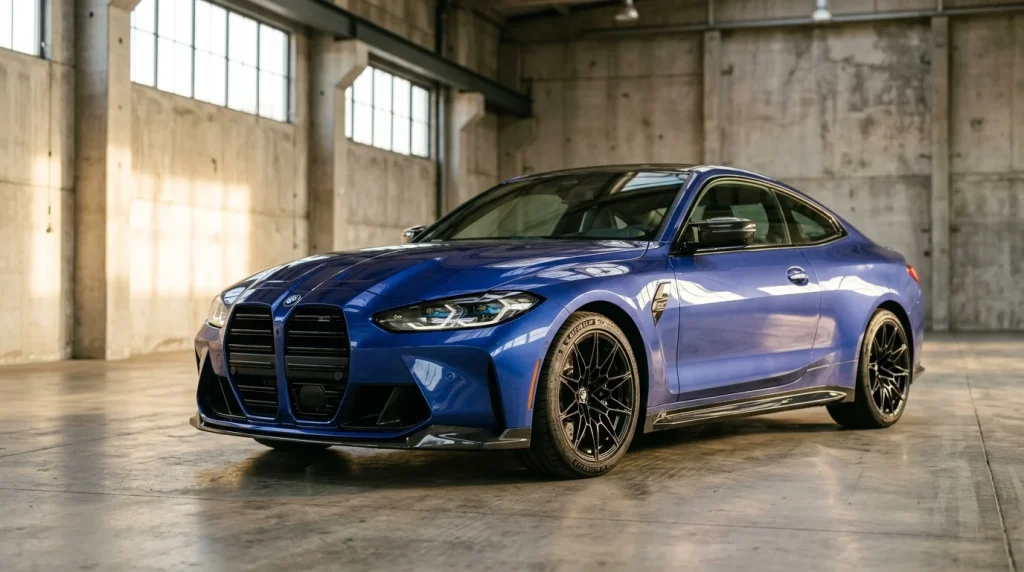
To answer what engine does a BMW M4 have: the current generation BMW M4 (G82 coupe and G83 convertible) is powered by the BMW S58 engine, a high-performance 3.0-liter twin-turbocharged inline-six engine. Depending on the model variant, the S58 delivers between 473 horsepower in the standard manual coupe and 543 horsepower in the track-focused M4 CS and CSL. The previous generation BMW M4 (F82 and F83, produced from 2014 to 2020) used the S55 twin-turbocharged 3.0-liter inline-six engine, which produced between 425 and 493 horsepower.
Key takeaways:
- Current G82 and G83 BMW M4 models run the 3.0-liter twin-turbo S58 inline-six engine with outputs spanning 473 hp to 543 hp.
- Previous F82 and F83 M4 models used the S55 twin-turbo 3.0-liter engine, producing 425 hp to 493 hp.
- Technical enhancements on the S58 include a rigid closed-deck crankcase, 350-bar direct fuel injection, a 3D-printed cylinder head core, and a rear-mounted timing chain drive.
- Transmission pairings include a six-speed manual on the 473-hp base rear-wheel-drive model and an eight-speed M Steptronic automatic on Competition and CS variants.
Overview of the BMW M4 Generations and Engine Lineup
The BMW M4 has stood as the benchmark for compact luxury performance coupes since its debut for the 2015 model year, when BMW separated the two-door coupe and convertible versions of the historic M3 line into the 4 Series family. Across its production lifecycle, the M4 has featured two distinct, bespoke powerplants crafted by BMW M GmbH: the S55 engine for the first generation (F82 coupe and F83 convertible) and the S58 engine for the second generation (G82 coupe and G83 convertible).
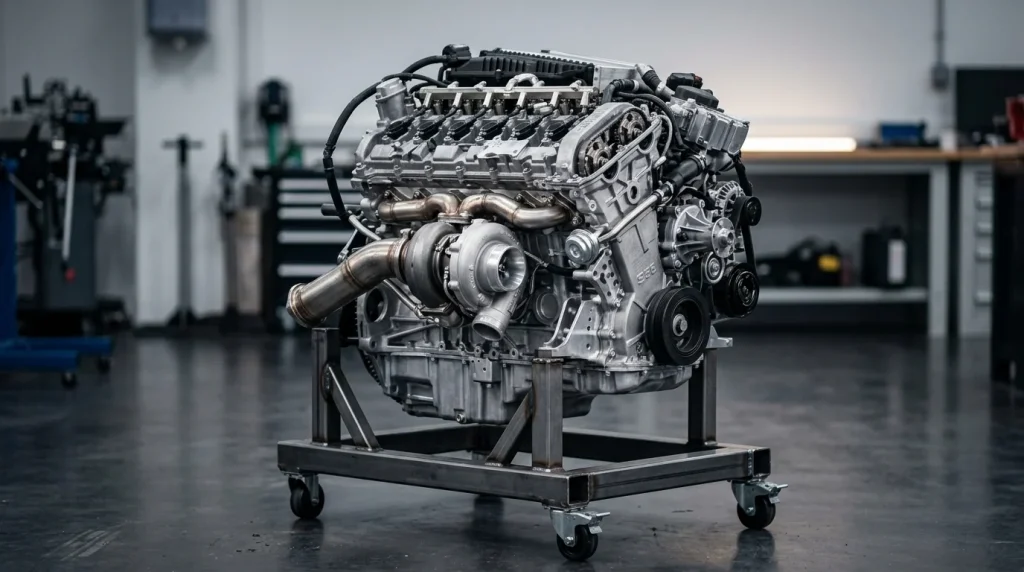
Unlike standard production vehicles in the standard BMW 3 Series engine lineup, which employ mass-market four-cylinder or single-turbo six-cylinder engines, BMW M powerplants receive dedicated engineering codes starting with the letter “S”. This designation denotes high-rpm capability, reinforced internal components, specialized cooling systems, and bespoke oiling circuits designed for sustained track use.
BMW M4 Generation Timeline & Engine Codes:
• First Generation (F82 Coupe / F83 Convertible, 2014-2020): BMW S55 Twin-Turbo 3.0L I6
• Second Generation (G82 Coupe / G83 Convertible, 2021-Present): BMW S58 Twin-Turbo 3.0L I6
The evolution from S55 to S58 reflects major advances in casting methods, thermal management, and forced-induction engineering. When BMW M introduced the S58 in high-performance sports activity vehicles such as the 2024 BMW X3 M crossover before integrating it into the G82 M4, the division established a modular yet uncompromising platform capable of supporting substantial horsepower increases while complying with stringent global emissions standards.
F82 and F83 Generation M4: The Twin-Turbo S55 Engine
Produced from 2014 through 2020, the first-generation BMW M4 marked a monumental shift for BMW M by replacing the high-revving 4.0-liter naturally aspirated S65 V8 engine of the previous E92 M3 coupe with a twin-turbocharged inline-six. Designated the S55B30T0, this engine displaced 2,979 cc with an 84.0 mm bore and an 89.6 mm stroke.
The S55 was engineered around a closed-deck aluminum cylinder block design to withstand elevated boost pressures (distinguishing it from the open-deck N55 architecture on which it was originally based), combined with extensive M-specific modifications. These included a forged steel crankshaft, lightweight forged connecting rods, twin mono-scroll turbochargers, and an air-to-water charge air cooler mounted atop the engine plenum. In its standard specification, the S55 produced 425 horsepower at 5,500 to 7,300 rpm and 406 lb-ft of torque across a broad plateau from 1,850 to 5,500 rpm.
BMW progressively expanded the S55 lineup through specialized trims:
- M4 Base Model (2015-2020): 425 horsepower, 406 lb-ft of torque.
- M4 Competition Package (2016-2020): 444 horsepower, 406 lb-ft of torque, featuring a retuned exhaust and revised engine control mapping.
- M4 CS (2018-2020): 454 horsepower, 442 lb-ft of torque, bridging the gap between street performance and track optimization.
- M4 GTS (2016): 493 horsepower, 443 lb-ft of torque, equipped with an innovative water injection system that sprayed a fine mist into the intake plenum to reduce combustion chamber temperatures and allow higher turbo boost.
G82 and G83 Generation M4: The High-Performance S58 Engine
Debuting for the 2021 model year, the second-generation G82 M4 introduced the BMW S58B30T0 engine. While maintaining the classic 3.0-liter straight-six configuration, the S58 represents an almost entirely new mechanical design based on BMW’s modular B58 engine family. Displacing 2,993 cc, the S58 features an 84.0 mm bore and a longer 90.0 mm stroke, creating an undersquare cylinder geometry optimized for low-end torque delivery and high-pressure combustion stability.
According to technical documentation released by BMW M GmbH, the S58 shares less than 10 percent of its structural components with the standard B58 engine. The cylinder block transitions to an extremely rigid closed-deck design, allowing the engine to withstand peak combustion pressures exceeding 140 bar. Furthermore, the cylinder head core is manufactured using additive manufacturing (3D printing), which enables intricate internal coolant passages that cannot be formed through conventional sand-casting methods.
Key Structural Differences:
• Engine Block: S55 Closed-deck crankcase (2,979 cc) vs S58 Sleeve-free closed-deck crankcase (2,993 cc)
• Fuel Pressure: S55 Direct Injection (200 bar) vs S58 High-Pressure Injection (350 bar)
• Cylinder Head: S55 Sand-cast aluminum vs S58 3D-printed core with geometric cooling channels
• Timing Drive Architecture: S55 Front friction-washer crank hub assembly vs S58 Rear-mounted timing chain drive
In an official statement regarding the bespoke nature of the S58 engine, former BMW M CEO Markus Flasch emphasized: “As a rule, we do not offer BMW M engines to third parties because we consider them such a strength of our cars. The S58 is a core asset of BMW M performance.”
Engine Options, Horsepower, and Performance Comparison
The modern BMW M4 lineup delivers a wide spectrum of power outputs tailored to diverse driving preferences. By adjusting turbocharger boost pressure, valve lift timing, and digital motor electronics (DME) calibrations, BMW offers the S58 across four main performance tiers.
S58 Boost Pressure Across Lineup:
• Base M4 Coupe (473 hp): ~18.9 psi peak boost
• M4 Competition (503 hp – 523 hp): ~24.7 psi peak boost
• M4 CS & CSL (543 hp): ~30.5 psi peak boost
The base M4 coupe remains dedicated to driver engagement by pairing a 473-horsepower tune with a six-speed manual gearbox. To protect the mechanical limits of the manual transmission, peak torque is electronically regulated at 406 lb-ft. Stepping up to the Competition models increases boost pressure to unlock 479 lb-ft of torque, managed through an automatic transmission.
For the 2025 and 2026 model years (Life Cycle Impulse or LCI), BMW updated the M4 Competition xDrive coupe and convertible, raising peak power from 503 hp to 523 hp at 6,250 rpm while extending the peak torque curve up to 5,730 rpm. At the pinnacle of the range, the limited-production M4 CSL and M4 CS produce 543 horsepower by elevating boost pressure to 30.5 psi.
Horsepower and Torque Output Across M4 Generations
The table below outlines the mechanical specifications, power outputs, and straight-line acceleration figures for every major BMW M4 variant across both generations:
| Model & Generation | Engine Code | Displacement | Horsepower (hp @ rpm) | Torque (lb-ft @ rpm) | Drivetrain & Gearbox | 0-60 mph (sec) |
|---|---|---|---|---|---|---|
| F82 M4 Base (2015-2020) | S55B30 | 2,979 cc | 425 @ 5,500-7,300 | 406 @ 1,850-5,500 | RWD / 6-Speed Man or 7-Speed DCT | 4.1 (DCT) / 4.3 (Man) |
| F82 M4 Competition (2016-2020) | S55B30 | 2,979 cc | 444 @ 7,000 | 406 @ 1,850-5,500 | RWD / 6-Speed Man or 7-Speed DCT | 3.9 (DCT) / 4.1 (Man) |
| F82 M4 CS (2018-2020) | S55B30 | 2,979 cc | 454 @ 6,250 | 442 @ 4,000-5,380 | RWD / 7-Speed Dual-Clutch | 3.7 |
| F82 M4 GTS (2016) | S55B30 (Water Inj) | 2,979 cc | 493 @ 6,250 | 443 @ 4,000-5,500 | RWD / 7-Speed Dual-Clutch | 3.4 |
| G82 M4 Base (2021-Present) | S58B30T0 | 2,993 cc | 473 @ 6,250 | 406 @ 2,650-6,130 | RWD / 6-Speed Manual | 4.1 |
| G82 M4 Competition (2021-Present) | S58B30T0 | 2,993 cc | 503 @ 6,250 | 479 @ 2,750-5,500 | RWD / 8-Speed M Steptronic | 3.8 |
| G82 M4 Comp xDrive (2025-2026) | S58B30T0 | 2,993 cc | 523 @ 6,250 | 479 @ 2,750-5,730 | AWD / 8-Speed M Steptronic | 3.4 (2.8 tested) |
| G82 M4 CS (2025) | S58B30T0 | 2,993 cc | 543 @ 6,250 | 479 @ 2,750-5,950 | AWD / 8-Speed M Steptronic | 3.2 |
| G82 M4 CSL (2023) | S58B30T0 | 2,993 cc | 543 @ 6,250 | 479 @ 2,750-5,950 | RWD / 8-Speed M Steptronic | 3.6 |
In real-world performance testing conducted by Car and Driver, the all-wheel-drive M4 Competition xDrive recorded a 0-60 mph sprint of 2.8 seconds and completed the quarter-mile in 11.0 seconds at 125 mph, proving that the S58 engine operates among the fastest BMW M Series production cars ever developed.
Drivetrain Options and Transmission Configurations
The transmission and drivetrain hardware on the M4 are calibrated specifically to manage S58 torque characteristics:
-
Six-Speed Manual Transmission: Available exclusively on the 473-hp base M4 coupe, this unit features a dual-plate clutch and an automatic rev-matching function (Gear Shift Assistant) that can be disabled via the iDrive menu.
-
Eight-Speed M Steptronic with Drivelogic: Replacing the seven-speed dual-clutch transmission (DCT) of the F82 generation, this torque-converter automatic delivers rapid, crisp gear changes on track while providing smooth low-speed driveability in traffic. The Drivelogic switch on the shift lever allows drivers to adjust shift speed across three distinct stages.
-
M xDrive All-Wheel Drive: Featuring an electronically controlled multi-plate clutch in the transfer case and an Active M Differential on the rear axle, M xDrive operates in rear-biased 4WD mode by default. Drivers can switch to 4WD Sport for track driving or engage 2WD mode (with stability control deactivated) for pure rear-wheel-drive dynamics.
For buyers comparing body styles, the mechanical package remains identical whether choosing the two-door coupe or four-door sedan; readers can compare the BMW M3 and M4 to evaluate how chassis dimensions and curb weight affect overall agility.
Core Engine Technologies and Performance Engineering
The S58 engine incorporates advanced motorsport-derived technologies that distinguish it from standard production engines. BMW M engineers focused on maximizing volumetric efficiency, minimizing rotational inertia, and ensuring sustained thermal equilibrium under extreme track conditions.
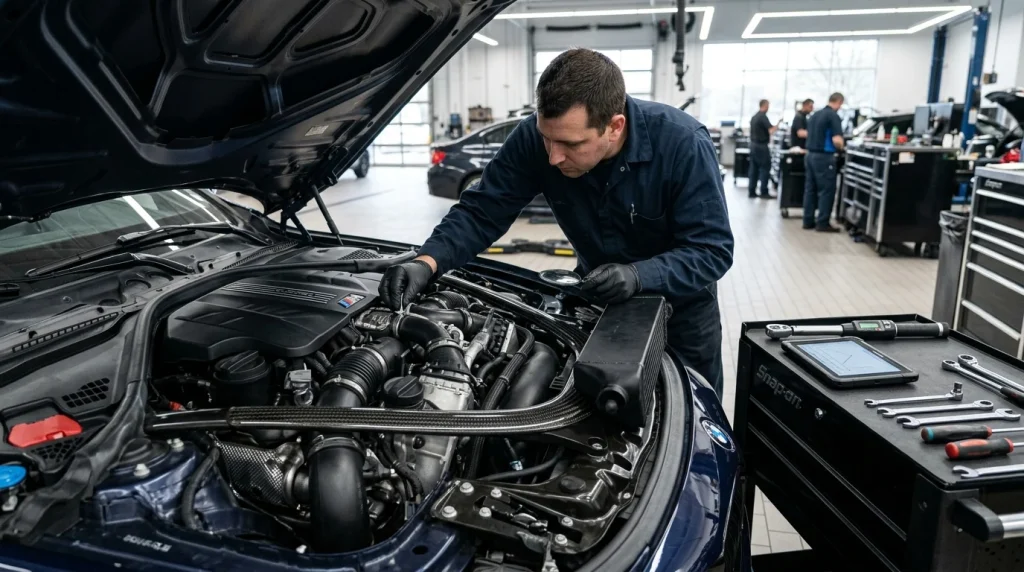
Core Engine Technologies Summary:
• Variable Valvetrain: Double-VANOS (camshaft adjustment) + Valvetronic (stepless valve lift)
• Fuel Delivery: Direct injection operating at an ultra-high 350 bar (5,076 psi)
• Cylinder Coating: Twin-wire arc-sprayed (LDS) iron coating on cylinder bores
• Thermal Control: Indirect liquid-to-air charge cooler integrated directly into intake plenum
The lightweight forged crankshaft reduces rotating mass by approximately 4.4 pounds compared to previous generations, allowing the S58 to rev freely to its 7,200 rpm redline. Cylinder bores feature an ultra-thin iron coating applied via twin-wire arc spraying (Lichtbogenspritzen or LDS), which eliminates heavy cast-iron cylinder liners while reducing internal friction. The transition from the dual-clutch transmission of the S55 to the eight-speed M Steptronic automatic in the S58 platform allowed BMW engineers to handle higher torque limits (up to 479 lb-ft from the factory and substantial headroom for aftermarket tuning) without clutch slip. The torque converter lockup clutch engages almost instantaneously once rolling, preserving direct throttle response while eliminating low-speed clutch shudder.
Double-VANOS and Electronic Engine Management
Variable valve timing on the S58 is handled by BMW’s Double-VANOS system, which continuously adjusts the timing of both the intake and exhaust camshafts. This is paired with Valvetronic fully variable valve lift, which controls intake air volume by altering valve opening depth rather than relying solely on a conventional throttle plate.
Operating in tandem with the BMW VANOS variable valve timing system, the engine control unit coordinates valve overlap to optimize low-rpm spool-up of the twin turbochargers while reducing exhaust gas emissions during cold starts. The system responds in milliseconds to throttle inputs, eliminating noticeable turbo lag despite the fitment of larger compressor wheels.
While BMW’s electrified performance vehicles use electric motor assist, as seen in the BMW i8 hybrid sports car powertrain, the M4 relies entirely on high-pressure combustion and precision valve control to deliver instant throttle response.
Thermal Management, Intercooling, and Lubrication
High cylinder pressures generate tremendous thermal loads. To maintain peak performance during track sessions, the S58 uses a complex multi-radiator cooling package:
- High-Temperature Engine Circuit: A primary central radiator backed by two auxiliary remote radiators mounted in the wheel arches cools the engine block and cylinder head.
- Low-Temperature Intercooler Circuit: An indirect liquid-to-air charge air cooler is integrated directly inside the intake manifold plenum, minimizing intake air tract length and maintaining dense, cool air charges under heavy boost.
- Dedicated Fluid Coolers: Separate horizontal heat exchangers cool engine oil and transmission fluid, positioned low behind the front apron.
S58 Oiling System Highlights:
• Map-controlled variable-displacement vane-type oil pump
• Integrated secondary oil suction stage for track cornering up to 1.3g
• Deep-sump oil pan with integrated anti-slosh baffles
Speaking on the cooling and oiling development of the S58 engine, BMW M Head of Development Dirk Hacker noted: “The cooling system of the S58 was tested extensively on the Nurburgring Nordschleife to ensure that oil and coolant temperatures remain perfectly stable under prolonged lateral acceleration exceeding 1.3g.”
M4 Engine Maintenance Schedules and Ownership Costs
Maintaining the S58 or S55 engine requires strict adherence to fluid specifications and preventive inspection intervals. High-output turbocharged engines operate under high thermal stress, making fluid degradation the primary catalyst for premature wear.
Recommended S58 Maintenance Schedule:
• Engine Oil & Filter: Every 5,000 to 7,500 miles (BMW LL-01 FE / LL-12 FE approved 0W-30 or 5W-30)
• Spark Plugs: Every 30,000 miles or every 3rd oil change
• Engine Air Filters: Every 30,000 miles
• Differential & Transmission Fluid: Every 45,000 to 50,000 miles
• Engine Coolant Flush: Every 4 years / 50,000 miles
Owners must ensure that replacement lubricants carry the official BMW Longlife-01 engine oil standard or LL-01 FE rating to protect the Valvetronic eccentric shaft actuators and turbocharger bearings. Similarly, the cooling loops require genuine BMW HT-12 and G48 coolant formulations to prevent corrosion and deposit formation inside the aluminum heat exchangers and cooling passages.
Critical Factors Affecting Engine Longevity and Reliability
In the enthusiast and independent mechanic community, the S58 is widely regarded as one of the most mechanically durable engines ever built by BMW M. However, several critical areas warrant ongoing monitoring:
-
Plastic Oil Filter Housing Cap: The S58 features a composite plastic oil filter housing. Over-torquing the cap during oil changes or exposing it to repeated high-heat track cycles can cause hairline cracks, resulting in oil seepage or filter collapse. Replacing the filter element with an OEM fleece filter and torquing the cap strictly to 25 Nm prevents this issue.
-
Timing Drive Architecture (S55 vs S58): On the older S55 engine, the front friction-fit crankshaft hub assembly was susceptible to slipping out of alignment under sudden torque spikes (such as aggressive DCT downshifts or aftermarket power upgrades), causing timing loss. On the S58 architecture, BMW resolved this vulnerability by relocating the entire timing chain drive to the rear of the engine (flywheel side) with an integrated drive sprocket on the crankshaft, while the front crankshaft snout solely drives auxiliary accessories without using a keyed gear mechanism.
-
Low-Mounted Coolant Radiator Exposure: The auxiliary engine oil cooler and charge cooler radiators sit low behind the front bumper grilles. Installing aftermarket protective mesh guards helps shield these cooling fins from kicked-up road gravel, which could otherwise puncture the cooler and cause rapid fluid loss.
Note: If an engine warning light or BMW drivetrain malfunction alert appears on the digital instrument cluster, it is frequently linked to a misfire from worn high-performance spark plugs or a low coolant level in the secondary intercooler tank. Addressing fluid levels immediately prevents the DME from entering limp-mode.
Estimated Annual Maintenance and Operating Costs
Operating a BMW M4 incurs higher routine running costs than standard 4 Series models due to specialized components, high-octane fuel requirements, and rapid tire wear.
Estimated Annual Operating Budget (10,000 – 12,000 miles/year):
• Routine Fluid Service (2 Oil Services + Microfilter): $450 – $650
• High-Performance Tires (Michelin Pilot Sport 4S, set of 4): $1,400 – $1,800 (every 15,000 – 20,000 miles)
• Brake Pads and Fluid Service: $600 – $900
• Premium Fuel (93 Octane, 18 mpg average): $2,600 – $3,200
• Total Estimated Annual Routine Budget: $5,000 – $6,500
Owners planning long-term ownership beyond 60,000 miles should budget for preventive replacements of serpentine drive belts, oxygen sensors, and suspension bushings to preserve optimal chassis response.
Buyer’s Guide: Choosing the Right M4 Engine Variant
Selecting the ideal BMW M4 depends on how you balance everyday commuting comfort against track day performance and collector value.
M4 Buyer Decision Framework:
• Purist Daily Driver: Base M4 Coupe (6-Speed Manual, 473 hp, RWD)
• All-Weather Super Coupe: M4 Competition xDrive (8-Speed Auto, 523 hp, AWD)
• Track Specialist / Weekend Weapon: M4 CS or CSL (8-Speed Auto, 543 hp, Lightweight CFRP)
For prospective buyers calculating total cost of ownership, consulting an average BMW maintenance cost breakdown helps set realistic expectations for insurance, depreciation, and scheduled maintenance.
Base M4 vs Competition vs CS: Which Model Fits Your Driving Needs?
- Base M4 Coupe (473 hp / 406 lb-ft, RWD, 6MT): Best suited for enthusiasts who prioritize three-pedal mechanical involvement over raw acceleration numbers. While slower to 60 mph than automatic models, the manual transmission provides an increasingly rare analog driving experience.
- M4 Competition xDrive (523 hp / 479 lb-ft, AWD, 8AT): The definitive choice for 90 percent of drivers. The M xDrive all-wheel-drive system provides immense traction in wet and winter conditions while retaining the ability to switch into rear-wheel-drive mode. It delivers supercar-rivaling acceleration while remaining completely docile in daily traffic.
- M4 CS and CSL (543 hp / 479 lb-ft, AWD/RWD, 8AT): Built for dedicated track enthusiasts and collectors. Featuring solid engine mounts, stiffer anti-roll bars, carbon ceramic brakes, and carbon-fiber body panels that shed weight, these models trade daily ride compliance and cabin quietness for razor-sharp lap times.
Pre-Purchase Inspection Checklist for Used M4 Models
When purchasing a pre-owned F82 or G82 BMW M4, conduct a comprehensive pre-purchase inspection (PPI) covering these essential checkpoints:
-
Digital DME Scan & Flash History: Scan the engine control unit with diagnostic software to verify whether the engine has been tuned with aftermarket flash software. Excessive boost tunes can strain connecting rod bearings and void factory powertrain warranties.
-
S55 Crank Hub Inspection (F82 models): On F82 models, inspect the timing gear for evidence of crank hub slippage or confirm whether an aftermarket keyed crank hub fix has been installed.
-
Coolant Tank Fluid Levels: Inspect both the high-temperature engine reservoir and the smaller low-temperature intercooler reservoir. A low intercooler tank indicates potential internal leakage inside the intake manifold charge air cooler.
-
Valve Cover & Oil Filter Housing Gaskets: Check the rear of the valve cover and the perimeter of the oil filter housing for oil weeping, which typically manifests between 50,000 and 70,000 miles.
-
iDrive Diagnostic Records: Check the central display for stored fault codes and verify that the vehicle has received the latest BMW iDrive software updates to ensure optimal transmission and engine control calibrations.
Summary and Next Steps for Prospective M4 Owners
The BMW M4 represents the pinnacle of modern twin-turbocharged inline-six engineering. From the pioneering S55 engine of the F82 generation to the exceptionally strong, motorsport-bred S58 engine powering the current G82 and G83 lineup, the M4 combines high-rpm agility with extraordinary durability.
Whether choosing a six-speed manual base model for classic purist engagement or an M xDrive Competition model for all-weather supercar performance, prospective owners will experience one of the finest performance engines in automotive history.
For those shopping the pre-owned market, reviewing typical BMW high-mileage breakdown milestones provides valuable insight into when auxiliary components and cooling gaskets require replacement. Furthermore, knowing how to interpret a BMW drivetrain malfunction warning ensures that minor sensor misfires or ignition coil wear can be resolved promptly before causing performance degradation. Prioritizing routine maintenance records and verifying cooling system integrity ensures that the M4 delivers dependable high-performance driving for years to come.
Frequently Asked Questions About the BMW M4 Engine
What engine code is in the current BMW M4?
The current generation BMW M4 (G82 coupe and G83 convertible, 2021 to present) is powered by the BMW S58 engine (specifically the S58B30T0). It is a 3.0-liter twin-turbocharged inline-six engine producing between 473 hp and 543 hp depending on the specific model trim.
What is the difference between the BMW S55 and S58 engines?
The S55 engine powered the previous F82 M4 (2014-2020), using a closed-deck aluminum block (2,979 cc), 200-bar direct injection, and a front friction-fit crank hub assembly. The S58 engine powers the current G82 M4 (2021-present), featuring a reinforced modular closed-deck block (2,993 cc), 350-bar direct injection, a 3D-printed cylinder head core, and a rear-mounted timing chain drive.
Does the BMW M4 come with a V8 engine?
No, the BMW M4 has never been equipped with a V8 engine from the factory. The M4 has exclusively featured 3.0-liter twin-turbocharged inline-six engines (S55 and S58) since its introduction in 2014. The previous generation M3 coupe (E92, 2008-2013), which preceded the M4 naming split, was the only generation to feature a naturally aspirated 4.0-liter V8 engine (the S65).
Is the BMW S58 engine reliable for daily driving?
Yes, the S58 is considered one of the most reliable and over-engineered performance engines produced by BMW M. Its closed-deck block and reinforced forged internals handle factory power levels effortlessly. Routine maintenance, including oil changes every 5,000 to 7,500 miles and regular inspection of the cooling radiators, ensures excellent long-term durability.
Can you get a BMW M4 with a manual transmission?
Yes, BMW offers a six-speed manual transmission exclusively on the standard rear-wheel-drive M4 coupe. This configuration pairs with a 473-horsepower version of the S58 engine. The higher-output Competition (503 hp – 523 hp) and CS/CSL (543 hp) variants are equipped exclusively with an eight-speed M Steptronic automatic transmission.

