

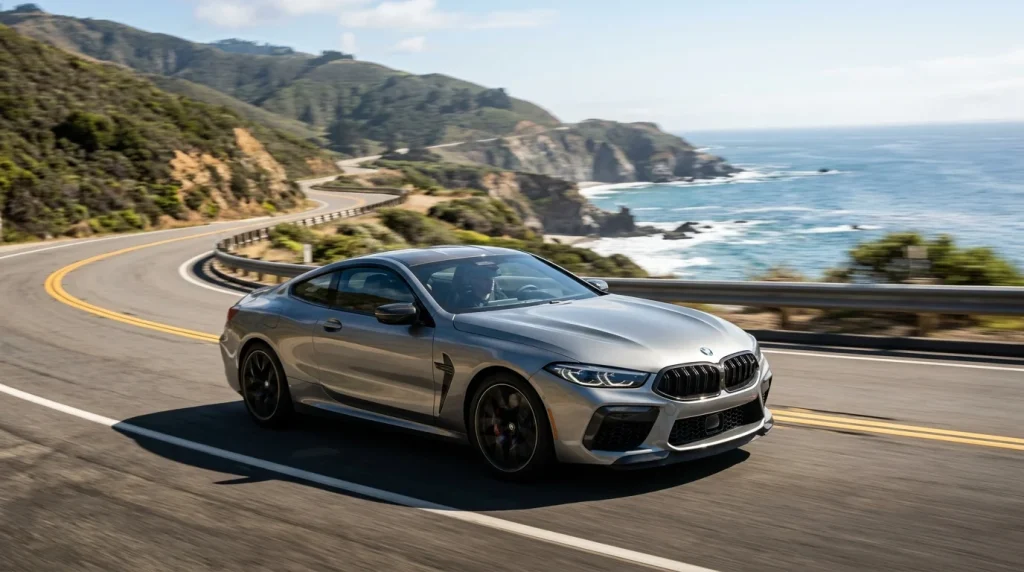
When determining what is the fastest BMW M Series model, the answer depends on the performance metric: the BMW M8 Competition leads in acceleration with a verified 2.5-second 0-60 mph sprint in independent testing, while the limited-edition BMW M4 CSL holds the highest factory top speed at 191 mph (307 km/h). For total power output, the BMW XM Label leads the division with 738 horsepower from its hybrid V8 powertrain.
Key takeaways:
- The BMW M8 Competition delivers a verified 2.5-second 0-60 mph sprint, beating BMW’s factory conservative estimate of 3.0 seconds.
- The track-focused BMW M4 CSL achieves the highest factory top speed in the M lineup at 191 mph.
- The 2022 BMW M5 CS features the best power-to-weight ratio among modern M sedans at 6.56 lbs per horsepower.
- The 2026 BMW M5 plug-in hybrid produces 717 horsepower but carries a 5,390-lb curb weight, resulting in an official 3.4-second 0-60 mph acceleration time.
- Standard BMW M models are electronically capped at 155 mph, while the optional M Driver’s Package raises this limit to 175-191 mph depending on the chassis.
Dominant speed contenders in the BMW M lineage
When evaluating the fastest vehicle in the BMW M portfolio, the answer depends entirely on the performance metric in question. Straight-line acceleration, top speed on an open stretch of Autobahn, and circuit capability demand distinct mechanical strengths. Over the past five decades, BMW Motorsport has transitioned from naturally aspirated lightweight coupes to twin-turbocharged all-wheel-drive grand tourers and high-voltage hybrid sedans.
Modern performance testing highlights three primary champions across different categories. The BMW M8 Competition Gran Coupe stands as the acceleration benchmark for production road cars. The BMW M4 CSL represents the peak of straight-line top speed and road-course agility. Meanwhile, the latest generation 2026 BMW M5 showcases the pinnacle of combined hybrid powertrain output.
| Model Variant | 0-60 mph (Tested) | Top Speed (Factory Limit) | Horsepower | Engine Code | Drivetrain |
|---|---|---|---|---|---|
| BMW M8 Competition (F92/F93) | 2.5 sec | 190 mph | 617 hp | 4.4L S63 Twin-Turbo V8 | M xDrive AWD |
| BMW M5 CS (F90, 2022) | 2.6 sec | 190 mph | 627 hp | 4.4L S63 Twin-Turbo V8 | M xDrive AWD |
| BMW M4 CSL (G82, 2023) | 3.3 sec | 191 mph | 543 hp | 3.0L S58 Twin-Turbo I6 | Rear-Wheel Drive |
| BMW M5 Sedan (G90, 2026) | 3.4 sec (claimed) | 190 mph | 717 hp | 4.4L S68 Twin-Turbo V8 Hybrid | M xDrive AWD |
| BMW M3 CS (G80, 2024) | 2.7 sec | 188 mph | 543 hp | 3.0L S58 Twin-Turbo I6 | M xDrive AWD |
| BMW XM Label (G09, 2024) | 3.6 sec (claimed) | 175 mph | 738 hp | 4.4L S68 Twin-Turbo V8 Hybrid | M xDrive AWD |
Understanding how these numbers interact requires looking at both factory documentation and independent real-world trials.
Official data sources and verification
Official performance data published by BMW M GmbH provides the baseline for vehicle certification. According to technical documentation archived at the BMW Group PressClub, factory figures deliberately quote conservative acceleration windows. BMW measures 0-60 mph and 0-100 km/h with two occupants, average European fuel loads, and strict homologation standards.
Under factory ratings, the 2026 BMW M5 is credited with a 3.4-second 0-60 mph sprint, while the standard M8 Competition carries an official 3.0-second rating. The BMW M4 CSL carries an official 3.7-second 0-100 km/h figure, but its electronic governor allows an unrestricted terminal velocity of 191 mph (307 km/h) directly from the factory floor.
Independent verification and testing conditions
Independent automotive testing tells a significantly faster story. In instrumented trials conducted on closed testing facilities by Car and Driver, an M8 Competition Gran Coupe launched from 0 to 60 mph in an astonishing 2.5 seconds, running the quarter-mile in 10.7 seconds at 129 mph.
These independent tests use precision GPS timing equipment, clean prepped pavement, and aggressive launch control activation. The massive traction generated by modern all-wheel-drive systems allows turbocharged M vehicles to launch well below their conservative manufacturer claims. For readers tracking platform comparisons, our detailed BMW M3 vs. M4 performance comparison outlines how chassis tuning and traction systems shift acceleration times across smaller M platforms.
Engine and drivetrain configurations that influence top speed
Top speed and acceleration in the BMW M family are governed by the relationship between powertrain output, aerodynamic drag, transmission gearing, and total curb weight.
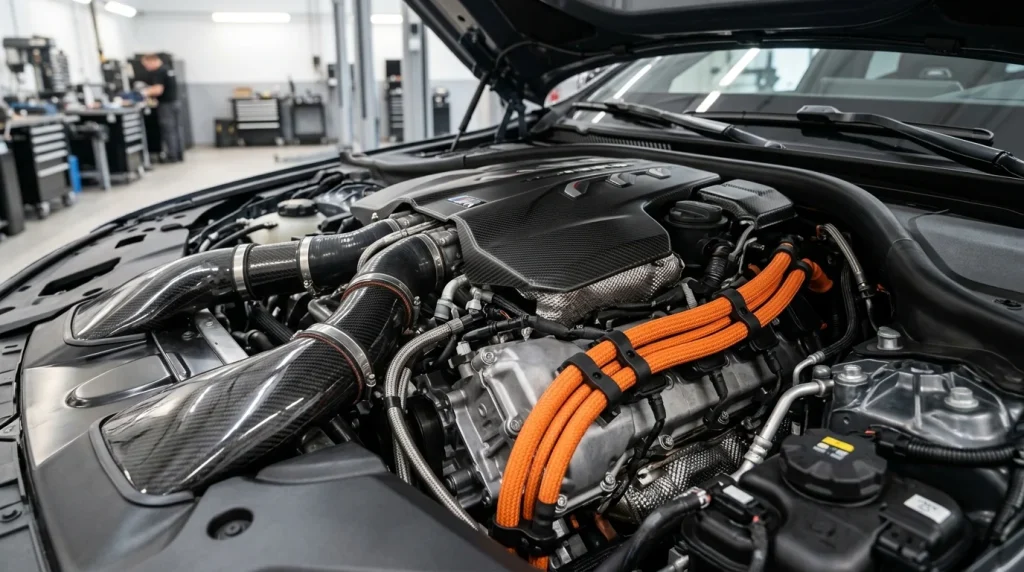
At the heart of the modern lineup sit three distinct engine architectures:
- The S58 3.0-liter Twin-Turbocharged Inline-6: Found in the M2, M3, M4, and high-performance SAVs. In the M4 CSL and M3 CS, this engine produces 543 horsepower and 479 lb-ft of torque. It uses a 3D-printed cylinder head core, a forged lightweight crankshaft, and twin mono-scroll turbochargers running at up to 30.5 psi of boost. Readers interested in internal componentry can explore our breakdown of the BMW M4 S58 engine architecture to understand how closed-deck block design handles extreme boost.
- The S63 4.4-liter Twin-Turbocharged V8: The legendary pure internal combustion engine that powered the F90 M5 and F92 M8. It features a cross-bank exhaust manifold that evenly pulses exhaust gases into twin-scroll turbochargers nestled within the “hot-V” valley.
- The S68 4.4-liter Twin-Turbocharged V8 M Hybrid: The new generation plug-in hybrid architecture used in the 2026 G90 M5 and XM Label. The S68 engine integrates a 194-horsepower electric motor inside the 8-speed M Steptronic transmission casing, supplying instant torque fill while the twin turbochargers build manifold pressure.
| Engine Code | Displacement & Layout | Peak Power Output | Peak Torque | Induction System | Primary Applications |
|---|---|---|---|---|---|
| S58B30T0 | 3.0L Twin-Turbo Inline-6 | 473 – 543 hp | 406 – 479 lb-ft | Twin Mono-Scroll Turbo | M2, M3, M4, X3 M |
| S63B44T4 | 4.4L Twin-Turbo V8 | 600 – 627 hp | 553 lb-ft | Hot-V Twin-Scroll Turbo | F90 M5, F92/F93 M8 |
| S68B44T0 (M Hybrid) | 4.4L Twin-Turbo V8 + Electric Motor | 717 – 738 hp | 738 lb-ft | Hot-V Twin-Scroll + E-Motor | G90 M5, XM Label |
While electric motors offer immediate off-the-line torque, they add substantial weight from high-voltage battery packs. To ensure optimal combustion pressure and avoid sensor-triggered power reductions, following the correct octane fuel requirements for BMW performance engines remains vital for sustained high-speed runs. The shift from pure internal combustion engines like the S63 to plug-in hybrids like the S68 yields massive horsepower gains on paper. However, in straight-line acceleration up to 60 mph, extra battery mass partially counteracts the torque advantage. The 4,114-lb M5 CS remains quicker to 60 mph than the 5,390-lb hybrid 2026 M5 because every single horsepower moves significantly less physical mass.
Model-by-model top-speed snapshots
To understand which model fits specific performance needs, examining individual flagship variants reveals the precise balance between acceleration, terminal velocity, and production status.
BMW M8 Competition (Coupe and Gran Coupe)
The M8 Competition represents the fastest pure acceleration ever achieved by a series-production BMW. Powered by the 617-hp S63 V8 and the rear-biased M xDrive system, it consistently hooks up on standard road surfaces. Although BMW ended production of the M8 Coupe and Gran Coupe in late 2025, remaining dealer units and pre-owned examples remain the ultimate benchmark for 0-60 mph sprints.
2022 BMW M5 CS
The limited-production 2022 BMW M5 CS is widely regarded by automotive historians as the pinnacle of pure gasoline BMW super sedans. BMW stripped 230 pounds of weight using carbon fiber hood panels, carbon bucket seats, and reduced sound insulation. With 627 horsepower and a 4,114-lb curb weight, it rockets to 60 mph in 2.6 seconds and reaches 190 mph with factory stability.
BMW M4 CSL
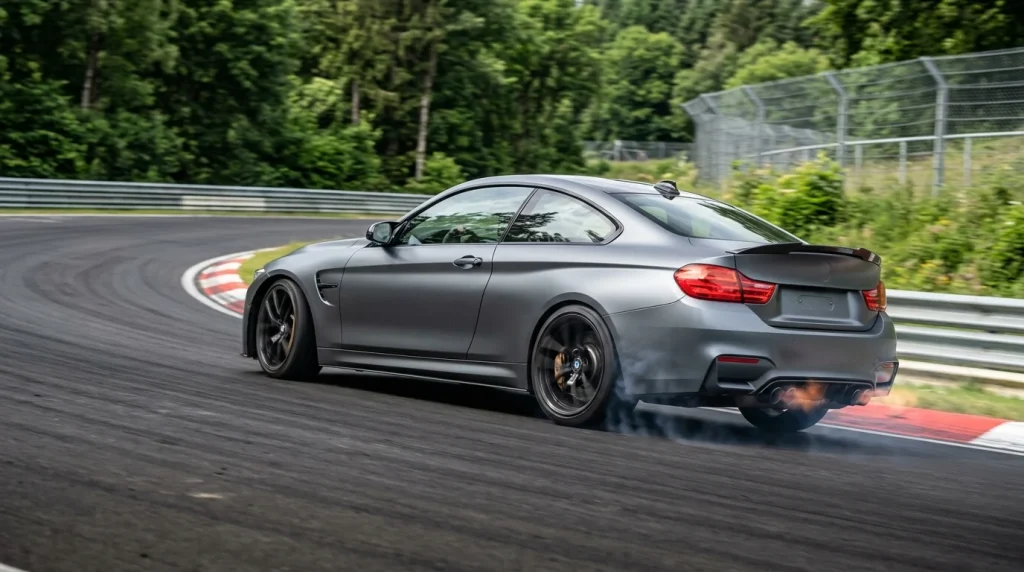
Built to celebrate the 50th anniversary of BMW M GmbH, the M4 CSL is the top speed champion of the division at 191 mph. By eliminating the rear seats, installing a titanium rear silencer, and refining front and rear downforce, BMW created a track weapon capable of blitzing long straights while maintaining extreme stability at nearly 200 mph.
2026 BMW M5 Sedan
The 2026 G90 M5 introduces the 717-hp hybrid era to the executive sedan class. While its 5,390-lb weight makes it slightly slower to 60 mph (3.4 seconds claimed) than the M5 CS, its mid-range passing acceleration from 60 to 120 mph is remarkably brutal thanks to the electric motor’s 207 lb-ft of instant torque. When configured with factory BMW performance option packages, the electronic speed governor expands from 155 mph to a full 190 mph.
High-Performance SAVs: BMW X3 M and XM
In the sports activity vehicle sector, the specialized 2024 BMW X3 M performance review shows that the S58-powered compact crossover can hit 60 mph in 3.6 seconds. The larger 738-hp XM Label reaches 60 mph in 3.6 seconds as well, although its bluff aerodynamic profile limits top speed to 175 mph.
What makes a BMW M model the fastest on track vs street
A car that records the highest velocity in a straight line does not automatically dominate a racing circuit. Straight-line speed relies primarily on launch traction, horsepower, and low frontal aerodynamic drag. In contrast, track speed requires sustained braking thermal capacity, lateral mechanical grip, downforce, and corner-exit stability.
| Performance Arena | Key Limiting Factor | Winning Model | Primary Engineering Advantage |
|---|---|---|---|
| 0-60 mph Acceleration | Traction & Power-to-Weight | BMW M8 Competition | M xDrive AWD launch control with 617 hp |
| Maximum Terminal Velocity | Aerodynamics & Gearing | BMW M4 CSL | 191 mph top speed with low drag profile |
| Circuit Lap Times | Cornering Grip & Weight | BMW M4 CSL | 7:18.137 Nürburgring Nordschleife lap time |
| High-Speed Luxury Cruising | Chassis Stability & Power | 2026 BMW M5 / M8 | 190 mph sustained Autobahn high-speed cruise |
On the Nürburgring Nordschleife, the ultimate proving ground for automotive performance, verified data published on the official Nürburgring record leaderboard confirms the M4 CSL as the fastest production BMW in history. It completed the full 20.832-kilometer circuit in an official time of 7:18.137 minutes, outpacing heavier V8 sedans despite having less peak horsepower.
Aerodynamic features such as the functional ducktail trunk lid on the CSL generate real downforce at speeds above 120 mph without inducing excessive drag penalties. Furthermore, standard carbon-ceramic braking packages prevent brake fade during repeated high-speed stops.
Note: Push-to-pass functions and launch control systems place extreme thermal stress on multi-plate clutches and cooling loops. If extreme track driving triggers warning indicators on the digital cluster, diagnosing potential BMW drivetrain malfunction warnings early protects expensive transmission hardware from permanent heat damage.
Historical perspective and evolution
The definition of speed in the BMW M division has changed dramatically across distinct engineering eras.
In the late 1970s, the mid-engine BMW M1 reached a top speed of 162 mph (260 km/h) with 277 horsepower, making it the fastest German road sports car of its time. During the 1990s and 2000s, BMW models were strictly bound by a voluntary 155 mph (250 km/h) gentleman’s agreement among German manufacturers, even as high-revving engines like the E60 M5’s S85 5.0-liter V10 possessed the mechanical gearing to surpass 200 mph when de-restricted.
The introduction of factory twin-turbocharging in the F10 M5 and F80 M3 initiated the modern horsepower explosion. Drivetrain engineering took another leap with the adoption of rear-biased all-wheel drive on the F90 M5, solving the traction limitations that previously capped rear-wheel-drive 0-60 mph times around 3.8 to 4.0 seconds.
Modern electrification represents the latest phase. By combining high-output combustion engines with electric propulsion, as first explored in the BMW i8 hybrid powertrain, BMW maintains compliance with global emissions standards while pushing power numbers beyond 700 horsepower.
For collectors and enthusiasts keeping older high-performance models on the road, reviewing high-mileage BMW maintenance intervals is essential to prevent premature wear on cooling systems, rod bearings, and high-pressure fuel pumps.
Debunking myths and setting expectations
Several persistent misconceptions surround top speed and performance in the BMW M lineup:
- Myth 1: The vehicle with the most horsepower is always the fastest. Peak horsepower figures do not guarantee acceleration. The 738-hp XM Label has 121 more horsepower than the 617-hp M8 Competition, yet the M8 reaches 60 mph over a full second quicker due to carrying nearly 1,800 fewer pounds of weight.
- Myth 2: Top speed indicates circuit capability. Top speed is determined on long straightaways. On technical road courses with short straights and heavy braking zones, a lighter car with higher cornering grip will consistently post faster lap times than a heavy car with a higher terminal velocity.
- Myth 3: Every BMW M car can hit 190 mph out of the box. All standard BMW M models shipped to North America and Europe are electronically limited to 155 mph (250 km/h). Reaching top speeds between 175 and 191 mph requires selecting the factory M Driver’s Package, which unlocks the engine control unit software and fits high-speed rated tires.
Frequently asked questions about the fastest BMW M series
What is the fastest BMW M model currently sold?
The 2026 BMW M5 Sedan (G90) is the fastest new BMW M car available for custom factory order at dealerships. It generates 717 horsepower from its hybrid V8 powertrain, accelerates from 0 to 60 mph in 3.4 seconds, and achieves a top speed of 190 mph with the optional M Driver’s Package.
How does horsepower translate to top speed in BMW M series?
Horsepower determines how effectively a vehicle can overcome aerodynamic drag at high velocities. Because aerodynamic drag increases with the square of vehicle speed, doubling a car’s top speed requires roughly eight times the engine power. Gearing ratios and electronic limiter software ultimately dictate the final top speed number.
Which BMW M models are fastest on track vs street?
The BMW M8 Competition and 2022 M5 CS are the fastest on the street for straight-line acceleration from stoplights and highway on-ramps. On dedicated road racing circuits, the lighter BMW M4 CSL and M3 CS are the fastest models due to their higher downforce, lower curb weights, and superior cornering agility.

