

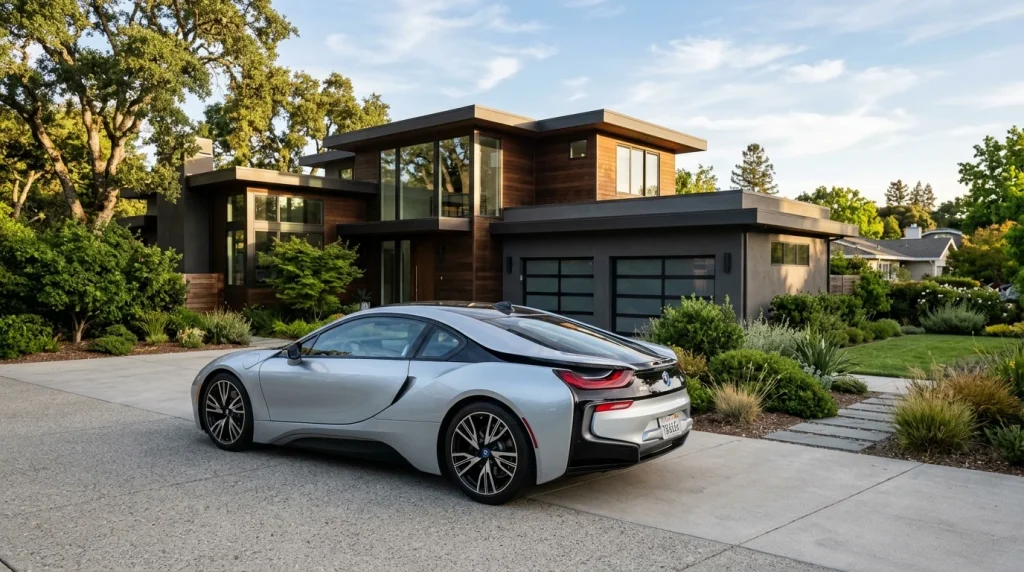
What Engine Does the BMW i8 Have? Hybrid Specs Explained
The BMW i8 is powered by a plug-in hybrid powertrain consisting of a mid-mounted 1.5-liter BMW TwinPower Turbo 3-cylinder gasoline engine generating 228 horsepower (170 kW) driving the rear wheels, paired with a front-mounted hybrid synchronous electric motor for a combined total system output of 357 horsepower and 420 lb-ft of torque in 2014-2018 models, and 369 horsepower in 2018-2020 models.
Key takeaways:
-
Mid-mounted 1.5-liter BMW TwinPower Turbo 3-cylinder gasoline engine (B38K15T0) produces 228 hp (170 kW) and 236 lb-ft (320 Nm) of torque.
-
Front-mounted hybrid synchronous electric motor contributes 131 hp (96 kW) in early models and 143 hp (105 kW) in updated models.
-
High-voltage starter-generator on the combustion engine provides 15 kW (20 hp) and 50 Nm of torque assistance, power generation, and instant engine restarts.
-
Combined system output reaches 357 hp (2014-2018) and 369 hp (2018-2020) with 420 lb-ft of torque, enabling 0 to 100 km/h acceleration in 4.4 seconds.
-
Split-axle all-wheel-drive system coordinates power across both axles electronically without a mechanical driveshaft.
The Core Gasoline Engine: 1.5-Liter BMW TwinPower Turbo 3-Cylinder
The internal combustion engine at the center of the BMW i8 is a 1.5-liter, 12-valve, direct-injected inline-3 equipped with BMW TwinPower Turbo technology. Designated internally under the engine code B38K15T0, this compact gasoline unit generates 170 kW (228 horsepower) at 5,800 rpm and 236 lb-ft (320 Nm) of torque at 3,700 rpm. With an exact displacement of 1,499 cc, the engine delivers 152.1 horsepower per liter of displacement. This represents one of the highest specific power outputs among production passenger vehicle engines of its era.
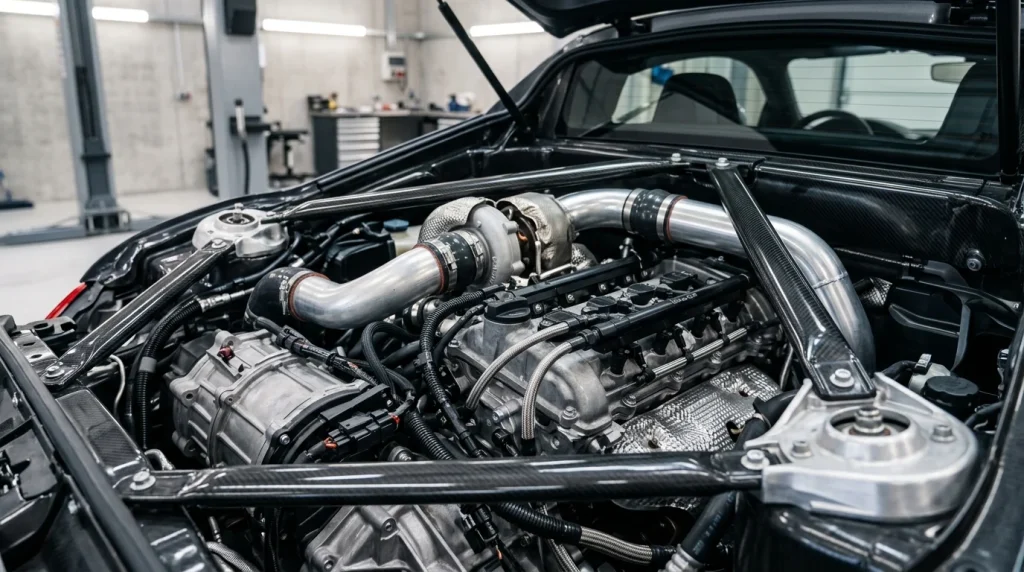
BMW developed this engine as a high-output variant of its modular engine family, sharing architectural principles with other modern powerplants such as modular BMW 328i engine families. The engine features an undersquare cylinder geometry with an 82.0 mm bore and a 94.6 mm stroke, establishing a 1.15:1 stroke-to-bore ratio that promotes low-end torque production and rapid thermal warm-up. The crankcase and cylinder head are cast from lightweight aluminum alloy, utilizing thermally sprayed arc-wire steel coatings on the cylinder bores (0.3 mm thickness) instead of heavy cast-iron liners to minimize engine block weight, reduce friction, and optimize heat dissipation.
To extract maximum thermodynamic efficiency under high boost conditions, the B38K15T0 operates at a 9.5:1 compression ratio, which is specifically reduced compared to standard turbocharged B38 variants (11.0:1) to prevent pre-ignition under high boost. Forced induction is supplied by a single-scroll turbocharger engineered jointly with Continental. This unit marked the world’s first production automotive turbocharger featuring a water-cooled aluminum turbine housing integrated directly into the exhaust manifold, saving 1.2 kg and enduring exhaust gas temperatures up to 1,020 degrees Celsius. The turbocharger operates at relative boost pressures reaching up to 1.5 bar (21.7 psi), regulated by an electronic wastegate actuator.
High-pressure direct fuel injection delivers atomized gasoline at pressures up to 200 bar (2,900 psi) directly into the combustion chambers via centrally positioned solenoid injectors. To ensure optimal breathing across the entire rev band up to its 6,500 rpm redline, BMW equipped the valvetrain with Valvetronic variable valve lift and double-BMW VANOS variable valve timing.
According to technical specifications published by MotorTrend, mounting this small engine transversely directly ahead of the rear axle allowed BMW to keep vehicle weight low while achieving balanced sports car proportions. Power from the 3-cylinder engine routes exclusively to the rear wheels through an Aisin six-speed automatic transmission (GA6F21AW) featuring steering-wheel paddle shifters. An auxiliary high-voltage starter-generator (HV-SGR) rated at 15 kW (20 hp) and 50 Nm of torque connects to the crankshaft via a belt drive, restarting the combustion engine in under 300 milliseconds and smoothing out transmission gear shifts.
| Engine Specification | Technical Data |
|---|---|
| Engine Code | BMW B38K15T0 |
| Engine Configuration | Transverse Mid-Mounted Inline 3-Cylinder (I-3) |
| Displacement | 1.5 Liters (1,499 cc) |
| Bore x Stroke | 82.0 mm x 94.6 mm |
| Compression Ratio | 9.5:1 |
| Valvetrain | 12-Valve DOHC with Double-VANOS and Valvetronic |
| Fuel Injection System | High-Precision Direct Injection (up to 200 bar / 2,900 psi) |
| Aspiration | Single-Scroll Turbocharger with Aluminum Housing (up to 1.5 bar boost) |
| Peak Engine Horsepower | 228 hp (170 kW / 231 PS) @ 5,800 rpm |
| Peak Engine Torque | 236 lb-ft (320 Nm) @ 3,700 rpm |
| Specific Power Output | 152.1 hp per liter |
| Crankshaft Starter-Generator | 15 kW (20 hp), 50 Nm (37 lb-ft) High-Voltage Generator |
| Transmission | 6-Speed Automatic (Aisin GA6F21AW) |
| Driven Axle | Rear Axle |
The Electric Motor and BMW eDrive Hybrid System
Working in tandem with the rear-mounted gasoline engine, the BMW i8 incorporates a front-mounted hybrid synchronous electric motor. Engineered by BMW Group specifically for the BMW i sub-brand, this motor delivers instant torque to the front axle through a specialized two-speed automatic transmission developed by GKN Driveline.
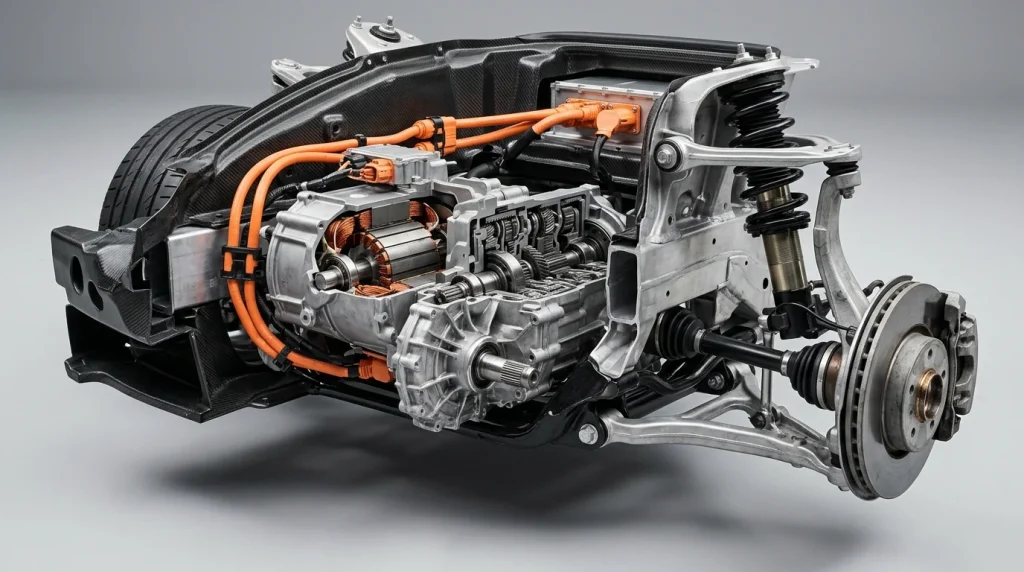
The front electric motor produces 96 kW (131 hp) and 184 lb-ft (250 Nm) of torque in early production vehicles (2014-2017). In refreshed models (2018-2020), optimized battery cell chemistry enabled BMW engineers to increase peak motor output to 105 kW (143 hp) while maintaining the same 184 lb-ft torque rating. Because electric motors produce maximum torque immediately from zero rpm, the electric drive provides instant throttle response before the gasoline engine’s turbocharger builds full boost pressure.
The front GKN two-speed transmission uses a first gear ratio of 11.3:1 for brisk off-the-line acceleration and pure electric driving in urban settings. As speed increases beyond approximately 75 mph (120 km/h), the gearbox shifts automatically into a taller second gear ratio of 5.85:1, allowing the electric motor to remain within its optimal operating rev range and continue providing electrical boost all the way to the car’s 155 mph top track speed.
Energy storage is supplied by a 355-volt lithium-ion battery pack located centrally in the chassis tunnel. In 2014-2017 models, the pack used 20 Ah cells providing a gross capacity of 7.1 kWh and a usable net capacity of approximately 5.2 kWh. For 2018-2020 models, BMW upgraded the pack with 34 Ah cells, expanding gross capacity to 11.6 kWh and usable net capacity to 9.4 kWh within the exact same structural enclosure. The high-voltage battery can be charged via Level 2 (240V / 16A) charging in approximately 2 to 2.5 hours using the vehicle’s onboard 3.7 kW charger.
Sophisticated vehicle management software coordinates power distribution between the front electric motor and rear combustion engine. Owners managing these sophisticated electronics can ensure smooth hybrid operation by applying the latest BMW hybrid management software update at scheduled service intervals. When high-voltage sensors detect anomalies, the system displays a BMW drivetrain malfunction warning to safeguard the hybrid components. The split-axle hybrid configuration allows the vehicle to run on electric power via the front axle, gasoline power via the rear axle, or combined all-wheel drive without adding the parasitic drag and weight of a mechanical center differential.
| Hybrid System Component | Specification / Value |
|---|---|
| Front Electric Motor Type | BMW eDrive Hybrid Synchronous Motor |
| Front Motor Output (2014-2017) | 96 kW (131 hp / 129 bhp) |
| Front Motor Output (2018-2020) | 105 kW (143 hp / 141 bhp) |
| Front Motor Peak Torque | 184 lb-ft (250 Nm) @ 0-4,100 rpm |
| Front Axle Transmission | GKN 2-Speed Automatic eAxle (11.3:1 / 5.85:1 ratios) |
| Battery Type & Voltage | Lithium-Ion, 355 Volts Nominal (96 cells in 6 modules) |
| Gross / Usable Battery Capacity (2014-2017) | 7.1 kWh gross / 5.2 kWh usable (20 Ah cells) |
| Gross / Usable Battery Capacity (2018-2020) | 11.6 kWh gross / 9.4 kWh usable (34 Ah cells) |
| Onboard Charger Power | 3.7 kW (Level 2 240V charging ~2.0-2.5 hours) |
| Maximum Regenerative Braking Power | Up to 60 kW energy recuperation |
Total System Output, Horsepower, and Real-World Performance
When both propulsion systems operate in unison, the BMW i8 functions as an electrified all-wheel-drive sports car. In standard production specification for 2014-2018 models, the combined hybrid system generates a total output of 357 horsepower and 420 lb-ft (570 Nm) of torque. In refreshed models (2018-2020) equipped with the upgraded electric motor, total system output rises to 369 horsepower while torque remains at 420 lb-ft.
According to manufacturer data documented in Wikipedia’s BMW i8 technical records, the i8 Coupé accelerates from 0 to 100 km/h (0 to 62 mph) in 4.4 seconds, while the open-top i8 Roadster completes the sprint in 4.6 seconds due to 132 pounds (60 kg) of additional structural roof reinforcements. In independent instrumented acceleration testing, automotive publications have recorded 0-60 mph sprint times as quick as 3.8 to 4.0 seconds when launching with a fully primed high-voltage battery. Top speed is electronically governed at 250 km/h (155 mph) in hybrid mode, and capped at 120 km/h (75 mph) in pure electric eDrive mode.
While traditional performance models like the BMW S58 twin-turbo inline-six engine rely on high-displacement combustion power, the i8 delivers competitive acceleration through instantaneous electrical torque combined with a lightweight carbon-fiber-reinforced plastic passenger cell. While it does not aim to eclipse the fastest BMW M series acceleration figures built strictly for track dominance, the i8 provides rapid real-world acceleration combined with sports grand tourer efficiency.
Fuel efficiency ratings reflect the vehicle’s dual nature. In hybrid mode, the EPA rates the BMW i8 at 76 MPGe combined, while operating solely on gasoline power yields 28 MPG combined. The vehicle was equipped standard with a 30-liter (7.9 US gallon) fuel tank, with an optional 42-liter (11.1 US gallon) extended-range fuel tank allowing total highway cruising distances exceeding 330 miles (530 km).
| Performance Metric | BMW i8 Coupé (2014-2018) | BMW i8 Coupé (2018-2020) | BMW i8 Roadster (2018-2020) |
|---|---|---|---|
| Combined Total Horsepower | 357 hp (362 PS) | 369 hp (374 PS) | 369 hp (374 PS) |
| Combined Peak Torque | 420 lb-ft (570 Nm) | 420 lb-ft (570 Nm) | 420 lb-ft (570 Nm) |
| 0 to 100 km/h (0 to 62 mph) | 4.4 seconds | 4.4 seconds | 4.6 seconds |
| 0 to 60 mph (approximate) | 4.2 seconds | 4.2 seconds | 4.4 seconds |
| Top Track Speed (Governed) | 155 mph (250 km/h) | 155 mph (250 km/h) | 155 mph (250 km/h) |
| Pure Electric Top Speed | 75 mph (120 km/h) | 75 mph (120 km/h) | 75 mph (120 km/h) |
| Pure Electric Range (EPA) | 15 miles (24 km) | 18 miles (29 km) | 17 miles (27 km) |
| EPA Fuel Economy (Hybrid / Gas) | 76 MPGe / 28 MPG | 69 MPGe / 27 MPG | 69 MPGe / 27 MPG |
| Standard / Optional Fuel Tank | 30 L (7.9 gal) / 42 L (11.1 gal) | 30 L (7.9 gal) / 42 L (11.1 gal) | 30 L (7.9 gal) / 42 L (11.1 gal) |
| Drivetrain Layout | Split-Axle All-Wheel Drive | Split-Axle All-Wheel Drive | Split-Axle All-Wheel Drive |
Note: Performance figures depend on high-voltage battery state of charge. When the battery depletes below 5-10% state of charge under sustained track driving or aggressive hill climbs, the vehicle operates primarily on the 228-horsepower gasoline engine until regenerative braking restores electrical reserves.
Chassis and Thermal Management: Lightweight CFRP and Cooling Systems
Extracting sports car performance from a 1.5-liter engine required extensive mass reduction across the entire chassis. BMW engineered the i8 around its proprietary LifeDrive architecture, which separates the vehicle into two distinct functional units: the Life Module and the Drive Module.
The Life Module consists of a high-strength passenger cell manufactured entirely from carbon-fiber-reinforced plastic (CFRP). This advanced composite structure provides 50% weight savings compared to conventional steel and 30% savings compared to aluminum, while offering exceptional torsional rigidity and passenger crash protection. The Drive Module is an all-aluminum chassis subframe that integrates the front electric powertrain, center tunnel battery pack, rear 3-cylinder engine, 6-speed transmission, and aluminum double-wishbone front and five-link rear suspension. This structural combination keeps total curb weight at 3,274 to 3,483 pounds (1,485 to 1,595 kg DIN) and achieves a 49/51 front-to-rear weight distribution with a low center of gravity below 18 inches (460 mm).
Thermal management in the BMW i8 incorporates three dedicated cooling circuits:
-
High-temperature cooling circuit (operating up to 105-110 °C): Regulates the B38 gasoline engine and water-cooled Continental turbocharger housing via mechanical and electric water pumps.
-
Low-temperature cooling circuit (operating at 40-50 °C): Circulates coolant through the front electric motor, power electronics inverter, and high-voltage DC-DC converter.
-
Refrigerant-based direct battery chiller: Connected to the vehicle’s air conditioning system, utilizing an evaporator cooling plate beneath the lithium-ion cells to keep the battery within its optimal 25 °C to 40 °C thermal window during rapid discharge and high-rate charging.
Maintaining strict fluid chemistry with factory-approved BMW G48 and HT-12 coolant standards prevents galvanic corrosion across aluminum cooling channels and hybrid heat exchangers.
Because the high-boost 1.5-liter engine operates at elevated cylinder pressures (up to 1.5 bar boost), it requires premium fuel with a minimum rating of 91 AKI (95 RON) and a recommended rating of 93 AKI (98 RON). Adhering to the recommended high-octane fuel requirements for BMW engines prevents detonation and ensures the knock sensors do not retard ignition timing, preserving full 228-horsepower output.
Powertrain Evolution: From Vision EfficientDynamics Concept to Production
The conceptual foundation for the BMW i8 began in 2009 with the unveiling of the BMW Vision EfficientDynamics concept vehicle at the Frankfurt Motor Show. That initial design study featured a 1.5-liter 3-cylinder turbo-diesel engine generating 120 kW (161 hp) paired with two electric motors (one per axle) producing 104 kW (139 hp), yielding a combined 262 kW (351 hp) and 590 lb-ft (800 Nm) of torque.
As development progressed toward serial production, BMW engineers replaced the turbo-diesel unit with a newly designed gasoline TwinPower Turbo 3-cylinder engine. This transition was driven by several key factors: broader international market compatibility in North America and Asia where passenger diesel adoption was limited, significant weight reduction, cleaner emissions compliance, and higher revving dynamics suited for sports grand touring. This transition reflected BMW’s broader modular engine strategy and historical engineering heritage, which extends back to early BMW engineering origins before passenger cars.
The production i8 demonstrated that a high-performance sports car could rely on a downsized modular engine when supported by electrical torque fill. This architecture paved the way for BMW’s modular 500 cc per cylinder strategy (scaling across 3-cylinder B38, 4-cylinder B48, and 6-cylinder B58 engines) and influenced subsequent hybrid powertrains across the brand’s lineup, echoing the performance evolution seen in specialized BMW performance iS designations and modern plug-in hybrid electric vehicles.
Serial production of the BMW i8 took place at the BMW Leipzig plant in Germany from April 2014 until June 2020. Over its six-year production run, BMW built a total of 20,448 units (16,581 Coupés and 3,867 Roadsters), securing the i8’s position as the world’s most commercially successful plug-in hybrid sports car of its time.
Frequently Asked Questions
Is the BMW i8 a 3-cylinder?
Yes. The internal combustion engine in the BMW i8 is a 1.5-liter inline 3-cylinder turbocharged gasoline engine producing 228 horsepower, which works alongside an electric motor.
How much horsepower does the gas engine alone make?
The 1.5-liter BMW TwinPower Turbo 3-cylinder engine generates 228 horsepower (170 kW / 231 PS) and 236 lb-ft (320 Nm) of torque on its own, driving the rear wheels.
Does the BMW i8 have an electric motor?
Yes. The BMW i8 features a front-mounted hybrid synchronous electric motor producing 131 hp in earlier models and 143 hp in refreshed models, driving the front wheels.
Does the BMW i8 have all-wheel drive?
Yes. The BMW i8 uses an electrified all-wheel-drive system where the front electric motor powers the front axle and the rear gasoline engine drives the rear axle without a mechanical driveshaft.

