

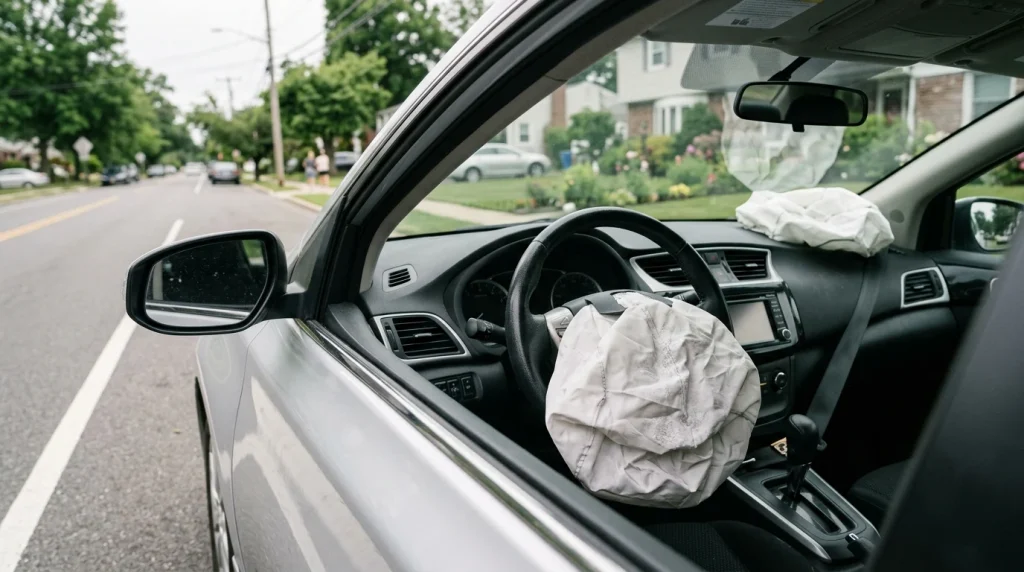
Quick answer: No, airbag deployment does not automatically total your car. Your insurance company declares a vehicle a total loss only when the total cost of repairs, including replacing the deployed airbags, exceeds your state’s total loss threshold, which typically ranges from 70% to 80% of the vehicle’s pre-accident actual cash value. For newer, expensive cars, a $3,000 airbag repair is easily fixable, whereas the same cost will total an older vehicle.
Key takeaways:
- Airbag deployment is not an automatic total loss; it depends entirely on the math comparing repair costs to the vehicle’s actual cash value.
- Replacing a single airbag typically costs $1,000 to $2,000 in 2026, while a multi-airbag deployment can quickly run from $3,000 to $6,000 or more.
- State laws dictate the threshold: some states use a flat percentage (like 70% in Indiana or 80% in Florida), while others use the Total Loss Formula (TLF).
- Deployed airbags can never be reused or repacked; the entire system, including modules, sensors, and seatbelt pretensioners, must be replaced.
How Insurance Companies Calculate if a Car Is Totaled
When an accident occurs, insurance companies evaluate the vehicle’s condition using a standard equation. Insurers compare the total cost of restoring the vehicle to its pre-crash state against the actual cash value (ACV) of the vehicle. If the repair bill represents a significant portion of the vehicle’s value, the insurer declares it a total loss.
To determine a total loss, the insurance adjuster calculates the total repair estimate, including body panels, paint, structural straightening, mechanical parts, and the complete airbag safety assembly. If the cost of these repairs relative to the pre-crash market value of the car exceeds the specific threshold mandated by state law or policy guidelines, the vehicle is declared totaled.
The math behind this decision varies depending on the age and overall market value of the vehicle. The table below illustrates how the exact same repair bill leads to different insurance decisions based on the pre-accident value of the car:
| Vehicle Scenario | Pre-Accident Cash Value | Estimated Repair Cost | State Threshold | Result |
|---|---|---|---|---|
| New Luxury SUV (Minor Damage) | $55,000 | $12,000 | 75% | Repairable (Costs at 21.8% of ACV) |
| Used Commuter Sedan (Moderate Damage) | $8,500 | $6,800 | 75% | Totaled (Costs at 80.0% of ACV) |
| New Sedan (Severe Impact) | $32,000 | $26,000 | 75% | Totaled (Costs at 81.2% of ACV) |
This comparison highlights why airbag deployment alone does not determine if your car is totaled. The replacement of a single steering wheel airbag and dashboard module might cost $3,000. On a modern $50,000 car, this is a minor fraction of the value, meaning the vehicle will easily be repaired. However, on a ten-year-old vehicle worth only $4,000, that same $3,000 airbag bill immediately pushes the vehicle past the total loss limit.
Total Loss Thresholds and Rules by State in 2026
State regulations play a primary role in how insurance claims are processed. Across the United States, states are split between using a flat Total Loss Threshold (TLT) percentage and the Total Loss Formula (TLF). According to data verified by Matthiesen, Wickert & Lehrer, S.C., thresholds range from 60% of vehicle value up to 100%, while many states choose not to enforce a flat percentage.
Flat percentage states establish a clear mathematical line. In these states, if the repairs reach the designated percentage of the actual cash value, the vehicle must be written off. For example, if you live in Indiana, the threshold is 70%, meaning a $10,000 car is totaled at $7,000 in repairs. In Florida, the threshold is 80%, giving you slightly more room to perform repairs.
Conversely, states that do not use a flat percentage utilize the Total Loss Formula (TLF). Under the TLF, a vehicle is declared a total loss only when the cost of repair plus the salvage value of the damaged car exceeds the pre-accident actual cash value. Many populated states, including California, New York, Ohio, and Pennsylvania, use this formula to allow adjusters more flexibility.
According to the 2026 mapping by World Population Review, the state-by-state regulations are categorized as follows:
- 100% Threshold: Texas and Colorado. In these states, repairs can theoretically equal the full value of the vehicle before a total loss is mandatory.
- 80% Threshold: Florida, Minnesota, Missouri, and Oregon.
- 75% Threshold: Alabama, Kansas, Kentucky, Louisiana, Maryland, Michigan, Nebraska, New Hampshire, New York, North Carolina, North Dakota, Rhode Island, South Carolina, Tennessee, Virginia, West Virginia, and Wyoming.
- 70% Threshold: Arkansas, Indiana, Iowa, and Wisconsin.
- 65% Threshold: Nevada.
- 60% Threshold: Oklahoma.
- Total Loss Formula (TLF) States: California, Arizona, Delaware, Georgia, Idaho, Illinois, Maine, Massachusetts, Mississippi, Montana, New Jersey, New Mexico, Ohio, Pennsylvania, South Dakota, Utah, Vermont, and Washington.
Understanding these state-specific boundaries is essential when managing a claim, as they dictate the direct financial outcome of your vehicle’s assessment.
The Real Cost of Airbag Replacement in 2026
Airbags are not simple fabric cushions. They are complex safety devices that rely on chemical propellants, digital control units, and precise physical wiring. Because of this complexity, replacing a deployed airbag system is one of the most expensive automotive repairs. According to 2026 market data from AutoZone, a single airbag replacement ranges from $1,000 to $2,000, while a full system overhaul after a multi-airbag deployment can easily cost between $3,000 and $6,000.
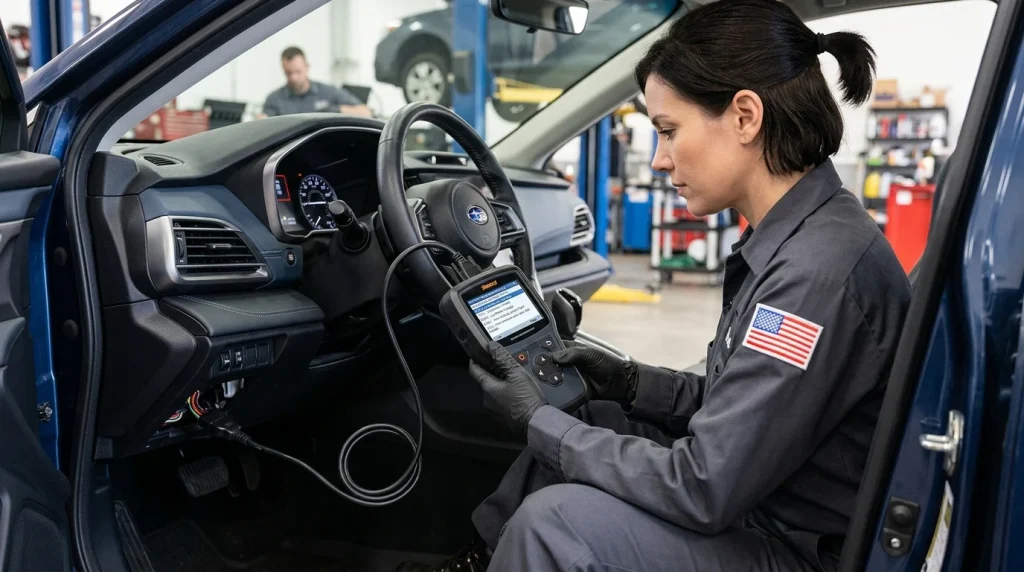
The total bill is composed of multiple independent parts that must all be replaced after a deployment. You cannot simply stuff a new bag into the existing cover. The following table provides an estimated breakdown of the components required to restore a deployed system:
| Safety System Component | Average Parts Cost | Average Labor Cost | Total Estimated Cost |
|---|---|---|---|
| Steering Wheel Airbag (Driver) | $600 – $900 | $200 – $350 | $800 – $1,250 |
| Dashboard Airbag (Passenger) | $750 – $1,100 | $300 – $500 | $1,050 – $1,600 |
| Side Curtain Airbag (Each) | $500 – $800 | $250 – $400 | $750 – $1,200 |
| Airbag Control Module (SRS) | $550 – $750 | $150 – $250 | $700 – $1,000 |
| Impact Crash Sensor (Each) | $150 – $300 | $80 – $150 | $230 – $450 |
| Clock Spring (Steering Column) | $200 – $350 | $100 – $180 | $300 – $530 |
In a severe collision, it is common for the driver airbag, passenger airbag, and side curtain airbags to deploy simultaneously. When this happens, the replacement parts alone can exceed $4,000, and the diagnostic programming to reset the Supplemental Restraint System (SRS) adds several hundred dollars in specialized labor. For luxury imports like BMW or Mercedes-Benz, parts prices are even higher, occasionally doubling the costs shown above.
Crucial Factors in the Total Loss Equation
Airbag deployment does not happen in a vacuum. The forces required to trigger the deployment sensors are significant. Therefore, when airbags deploy, they are almost always accompanied by other types of damage that complicate the final repair estimate.
Vehicle Age and Depreciating Market Value
This is the most critical element. As vehicles age, their actual cash value decreases. A new car worth $40,000 can absorb a $6,000 airbag replacement along with $10,000 in body repairs and still remain well below the 70% threshold. An older car worth $7,000 will be declared totaled by a single steering wheel airbag deployment because the $2,000 replacement bill represents a large portion of the car’s remaining value.
Structural and Frame Damage
Airbag sensors are programmed to deploy only during moderate to severe impacts. This level of force often causes structural frame damage or unibody distortion. Repairing a bent vehicle frame requires specialized frame-straightening machines and extensive labor, which easily adds $5,000 to $10,000 to the repair bill. If the frame is compromised, the vehicle is almost always written off.
Mechanical and Cooling System Impact
Frontal collisions that trigger airbag deployment often push the bumper and radiator inward, damaging the engine block, transmission mounts, steering rack, and suspension components. While you wait for your engine and mechanical parts to be checked, understanding how long a car takes to cool down after operation can help you plan your inspection times. If the mechanical repair costs are combined with the safety system costs, the total quickly exceeds the state threshold.
Can Deployed Airbags Be Reused or Repacked?
Under no circumstances can deployed airbags be reused, repacked, or re-stuffed into their modules. Deployed airbags are single-use emergency devices. During a crash, the diagnostic system sends an electrical signal that ignites a chemical propellant, producing nitrogen gas to inflate the bag in milliseconds. This chemical reaction permanently alters the internal components of the inflator module.
To ensure safety, the entire assembly must be replaced with brand-new parts. Some untrustworthy salvage yards or mechanics might offer cheap options like repacking the old bag or installing salvaged airbags from crashed vehicles. This practice is dangerous and, in many jurisdictions, highly illegal. Salvaged airbags may have suffered moisture damage, sensor degradation, or incorrect electrical wiring, which could prevent them from deploying in a future accident.
Note: Always ask for a certified repair receipt showing that new, original equipment manufacturer (OEM) airbag modules were installed. If you are buying a used vehicle with a rebuilt title, have an independent mechanic check the dashboard and steering wheel cover to ensure the airbag units are present and active, rather than replaced with plastic covers or bypass resistors.
Analysis gốc: Buying Back a Totaled Car vs. Accepting the Payout
When an insurance company declares your car a total loss, you have two choices. You can accept the full cash payout, or you can buy the vehicle back from the insurance company to repair it yourself. Accepting the payout is the simplest path. The insurer takes ownership of the car, deducts your deductible, and sends you a check for the actual cash value.
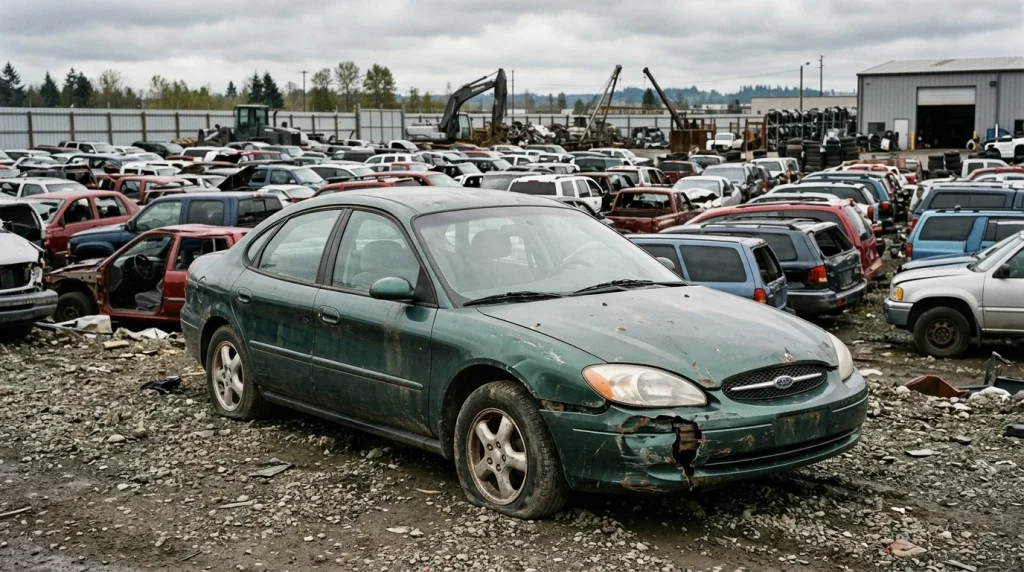
If you choose to buy the vehicle back, the insurer will calculate the salvage value of the car (what they would have received from a scrap yard) and deduct that amount from your total payout check. You keep the damaged car along with the remaining cash, but the vehicle is immediately issued a salvage title. Before making this choice, it is vital to know what happens when your car is totaled but still drivable to ensure the vehicle remains safe to operate.
Expert view: Buying back a totaled car with deployed airbags is rarely a smart financial decision. A salvage title automatically reduces the vehicle’s resale value by 30% to 50%, regardless of how well it is repaired. Furthermore, registering a salvaged vehicle requires passing strict state safety inspections, and the high cost of certified airbag parts makes it difficult to turn a profit on the rebuild.
If you decide to accept the payout and look for a replacement vehicle, understanding the typical timeline to buy a new car can help you coordinate your transportation needs during the transition. Most drivers find that using the insurance check to purchase a clean-title vehicle is far safer and more cost-effective than trying to rebuild a salvage vehicle with a history of airbag deployment.
Will Your Insurance Cover Airbag Replacement?
Insurance coverage for airbag replacement depends on the details of your policy and who was at fault in the collision. If the vehicle is repairable and the repairs are covered under your policy, the insurer will pay for the new airbag assembly as part of the overall claim.
| Accident Scenario | Coverage Type Applied | Out-of-Pocket Expense | Who Pays for Repairs |
|---|---|---|---|
| Another driver hit you (At Fault) | Other driver’s property liability | None ($0) | Other driver’s insurance |
| You caused the crash (At Fault) | Collision coverage | Policy deductible | Your insurance company |
| You caused the crash (No Collision) | None | Full repair bill | You pay out of pocket |
| Hit-and-run collision | Uninsured motorist property damage | Varies by state | Your insurance company |
If you carry only basic liability coverage, your insurance company will not pay for any repairs to your own vehicle. To protect yourself against high airbag replacement bills, maintaining comprehensive and collision coverage is highly recommended. If you are leasing or financing your vehicle, you should check whether do you need full coverage on a financed car to comply with your lender’s requirements before an accident occurs. Additionally, understanding how long it takes to settle a car accident claim can help you manage your transportation options while your vehicle undergoes repairs or evaluation.
Frequently Asked Questions
Does airbag deployment automatically mean my car is totaled?
No, airbag deployment does not automatically total your car. The insurance company compares the total cost of all repairs, including the airbags, against the vehicle’s pre-accident cash value. The car is only declared a total loss if the repair bill exceeds your state’s threshold, which is typically 70% to 80% of the vehicle’s value.
How much does it cost to replace airbags after an accident?
Replacing a single airbag in 2026 typically costs between $1,000 and $2,000, including parts and labor. If multiple airbags deploy during a collision, the total system replacement bill can easily range from $3,000 to $6,000 or more depending on the make and model.
At what speed do airbags deploy?
Airbags generally deploy in frontal impacts equivalent to hitting a solid barrier at 16 to 28 miles per hour. The deployment is triggered by crash sensors measuring rapid deceleration forces, meaning an angled or glancing impact at a higher speed might not trigger deployment if the deceleration threshold is not met.
Can I buy back my totaled car and repair it myself?
Yes, you can buy back your totaled car from the insurance company for its salvage value, which is deducted from your payout. However, the vehicle will receive a salvage title, and you must repair the car, pass a state safety inspection, and obtain a rebuilt title before it can be legally driven again.
Why are airbags so expensive to replace?
Airbags are expensive because they are complex safety systems rather than simple parts. A complete replacement requires not only the airbag module itself, but also new crash sensors, an airbag control module, a steering column clock spring, seatbelt pretensioners, and specialized labor for safety programming.

