

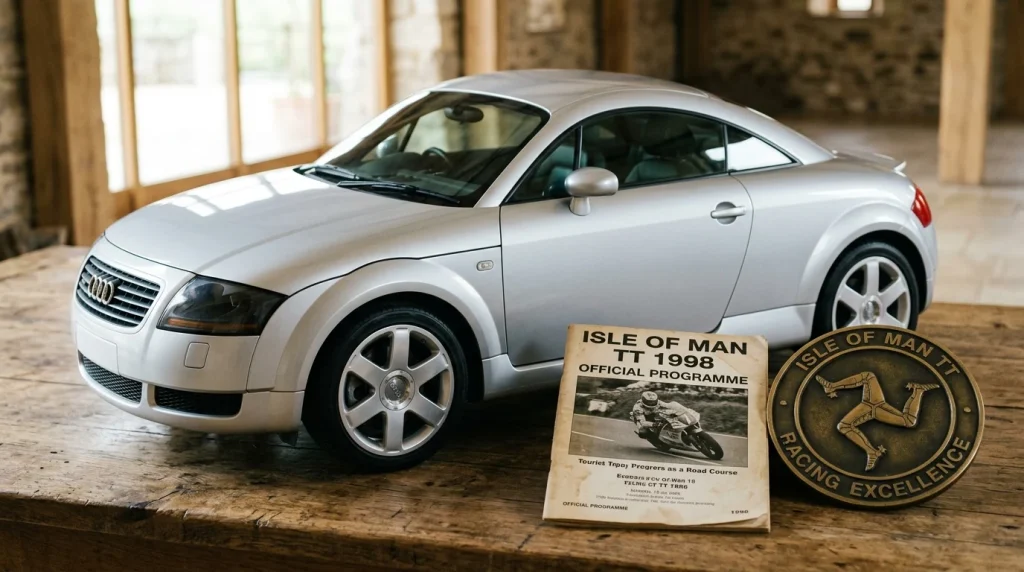
Audi TT stands for Tourist Trophy. The name pays tribute to the historic Isle of Man Tourist Trophy motorcycle race and the legacy of NSU, a German motor vehicle manufacturer that achieved famous victories there before merging into the modern Audi company. Despite popular belief, TT does not stand for Twin Turbo.
Key takeaways:
- TT stands for Tourist Trophy, honoring NSU racing victories at the Isle of Man TT.
- TT does not mean Twin Turbo; standard models featured single-turbo four-cylinder or naturally aspirated engines.
- The badge hierarchy ranges from the base TT to performance TTS (Sport) and flagship TTRS (RennSport).
- Production ended in November 2023 after 25 years and 662,762 vehicles produced worldwide.
What does Audi TT actually stand for?
When automotive enthusiasts ask what Audi TT means or what TT in Audi stands for, the definitive answer comes from motorsport history. The designation TT stands for Tourist Trophy. This name references the Isle of Man Tourist Trophy, one of the oldest and most prestigious motorcycle races in the world.
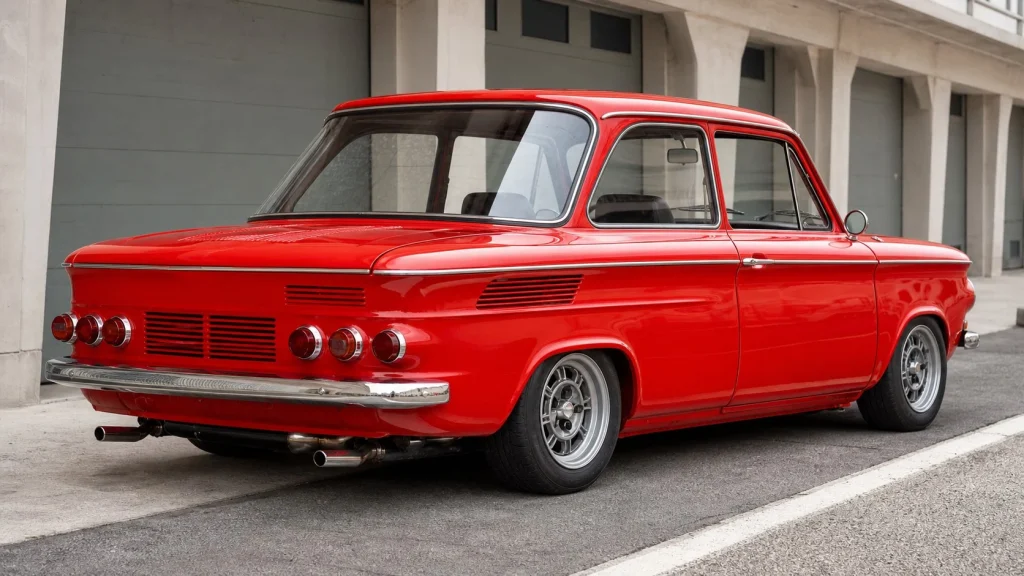
Understanding why TT stands for Tourist Trophy on an Audi requires tracing the ancestry of the four rings logo. Before Audi became the brand recognized today, it was part of Auto Union, which eventually merged with NSU Motorenwerke in 1969. NSU had earned legendary status at the Isle of Man TT races during the 1950s. To celebrate these racing achievements, NSU named several of its lightweight vehicles after the race, including the NSU Quickly TT moped and the high-revving NSU Prinz TT car.
When Audi engineers Freeman Thomas and J Mays designed the revolutionary sports car concept presented at the 1995 Frankfurt Motor Show, Audi chose to honor this inherited motorsport heritage. According to Audi’s official 25th-anniversary press release, the TT nameplate was selected specifically to connect the new compact sports coupe with NSU’s legendary racing history. Drivers exploring the broader Audi vehicle catalog often recognize the TT as one of the brand’s most distinctive design icons.
Why is it called “Tourist Trophy”?
The Isle of Man Tourist Trophy race began in 1907 as a test of endurance and mechanical reliability on public mountain roads. In 1954, NSU achieved historic success on the island when its motorbikes swept the top positions in the 125cc and 250cc classes.
Following these victories, NSU integrated the “TT” suffix into its road-going vehicles to signify sporting intent and engineering efficiency. When Audi resurrected the badge in the 1990s, the goal was to capture that same spirit of lightweight agility and distinctive styling rather than sheer brute power.
Is TT short for “Twin Turbo”?
One of the most persistent misconceptions in car culture is that TT stands for Twin Turbo. Because “TT” is commonly used as an abbreviation for twin-turbocharged engines across performance automotive forums, many drivers assume the badge on the tailgate indicates a twin-turbo layout under the hood.
However, the Audi TT was never named for its induction system. The vast majority of production Audi TT models used single-turbocharged inline four-cylinder engines, such as the 1.8-liter 20-valve turbo in the first-generation 8N model or the 2.0-liter TFSI engine in later generations. Furthermore, certain versions featured a naturally aspirated 3.2-liter VR6 engine, proving that turbochargers were not even universal across the TT lineup. Misinterpreting model badges based on common mechanical abbreviations is frequent among car enthusiasts. While “TT” means twin turbo on cars like the Nissan 300ZX TT, Audi applied the letters as a proper noun referring to a race, not an engine specification.
Maintaining proper grip and high-speed stability on sports coupes requires selecting best high-performance tires for Audi models to handle the chassis tuning designed for the TT platform.
What about the “Technology and Tradition” theory?
Alongside the Twin Turbo myth, another secondary explanation occasionally appears in enthusiast discussions suggesting TT stands for “Technology and Tradition” or “Technik und Tradition” in German.
While “Technik” aligns with Audi’s famous brand slogan “Vorsprung durch Technik” (Progress through Technology), company historians confirm that “Technology and Tradition” is an unofficial backronym created by fans. While it accurately describes the philosophy behind blending modern design with historical roots, it was never the official expansion of the badge.
What do TTS and TTRS mean?
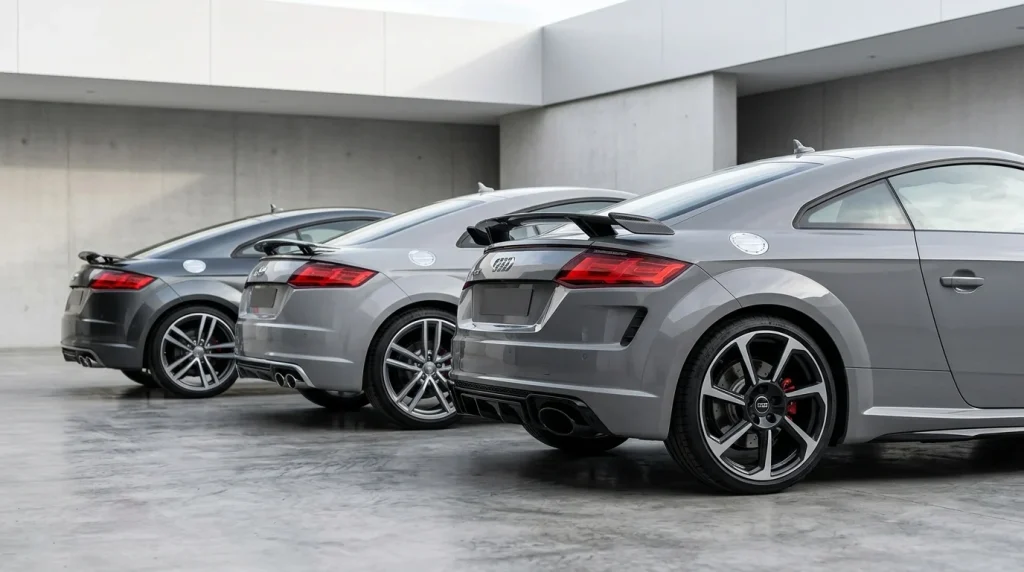
As Audi expanded the TT range across three generations, higher-performance variants were introduced featuring enhanced powertrains and upgraded chassis components. Understanding the badge progression clarifies how Audi classifies performance:
| Model Badge | Meaning of S / RS | Engine Configuration | Drivetrain System |
|---|---|---|---|
| Audi TT | Standard Tourist Trophy | 1.8T / 2.0 TFSI / 3.2 VR6 | Front-Wheel Drive or quattro |
| Audi TTS | Tourist Trophy Sport | High-output 2.0 TFSI (up to 306 hp) | Standard quattro AWD |
| Audi TTRS | Tourist Trophy RennSport (Racing Sport) | 2.5-liter 5-cylinder TFSI (400 hp) | Standard quattro AWD |
The letter “S” in TTS simply stands for Sport, representing a step up in power, firmer suspension tuning, and larger brakes. The “RS” in TTRS stands for RennSport, which translates from German as “Racing Sport.”
Note: Performance-oriented variants like the TTS and TTRS come standard with the Audi quattro all-wheel drive system, delivering traction across all road conditions.
Drivers curious about where the TTRS ranks among the highest horsepower Audi models will find that its award-winning 2.5-liter turbocharged five-cylinder engine produces 400 horsepower, allowing the compact sports car to accelerate from 0 to 60 mph in just 3.6 seconds.
Is the Audi TT still in production?
The production run of the Audi TT came to an end in late 2023. According to automotive industry coverage from Carscoops detailing the final Audi TT assembly, the last TT model rolled off the assembly line at Audi’s Győr plant in Hungary on November 10, 2023.
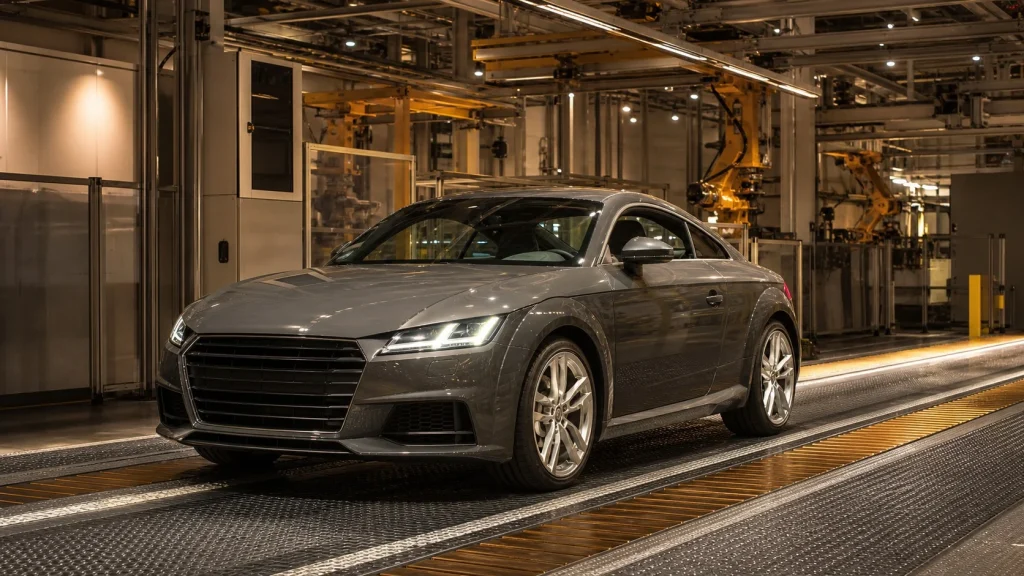
Over its 25-year lifespan spanning three generations (8N from 1998 to 2006, 8J from 2006 to 2014, and 8S from 2014 to 2023), Audi produced a total of 662,762 TT units. The final car produced was a Chronos Grey metallic Audi TTS Coupe decorated with flower wreaths by factory workers to celebrate the iconic model’s quarter-century history.
Modern TT owners looking to preserve their vehicles should stay familiar with practical ownership tasks such as replacing a dead Audi key fob battery or learning how to operate convenience features like the Audi Advanced Key feature for keyless entry and ignition.
Audi has indicated that future sports car concepts may inherit the spirit of the TT, with potential electric successors drawing design inspiration from the classic coupe’s clean geometry.
Does Audi TT have quattro all-wheel drive?
Yes, Audi offered the quattro all-wheel drive system across all three generations of the TT. While base models in certain markets came standard with front-wheel drive, higher trim levels, the TTS, and all TTRS models feature quattro as standard equipment.
Did the Audi TT ever come with a twin-turbo engine?
No, factory Audi TT models were never equipped with a twin-turbocharged engine. Production models featured single-turbocharged engines or naturally aspirated VR6 engines. The TT badge refers to the Tourist Trophy race, not twin-turbo induction.
What replaced the Audi TT?
Audi has not launched a direct one-to-one replacement for the internal-combustion TT. However, Audi executive leadership has signaled plans for a future compact electric sports car that will embody the design ethos and compact proportions of the original TT icon.

