

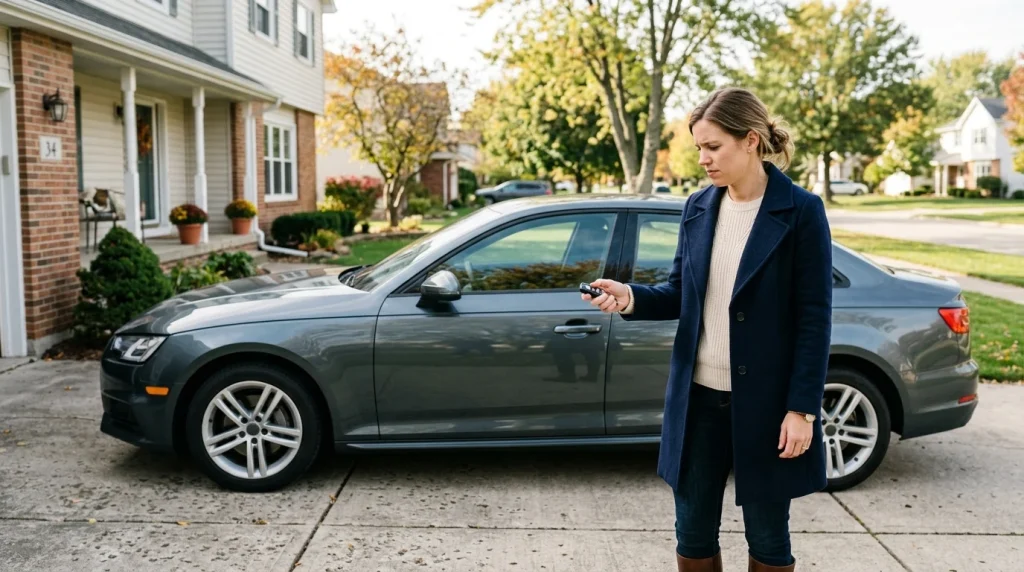
Understanding what to do when your Audi key battery dies gets you back on the road in minutes: release the integrated metal emergency key blade from the fob, remove the protective lock cylinder cap on the driver door handle if present, and turn the key clockwise to unlock the vehicle. Once inside, place the dead key fob directly against the marked wireless transponder symbol, typically located inside the front cup holder, center console tray, or on the steering column, then step firmly on the brake pedal and push the Start/Stop engine button. The car will authenticate the passive immobilizer chip and start the engine immediately. Replacing the CR2032 coin-cell battery takes under five minutes and does not require dealership reprogramming.
Key takeaways:
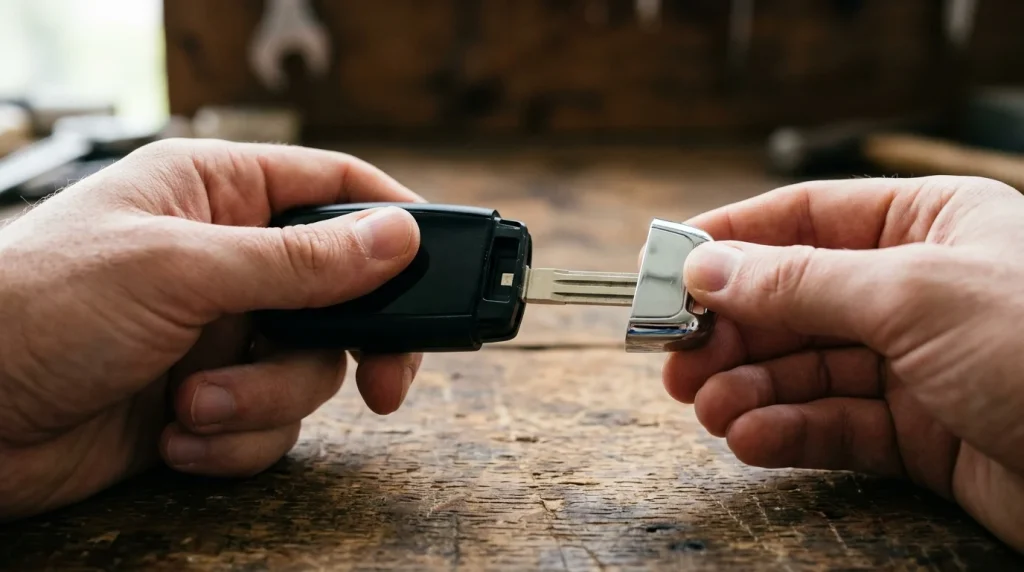
- Eject the mechanical key blade using the release catch on your specific Audi fob generation.
- Pry off the underside cap on the driver door handle to expose the hidden lock cylinder on 2017 and newer models.
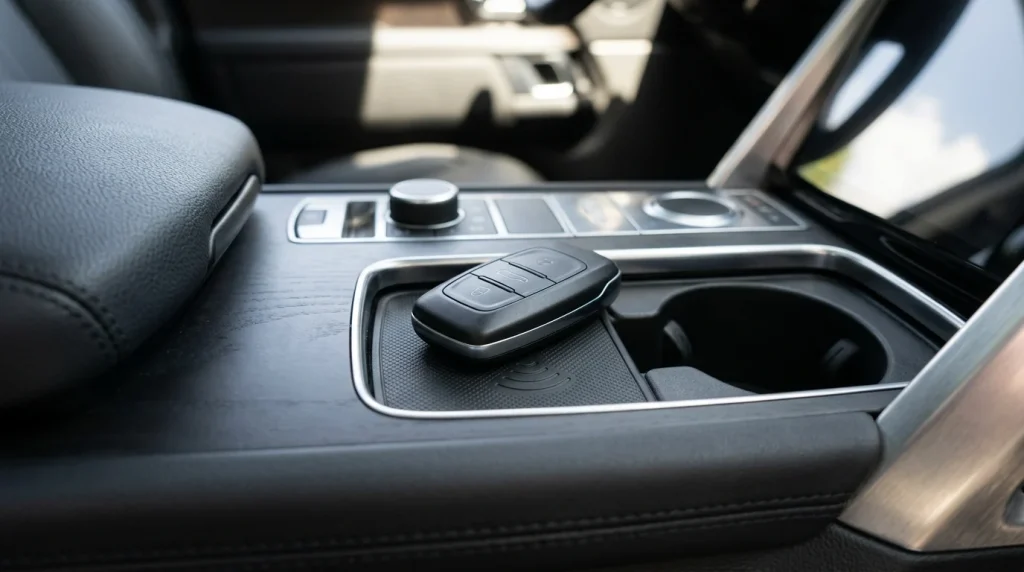
- Place the dead key fob flat against the transponder coil symbol to start the engine through passive magnetic induction.
- Starting the engine silences the security alarm triggered by manual mechanical door unlocking.
- Install a fresh 3V CR2032 lithium battery with the positive terminal (+) facing upward in smart key trays.
- Never substitute a thinner CR2025 battery because the 0.7 millimeter gap causes loose terminal contacts and electrical dropouts.
Symptoms and Immediate Consequences
An Audi key fob operates through two independent electronic systems: an active radio frequency transmitter and a passive radio frequency identification transponder. The active transmitter uses a 3-volt coin-cell battery to emit signals at 315 MHz for North American vehicles or 433 MHz for European vehicles. This active circuit powers convenience functions, including remote locking, remote unlocking, motorized tailgate release, and proximity sensor recognition. When the internal battery depletes, the active transmitter loses power, and the vehicle stops recognizing your approach.
| Key Subsystem | Power Source | Primary Functions | Status When Battery Dies |
|---|---|---|---|
| Active Radio Transmitter (315 MHz / 433 MHz) | Internal 3V CR2032 coin-cell battery | Remote lock/unlock, trunk release, proximity entry | Disabled (requires manual mechanical backup) |
| Passive RFID Transponder Chip | Vehicle inductive loop (0 battery power required) | Anti-theft immobilizer authentication, engine ignition | 100% functional at backup transponder coil |
Before the battery dies completely, your Audi typically displays early warning signs. On modern models equipped with the Audi Virtual Cockpit or digital instrument cluster, a dedicated warning message stating “Key battery low: Please replace” appears several weeks before total depletion. You might also notice a gradual reduction in the remote range, requiring you to stand right beside the driver door before the sensors trigger. In some cases, drivers notice a blinking red key light with unresponsive locks, which occurs when the battery delivers sufficient voltage to illuminate the tiny diagnostic diode but lacks the current necessary to broadcast a full radio transmission.
When total depletion occurs, you experience an immediate lockout from convenience features. Touching the capacitive sensors on the exterior door handles will not unlock the car, and pushing the Start/Stop engine button produces an alert on the dashboard reading “Key not recognized” or “Remote control key not detected.” However, this does not mean you are stranded. The passive RFID transponder inside the fob casing requires zero battery power. It receives power through magnetic induction generated by an antenna coil hidden inside the cabin, allowing you to authenticate the vehicle immobilizer and drive normally once you gain access.
Vehicles equipped with the Audi Advanced Key proximity system use multi-zone exterior antenna sensors that continuously poll for the key fob within a 1.5-meter perimeter.
Quick Checks You Can Perform
Before assuming the key battery is completely drained, perform a few rapid diagnostic checks to rule out external interference or alternative vehicle issues:
- Inspect the Key Diode: Press any button on the fob and observe the small light-emitting diode at the top corner. If the red light does not illuminate or flashes weakly, the coin cell is discharged.
- Test with a Secondary Fob: If you have access to your spare key, test whether the vehicle responds. If both keys fail simultaneously, the root cause may lie with the vehicle 12-volt battery rather than the key fobs.
- Check for Radio Frequency Interference: Strong electromagnetic fields near high-voltage power lines, commercial radio transmission towers, or wireless smartphone charging pads can temporarily jam the 315 MHz or 433 MHz communication band.
- Examine for Physical or Liquid Damage: Inspect the fob casing for cracks, bent seams, or moisture intrusion that might create a short circuit on the transmitter board.
Battery Type and Replacement Basics
According to technical specifications published on the Audi Owner’s Manual Portal, modern Audi key fobs produced between 2008 and 2026 use a 3-volt lithium CR2032 button cell. This coin cell measures 20 millimeters in diameter and 3.2 millimeters in thickness, delivering an average capacity of 220 to 240 milliampere-hours (mAh). Certain older switchblade fobs found on early A3 or TT models occasionally used a CR2025 or CR1620 battery. Checking the stamp on your existing battery or consulting vehicle documentation confirms proper fitment.
| Battery Code | Diameter | Thickness | Nominal Voltage | Average Capacity | Typical Audi Key Applications |
|---|---|---|---|---|---|
| CR2032 | 20.0 mm | 3.2 mm | 3.0 V | 220-240 mAh | B8, B9, C8, MQB, and MLB Evo Smart Keys (2008-2026) |
| CR2025 | 20.0 mm | 2.5 mm | 3.0 V | 150-165 mAh | Select older slim fobs and auxiliary heater remotes |
| CR1620 | 16.0 mm | 2.0 mm | 3.0 V | 70-80 mAh | First-generation switchblade remotes (pre-2008) |
Immediate Actions to Regain Access and Mobility
Gaining access to your Audi and starting the engine requires two physical procedures: mechanical door unlocking and inductive engine starting. Both processes rely purely on mechanical hardware and passive magnetic coupling, meaning you can complete them in adverse weather without any specialized tools.
| Step | Action | Execution Detail |
|---|---|---|
| Step 1: Extract Key Blade | Press release catches | Squeeze side catches and slide mechanical metal blade outward |
| Step 2: Access Lock Cylinder | Expose hidden lock | Pull handle, insert blade tip into bottom slot, pry off protective cap |
| Step 3: Unlock Driver Door | Turn mechanical key | Insert blade into exposed cylinder, rotate clockwise, and pull door handle |
| Step 4: Manage Security Alarm | Enter vehicle quickly | Enter cabin immediately as alarm sounds and move fob toward sensor area |
| Step 5: Inductive Engine Start | Authenticate transponder | Hold fob flat against marked key symbol, depress brake, push Start/Stop |
Step 1: Ejecting the Mechanical Emergency Key Blade
Every Audi smart key contains a hidden mechanical key blade made of milled brass or steel. The extraction method depends on your key fob generation:
-
B9 and C8 Smart Keys (2017-2026 Models): These fobs feature a smooth casing with a chrome top loop. Locate the two small textured release catches on the left and right edges of the chrome cap. Squeeze both catches inward simultaneously using your thumb and index finger, then pull the chrome loop straight out of the plastic housing to reveal the metal blade.
-
B8 Smart Keys (2008-2016 Models): These fobs feature a rectangular profile with a silver top loop. Locate the small rectangular push button on the back face of the plastic casing. Press and hold this button down while pulling the silver loop outward.
-
Switchblade Flip Keys (Older A3, Q3, and TT Models): Locate the circular silver release button on the upper left corner of the fob face. Press the button firmly, and the spring-loaded mechanical blade will swing open automatically.
Step 2: Accessing the Concealed Driver Door Lock Cylinder
On older Audi vehicles, the door lock cylinder is visible directly beside the driver door handle. On modern vehicles built on the MQB and MLB Evo platforms (2017 to 2026), Audi engineers concealed the lock cylinder beneath a color-matched plastic escutcheon cap to maintain clean exterior lines.
To remove the protective cap safely without scratching your vehicle paint:
-
Pull the driver door handle outward into its fully open position and hold it firmly with one hand.
-
Look directly underneath the rear portion of the handle cap to locate a small rectangular access slot measuring approximately 5 millimeters wide.
-
Insert the tip of your mechanical key blade straight into this slot until you feel it seat against the internal release tab (approximately 10 to 12 millimeters deep).
-
Gently pry the key blade upward toward the sky. This lever action releases the internal plastic locking clip.
-
While maintaining upward pressure, slide the plastic cap outward and away from the door handle with your free hand.
-
Set the plastic cap inside your pocket or vehicle cabin. Release the door handle back to its resting position.
-
Insert the mechanical key blade into the exposed cylinder and rotate it clockwise to mechanically unlock the driver door latch.
When prying off the door handle escutcheon cap, apply steady upward pressure rather than twisting the key blade sideways. Twisting the blade can bend the internal retaining tabs, making it difficult for the cap to snap securely back into place after servicing.
Step 3: Starting the Engine at the Inductive Sensor Location
Once you open the door and sit in the driver seat, the vehicle central computing cluster will not detect active radio signals from the dead fob. Attempting to start the car normally will illuminate a dashboard message reading “Place key on designated area.”
Audi integrates an inductive transponder reader coil into specific cabin locations across its model range. To start the engine:
-
Locate the emergency sensor zone for your specific vehicle platform from the reference table below. The zone is marked with a symbol depicting a vehicle key overlaid with radiating wireless wave lines.
-
Place the dead key fob flat against the sensor symbol so that the internal transponder aligns with the vehicle magnetic coil.
-
Depress the brake pedal firmly with your foot (or the clutch pedal on manual transmission models).
-
Press the Start/Stop Engine button on the center console.
-
The immobilizer control module energizes the coil, authenticates the key security algorithm, starts the starter motor, and brings the engine to an idle.
| Vehicle Model & Generation | Platform | Primary Inductive Sensor Location | Starting Action |
|---|---|---|---|
| A4, S4, RS4, A5, S5, RS5 (2017-2026) | MLB Evo | Front center console cupholder (between cup positions) | Lay key flat on marked symbol, press brake, push Start button |
| Q5, SQ5 (2018-2026) | MLB Evo | Base of front center cupholder or forward console bin | Place key over wireless emblem, press brake, push Start button |
| A6, S6, A7, S7, A8, S8 (2019-2026) | MLB Evo | Center storage bin beneath front armrest | Lay key on bottom mat symbol, press brake, push Start button |
| Q7, SQ7, Q8, SQ8, RS Q8 (2017-2026) | MLB Evo | Center console tray adjacent to electronic gear selector | Place key on marked outline, press brake, push Start button |
| A3, S3, RS3, Q3 (2015-2026) | MQB / MQB Evo | Right side of steering column shroud or front cupholder | Hold key against steering column icon, press brake, push Start |
| TT, TTS, TT RS, R8 (2016-2026) | MQB / MSS | Steering column lower shroud (marked key outline) | Hold key flat against column mark, press brake, push Start |
| A4, S4, A5, S5, Q5 (2008-2016) | B8 | In-dash electronic key docking slot | Insert complete key fob into dash slot and push inward firmly |
| A6, S6, A7, S7 (2012-2018) | C7 | Marked transponder symbol on dashboard | Hold key against marked dash symbol, press brake, push Start button |
The Emergency Key Blade and Alarm Implications
Unlocking the driver door with the physical mechanical key blade bypasses the central electronic locking system. Because the anti-theft system does not receive a wireless disarm confirmation from the active remote transmitter, opening the door mechanically triggers the vehicle security alarm. The vehicle exterior hazard lights will flash, and the alarm siren will sound.
Entering the vehicle by unlocking the door with an emergency key trips the door perimeter sensors before immobilizer authentication occurs. Audi designs its immobilizer software with a built-in 15-second grace window. Once you open the door mechanically, enter the vehicle immediately, place the dead key fob against the inductive transponder coil, and press the Start/Stop button. The moment the immobilizer verifies the key transponder chip, the vehicle automatically disarms the anti-theft siren, cancels the flashing lights, and clears the security fault.
Vehicles configured with smartphone remote start access communicate over cellular networks rather than key fob radio frequencies, though driving still requires a verified physical key.
Safety and Legal Considerations
Operating a vehicle during an electronic key failure introduces specific safety factors that every driver should understand:
- In-Cabin Key Retention: Keep the key fob located on or near the center console while driving. If the key slides under the seat or falls into a footwell, the vehicle will continue to run because Audi immobilizer logic does not shut off an active engine if key communication drops while in motion. However, you will not be able to restart the engine after parking.
- Avoid Stalling in Traffic: If you drive a manual transmission Audi or operate in severe stop-and-go conditions, ensure the key rests securely on the inductive sensor pad so that auto-start-stop functionality restarts the engine without delay.
- Child and Pet Safety: Never leave a mechanical key blade inserted in an exterior lock cylinder where passersby can tamper with it. Always reassemble the fob once inside the cabin.
- Instrument Cluster Alerts: Intermittent battery contact can trigger dashboard error messages similar to Audi drive system malfunction warnings, though transponder recognition issues resolve immediately once battery voltage stabilizes.
- Water Exposure Precautions: A key that failed due to moisture requires specialized drying procedures for laundered or water-damaged Audi remotes before inserting a fresh battery to prevent short-circuiting the circuit board.
Note: Official vehicle immobilizer programming ensures the engine will never shut off automatically while driving if the key fob battery depletes completely after ignition. The engine remains running until the driver manually pushes the Start/Stop button or turns off the ignition.
Replacement Options and Cost Ranges
Replacing an Audi key fob battery is a straightforward maintenance task that vehicle owners can complete at home for minimal expense, though authorized dealership services remain available for drivers who prefer professional handling.
| Service Option | Component / Scope | Estimated Cost | Service Duration & Programming |
|---|---|---|---|
| DIY Home Replacement | Name-brand CR2032 coin cell (Panasonic, Duracell, Energizer) | $3 to $8 per two-pack | 2 to 5 minutes (no reprogramming required, automatic sync) |
| Dealership Battery Service | OEM battery replacement and diagnostic range check | $15 to $50 (often complimentary during major service) | 10 to 20 minutes (full diagnostic scan) |
| Complete Fob Replacement | OEM key hardware, laser blade cutting, and ODIS pairing | $410 to $730 per key | Hardware ($250-$450) + Blade ($40-$80) + Dealership programming ($120-$200) |
Step-by-Step DIY Battery Replacement Procedure
To replace the battery in a standard B9 or C8 generation smart key (2017-2026):
-
Extract Key Blade: Squeeze the side release catches on the chrome cap and pull the metal emergency key out.
-
Access Battery Tray: Look inside the open slot where the mechanical blade was seated. You will see two small black plastic tabs on the inner tray.
-
Slide Out Tray: Squeeze both inner plastic tabs together firmly and pull the battery tray straight out of the plastic fob body.
-
Remove Old Coin Cell: Lift the depleted CR2032 battery out of the circular tray. Note the orientation of the battery markings.
-
Insert Fresh Battery: Place a fresh 3V CR2032 lithium battery into the tray. On standard Audi smart keys (including B8, B9, C8, and MQB models), the positive terminal (marked with a “+” sign and battery text) must face upward, while the negative side rests against the base of the tray. Inserting the battery upside down reverses polarity and prevents the key fob from functioning.
-
Reinsert Tray: Slide the battery tray back into the main key fob body until you hear a distinct click confirming the retaining clips have engaged.
-
Reinsert Metal Blade: Push the chrome emergency key blade back into the fob until it locks flush.
-
Test Remote Functionality: Stand near your vehicle and press the lock or unlock button. The red LED indicator on the fob should flash brightly, and the vehicle hazard lights should confirm synchronization.
Routine battery replacement and minor key diagnostics can be handled at independent repair shops servicing Audi without voiding factory warranty protections. Key replacement costs scale with overall Audi ownership and maintenance expenses, where higher-tier luxury trims carry higher programming fees.
Alternatives and Support Channels
If replacing the coin cell does not immediately restore key function, several alternative access and support options exist:
- Audi 24/7 Roadside Assistance: For vehicles covered under the 4-year/50,000-mile new vehicle limited warranty or certified pre-owned warranty, Audi Roadside Assistance provides complimentary lockout and jump-start services across the United States. You can dispatch assistance directly through the myAudi smartphone app or by calling the dedicated toll-free roadside line.
- The myAudi Smartphone Application: If your vehicle is equipped with Audi connect services and you have an active digital subscription, you can use the myAudi app to lock and unlock your doors remotely over cellular data networks. Note that remote app unlocking does not enable engine starting on models requiring an authenticated physical transponder in the cabin.
- Mobile Automotive Locksmiths: Certified automotive locksmiths equipped with European diagnostic software (such as VCDS or Autel MaxiIM) can perform on-site battery testing, key casing repairs, or emergency transponder programming at a lower rate than towing your vehicle to a distant dealer.
Center console cup holder dimensions and tray depths, such as the Audi Q5 cabin and console dimensions, determine the exact placement of the inductive transponder pad. Long-term electrical reliability varies across vehicle generations, as documented in used Audi A5 reliability evaluations regarding comfort control modules.
Maintenance Tips to Extend Key Battery Life
A few simple storage and maintenance habits will extend the operational lifespan of your Audi key fob coin cell from two years to nearly four years:
-
Avoid Keyless Sleeping Proximity: Never store your key fob within 15 to 20 feet (4.5 to 6 meters) of your parked Audi inside a residential garage or home entryway. When stored within close proximity, the active transceivers in the key and vehicle continuously exchange low-energy polling signals, preventing the fob from entering its low-power sleep mode and draining the coin cell in under 12 months.
-
Use RFID-Blocking Storage: Storing keys inside a dedicated Faraday pouch or metal key box prevents relay theft attacks while shielding the fob from continuous radio polling.
-
Prevent Thermal Stress: Leaving your key fob on a hot vehicle dashboard during summer or exposing it to sub-zero winter temperatures accelerates lithium chemical degradation. Maintain coin cells at moderate room temperatures whenever possible.
-
Synchronize Spare Key Maintenance: When you replace the coin cell in your primary key fob, replace the battery in your spare backup key simultaneously. Coin cells slowly lose charge over time even when resting in a storage drawer.
Keyless module drain issues occasionally affect older luxury platforms, as detailed in second-generation Audi Q7 electrical reliability reports. Similarly, high-voltage vehicle systems in hybrid Audi powertrains operate separately from the 12-volt accessory circuits that power comfort entry antennas.
Quick-Reference Checklist
When you find yourself standing beside a locked Audi with an unresponsive remote, execute this sequential checklist:
-
[ ] Extract Mechanical Key: Squeeze side release catches and pull the metal blade outward from the chrome cap.
-
[ ] Remove Handle Cover: Insert blade tip into the bottom slot of the driver door handle and pry gently upward.
-
[ ] Unlock Door: Insert key blade into the exposed cylinder, turn clockwise, and open the driver door.
-
[ ] Enter Cabin: Sit in driver seat and locate the wireless key emblem on the cupholder or steering column.
-
[ ] Position Key Fob: Place the dead key fob flat against the transponder symbol.
-
[ ] Start Engine: Depress the brake pedal firmly and press the Start/Stop Engine button to start the car and silence the alarm.
-
[ ] Purchase Replacement Battery: Buy a fresh, name-brand 3V CR2032 lithium coin cell.
-
[ ] Install New Cell: Slide out the internal tray, seat the new battery with the positive (+) terminal facing upward, and click the tray securely back into place.
Frequently Asked Questions About Audi Key Battery Replacement
How long does an Audi key fob battery typically last?
An Audi key fob battery lasts between two and four years under normal driving conditions. Vehicles equipped with Audi Advanced Key keyless proximity entry consume battery power faster than standard remote-entry systems because the fob regularly listens for vehicle polling signals. Storing the key within 15 feet of the vehicle can reduce battery life to under one year.
Can you drive an Audi with a completely dead key fob battery?
Yes, you can drive an Audi normally with a completely dead key fob battery. The vehicle immobilizer uses a passive RFID transponder chip located inside the key fob housing that requires zero internal battery power. Once you hold the fob against the inductive transponder reader coil inside the cabin and start the engine, the vehicle operates without restriction.
Does replacing the key fob battery cause the car to lose its programming?
No, replacing the key fob battery does not erase vehicle memory, rolling security codes, or immobilizer pairing. The key security encryption data is stored in non-volatile flash memory inside the key microchip. Installing a fresh CR2032 battery restores full remote functions immediately without requiring dealership diagnostic tools or reprogramming.
Why does the car alarm sound when using the mechanical key?
The anti-theft alarm sounds because unlocking the door with the physical key blade bypasses the active radio receiver. The vehicle security module detects an entry event without receiving a corresponding wireless disarm confirmation. Placing the key fob on the internal inductive transponder symbol and pressing the Start/Stop button authenticates the key and silences the alarm immediately.
Where is the emergency key sensor located on older Audi models?
On older B8 generation models produced between 2008 and 2016 (such as the A4, A5, and Q5), the emergency start mechanism consists of an electronic ignition docking slot located directly on the dashboard to the right of the steering wheel. To start the vehicle, insert the entire key fob assembly directly into the dashboard slot and push it inward firmly while depressing the brake pedal. On C7 generation models (A6 and A7 2012-2018), place the key against the marked transponder symbol on the dashboard while pressing the Start/Stop button.
What should you do if the key fob still fails after installing a new battery?
If a new battery does not restore function, verify that the battery is a CR2032 installed with the positive (+) terminal facing upward. Check that the metal contact prongs inside the plastic tray are clean and not bent flat. If the key remains unresponsive, test the vehicle 12-volt battery or have an authorized technician scan the comfort control module for diagnostic trouble codes.

