

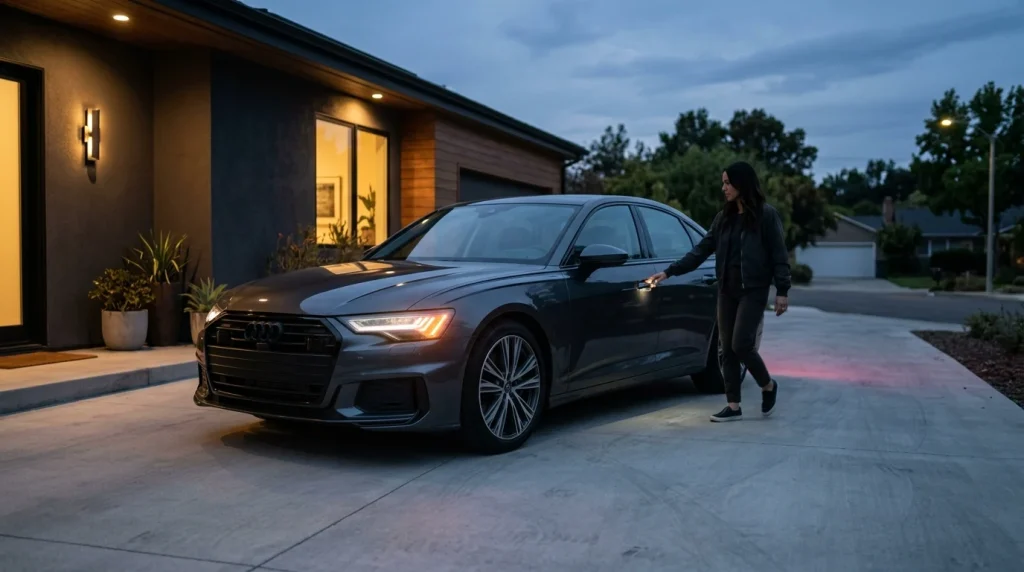
When asking what is the Audi Advanced Key, it is a proximity-based passive entry and ignition system that allows drivers to unlock, lock, and start their vehicle without taking the key fob out of their pocket or bag. Operating within a range of approximately 1.5 meters (5 feet), the system communicates via low-frequency interior and exterior antennas, capacitive door handle sensors, and rolling-code radio signals.
Key takeaways:
- Proximity antennas detect the authorized key fob within a 1.5-meter (5-foot) radius around exterior handles and luggage compartment.
- Locking and unlocking occur through capacitive touch sensors on door handles without pressing physical fob buttons.
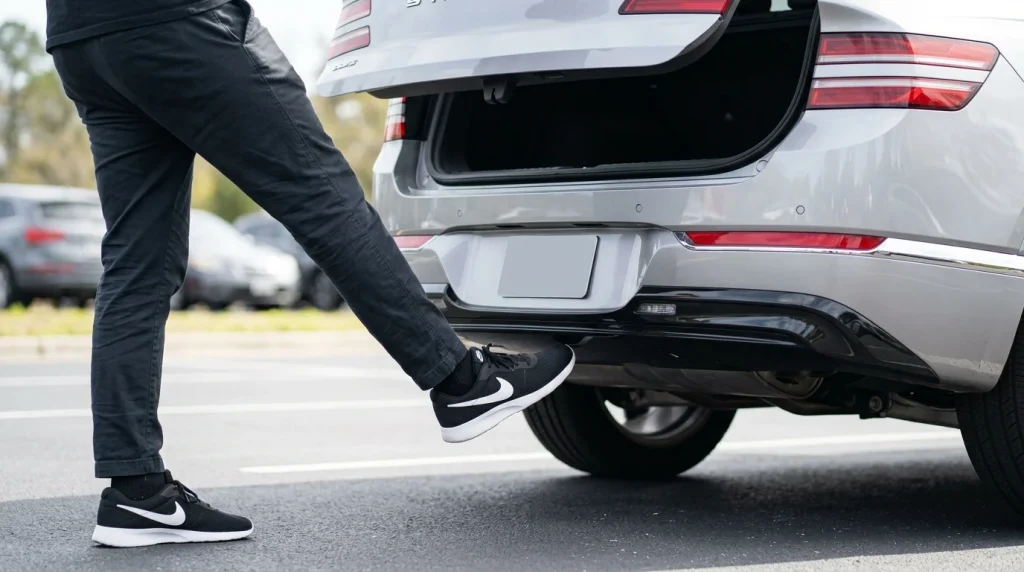
- Hands-free trunk release activates via a single directional foot kick under the center rear bumper.
- Motion-sensing accelerometers inside newer fobs deactivate radio transmission after 1-2 minutes of inactivity to eliminate relay theft risks.
- Vehicles include a passive backup RFID reader on the steering column or center console to start the engine even if the fob battery is dead.
What is the Audi Advanced Key? The Technology Behind It
The Audi Advanced Key is an electronic access and authorization system developed to provide smooth keyless entry, vehicle exit locking, and push-button ignition. Unlike basic remote entry fobs that require physical button presses, the Advanced Key operates passively through continuous short-range radio communication between vehicle antennas and transponders embedded inside the key fob casing.
When approaching the vehicle, exterior proximity antennas detect the key fob once it enters an operational radius of roughly 1.5 meters (5 feet). In North American market specifications, data verification uses a radio frequency of 315 MHz, whereas European market models communicate at 434 MHz. The vehicle control module authenticates cryptographic rolling codes before enabling the exterior handle sensors.
| Component | Communication Signal | Operational Frequency | Operating Range |
|---|---|---|---|
| Audi Vehicle Sensors / MMI | Low-Frequency (LF) Ping | Short-range wake-up challenge | ~1.5 meters (5 feet) |
| Audi Key Fob Transponder | Encrypted RF Response | 315 MHz (North America) / 434 MHz (Europe) | Exterior perimeter |
Accessing the vehicle requires grasping the door handle. A capacitive sensor located on the inner surface of the handle detects hand presence and instantly unlocks the door mechanisms. When exiting, touching the small indentation or grooved sensor on the outer surface of any door handle locks the vehicle. This hardware configuration is often paired with electronic systems such as configuring Audi remote start settings to prepare the cabin climate before entering. If a key transmitter experiences electrical interference, diagnosing key fob red light blinking issues helps determine whether the battery or receiver is at fault.
History and Evolution of Audi Key Technologies
Key systems at Audi have evolved across multiple vehicle generations, transitioning from traditional mechanical cut blades to infrared transponders, basic radio fobs, and current proximity networks. Early modern models, including classic coupes that defined the Audi TT naming heritage, relied on switchblade physical keys with basic central locking transmitters.
During the mid-2000s, Audi introduced the initial generation of Advanced Key across executive sedans and SUVs manufactured in German facilities and global Audi manufacturing assembly plants. Early iterations required dedicated start and stop buttons located on the center console near the gear selector.
| Generation | Era | Primary Features | Access Hardware |
|---|---|---|---|
| Mechanical Switchblade | 1990s – 2005 | Manual ignition, remote central locking | Physical cut key blade |
| First-Gen Advanced Key | 2005 – 2012 | Start/stop console buttons, passive door sensors | Dedicated start/stop buttons |
| Modern Advanced Key | 2013 – Present | Single push-button start, kick trunk gesture, sleep mode | Capacitive handle sensors |
| Audi Digital Key / MMI | 2020 – Present | Smartphone NFC/UWB integration, digital sharing | Smartphone and smartwatch access |
The current generation integrates directly with vehicle convenience architectures. It combines passive engine starting with hands-free luggage access and encrypted wireless authorization. In recent EV and luxury lines, digital key capabilities allow compatible Android and iOS smartphones to replicate key fob functions through near-field communication (NFC) and ultra-wideband (UWB) protocols.
How Audi Advanced Key Works in Practice
Operating the Audi Advanced Key in daily routines involves three primary functional zones: vehicle entry, cabin start, and luggage compartment management. Drivers do not need to retrieve the key from their pocket, coat, or briefcase during any point of travel.
| Operational Zone | Hardware Sensors | Activation Trigger | Primary Function |
|---|---|---|---|
| Zone 1: Front Doors | Capacitive touch handle sensors | Grasp inner handle / touch outer sensor | Passive door unlocking / exterior locking |
| Zone 2: Cabin Ignition | Interior LF antennas & backup RFID loop | Depress brake pedal + start-stop button | Engine ignition authorization |
| Zone 3: Rear Trunk | Bumper capacitive sensor wires | Direct forward-back foot kick | Hands-free tailgate release & anti-lockout |
Vehicle Access and Door Operation
When walking up to the car, touching the inside of the driver or passenger door handle signals the control unit. The vehicle sends an authorization challenge to the key fob, receives the encrypted validation code, and releases the mechanical door latch in a fraction of a second. To lock the doors after parking, lightly tap the touch-sensitive depression located on the exterior face of any handle.
Starting and Operating the Engine
Once inside the cabin, interior antennas verify that the key fob resides within the passenger compartment. Stepping firmly on the brake pedal (or clutch pedal in manual models) and pressing the aluminum start-stop button fires the engine. If the key fob remains outside the car or is positioned too far away on an exterior window ledge, the dashboard instrument cluster displays an alert stating that no key was identified.
Hands-Free Trunk Release and Anti-Lockout Safeguards
The hands-free tailgate mechanism allows trunk opening when carrying luggage or shopping bags. Two capacitive sensor wires embedded inside the lower rear bumper monitor movement. Making a single, smooth kicking motion straight forward and backward under the center license plate area triggers the power tailgate to rise automatically.
Accidental water exposure can impact remote electronics. While durable, evaluating whether laundered Audi key fobs retain signal strength is crucial if the casing is submerged. If entering a vehicle manually using the hidden physical blade, understanding whether Audi emergency key alarm triggers activate helps drivers silence the siren properly before starting.
The vehicle includes an anti-lockout safety program. If you place a bag containing your key fob into the trunk and close the power lid, internal antennas detect that the authorized key is located inside the cargo bay while all doors remain locked. The system immediately rejects the latch command, beeps three times, and pops the trunk open to prevent accidental lockouts.
Security and Privacy Considerations
Because proximity keys communicate via wireless data, automotive security specialists have closely scrutinized potential vulnerabilities such as relay attacks and frequency interception.
In a traditional relay attack, bad actors use paired radio frequency transmitters and signal amplifiers to bridge the physical distance between the parked car and a key fob inside a home. When a thief touches the vehicle door handle, the car emits a low-frequency (LF) challenge signal. The primary relay booster captures this vehicle LF signal and transmits it across radio frequencies to a secondary device near the house, which broadcasts the LF wake-up request to the key resting inside. The key fob responds with its standard encrypted radio frequency (RF) authentication signal, which is relayed back to the car to unlock the doors and authorize ignition. Motion-sensor sleeping key fobs that enter sleep mode when stationary provide an effective countermeasure against relay attacks by disabling wireless transmission when the key is at rest.
According to automotive risk research from Thatcham Research, vehicle security systems increasingly incorporate motion-sensing sleeping fobs to neutralize relay theft vulnerabilities. Audi implemented an internal motion sensor (accelerometer) directly into the key fob circuitry to address this risk. When the fob rests stationary on a desk or hook for more than 1-2 minutes, it automatically enters a low-power sleep mode and deactivates its radio transmitter. Moving or picking up the key instantly restores standard proximity communication.
| Key Fob State | Accelerometer Condition | Radio Transmitter Status | Theft Protection Effect |
|---|---|---|---|
| Key Resting Stationary | Idle for 1-2 minutes | RF transmission shuts down (Sleep Mode) | Blocks relay amplifiers from capturing signal |
| Key Picked Up / Moved | Motion detected | RF transmitter awakens immediately | Restores instant keyless vehicle access |
For stolen vehicle recovery and fleet security, integrating key safeguards with stolen Audi vehicle tracking through the myAudi connected services application provides GPS geolocation tracking. In the event of system errors, diagnosing Audi drive system malfunction warnings ensures electronic immobilizer modules coordinate cleanly with transmission control units.
Compatibility and Model Coverage
The Audi Advanced Key is widely available across the entire modern vehicle lineup, either as standard equipment on higher trim grades or as part of optional equipment packages.
Evaluating baseline Audi model pricing tiers helps buyers choose between entry trims and fully optioned packages. On high-performance sports sedans detailed in the 2025 Audi S3 performance review, the Advanced Key comes standard alongside performance drive modes and sport differentials.
| Model Series | Premium (Base Trim) | Premium Plus (Mid Trim) | Prestige (Top Trim) |
|---|---|---|---|
| Audi A3 | Optional Convenience Pkg | Standard | Standard |
| Audi S3 / RS3 | Standard | Standard | Standard |
| Audi A4 / A5 / A6 | Optional Convenience Pkg | Standard | Standard |
| Audi Q3 / Q5 / Q7 / Q8 | Optional Convenience Pkg | Standard | Standard |
| Audi e-tron / Q6 / Q8 e-tron | Standard | Standard | Standard |
On base Premium trims of core models such as the A3, A4, or Q5, standard equipment usually includes basic Keyless Go (push-button start only). Upgrading to the Convenience Package or selecting Premium Plus adds the four-door capacitive sensors and the hands-free foot-kick trunk release.
Maintenance, Battery Life, and Troubleshooting
The active transponder inside an Advanced Key fob continuously listens for proximity pings, with coin battery longevity depending on daily driving frequency and vehicle proximity during storage. Rather than relying on an arbitrary calendar schedule, drivers should follow instrument cluster alerts.
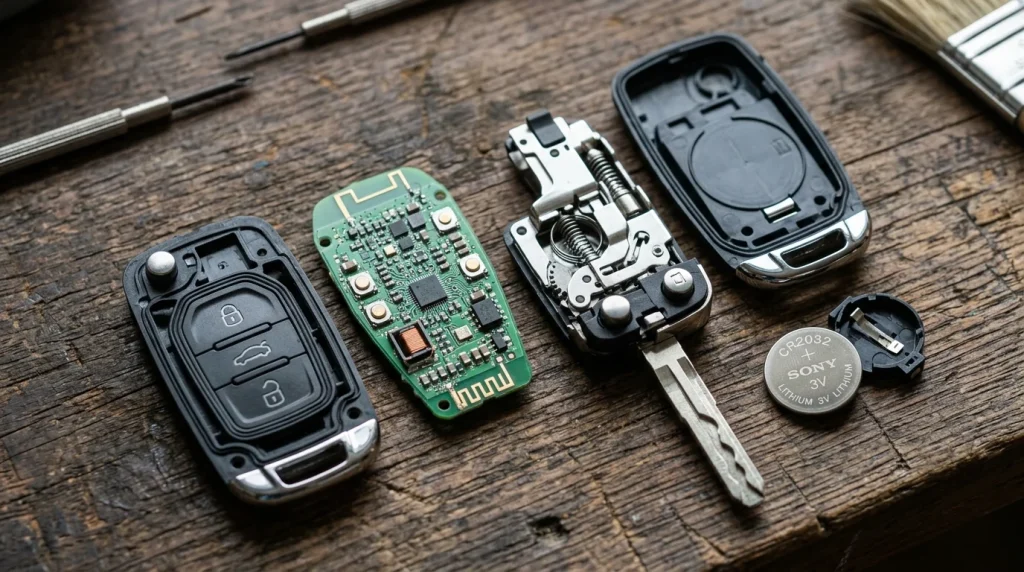
When the battery charge drops, the central driver display generates a prompt reading: “Please change key battery.” Drivers can also detect a depleted cell when door handle sensors require multiple touches or operating range shortens noticeably.
If the key fob battery dies completely while away from home, follow this manual procedure for a dead Audi key battery backup start:
- Depress the mechanical release button on the key fob and pull out the concealed metal key blade.
- Locate the small access slot underneath the plastic cap on the driver door handle.
- Gently insert the key tip into the slot to unclip the protective cover and reveal the physical lock tumbler.
- Insert the key blade and rotate it counterclockwise to unlock the driver door manually.
- Sit in the driver seat and locate the backup wireless key transponder marking. On compact models (such as the A3 and Q3), hold the back of the key fob against the key symbol on the steering column shroud; on larger models (such as the A4, A6, Q5, and Q7), place the key fob directly over the designated key marking inside the center console or cup holder.
- Depress the brake pedal and push the start-stop button. The passive induction coil powers the transponder chip to start the vehicle.
Note: Replacement fobs purchased from outside vendors must be paired with vehicle immobilizer software using dedicated diagnostic equipment.
When selecting an independent repair facility, checking independent Audi service authorization confirms whether local shops have the factory ODIS diagnostic tooling needed for key programming.
Real-World Use Cases and Comparisons
The Advanced Key provides tangible utility across various driving routines, particularly for families and commuters managing heavy cargo.
On midsize luxury crossovers, understanding Audi Q5 dimensions and cargo capacity highlights why hands-free trunk gestures are valuable when loading sports equipment or groceries. Similarly, drivers comparing Audi plug-in hybrid powertrains benefit from automated central locking confirmation while managing charging cables at public stations.
| Scenario | Standard Keyless Go | Audi Advanced Key | Practical Advantage |
|---|---|---|---|
| Grocery Shopping | Must set down bags to press fob | Single foot kick opens tailgate | Clean, hands-free loading |
| Inclement Weather | Fumble through pockets for remote | Touch handle directly to enter | Immediate shelter from rain/snow |
| Multi-Driver Profiles | Manual adjustment of mirrors and seat | Syncs seat and MMI profile to key | Personalized driving position |
| Valet Parking | Provide entire key to attendant | Remove mechanical blade, lock glovebox | Secure storage of personal items |
Audi Advanced Key vs Competitor Systems
When compared to BMW Comfort Access and Mercedes-Benz Keyless-Go, the Audi system offers comparable touch response speeds and reliable anti-lockout logic. BMW offers extended passive walk-away locking in newer models, while Audi emphasizes deliberate handle touching to prevent unintended locking cycles when washing the exterior bodywork.
Impact on Ownership Experience and Value
Equipping a vehicle with the Audi Advanced Key elevates daily convenience and preserves resale appeal in the pre-owned luxury market. Used car buyers routinely expect keyless entry as a standard comfort amenity on premium vehicles.
Vehicles lacking keyless access often experience minor depreciation penalties compared to identical models with convenience packages. When trading in or selling privately, having two functional, fully programmed Advanced Key fobs preserves maximum vehicle value, as replacement fobs ordered from dealerships cost between $450 and $800 plus programming labor.
Best Practices and Quick Start Guide
To ensure reliable performance and prolong key hardware lifespan, keep these practical operational recommendations in mind:
- Keep a Spare Battery Handy: Store a spare CR2032 3V coin cell in your home or glovebox and replace the battery promptly when the low-battery warning appears on the instrument cluster.
- Execute Clean Foot Kicks: When using the hands-free trunk release, perform one direct forward-and-back kick under the license plate area rather than sweeping your foot sideways.
- Store Keys Away From Entryways: Keep vehicle keys away from exterior doors and windows when inside the house, or rely on the motion-sensing sleep mode.
- Clean Handle Sensors: Keep door handle grooves clear of dirt, winter road salt, and heavy wax buildup to maintain capacitive sensor responsiveness.
- Use Valet Safeguards: Remove the internal mechanical key blade to lock the glove compartment and trunk release switch before handing the fob to parking attendants.
Frequently Asked Questions About Audi Advanced Key
What is the difference between Audi Keyless Go and Audi Advanced Key?
Audi Keyless Go is a base feature providing push-button engine ignition while still requiring physical fob button presses to unlock doors. Audi Advanced Key is an upgraded package adding capacitive touch door handle locking, passive unlocking, and hands-free foot-kick trunk release.
How much does it cost to replace an Audi Advanced Key?
Replacing an Audi Advanced Key costs between $450 and $800 for the hardware from an authorized dealership, with an additional $150 to $300 in labor fees for immobilizer programming.
How do I know if my Audi has Advanced Key installed?
Check your exterior door handles for small rectangular indentations or grooved sensors on the outside surface. If your handles are smooth without touch sensors, your vehicle has base Keyless Go rather than the Advanced Key package.
Does the Audi Advanced Key work if the fob battery is dead?
Yes. You can unlock the driver door using the hidden mechanical key blade inside the fob and start the engine by placing the dead fob directly over the backup key symbol, located on either the steering column shroud or the center console depending on the model.
Can I add or retrofit Advanced Key to an Audi that did not come with it?
Retrofitting is technically possible but rarely cost-effective. It requires installing four new door handles with capacitive sensors, lower bumper wiring harnesses, multiple interior and exterior antennas, and extensive control unit coding.

