


To understand what does quattro in Audi mean, the designation refers to the automaker’s proprietary all-wheel-drive (AWD) technology, derived directly from the Italian word for “four.” Introduced in 1980 on the original Audi Quattro rally coupe, the system automatically distributes engine torque between the front and rear axles to maximize traction, directional stability, and cornering grip across diverse driving conditions.
Key takeaways:
- Quattro represents Audi’s trademarked all-wheel-drive engineering, named after the Italian word for the number four.
- Unlike manual four-wheel drive with a separate transfer case, quattro operates automatically without requiring driver intervention.
- Audi uses distinct mechanical center differentials, transverse multi-plate clutches, and dual-motor electric setups depending on vehicle architecture.
- While quattro comes standard on high-tier trims and performance models, select entry-level configurations offer front-wheel drive.
- Upgrading to quattro on base trims generally adds between $2,000 and $3,000 to the manufacturer suggested retail price.
Origins of the term quattro
The word “quattro” translates directly to “four” in Italian. In automotive branding, Audi adopted the term in lower case to designate vehicles equipped with permanent or predictive all-wheel drive, symbolizing drive torque delivered to all four wheels.
The project originated during winter test drives in Scandinavia between 1976 and 1977. Audi chassis test engineer Jörg Bensinger observed that the military off-road vehicle Volkswagen Iltis consistently outperformed more powerful road cars on deep snow and ice due to its four-wheel traction. Bensinger proposed adapting a compact all-wheel-drive system into a production passenger car to Ferdinand Piëch, who was then Audi’s Board Member for Technical Development.
Development began under project code EA 262 in February 1977, led by project manager Walter Treser. When marketing executives initially suggested naming the new performance coupe “Carat,” Treser objected. Walter Treser famously argued that Carat sounded like a ladies’ perfume rather than an engineered performance vehicle, proposing “quattro” instead to highlight the four driven wheels. Much like the distinct naming story behind the Audi TT, Audi’s model nomenclature frequently ties directly into historical milestones and engineering intent.
When capitalized as “Quattro,” the name specifically identifies the original 1980 turbocharged rally-homologation coupe, colloquially called the “Ur-Quattro” (with “Ur-” meaning original in German). In contrast, the lower-case “quattro” badge on a modern tailgate indicates the presence of Audi’s all-wheel-drive hardware.
Technical meaning of quattro
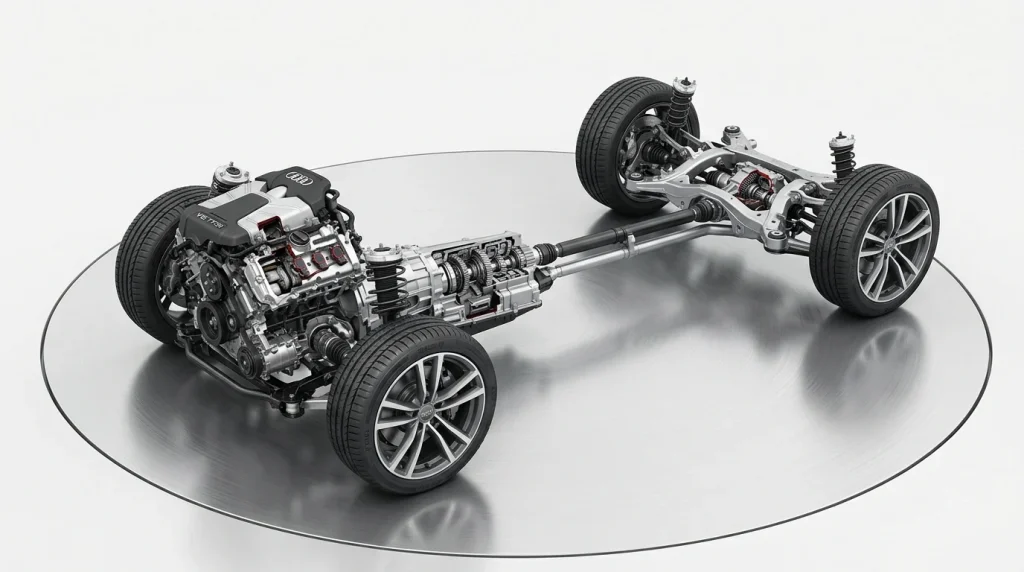
Technically, quattro denotes an automated drivetrain that continuously or on-demand channels torque to both axles. In early four-wheel-drive passenger vehicles, automakers relied on heavy, bulky transfer cases that locked the axles together, causing tire scrubbing and mechanical binding during tight turns on dry pavement.
Audi overcame this limitation by engineering a hollow secondary shaft inside the transmission. This design routed power back to a center differential, which in turn split torque between the front and rear driveshafts. Because the center differential allows the front and rear wheels to rotate at varying speeds while turning, drivers enjoy uninterrupted all-wheel traction on dry asphalt, rain-soaked highways, and snow without binding.
Modern longitudinal Audi models rely on a mechanical self-locking center differential. According to Audi TechTalk technical documentation, this mechanical differential delivers a default 40:60 front-to-rear torque split during normal cruising. If an axle begins to slip, the differential mechanically diverts up to 70% of drive force to the front axle or up to 85% to the rear axle within milliseconds. Maintaining consistent tire tread depth across all four corners is essential to prevent differential strain, making recommended tires for Audi AWD models a key ownership consideration.
Timeline of quattro adoption
Over more than four decades, Audi expanded and refined its all-wheel-drive lineup across several distinct generations:
- 1977 (Project Genesis): Initial prototype development begins using an Audi 80 chassis fitted with an all-wheel-drive system derived from the VW Iltis.
- 1980 (Geneva Debut): The original Audi Quattro coupe debuts at the Geneva Motor Show, featuring a permanent all-wheel-drive system with manually lockable center and rear differentials.
- 1986 (Torsen Integration): Audi replaces the manually locked center differential with a self-locking Torsen (torque-sensing) worm-gear unit, automating variable torque distribution.
- 1998 (Transverse Haldex Architecture): Audi introduces an electro-hydraulic multi-plate clutch system for transverse engine models, bringing quattro capability to compact vehicles like the A3 and TT.
- 2008 (Sport Differential): Audi launches the active rear Sport Differential on the S4, using two superposition gearsets to distribute torque individually between the left and right rear wheels.
- 2016 (Quattro with Ultra Technology): Audi implements dual-clutch decoupling on longitudinal models, disconnecting the rear driveshaft during steady highway cruising to reduce parasitic drag and improve fuel economy.
- 2020 and Beyond (Electric Quattro): Battery-electric e-tron models introduce electric all-wheel drive, using dedicated front and rear electric motors that regulate axle torque without any mechanical connection.
Quattro in branding and marketing
Beyond its engineering merits, quattro served as the primary catalyst that elevated Audi from a regional German automaker into a globally recognized luxury brand. In the early 1980s, Audi entered the World Rally Championship (WRC) under Group B regulations. Competing against traditional rear-wheel-drive rivals, Audi Quattro race cars secured multiple manufacturers’ and drivers’ world championship titles between 1982 and 1984, proving that all-wheel traction offered a decisive competitive advantage on loose gravel and snow.
Audi capitalized on these motorsport victories through memorable advertising campaigns. In 1986, professional rally driver Harald Demuth drove an Audi 100 CS quattro up the snow-covered Pitkävuori ski jump in Kaipola, Finland, ascending an 80 percent gradient (37.5 degrees) under the car’s own power. Audi recreated this feat in 2005 with an Audi A6 4.2 quattro to celebrate the system’s 25th anniversary.
These demonstrations anchored the company’s long-standing philosophy of “Vorsprung durch Technik” (Progress through Technology). As the brand looks toward future engineering challenges, including Audi’s upcoming entry into Formula 1, the technical credibility established by quattro remains a central pillar of its corporate identity. Quattro fundamentally reshaped consumer expectations in the premium automotive segment. Prior to 1980, all-wheel drive was viewed strictly as utilitarian equipment for agricultural trucks and military transports. By pairing permanent four-wheel traction with luxury sedans and turbocharged engines, Audi established all-weather traction as a hallmark of premium performance.
Notable models and applications
The quattro badge spans virtually every segment of Audi’s passenger car catalog, adapted to suit distinct vehicle layouts:

- Audi Quattro (Ur-Quattro, 1980-1991): The pioneer model powered by a 2.1-liter turbocharged inline-five cylinder engine, establishing the benchmark for rally homologation specials.
- Audi RS2 Avant (1994): Developed in collaboration with Porsche, this high-performance wagon combined a 311-horsepower turbocharged five-cylinder engine with quattro traction, inaugurating Audi’s celebrated RS performance line.
- Audi A4 allroad and A6 allroad: Elevated estate wagons featuring standard quattro, raised rough-road suspension (with adaptive air suspension equipped on the A6 allroad), and protective lower cladding, designed for light unpaved trails. Drivers evaluating the 2023 Audi A4 allroad frequently note how the system balances highway composure with rough-road stability.
- Audi Q5 and Q7: Midsize and full-size luxury crossovers where standard quattro provides towing stability and wet-weather confidence. Evaluating the dimensions and lifespan of the Audi Q5 shows how integrated AWD packaging supports practical daily usability.
- Audi R8: The mid-engine flagship supercar using a rear-biased quattro system with a bespoke viscous coupling or multi-plate clutch. Reviewing the horsepower output of the Audi R8 highlights how the drivetrain directs the majority of power to the rear wheels while maintaining front-axle stabilization at high speeds.
| Vehicle Category | Representative Model | AWD Mechanism | Standard Torque Split |
|---|---|---|---|
| Compact Sedan / Crossover | Audi A3, Q3 | Transverse Multi-Plate Clutch | 100:0 (Front Bias) up to 50:50 |
| Midsize / Executive Sedan | Audi A4, A6, S4 | Longitudinal Mechanical Differential | 40:60 (Front:Rear) |
| High-Efficiency Touring | Audi A4 Ultra, Q5 Ultra | Quattro with Ultra (Decoupling) | 100:0 (FWD Mode) to 50:50 |
| Supercar / Sports Coupe | Audi R8 V10 | Mid-Engine Multi-Plate Clutch | Fully Variable (0:100 to 100:0) |
| Battery-Electric SUV | Audi Q8 e-tron | Dual Electric Motors | Fully Variable Electronic Split |
Common misconceptions and clarifications
Because Audi applies the quattro label across various vehicle platforms, several common misunderstandings exist among car buyers:
- Misconception 1: Every quattro system uses the same hardware. In reality, Audi uses three distinct mechanical setups. Longitudinal models (A4 through A8, Q7) use self-locking mechanical center differentials. Transverse models (A3, TT, Q3) use an electronically modulated hydraulic clutch pack. Newer efficiency-oriented trims use quattro with ultra technology, which physically disengages the rear driveshaft during steady highway driving to reduce fuel consumption.
- Misconception 2: Quattro is identical to truck-based 4WD. Traditional four-wheel drive uses a part-time transfer case that locks front and rear driveshafts to rotate at identical speeds, which can cause driveline binding on dry roads. Quattro is a full-time or predictive AWD system that permits rotational speed differences between axles, making it safe for continuous use on dry asphalt and slick pavement alike.
- Misconception 3: All Audi vehicles come standard with quattro. While quattro is standard on Audi S and RS models, allroad wagons, and larger SUVs, base front-wheel-drive configurations exist for the A3, A4, and Q3 in specific markets to offer lower starting price points. Reviewing the 2026 Audi model price guide shows that stepping up from front-wheel drive to quattro typically adjusts the vehicle MSRP by $2,000 to $3,000 across core trims.
Owners should also recognize that sophisticated all-wheel-drive systems rely on real-time sensor monitoring. If wheel-speed sensors or differential control modules experience faults, diagnosing an Audi drive system malfunction message promptly helps protect expensive drivetrain components from premature wear.
Note: Drivetrain configurations vary by market and model year. In North America, the majority of Audi models include quattro as standard equipment, whereas European markets offer a broader selection of entry-level front-wheel-drive options.
Global footprint and regional usage
Audi’s global production network manufactures quattro-equipped vehicles across multiple continents. A full examination of where Audi models are built globally illustrates that facilities in Ingolstadt and Neckarsulm (Germany), Győr (Hungary), San José Chiapa (Mexico), and Changchun (China) assemble all-wheel-drive models tailored to local consumer demands.
In North America, consumer preference for winter traction and high equipment levels makes quattro standard on almost all mid-tier and luxury Audi vehicles. In contrast, European buyers frequently select front-wheel-drive variants paired with smaller displacement engines to minimize road tax and optimize fuel consumption.
As the industry transitions toward electrification, Audi is integrating all-wheel drive into electrified architectures. Examining Audi hybrid and plug-in hybrid powertrains reveals how modern TFSI e plug-in hybrids retain mechanical quattro shafts, while pure battery-electric e-tron models manage torque distribution exclusively through high-speed power electronics.
Frequently asked questions about Audi quattro
Does quattro mean 4×4 or all-wheel drive?
Quattro refers to all-wheel drive (AWD). Unlike a traditional 4×4 system that requires the driver to manually engage a transfer case for off-road driving, quattro operates automatically and continuously balances power across all four wheels on both dry pavement and slick surfaces.
Can you turn off quattro in an Audi?
In most Audi vehicles, quattro cannot be manually disabled because the mechanical center differential or electronic clutch is permanently integrated into the powertrain. While Audi manufactures standalone rear-wheel-drive variants like the R8 V10 RWD without all-wheel-drive hardware, quattro-equipped vehicles remain permanent or automatic. Systems with ultra technology automatically decouple the rear axle during steady highway cruising, while sport models like the RS 3 use torque-splitter systems with dedicated modes to route dynamic drive force to the rear wheels.
Is Audi quattro expensive to maintain?
Maintaining a quattro drivetrain is comparable to other luxury AWD systems. Routine maintenance requires periodic center differential and rear differential fluid changes, typically recommended every 40,000 to 60,000 miles depending on model specifications. Keeping tire wear even across all four wheels is essential to avoid putting mechanical stress on the differential.
Which Audi models come standard with quattro?
Quattro is standard on all Audi S and RS performance models, allroad wagons (A4 allroad, A6 allroad), midsize and full-size SUVs (Q7, Q8), luxury sedans (A6, A7, A8), and dual-motor electric e-tron vehicles. Entry-level trims of the A3, A4, and Q3 offer front-wheel drive as base equipment in select markets.

