

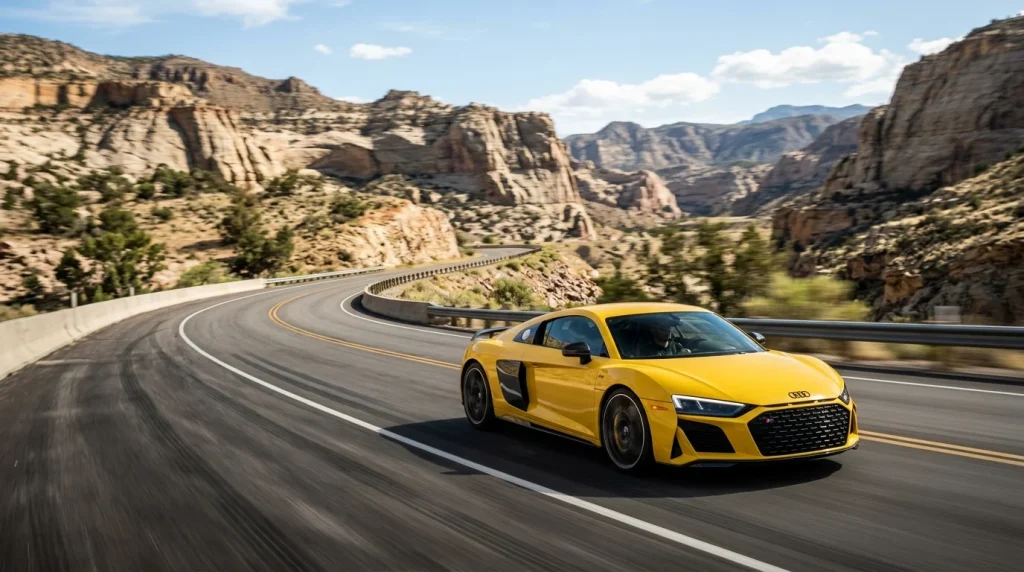
In answering how fast an Audi R8 can go, factory specifications confirm a maximum official top speed of 205 mph (330 km/h) for the flagship second-generation V10 Performance quattro Coupe, which sprints from 0 to 60 mph in 3.1 seconds. Across its 17-year production run from 2007 to March 2024, factory top track speeds ranged from 187 mph (301 km/h) in early 4.2-liter V8 models to 205 mph in late-model 602-horsepower V10 editions, while rear-wheel-drive variants topped out between 199 mph and 204 mph due to differing gear ratios and aerodynamic setups.
Key takeaways:
- The fastest road-going production version is the second-generation Audi R8 V10 Performance quattro Coupe, rated at an official top speed of 205 mph (330 km/h) and a factory 0-60 mph sprint of 3.1 seconds.
- Early first-generation 4.2-liter V8 models (2007 to 2015) delivered top speeds of 187 to 188 mph, while the original 5.2-liter V10 raised that benchmark to 196 mph.
- Rear-wheel-drive configurations, including the limited 2023 R8 GT, reach 199 to 204 mph, trading a fraction of launch grip for reduced weight and mechanical playfulness.
- In independent instrumented tests, magazines such as MotorTrend recorded 0 to 60 mph acceleration times as rapid as 2.6 seconds, outperforming conservative factory claims.
- Maximum velocity is determined by the equilibrium where mechanical wheel thrust equals the sum of aerodynamic drag and rolling resistance, governed by the formula where required horsepower scales with the cube of vehicle speed.
Top speed figures across Audi R8 generations
The Audi R8 established itself as an everyday supercar capable of competing directly with thoroughbred exotics on open stretches of highway and closed circuits alike. Across two distinct mechanical generations, Audi altered engine displacements, aspiration methods, transmission designs, and chassis materials. Each mechanical adjustment shifted the vehicle’s top speed ceiling and acceleration profile.
When the first-generation Type 42 debuted for the 2008 model year in North America, it arrived with a mid-mounted 4.2-liter FSI naturally aspirated V8 engine producing 420 horsepower. Factory specifications recorded an official top track speed of 187 mph (301 km/h) and a 0 to 60 mph sprint of 4.4 seconds with its classic six-speed gated manual transmission. Subsequent tuning for the 2011 to 2015 model years increased V8 output to 430 horsepower, lifting top velocity to 188 mph and trimming the 0 to 60 sprint to 4.2 seconds.
In 2009, Audi broadened the lineup by introducing the 5.2-liter FSI V10 engine, an uneven-firing unit co-developed within the Volkswagen Group. Delivering 525 horsepower at 8000 RPM, the V10 raised maximum velocity to 196 mph (316 km/h). The pinnacle of the first generation arrived with the 2014-2015 R8 V10 Plus, which increased output to 550 horsepower and 398 lb-ft of torque, pushing terminal speed to 197 mph (317 km/h) while lowering the 0-60 mph time to 3.3 seconds. For readers researching power variations across the vehicle’s lifespan, our breakdown of Audi R8 horsepower and engine outputs provides detailed engine codes and dyno metrics.
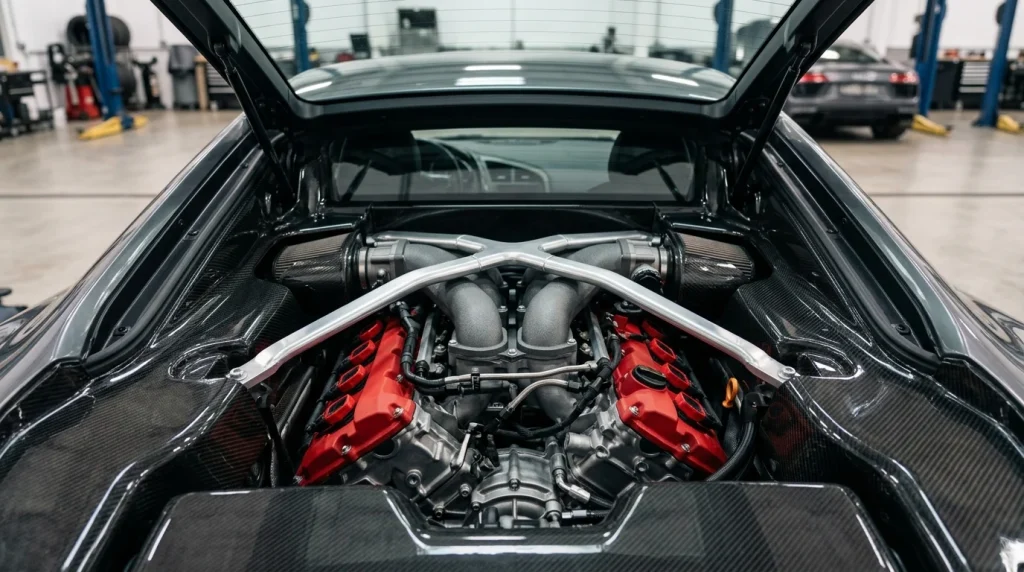
The second-generation Type 4S (2016 to 2024) eliminated the V8 option, standardizing the 5.2-liter V10 across all trims. In standard all-wheel-drive trim, early second-generation models generated 540 horsepower and ran to 199 mph. The higher-output V10 Plus (later renamed V10 Performance quattro) delivered 602 horsepower in US trim (610 PS in European specification) and 413 lb-ft of torque. This configuration achieved the highest official velocity in R8 history: 205 mph (330 km/h) for the fixed-roof Coupe and 204 mph (329 km/h) for the open-top Spyder. Pricing across these variants shifted dramatically over time, as detailed in our comprehensive Audi R8 price guide.
The table below outlines official factory performance metrics across all major Audi R8 production trims:
| Generation | Model Years | Engine & Displacement | Drivetrain | Horsepower | 0-60 mph (sec) | Official Top Speed |
|---|---|---|---|---|---|---|
| Gen 1 (Type 42) | 2008-2010 | 4.2L FSI V8 | quattro AWD | 420 hp | 4.4 s | 187 mph (301 km/h) |
| Gen 1 (Type 42) | 2011-2015 | 4.2L FSI V8 | quattro AWD | 430 hp | 4.2 s | 188 mph (302 km/h) |
| Gen 1 (Type 42) | 2009-2012 | 5.2L FSI V10 | quattro AWD | 525 hp | 3.7 s | 196 mph (316 km/h) |
| Gen 1 Facelift | 2011-2012 | 5.2L FSI V10 (GT) | quattro AWD | 560 hp | 3.5 s | 199 mph (320 km/h) |
| Gen 1 Facelift | 2013-2015 | 5.2L FSI V10 Plus | quattro AWD | 550 hp | 3.3 s | 197 mph (317 km/h) |
| Gen 2 (Type 4S) | 2016-2019 | 5.2L FSI V10 | quattro AWD | 540 hp | 3.5 s | 199 mph (320 km/h) |
| Gen 2 (Type 4S) | 2017-2019 | 5.2L FSI V10 Plus | quattro AWD | 602 hp | 3.2 s | 205 mph (330 km/h) |
| Gen 2 Facelift | 2020-2023 | 5.2L FSI V10 Performance | RWD | 562 hp | 3.6 s | 204 mph (329 km/h) |
| Gen 2 Facelift | 2020-2023 | 5.2L FSI V10 Performance | quattro AWD | 602 hp | 3.1 s | 205 mph (330 km/h) |
| Gen 2 Facelift | 2023 | 5.2L FSI V10 (R8 GT) | RWD | 602 hp | 3.3 s | 199 mph (320 km/h) |
How top speed is measured in official specs
Automotive manufacturers follow structured regulatory frameworks when certifying top speed figures for homologation and sales literature. In Europe, vehicle speed verification conforms to standardized procedures such as UN/ECE Regulation No. 68, which establishes exact environmental and mechanical baselines.
Official top speed measurements require specific procedural controls:
- Two-way flying runs: The test car must run the measured distance in both opposite directions over a level straight within a strict time limit, usually 20 to 30 minutes. The official speed is calculated as the arithmetic mean of both runs, canceling out the influence of headwind, tailwind, and subtle road gradients.
- Proving ground environments: High-speed testing occurs on specialized closed facilities. The Volkswagen Group uses the Ehra-Lessien testing facility in Lower Saxony, Germany, which features an uninterrupted straight section spanning approximately 5.6 miles (9 kilometers). Other trials occur on banked continuous ovals like the Nardo Technical Center in southern Italy.
- Standard atmospheric conditions: Ambient temperature, barometric air pressure, and track dry surface standards must fall within certified testing bands (typically near 20 degrees Celsius and standard sea-level barometric pressure of 1013.25 hPa) to ensure reproducible air density.
- Vehicle ballast and fluid loads: The vehicle is ballasted to reflect nominal operating weight, including a standardized driver mass of 75 kg, full cooling and lubrication fluids, and at least 90 percent fuel capacity.
Official vs. tested speeds
Stated manufacturer figures frequently diverge from numbers published by automotive journalists and independent track testers. Carmakers publish conservative numbers to ensure that production customer vehicles can replicate the claimed speed across varying climates, elevations, and tire conditions.
Former technical director at Audi’s sports car division, Stephan Reil, explained the brand’s testing philosophy directly when addressing performance ratings. Reil noted that Audi prefers to calibrate factory metrics so that independent testers consistently match or beat the numbers in real-world driving: “I simply don’t want to hear, when you guys write ‘well, they claim 3.9, but we got 4.0.'”
This deliberate engineering buffer explains why instrumented tests frequently beat factory claims. In independent instrumented testing of the 2017 R8 V10 Plus, MotorTrend recorded a 0 to 60 mph sprint of 2.6 seconds, completing the quarter-mile in 10.6 seconds at a terminal trap speed of 129.8 mph.
What factors influence the Audi R8’s top speed?
Reaching 205 mph in a mid-engine road vehicle requires overcoming substantial physical resistance. Top speed is not merely a function of peak engine horsepower; it represents an exact mechanical balance where the engine’s propulsive wheel force matches the cumulative resistance forces acting against the car.
Total Resistance Force = Aerodynamic Drag Force + Rolling Resistance Force
The dominant force at extreme velocity is aerodynamic drag ($F_d$), calculated using the standard fluid dynamics equation:
F_d = 0.5 * rho * v^2 * C_d * A
In this equation, $\rho$ (rho) represents ambient air density (approximately 1.225 kg/m³ at sea level), $v$ is vehicle velocity in meters per second, $C_d$ is the drag coefficient, and $A$ is the frontal cross-sectional area. Because velocity is squared in the drag equation, doubling the vehicle’s speed quadruples the aerodynamic resistance force.
Furthermore, the engine power ($P$) required to overcome aerodynamic drag scales with the cube of velocity:
Required Power = F_d * v = 0.5 * rho * v^3 * C_d * A
For the Audi R8 V10 Performance Coupe, the drag coefficient sits between 0.35 and 0.36 with a frontal area of approximately 2.01 square meters. While moving at 100 mph requires roughly 40 horsepower to overcome aerodynamic resistance, pushing from 190 mph to 205 mph requires an additional 120 horsepower simply to overcome the denser air wall.
Beyond aerodynamics, several mechanical components dictate maximum vehicle velocity:
-
Gear ratios and final drive: The 7-speed S tronic dual-clutch transmission uses specific gear ratios calculated to allow top speed in top gear right as the engine approaches its peak power band. If seventh gear is too tall, the engine lacks the torque to reach redline; if it is too short, the car hits the rev limiter before reaching aerodynamic terminal velocity.
-
Tire construction and centrifugal expansion: At 205 mph, a standard 20-inch tire rotates more than 2,700 times per minute. The centrifugal forces subject the tire tread and sidewalls to immense internal stresses. The R8 uses (Y)-speed-rated performance tires certified for speeds exceeding 186 mph. Choosing the correct compound is essential for high-speed durability, as highlighted in our guide to high-performance tires for Audi vehicles.
-
Powertrain temperature management: Sustained wide-open throttle generates significant thermal load. The R8 employs dual side-mounted coolant radiators and an external dry-sump oil cooling circuit to prevent oil breakdown and maintain safe operating temperatures. If sensors detect excessive heat, the electronic control unit reduces throttle opening, a safety protocol discussed in our technical guide on troubleshooting Audi drive system malfunctions.
Model-year and trim impact
Engineering revisions across model years altered aerodynamic efficiency and weight distribution. During the 2019 mid-cycle refresh, Audi Sport Technical Managing Director Oliver Hoffmann emphasized the focus on airflow management, stating that the updated front splitter and wider intake grilles were designed to optimize cooling while stabilizing high-speed downforce. Aerodynamic stability at speeds above 190 mph requires balancing downforce against parasitic drag. Increasing rear downforce prevents rear-end lift and maintains rear axle tire contact, whereas controlling front-end lift requires dedicated front splitters and intake ducting. However, every additional kilogram of total downforce increases aerodynamic drag, lowering theoretical top speed. Audi opted for a fixed rear carbon wing on Performance trims to balance high-speed stability against top-end velocity.
Variant-level differences
Drivetrain configurations introduce distinct variations in top velocity:
- Coupe vs. Spyder: The R8 Spyder incurs an aerodynamic penalty due to open-cockpit air turbulence and structural bracing weight (adding roughly 220 pounds / 100 kg). The Spyder V10 Performance tops out at 204 mph compared to 205 mph for the Coupe.
- quattro AWD vs. RWD: The rear-wheel-drive R8 Performance generates 562 hp (or 602 hp in the R8 GT) and delivers top speeds of 199 to 204 mph. While the RWD car is roughly 143 pounds lighter due to the omission of the front differential, propshaft, and front drive axles, its revised gear ratios and tire traction limits reduce acceleration off the line.
Real-world considerations: speed in everyday driving vs. track testing
While the Audi R8 is mechanically engineered to achieve 205 mph, reaching such velocities in the real world is restricted to strictly controlled environments. On public highways worldwide, legal speed limits and road design prevent supercars from operating anywhere near their theoretical mechanical limit.
Even on unrestricted stretches of the German Autobahn, traveling above 180 mph demands ideal conditions: dry pavement, extended clear visibility, light traffic density, and several miles of straight roadway. At 200 mph, a vehicle travels 293 feet per second (89 meters per second). Driver reaction time and braking distance expand exponentially; bringing a 3,600-pound vehicle to a complete stop from 200 mph requires more than 1,000 feet under full anti-lock carbon-ceramic braking force.
The table below contrasts standard road driving parameters with high-speed proving ground testing:
| Parameter | Proving Ground Testing (Ehra-Lessien) | Public Highway Driving |
|---|---|---|
| Track Surface | Laser-leveled asphalt, debris-free | Variable asphalt, expansion joints, potholes |
| Distance Available | 5.6-mile continuous straightaway | Interrupted by exits, curves, and congestion |
| Tire Preparation | Nitrogen-filled, precise cold pressures | Variable tire wear, everyday pressure fluctuations |
| Braking Buffer | Miles of dedicated run-off zones | Bounded by guardrails, barriers, and surrounding traffic |
| Legal Framework | Closed test facility homologation | Speed limits (55 to 85 mph across US states) |
Everyday comfort represents one of the R8’s greatest achievements. Built alongside the brand’s high-end sports models at dedicated Audi global manufacturing facilities, the R8 incorporates magnetic ride adaptive suspension, standard cabin climate controls, and proximity convenience features like the Audi advanced key technology, allowing owners to commute comfortably in urban traffic before heading onto a track day.
How the Audi R8 compares to rivals
The naturally aspirated 5.2-liter V10 engine placed the Audi R8 in a unique position against turbocharged and hybrid rivals. While twin-turbocharged competitors from Porsche and McLaren produce greater low-end torque, the R8 relies on linear atmospheric power delivery and an 8700 RPM redline.

The Lamborghini Huracan shares its aluminum and carbon-fiber hybrid chassis, 5.2-liter V10 engine block, and 7-speed dual-clutch transmission with the second-generation R8. However, Lamborghini tuned later iterations (such as the Huracan Evo and STO) to deliver up to 631 horsepower (640 PS), with official factory specifications listing top speeds ranging from 193 mph (310 km/h) on the high-downforce Huracan STO to 202 mph (325 km/h) on the Huracan Evo. The Huracan features stiffer suspension bushings and aggressive styling, whereas the R8 maintains greater sound dampening and everyday ergonomics.
Audi’s sports car heritage, from early lightweight coupes explained in the history behind the Audi TT nameplate to the brand’s forthcoming works effort outlined in our Audi Formula 1 project timeline, has centered on balancing track performance with road usability.
The table below compares the Audi R8 V10 Performance against key contemporaries:
| Supercar Model | Powertrain Type | Peak Horsepower | 0-60 mph (sec) | Claimed Top Speed |
|---|---|---|---|---|
| Audi R8 V10 Performance Coupe | 5.2L Naturally Aspirated V10 | 602 hp | 3.1 s | 205 mph (330 km/h) |
| Lamborghini Huracan Evo | 5.2L Naturally Aspirated V10 | 631 hp | 2.9 s | 202 mph (325 km/h) |
| Porsche 911 Turbo S (992) | 3.7L Twin-Turbo Flat-6 | 640 hp | 2.6 s | 205 mph (330 km/h) |
| Chevrolet Corvette Z06 (C8) | 5.5L Flat-Plane Crank V8 | 670 hp | 2.6 s | 195 mph (314 km/h) |
| McLaren 570S Coupe | 3.8L Twin-Turbo V8 | 562 hp | 3.1 s | 204 mph (328 km/h) |
Sources, reliability, and how to read speed figures
Evaluating automotive performance claims requires critical examination of data origins. Vehicle performance numbers fall into three distinct tiers of credibility:
-
Manufacturer homologation sheets: Primary technical documentation certified by testing authorities under regulated protocols (e.g., ECE R68). These figures reflect standardized, reproducible baselines.
-
Independent instrumented road tests: Tests conducted by reputable automotive publications (MotorTrend, Car and Driver, Sport Auto) using calibrated GPS telemetry boxes (such as VBOX units) with 100 Hz satellite tracking and weather correction factors.
-
Informal social media speedometer videos: Digital dashboard recordings on open public roads. These numbers are subject to speedometer calibration error (most European speedometers read 2 to 5 mph higher than true GPS speed at 150+ mph), tailwinds, and downhill slope assistance.
When comparing vehicle purchase choices across brand portfolios using an Audi pricing guide across models or evaluating future electric technology in our Audi hybrid and electrified vehicle guide, buyers should distinguish between laboratory claims and real-world results. For buyers looking across practical vehicle categories, comparing sports car footprints to family crossovers like the Audi Q5 highlights how architecture choices and vehicle weight influence overall speed.
Note: Official top speed figures reflect factory vehicle specifications with homologated tire compounds and standard aerodynamic trim. Modifications such as aftermarket wings, altered ride height, or non-certified tire sizes will alter drag resistance and maximum achievable velocity.
Interpreting top speed data responsibly
When reading performance tables, enthusiasts should check whether published acceleration figures include a “one-foot rollout” deduction. North American publications traditionally deduct the first foot of vehicle movement (approximately 0.2 to 0.3 seconds) to emulate drag strip timing lights, whereas European homologation times measure acceleration from a true standstill. Understanding these measurement nuances ensures accurate comparisons between sports cars.
Frequently asked questions about how fast the Audi R8 can go
Is the Audi R8 faster than a Porsche 911 Turbo?
The Audi R8 V10 Performance Coupe has a higher top speed than the standard 992-generation Porsche 911 Turbo, which is factory-rated at 198 mph (320 km/h). The R8 matches the 205 mph top speed of the higher-output Porsche 911 Turbo S. However, the all-wheel-drive 911 Turbo S provides quicker acceleration off the line, reaching 60 mph in 2.6 seconds compared to the official 3.1-second sprint of the Audi R8.
Can you daily drive an Audi R8 at normal speeds?
Yes, the Audi R8 is widely regarded as one of the most practical supercars ever built. It provides comfortable seat positioning, clear forward visibility, standard automatic climate control, and optional front-axle nose lift systems to clear speed bumps and steep driveways without underbody scraping.
Why does the RWD R8 have a lower top speed than the quattro version?
The rear-wheel-drive R8 Performance and R8 GT top out at 199 to 204 mph, compared to 205 mph for the quattro model. This difference is driven by revised transmission gear ratios and aerodynamic setups rather than engine output limitations, as the R8 GT shares the full 602-horsepower V10 engine tuning.
Will Audi make another R8?
Audi officially ended production of the combustion-powered R8 in March 2024. Company leadership has confirmed that any future halo sports car will adopt an all-electric or electrified architecture, marking the conclusion of the naturally aspirated mid-engine V10 era for the brand.

