

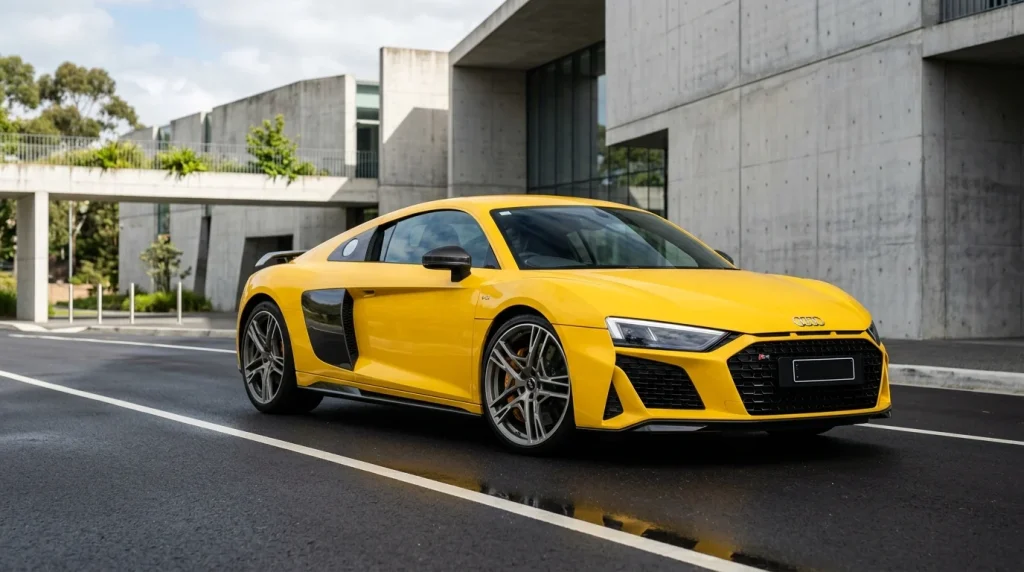
The Audi R8 produces between 414 hp and 612 hp (420 PS to 620 PS), depending on the model year, engine type, and trim level. First-generation models (2006-2015) offered a 4.2-liter V8 delivering 414 hp to 430 hp, alongside a 5.2-liter V10 generating up to 570 hp. Second-generation models (2015-2024) exclusively featured a naturally aspirated 5.2-liter V10, outputting 533 hp in base configuration and topping out at 602 hp (612 hp SAE / 620 PS) in the V10 Performance quattro.
Key takeaways:
- Engine power ranges from 414 hp in early V8 coupes to 612 hp SAE in late-model V10 Performance quattro trims.
- First-generation (Type 42, 2006-2015) models came with either a 4.2L V8 FSI or a 5.2L V10 FSI engine.
- Second-generation (Type 4S, 2015-2024) models used a naturally aspirated 5.2L V10 exclusively, producing up to 602-612 hp SAE.
- Standard models feature Audi’s quattro all-wheel-drive system, though rear-wheel-drive (RWS/RWD) variants generate between 533 hp and 562 hp.
- Global production concluded in March 2024 at Audi’s Böllinger Höfe plant, completing a total run of roughly 45,949 units.
How Much Horsepower Does the Audi R8 Have?
The horsepower of the Audi R8 varies significantly based on generation, engine displacement, and model specification. Over its 18-year production run from 2006 to 2024, Audi equipped the R8 with two distinct engine families: a high-revving 4.2-liter V8 FSI and a mid-mounted 5.2-liter V10 FSI.
Across the entire lineup, standard engine output spans from 414 horsepower in the initial 2007 V8 model up to 612 horsepower SAE (620 PS) in the final V10 Performance quattro iterations. When comparing performance figures across different markets, note that European specifications list output in metric horsepower (PS), while North American specs cite SAE net horsepower. For instance, the flagship 5.2 V10 Performance is rated at 620 PS in Europe, which translates directly to 612 hp SAE in the United States.
To evaluate overall vehicle capabilities beyond raw engine output, enthusiasts often compare how peak horsepower influences top speed and acceleration across different supercar platforms. Understanding what Audi has the most horsepower provides additional context on where the mid-engine R8 sits relative to high-performance RS sedans and electric e-tron GT flagships.
How Much HP Does a Audi R8 Have by Generation?
Audi produced the R8 across two distinct generations, each featuring distinct engine tunes and power tiers.
In the first generation (Type 42, 2006-2015), launched for the 2007 model year, initial coupe models produced 414 hp (420 PS) from a naturally aspirated 4.2L V8. In 2009, Audi added a 5.2L V10 rated at 518 hp (525 PS). Subsequent updates raised V8 output to 430 PS (424 hp) and introduced high-output variants including the V10 Plus (542 hp), the limited-edition R8 GT (552 hp), and the R8 LMX / Competition (570 hp).
In the second generation (Type 4S, 2015-2024), introduced in late 2015, Audi eliminated the V8 engine, offering only the 5.2L V10. At launch, the base V10 generated 533 hp (540 PS), while the V10 Plus produced 602 hp (610 PS). A mid-cycle refresh for the 2019 model year boosted the base V10 to 562 hp (570 PS) and upgraded the flagship variant (renamed V10 Performance quattro) to 612 hp SAE (620 PS).
Understanding what Quattro in Audi vehicles represents clarifies how power ratings correspond with mechanical traction differentials across both generations.
The table below summarizes official horsepower and torque output across major Audi R8 production variants:
| Generation | Model Variant | Engine Type | Power Output (hp / PS) | Peak Torque |
|---|---|---|---|---|
| Gen 1 (Type 42) | R8 4.2 FSI V8 (2007-2012) | 4.2L V8 | 414 hp / 420 PS | 317 lb-ft (430 Nm) |
| Gen 1 (Type 42) | R8 4.2 FSI V8 (2013-2015) | 4.2L V8 | 424 hp / 430 PS | 317 lb-ft (430 Nm) |
| Gen 1 (Type 42) | R8 5.2 FSI V10 (2009-2012) | 5.2L V10 | 518 hp / 525 PS | 391 lb-ft (530 Nm) |
| Gen 1 (Type 42) | R8 V10 Plus (2013-2015) | 5.2L V10 | 542 hp / 550 PS | 398 lb-ft (540 Nm) |
| Gen 1 (Type 42) | R8 GT (2011 Limited) | 5.2L V10 | 552 hp / 560 PS | 398 lb-ft (540 Nm) |
| Gen 2 (Type 4S) | R8 V10 Base (2015-2018) | 5.2L V10 | 533 hp / 540 PS | 398 lb-ft (540 Nm) |
| Gen 2 (Type 4S) | R8 V10 Base (2019-2024) | 5.2L V10 | 562 hp / 570 PS | 406 lb-ft (550 Nm) |
| Gen 2 (Type 4S) | R8 V10 Plus (2015-2018) | 5.2L V10 | 602 hp / 610 PS | 413 lb-ft (560 Nm) |
| Gen 2 (Type 4S) | R8 V10 Performance quattro (2019-2024) | 5.2L V10 | 612 hp / 620 PS | 428 lb-ft (580 Nm) |
| Gen 2 (Type 4S) | R8 V10 Performance RWD (2022-2024) | 5.2L V10 | 562 hp / 570 PS | 406 lb-ft (550 Nm) |
How Much Horsepower Does a Audi R8 Have in the V10 Performance?
The highest horsepower achieved by a regular production Audi R8 is found in the second-generation V10 Performance quattro. According to official technical data from Audi MediaCenter, this flagship model delivers 456 kW (620 metric horsepower / 612 hp SAE) at 7,900 rpm and 580 Nm (427.8 lb-ft) of torque at 6,500 rpm.
The engine utilizes dual injection (combining direct FSI and indirect MPI injection) and a 12.7:1 compression ratio to maximize volumetric efficiency. Power is routed through a seven-speed S tronic dual-clutch transmission capable of executing gear shifts in approximately 120 milliseconds. This configuration propels the coupe from 0 to 60 mph in 3.1 seconds, reaching a top track speed of 206 mph (331 km/h). Power delivery in the R8 V10 Performance is linear and progressive compared to forced-induction rivals. Because peak power occurs at 7,900 rpm and peak torque arrives at 6,500 rpm, the engine rewards high revs while maintaining tractable low-end response through electronic cam phasing.
Note: Output ratings for US-spec R8 models were officially recorded at 602 hp SAE for the 2017-2023 V10 Performance coupe, whereas European homologation reflects the 620 PS (612 hp SAE) specification following updated particulate filter calibration.
What Engine Does the Audi R8 Have?
The Audi R8 was powered by naturally aspirated gasoline engines throughout its entire lifecycle. Unlike many modern supercars that transitioned to twin-turbochargers or hybrid powerplants, Audi maintained atmospheric breathing for the R8 to preserve immediate throttle response and a high redline.
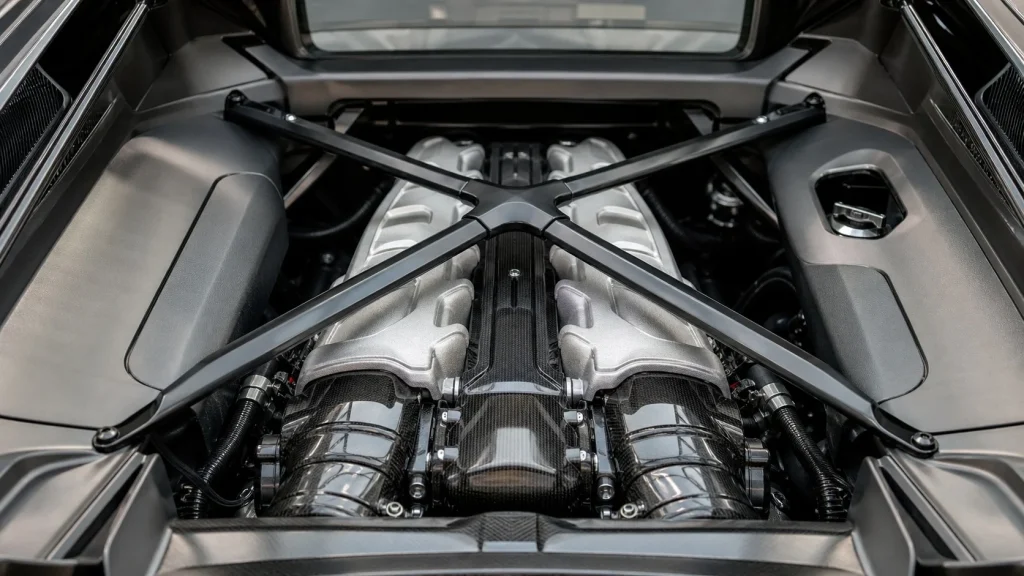
The engine family choice depended on the production era:
- 4.2-liter V8 FSI: 4,163 cc displacement, 32-valve DOHC, dry-sump lubrication, 8,250 rpm redline.
- 5.2-liter V10 FSI: 5,204 cc displacement, 40-valve DOHC, 90-degree cylinder bank angle, dry-sump lubrication, up to 8,700 rpm redline.
Both engine families shared fundamental motorsport engineering principles, including dry-sump lubrication to prevent oil starvation during high lateral acceleration and uneven firing orders (1-6-5-10-2-7-3-8-4-9 on the V10) that produce a distinct exhaust acoustic profile. High-revving naturally aspirated engines demand strict maintenance routines to preserve internal components. Owners researching long-term ownership requirements often check how many miles an Audi can last to plan routine valve cleaning and fluid service intervals across high-performance Audi engines.
What Engine Is in Audi R8 First-Generation Models?
First-generation R8 models (Type 42) initially used a 4.2-liter (4,163 cc) 90-degree V8 FSI engine derived from the RS4 sports sedan. It featured high-tumble intake ports, continuous camshaft adjustment, and gasoline direct injection. Producing 414 hp at 7,800 rpm, it allowed the original R8 to sprint from 0 to 60 mph in roughly 4.4 seconds.
In 2009, Audi introduced the 5.2-liter (5,204 cc) V10 FSI engine to the Type 42 chassis. Based on the powerplant used in the Lamborghini Gallardo LP560-4, the 5.2L V10 delivered 518 hp (525 PS) at 8,000 rpm. Detailed automotive history reviews published by MotorTrend highlight that adding the V10 engine transformed the R8 from an entry-level sports car into a full-fledged mid-engine supercar competitor.
What Engine Does an Audi R8 Have in the Second Generation?
Second-generation R8 models (Type 4S) relied exclusively on an updated variant of the 5.2-liter naturally aspirated V10, sharing its core architecture and cylinder block casting with the Lamborghini Huracán.
Engine refinements for the Type 4S generation included:
- Dual-Injection System: Combined direct FSI cylinder injection with port injection under partial loads to reduce particulate emissions and optimize fuel atomization.
- Cylinder on Demand (CoD): Under low load conditions, the ECU deactivates one cylinder bank (turning the engine into a temporary inline-5) to improve fuel efficiency.
- Dry-Sump Lubrication Upgrade: Utilized a multi-stage oil pump integrated into the crankcase, lowering the engine’s center of gravity within the chassis.
While mid-engine supercars rely on specialized full-synthetic lubricants formulated for high oil temperatures, drivers managing multi-vehicle garages frequently evaluate lubricant viscosity grades, such as when comparing recommendations for choosing the best engine oil for Audi diesel models versus high-rpm gasoline powerplants.
Is Audi R8 All Wheel Drive?
Most Audi R8 models feature Audi’s permanent quattro all-wheel-drive system as standard equipment. However, selected special editions and late-production models were offered with rear-wheel drive.
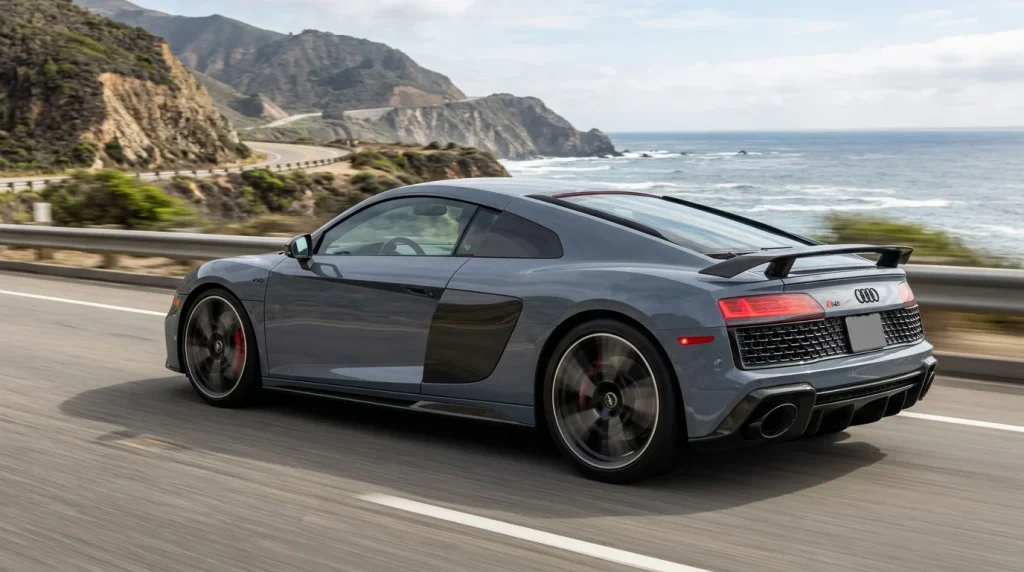
The implementation of quattro on the R8 differs from front-engine Audi sedans. Because the R8 employs a mid-engine layout, the transmission is positioned behind the rear axle. Power is sent to an electrohydraulically controlled multi-plate clutch, which dynamically transfers torque forward to the front differential. Under normal driving conditions, up to 100 percent of engine torque is directed to the rear wheels. When wheel slip is detected, the system can instantly shift up to 100 percent of available torque to the front axle.
Understanding what Quattro means in Audi engineering clarifies how central viscous couplings and modern multi-plate clutches distribute torque across front and rear drive axles. Should electronic sensors report torque transfer or traction control warnings during spirited driving, owners can inspect steps for fixing an Audi drive system malfunction to diagnose differential fault codes and sensor errors.
Key drive configuration options across the model line include:
- R8 quattro (Standard): Electrohydraulic multi-plate clutch with mechanical rear differential lock.
- R8 RWS (Rear Wheel Series, 2018): Limited run of 999 units worldwide (coupe and spyder), featuring pure rear-wheel drive and a weight reduction of roughly 110 pounds (50 kg).
- R8 V10 RWD / Performance RWD (2020-2024): Permanent rear-wheel-drive production variant offering 533 hp (later 562 hp), fitted with a mechanical limited-slip differential.
When Did Audi R8 Come Out?
The Audi R8 officially debuted at the Paris Motor Show in September 2006, with customer deliveries commencing in Europe in mid-2007 and North America for the 2008 model year. The vehicle was inspired by Audi’s Le Mans-winning R8 race prototypes and built upon the Audi Le Mans quattro concept car unveiled at the 2003 Frankfurt Motor Show.
The timeline of production milestones spans two decades:
- September 2006: World premiere of the first-generation Audi R8 4.2 FSI V8 Coupe at Paris.
- December 2008: Introduction of the R8 5.2 FSI V10 Coupe.
- September 2009: Launch of the R8 Spyder (convertible body style).
- March 2015: World debut of the second-generation R8 (Type 4S) at the Geneva Motor Show.
- March 2024: Official end of R8 production at Audi’s assembly plant.
All production R8 models were manufactured at Audi Sport’s specialized Böllinger Höfe facility in Neckarsulm, Germany. Readers interested in Audi manufacturing geography can explore where Audi cars are made to see how hand-assembly lines at Neckarsulm compare with high-volume facilities in Ingolstadt and Győr.
Along with powertrain advancements, later production years integrated modern cabin electronic systems. Keyless convenience features like the Audi Advanced Key keyless entry system replaced traditional mechanical ignitions across the R8 lineup, providing proximity unlock and push-button start functionality.
How Many Audi R8 Were Made?
Over its 18-year production span from June 2006 to March 2024, total global production of the Audi R8 reached 45,949 units, as documented in the official Audi R8 production history.
The complete manufacturing run encompassed two distinct vehicle generations assembled at Audi Sport’s Böllinger Höfe facility in Neckarsulm:
- First Generation (Type 42, 2006-2015): Established the model line globally across 4.2L V8 and 5.2L V10 Coupe and Spyder configurations.
- Second Generation (Type 4S, 2015-2024): Focused exclusively on the naturally aspirated 5.2L V10 powertrain until the final vehicle was completed in March 2024.
Global production peaked during the initial model years between 2007 and 2010 before shifting toward highly exclusive low-volume manufacturing in later years, making final-run V10 Performance models relatively rare modern supercars.
While mass-market Audis incorporated factory options like smartphone-based engine start, buyers exploring whether an Audi can have remote start will note that track-focused models like the R8 omitted remote start to comply with manual gearbox interlocks and sports steering wheel button controls. Similarly, infotainment features evolved over the vehicle’s lifespan; drivers evaluating connected services can check whether Audi charges for Apple CarPlay activation to understand how smartphone mirror interface subscriptions apply across different Audi model years.
How Fast Is the Audi R8?
The top speed and acceleration of the Audi R8 depend on engine configuration, transmission type, and aerodynamics. Base 4.2L V8 coupes achieve a top speed of 187 mph (301 km/h) with a 0-60 mph sprint time of 4.4 seconds. In contrast, second-generation 5.2L V10 Performance quattro models accelerate from 0 to 60 mph in 3.1 seconds and reach a top track speed of 206 mph (331 km/h).
Detailed performance test figures, quarter-mile acceleration records, and braking distances are covered in depth in our dedicated guide detailing how fast an Audi R8 can go.
What is the highest horsepower Audi R8?
The highest factory horsepower output achieved by a series-production Audi R8 is 612 hp SAE (620 PS / 456 kW), featured in the second-generation R8 V10 Performance quattro (2019-2024) and the limited-run 2023 R8 GT.
Does the Audi R8 have a V8 or V10 engine?
The Audi R8 was offered with both V8 and V10 engines during its first generation (2006-2015). However, second-generation models (2015-2024) exclusively featured a 5.2-liter naturally aspirated V10 engine.
How much hp does an Audi R8 V10 Plus have?
First-generation R8 V10 Plus models (2013-2015) produce 542 hp (550 PS). Second-generation R8 V10 Plus coupes (2015-2018) generate 602 hp (610 PS) and 413 lb-ft of torque.
Is the rear-wheel drive Audi R8 less powerful than the quattro?
Yes. Standard rear-wheel-drive R8 models (RWS and V10 RWD) output 533 hp to 562 hp, whereas top-tier quattro variants generate up to 602 hp to 612 hp SAE. This power reduction helps preserve traction without front-axle drive engagement.

