

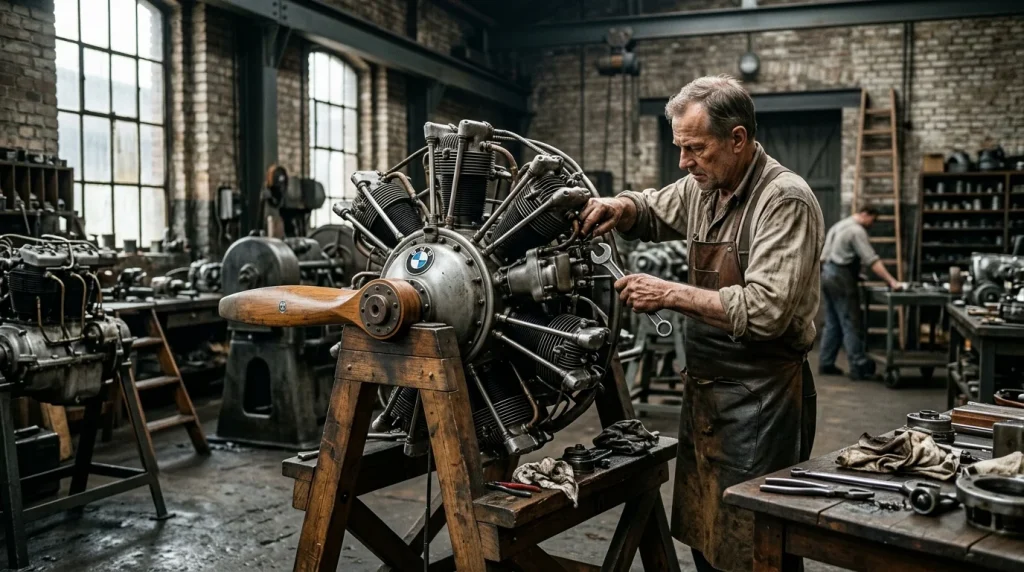
What did BMW start making before cars? The company originally manufactured high-altitude aircraft engines, railway pneumatic brakes, and motorcycles before building its first passenger car. Founded in Munich as Rapp Motorenwerke in 1913 and renamed Bayerische Motoren Werke in 1917, the company gained renown for the BMW IIIa six-cylinder aviation engine. Following post-World War I aviation restrictions in 1919, BMW diversified into industrial machinery and railway brakes, launched the BMW R32 motorcycle in 1923, and finally entered the automobile industry in November 1928 by purchasing the Dixi car factory in Eisenach.
Key takeaways:
- BMW originated as an aircraft engine builder in Munich, producing the high-altitude BMW IIIa straight-six engine in 1917.
- Following the 1919 Treaty of Versailles, the company survived by building railway brakes, agricultural machinery, and stationary engines.
- BMW built its first complete road vehicle in 1923 with the R32 motorcycle, establishing its signature boxer engine and shaft drive.
- Car production began in November 1928 when BMW bought Fahrzeugfabrik Eisenach to build the licensed Dixi 3/15.
- The blue-and-white BMW roundel represents Bavarian state colors, not a rotating aircraft propeller.
Early formation and initial products
The foundation of BMW began in the aviation sector rather than the automotive world. On October 27, 1913, engineer Karl Rapp established Rapp Motorenwerke in a former bicycle factory on Clemensstraße in Munich. The company focused on building heavy four-cylinder and six-cylinder aero engines for the Austro-Hungarian and Bavarian militaries during the early stages of World War I. Early Rapp powerplants suffered from excessive vibration and reliability hurdles, prompting an organizational overhaul in mid-1917.
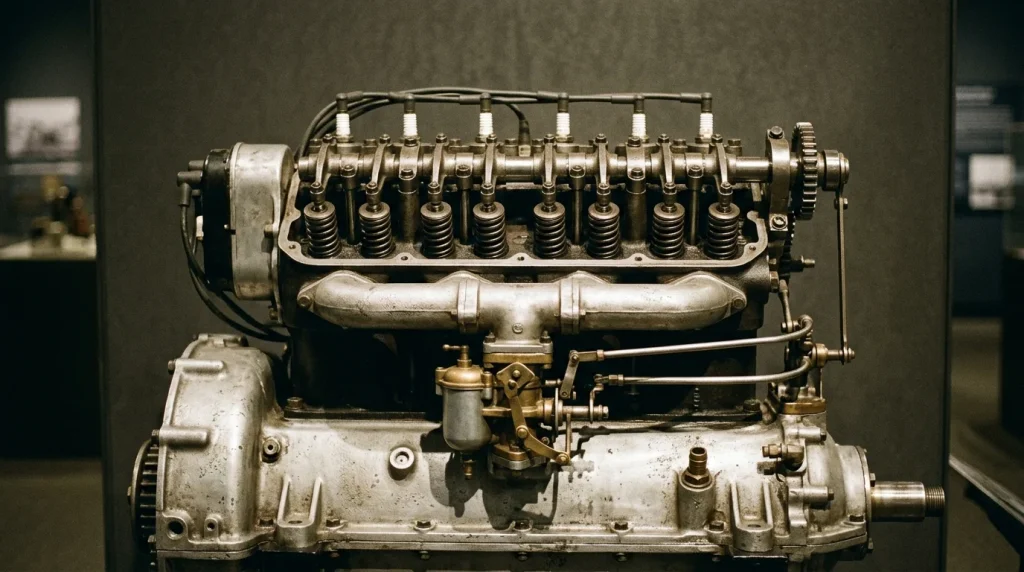
In July 1917, Austrian industrialist Franz Josef Popp took over operational leadership and reorganized the business as Bayerische Motoren Werke GmbH. Shortly after, chief designer Max Friz joined the engineering team and created the company’s defining early product: the BMW IIIa liquid-cooled inline-six aircraft engine.
According to historical archives documented by BMW Group Classic, the BMW IIIa is recognized as the company’s first official manufactured product. The engine featured an innovative altitude carburetor that allowed pilots to adjust fuel-to-air mixture ratios as air thinned at high elevations. Delivering roughly 185 horsepower, the BMW IIIa powered aircraft such as the Fokker D.VIIF to an altitude of 5,000 meters in about 14 minutes, outperforming contemporary allied powerplants. The precision engineering principles established on these early inline-six cylinder blocks would later influence high-output road car engines, such as the BMW M4 engine specifications used in modern performance machinery.
This aerospace heritage helped forge the early BMW luxury brand identity, establishing a reputation for mechanical refinement long before the firm ever stamped its first automotive body panel.
Transition from engines to broader mechanical manufacturing
The end of World War I brought severe disruptions to German heavy industry. Under the terms of the Treaty of Versailles signed in June 1919, German companies were strictly forbidden from designing or manufacturing military aircraft and aviation engines. Overnight, BMW lost its sole source of commercial revenue and faced liquidation.
To maintain operations and retain its skilled workforce, general director Franz Josef Popp restructured the production lines to satisfy peacetime civilian needs. Between 1919 and 1922, BMW manufactured an unexpected variety of everyday goods:
- Pneumatic train brakes under license from the Berlin-based Knorr-Bremse AG.
- Stationary two-cylinder and four-cylinder industrial engines for water pumps, generators, and sawmills.
- Portable farm machinery, motorized tillers, and agricultural implements.
- Cast aluminum household cookware, frying pans, and kitchen utensils.
This rapid conversion demonstrated mechanical versatility, establishing manufacturing rigor that mirrored broader BMW and Mercedes reliability comparisons in German industrial history. In 1922, financier Camillo Castiglioni purchased the BMW brand name, patents, and engine production assets, moving them into the facilities of Bayerische Flugzeugwerke (BFW). This transaction officially aligned BMW’s corporate founding date with BFW’s incorporation on March 7, 1916.
Pre-war manufacturing footprint and capabilities
By the early 1920s, BMW consolidated its manufacturing footprint around the Oberwiesenfeld district in northern Munich. The factory complex on Lerchenauer Straße housed modern foundry equipment, precision milling machinery, and dedicated test cells originally built to run aircraft engines under continuous load.
The engineering team leveraged lightweight aluminum alloys and specialized hardening processes developed during wartime engine production. In 1920, engineer Martin Stolle designed the M2B15 “Bayern-Kleinmotor”, a 494 cc horizontally opposed twin-cylinder engine. BMW sold this engine as an independent power unit to outside motorcycle manufacturers, including Victoria and Helios, proving that compact internal combustion engines could deliver dependable everyday transport. Managing airflow and combustion timing in these early units laid the groundwork for sophisticated valvetrain systems, including modern BMW VANOS variable valve timing.
Notable products before cars
Prior to acquiring its first automotive assembly line in late 1928, BMW built a distinct portfolio of mechanical products across aviation, industrial, and two-wheeled transport sectors.
| Product / Model | Production Years | Category | Key Engineering Feature |
|---|---|---|---|
| BMW IIIa | 1917-1919 | Aircraft Engine | In-line 6-cylinder with high-altitude carburetor (185 hp) |
| BMW IV | 1918-1920 | Aircraft Engine | Set world altitude record of 9,760 meters in June 1919 |
| Knorr-Bremse Brakes | 1919-1924 | Railway Equipment | Compressed-air train braking systems |
| M2B15 Bayern-Motor | 1920-1923 | Industrial / Moto Engine | 494 cc flat-twin boxer layout supplied to third parties |
| BMW R32 | 1923-1926 | Motorcycle | First complete vehicle; transverse boxer twin with shaft drive |
| BMW R37 | 1925-1926 | Sports Motorcycle | Overhead-valve (OHV) aluminum cylinder heads (16 hp) |
| BMW VI | 1926-1938 | Aircraft Engine | 46.9-liter V12 aero engine powering international long-distance flights |
Road to automobile production
BMW’s transition from an engine supplier to an automobile manufacturer required solving two major challenges: developing complete vehicle chassis systems and securing large-scale sheet metal pressing capacity.
The pivotal turning points
Four consecutive milestones enabled BMW to transition into four-wheeled mobility during the 1920s:
- 1919 Aviation Production Ban: The Treaty of Versailles compelled management to abandon exclusive reliance on military aviation contracts.
- 1922 Corporate Restructuring: The merger with Bayerische Flugzeugwerke provided substantial production halls and financial backing.
- 1923 R32 Motorcycle Launch: The success of the R32 proved that BMW could engineer, assemble, and market complete consumer vehicles rather than just component engines.
- 1928 Eisenach Plant Acquisition: Purchasing Fahrzeugfabrik Eisenach in Thuringia gave BMW an established car assembly plant, licensed tooling, and an existing dealer network.
The quest for mechanical efficiency that started in early aero engine test cells directly shaped the company’s trajectory, establishing high-speed records that prefigured the fastest BMW M Series models decades later. This journey transformed BMW from an analog machine shop into a technology leader, long before digital advancements highlighted the timeline of BMW Apple CarPlay adoption.
Early BMW motorcycle and car experiments
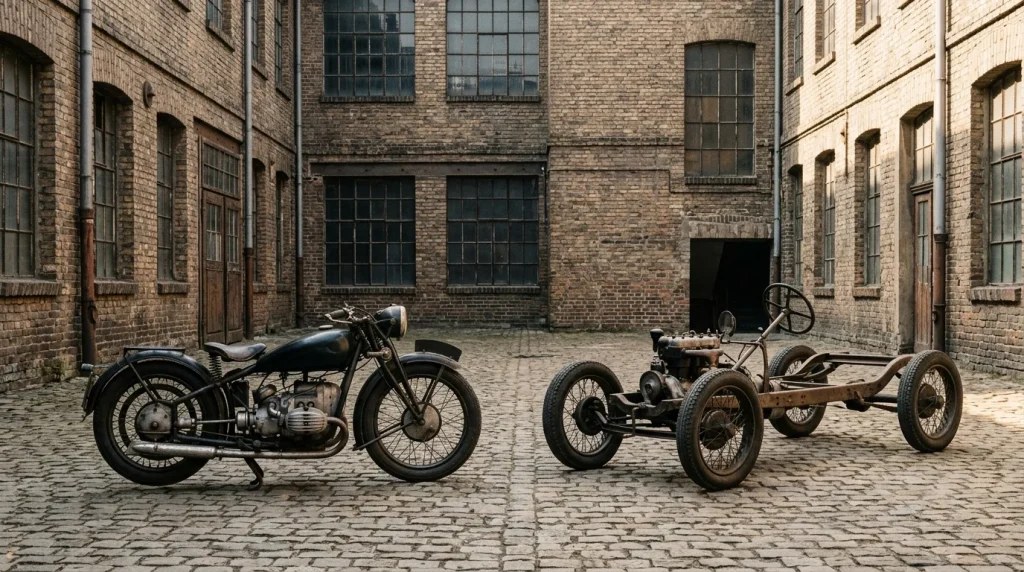
BMW took its first step into complete vehicle manufacturing in September 1923 by introducing the BMW R32 motorcycle at the Berlin Motor Show. Designed by Max Friz in under five weeks, the R32 was a clean-sheet design that solved the cooling and maintenance problems common to early motorcycles. Friz placed the 494 cc flat-twin engine transversely across the tubular steel frame, exposing both cylinder heads directly to the oncoming airflow. Instead of a messy drive chain that required frequent adjustment, the R32 used an enclosed drive shaft to transfer power to the rear wheel. The motorcycle produced 8.5 horsepower, reached 59 mph, and established an engineering template that BMW Motorrad continues to build today.
With motorcycle sales flourishing throughout the mid-1920s, BMW looked for an entry point into the burgeoning small-car market. In November 1928, BMW purchased Fahrzeugfabrik Eisenach in central Germany for 800,000 Reichsmarks in cash and 200,000 Reichsmarks in shares. Eisenach held the German manufacturing license for the British Austin Seven, which it sold under the brand name Dixi 3/15 PS DA-1.
The initial cars delivered in early 1929 retained the Dixi badge alongside the BMW roundel. Powered by a 747 cc side-valve four-cylinder engine producing 15 horsepower, the car seated four passengers in a compact fabric-over-wood body. In July 1929, BMW released an upgraded version named the BMW 3/15 PS DA-2, replacing the fabric body with an all-steel shell produced by Ambi-Budd in Berlin and adding foot-operated four-wheel brakes.
By 1932, the licensing agreement with Austin expired. BMW unveiled the BMW 3/20 PS (AM-1), featuring an in-house engineered 782 cc overhead-valve engine and a tubular backbone chassis with independent suspension. This milestone marked the birth of independent BMW passenger car production, initiating a lineage of compact and midsize cars that evolved through the BMW 328i engine generations in modern decades. BMW’s pre-car manufacturing background directly shaped its automotive engineering strategy. Unlike contemporary automakers that began as carriage builders, BMW entered the automotive field with advanced metallurgy, precision tooling, and high-altitude thermodynamic expertise gained from aircraft engines. This heritage led directly to lightweight overhead-valve designs and balanced inline-six architectures.
Note: The blue and white quadrants in the circular BMW logo represent the official state colors of Bavaria. While a 1929 advertising poster depicted the roundel inside a spinning aircraft propeller to promote aero engines, BMW historical archives confirm the logo was created in October 1917 based on the Bavarian flag.
Key figures and leadership
The emergence of BMW from a Munich workshop into an automotive manufacturer was guided by five key individuals:
- Karl Rapp: Founder of Rapp Motorenwerke in 1913, whose early aero workshop provided the physical factory space and workforce that became BMW.
- Gustav Otto: Aviation pioneer whose aircraft company (Otto Flugmaschinenfabrik) merged into Bayerische Flugzeugwerke, supplying the March 7, 1916 corporate lineage.
- Max Friz: Chief engineer who designed the high-altitude BMW IIIa aircraft engine in 1917 and the seminal R32 motorcycle in 1923.
- Franz Josef Popp: Managing director from 1917 to 1942 who guided BMW through post-WWI disarmament, the shift to civilian transport, and the Eisenach acquisition.
- Camillo Castiglioni: Financier who funded the 1922 restructuring and transferred the BMW brand, patents, and engine facilities to BFW.
Frequently asked questions about BMW early manufacturing
What was BMW’s first manufactured product?
BMW’s first manufactured product was the BMW IIIa aircraft engine, completed in 1917. Designed by chief engineer Max Friz, the inline-six liquid-cooled engine featured an altitude carburetor that allowed German aircraft to maintain high engine power at high altitudes.
When did BMW start making engines?
BMW began manufacturing engines under the BMW name in July 1917, following the reorganization of Rapp Motorenwerke. Karl Rapp had previously built experimental aircraft engines at the same site since October 1913.
How did BMW transition from aircraft engines and motorcycles to cars?
BMW transitioned into car production in November 1928 by acquiring Fahrzeugfabrik Eisenach. The purchase provided an active factory producing the Dixi 3/15 under license from Britain’s Austin Seven. BMW updated the vehicle into the 3/15 DA-2 in 1929 and launched its first fully independent design, the BMW 3/20 PS, in 1932.
Did BMW manufacture railway brakes and farm equipment?
Yes. Following the June 1919 Treaty of Versailles, which prohibited German aircraft engine production, BMW produced pneumatic railway brakes under license from Knorr-Bremse, stationary industrial motors, farm equipment, and aluminum cookware to stay in business.
Does the BMW logo represent a spinning propeller?
No. The BMW roundel logo, registered in October 1917, depicts the white and blue heraldic colors of the Bavarian state flag arranged in quartered segments. A 1929 marketing campaign superimposed the logo onto aircraft propellers, creating a persistent aviation myth.

