

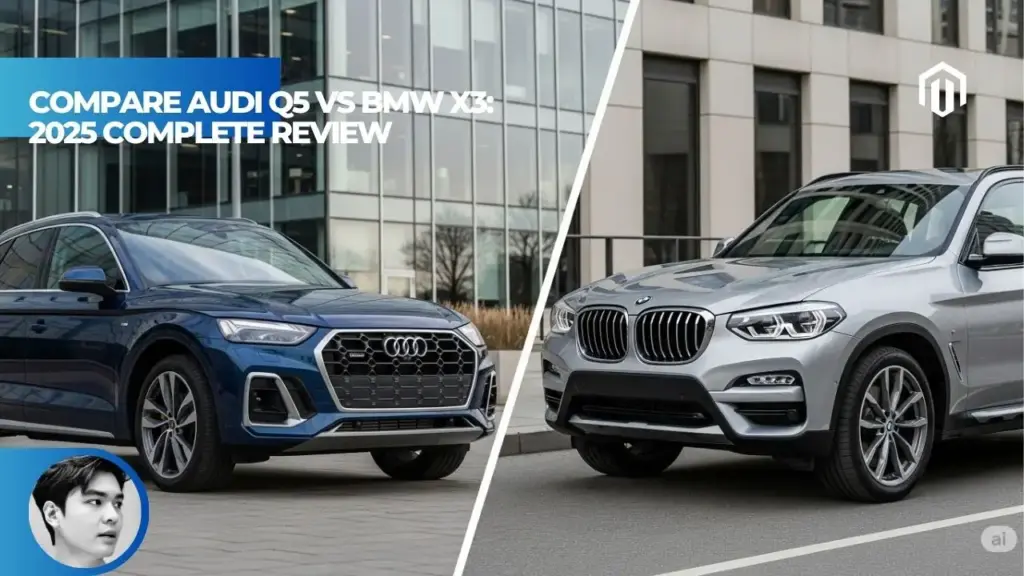
The 2026 BMW X3 30 xDrive, starting at $52,650, is the better choice for drivers seeking sportier handling and greater cargo practicality, effective July 2026. Conversely, the 2026 Audi Q5 40 TFSI, priced from $52,800, excels for those prioritizing a quiet, highly refined cabin, standard Quattro all-wheel drive, and a slightly higher base horsepower of 268 hp.
Key takeaways:
- The BMW X3 provides slightly more cargo space with 32 cubic feet behind the second row compared to the Audi Q5’s 28 cubic feet.
- Both luxury SUVs feature 48-volt mild-hybrid (MHEV) technology for 2026 to improve fuel efficiency and start-stop smoothness.
- The Audi Q5 offers an advanced “Digital Stage” interior with a massive 14.5-inch OLED touchscreen.
- BMW’s X3 M50 xDrive performance variant delivers 393 horsepower, significantly outpacing the Audi SQ5’s 362 horsepower.
- Base pricing is exceptionally competitive, with only a $150 difference between the entry-level models in the US market.
2026 Price and Trims Comparison
The 2026 BMW X3 30 xDrive starts at an MSRP of $52,650, while the 2026 Audi Q5 40 TFSI begins at a nearly identical $52,800 in the United States, based on official data from BMW USA. Both of these compact luxury SUVs represent the entry point into their respective brand’s highly popular midsize crossover segment.
When you dive into the trim levels and options, the pricing structures diverge based on the level of performance and luxury features you desire. For the 2026 model year, BMW has streamlined its naming conventions, dropping the “i” from its gas-powered models. The high-performance BMW X3 M50 xDrive starts at $67,850, bringing a substantial leap in power and standard M Sport styling. On the other hand, the high-performance Audi SQ5 typically commands a similar premium but focuses slightly more on balanced daily drivability rather than aggressive track performance.
Here is a quick look at the base pricing comparison for the 2026 model year:
| Feature/Model | 2026 Audi Q5 40 TFSI | 2026 BMW X3 30 xDrive |
|---|---|---|
| Starting MSRP (US) | $52,800 | $52,650 |
| Performance Variant | SQ5 (Pricing varies) | X3 M50 xDrive ($67,850) |
| Standard Drivetrain | Quattro AWD | xDrive AWD |
| Required Fuel | Premium Unleaded | Premium Unleaded |
If you are exploring the pre-owned market or looking at older generations instead of the brand-new 2026 versions, you might want to research the Audi Q5 years to avoid to ensure you are getting the most reliable model year for your investment. However, for 2026, both vehicles come with robust standard equipment, including advanced safety suites, panoramic sunroofs (standard on some trims, optional on others), and premium audio options.
Performance, Engines and Handling
The 2026 Audi Q5 delivers 268 horsepower from its standard 2.0-liter turbocharged four-cylinder engine, utilizing a 7-speed dual-clutch transmission to send power to all four wheels via Audi’s renowned Quattro system. This powertrain setup is designed for seamless, quiet acceleration and unwavering stability in adverse weather conditions. The dual-clutch transmission shifts rapidly, but it is tuned more for comfort than aggressive downshifting, making the Q5 an exceptional highway cruiser.
In contrast, the 2026 BMW X3 30 xDrive is powered by a 2.0-liter turbocharged inline-four that produces 255 horsepower. While slightly down on paper compared to the Audi, the BMW utilizes an 8-speed automatic transmission that is widely considered the best in the industry. It provides rapid, intuitive shifts that adapt instantly to your driving style. Combined with BMW’s rear-biased xDrive system, the X3 feels significantly more athletic and eager to rotate through corners, living up to the brand’s “Ultimate Driving Machine” ethos.
- 2026 Audi Q5 40 TFSI: 2.0L Turbo Inline-4 | 268 hp | 7-Speed Dual-Clutch | 0-60 mph in ~5.8 seconds.
- 2026 BMW X3 30 xDrive: 2.0L Turbo Inline-4 | 255 hp | 8-Speed Automatic | 0-60 mph in ~6.0 seconds.
Both models incorporate 48-volt mild-hybrid systems for 2026. This technology doesn’t allow for electric-only driving, but it drastically smooths out the automatic engine start-stop function and provides a slight torque boost off the line, reducing turbo lag. For buyers who want even more power, the BMW X3 M50 xDrive’s 393-horsepower inline-six engine provides a visceral thrill that the 362-horsepower Audi SQ5 struggles to match in terms of raw acceleration and exhaust note.
Expert view (neutral): The BMW X3’s rear-biased xDrive system makes it feel more engaging on winding roads, whereas Audi’s Quattro focuses on unwavering stability, comfort, and predictable understeer at the limit.
Interior Quality, Tech and Cargo Space
The 2026 BMW X3 offers 32 cubic feet of cargo space behind the second row, making it noticeably more spacious than the Audi Q5, which provides 28 cubic feet. This 4-cubic-foot difference might not sound massive on paper, but in the real world, it equates to an extra medium-sized suitcase or significantly more room for large strollers and bulky grocery runs. When the rear seats are folded down, the X3 continues to lead in overall utility.
Inside the cabin, the philosophies of the two German brands diverge sharply. The 2026 Audi Q5 introduces the brand’s new “Digital Stage” interior architecture. This setup includes a stunning, curved 11.9-inch digital instrument cluster paired seamlessly with a massive 14.5-inch OLED central touchscreen. The OLED technology ensures incredibly deep blacks and vibrant colors, making the infotainment system a visual centerpiece. Audi also offers an optional 10.9-inch passenger display, allowing the front passenger to stream video content or assist with navigation without distracting the driver.
The BMW X3, meanwhile, utilizes the sweeping BMW Curved Display running Operating System 9. It is highly intuitive and heavily reliant on touch and voice commands, reducing physical clutter on the dashboard. While both interiors utilize premium materials like open-pore wood, genuine aluminum, and high-quality synthetic or real leather, the Audi Q5 leans toward a minimalist, ultra-modern aesthetic, while the BMW X3 retains a slightly sportier, driver-centric cockpit feel.
If you are cross-shopping outside of the German brands and want to see how the Q5 stacks up against Japanese luxury, you can compare Audi Q5 vs Lexus RX 350 to see if a slightly larger, comfort-oriented alternative fits your lifestyle better.
Real Ownership Costs and Value
While the base MSRPs are separated by a mere $150, the 2026 BMW X3’s superior fuel economy can save the average driver roughly $150 to $200 annually on premium fuel costs compared to the Audi Q5. The BMW X3 30 xDrive achieves an impressive EPA-estimated 27 mpg city, 33 mpg highway, and 29 mpg combined. The Audi Q5, while efficient, traditionally falls a few mpg short of the BMW’s benchmark, hovering around 24 to 25 mpg combined, depending on final EPA certification for the 2026 MHEV system.
Over a typical five-year ownership period, the total cost of ownership goes beyond just fuel. Both vehicles require strict adherence to premium maintenance schedules. If you are concerned about long-term upkeep, reviewing the typical maintenance cost for BMW reveals that out-of-warranty repairs for the X3 can be expensive, though this is equally true for the Audi Q5. Both brands offer identical 4-year/50,000-mile limited warranties.
Who Should Buy the 2026 Audi Q5?
The Audi Q5 is the superior choice for buyers who prioritize a whisper-quiet cabin, cutting-edge interior displays, and a ride quality that isolates passengers from harsh road imperfections. It is the quintessential luxury commuter SUV, offering effortless power and sophisticated styling that doesn’t scream for attention.
Who Should Buy the 2026 BMW X3?
The BMW X3 is the undeniable winner for driving enthusiasts who need the practicality of an SUV but refuse to give up sharp steering and engaging handling. Furthermore, families with younger children will greatly appreciate the X3’s superior cargo capacity and slightly more accommodating rear-seat legroom.
Which is the Better 2026 SUV for You?
Choosing between the 2026 Audi Q5 and the 2026 BMW X3 ultimately comes down to your personal priorities: comfort and technology versus driving dynamics and cargo space. Both are exceptional vehicles that justify their luxury price tags through stellar build quality, advanced mild-hybrid powertrains, and prestigious brand cachet.
Note (neutral): Dealership pricing, lease rates, and manufacturer incentives fluctuate monthly. It is highly recommended to check your local inventory and request test drives for both models to experience the distinct differences in ride quality and infotainment interfaces firsthand.
Frequently Asked Questions about Audi Q5 and BMW X3
Which is more reliable, Audi Q5 or BMW X3?
Both the 2026 Audi Q5 and the BMW X3 offer average to above-average reliability ratings for the compact luxury SUV segment. They are backed by identical 4-year/50,000-mile warranties in the United States. Long-term ownership costs tend to be similar, as both highly engineered German vehicles require strict adherence to factory maintenance schedules and the use of premium synthetic fluids.
Is the Audi Q5 bigger than the BMW X3?
The BMW X3 is slightly larger on the inside, offering 32 cubic feet of cargo space behind the second row of seats, compared to the Audi Q5’s 28 cubic feet. While exterior dimensions are very similar, making both easy to park in urban environments, the BMW’s boxier rear design translates to better practicality for hauling bulky items. Both SUVs comfortably seat five passengers.
Do both luxury SUVs require premium gas?
Yes, both the 2026 Audi Q5 and the 2026 BMW X3 strictly require premium unleaded gasoline, typically 91 octane or higher, based on official data from Audi USA. Utilizing lower-grade fuel can result in reduced horsepower, decreased fuel economy, and potential long-term engine knocking, negating the benefits of their advanced turbocharged engines.
Does the BMW X3 have a plug-in hybrid option?
BMW has announced a plug-in hybrid electric vehicle (PHEV) variant, known as the X3 30e xDrive, joining the global lineup for the 2026 model year. This model offers an electric-only driving range suitable for short daily commutes before the gasoline engine engages. Audi also continues to offer a PHEV variant of the Q5, known as the Q5 TFSI e, directly competing in the electrified luxury segment.
Which SUV is faster, the Audi SQ5 or the BMW X3 M50?
The 2026 BMW X3 M50 xDrive is significantly faster than its Audi counterpart. The BMW produces 393 horsepower from its turbocharged 3.0-liter inline-six engine, propelling the SUV from 0 to 60 mph in approximately 4.4 seconds. The Audi SQ5 features a 3.0-liter turbocharged V6 producing 362 horsepower, making it exceptionally quick, but slightly slower than the aggressively tuned BMW.
Does the Audi Q5 offer an air suspension system?
Yes, the Audi Q5 offers an optional adaptive air suspension on higher trim levels, which provides an incredibly comfortable, cloud-like ride quality and the ability to adjust the vehicle’s ride height. This is a highly sought-after feature for buyers prioritizing luxury comfort, as the BMW X3 relies on traditional adaptive dampers and does not offer a full air suspension system.

