

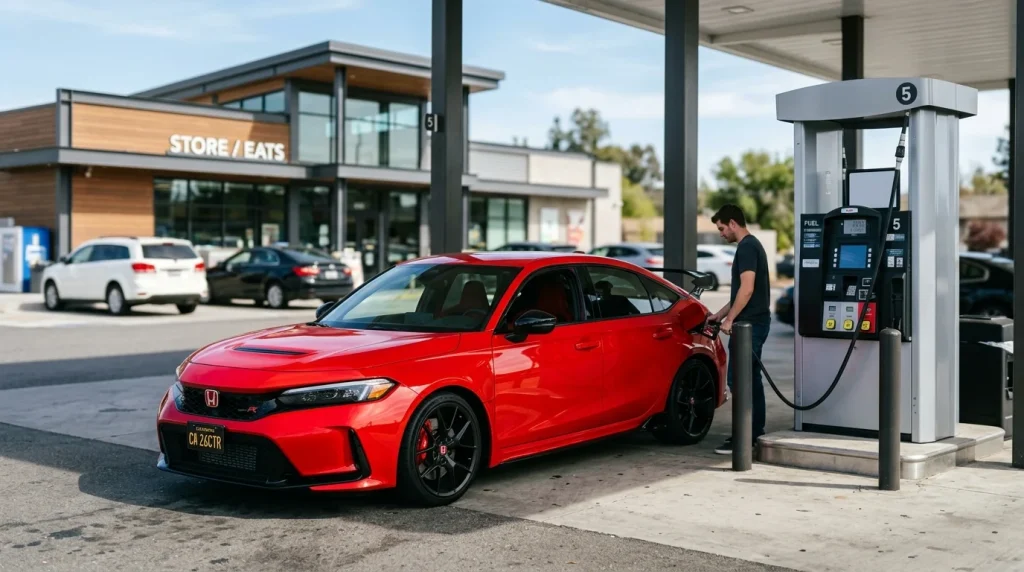
For anyone asking what is the gas mileage of the Civic Type R, the Honda performance hatchback delivers an EPA-rated fuel economy of 22 mpg in the city, 28 mpg on the highway, and 24 mpg combined. Fitted with a 12.4-gallon fuel tank, the vehicle yields an estimated driving range of 272 miles in urban driving and 347 miles during sustained highway cruising. Independent highway testing at a steady 75 mph demonstrates that the vehicle can return up to 30 mpg when driven smoothly under favorable conditions.
Key takeaways:
- Official EPA ratings for the current FL5 generation stand at 22 mpg city, 28 mpg highway, and 24 mpg combined.
- Real-world mixed commuting typically ranges between 23 and 26 mpg, while aggressive track driving drops efficiency below 12 mpg.
- The 12.4-gallon tank capacity creates an average highway cruising range of roughly 340 miles per fill-up.
- Honda mandates premium unleaded fuel with a 91-octane rating or higher to prevent ignition timing retard and maintain full power.
Official MPG foundations
The modern Honda Civic Type R is engineered around a 2.0-liter turbocharged inline-4 engine (internal code K20C1) generating 315 horsepower and 310 lb-ft of torque. Clean airflow delivery is critical for forced-induction efficiency, where understanding how an engine air filter functions helps explain why intake restrictions increase pumping losses and degrade baseline mileage. Because power delivery routes exclusively through a 6-speed manual transmission to the front wheels, fuel consumption depends directly on gear selection and engine load.
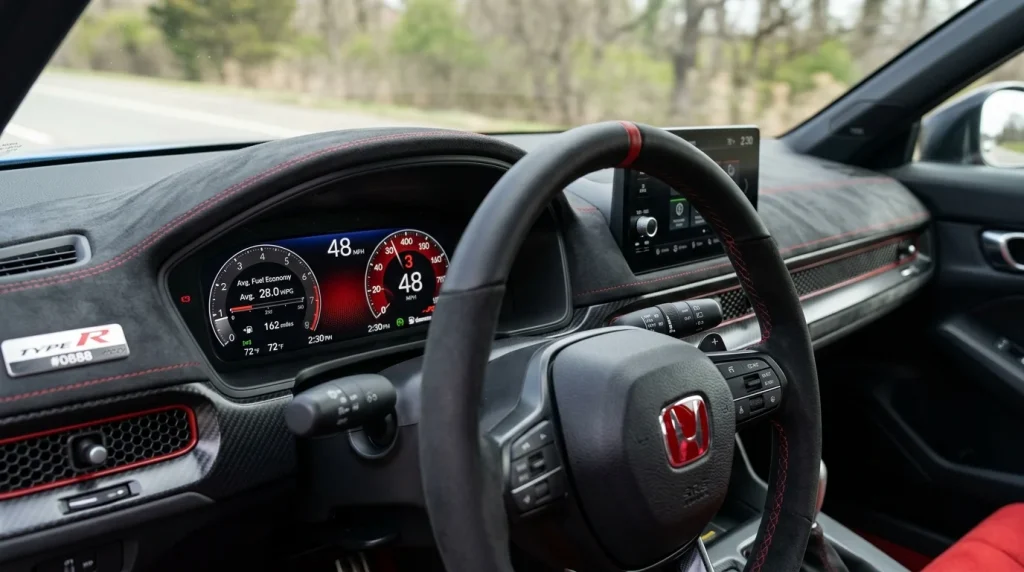
According to official certification data published in the U.S. EPA Fuel Economy test schedules, the Environmental Protection Agency rates the Civic Type R at 22 mpg for city driving, 28 mpg for highway driving, and 24 mpg in combined driving cycles. These figures remain uniform across all model years of the eleventh-generation FL5 platform from 2023 through 2026.
| Metric | Official Specification | Operating Note |
|---|---|---|
| City Fuel Economy | 22 mpg | Measured across urban start-and-stop cycles |
| Highway Fuel Economy | 28 mpg | Measured across steady high-speed simulation |
| Combined Fuel Economy | 24 mpg | Weighted average: 55% city, 45% highway |
| Fuel Tank Capacity | 12.4 gallons | Total tank volume including reserve |
| Estimated City Range | 272.8 miles | Calculated at 22 mpg on full capacity |
| Estimated Highway Range | 347.2 miles | Calculated at 28 mpg on full capacity |
| Recommended Fuel Grade | Premium (91+ Octane) | Required for rated horsepower and engine efficiency |
EPA mpg figures
The official numbers provide a baseline for vehicle comparison across the automotive industry. A combined rating of 24 mpg places the Civic Type R in an advantageous position relative to its engine output, outpacing many heavier all-wheel-drive competitors in curb weight efficiency.
The total theoretical range of 297 miles in mixed driving reflects the compact dimensions of the standard Civic hatchback chassis. Because the fuel tank holds 12.4 gallons, frequent high-rpm acceleration triggers the low-fuel warning lamp earlier than in standard commuter cars.
How EPA tests work
The Environmental Protection Agency measures automotive efficiency inside specialized laboratories using a chassis dynamometer. Rather than driving on open public roads, technicians secure the vehicle on rolling drums that simulate vehicle inertia and aerodynamic drag.
During the Federal Test Procedure (FTP-75), the vehicle undergoes a simulated urban driving cycle that includes cold starts, prolonged idling, and frequent stops. The Highway Fuel Economy Test (HWFET) simulates open road travel at an average speed of 48.3 mph with no stops. Technicians capture the tailpipe emissions directly using a collection hose, calculating fuel consumption by measuring total carbon mass in the exhaust stream rather than relying on fuel tank dipsticks. Detailed schedules and dynamometer adjustment factors are published directly on the official federal test schedules portal.
Real-world mpg and influencing factors
Laboratory dyno ratings serve as a standardized baseline, but real-world fuel economy fluctuates significantly based on external ambient conditions, topography, and driving aggression.
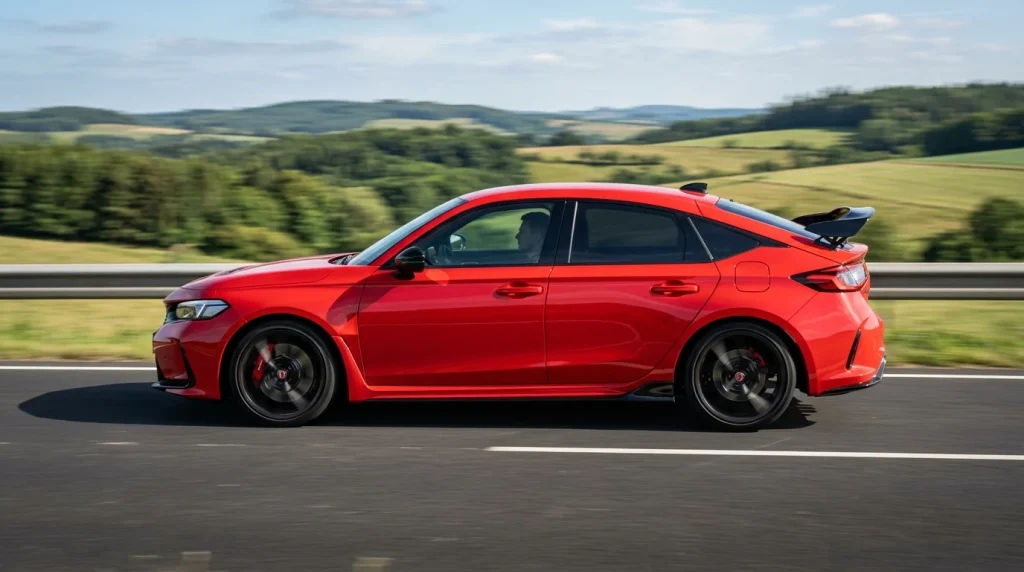
In independent road tests conducted by automotive publications, the FL5 generation demonstrated strong long-distance touring capabilities. During instrumented testing published by Car and Driver, a Civic Type R recorded 30 mpg on a 75-mph highway test loop, beating its official EPA highway estimate by 2 mpg.
Drive modes and mpg
The Civic Type R features four distinct drive modes selectable via the center console toggle: Comfort, Sport, Individual, and +R. These modes alter throttle mapping, adaptive damper stiffness, steering weight, and engine sound enhancement.
- Comfort Mode: Softens throttle sensitivity and requires deeper pedal travel to demand boost. This progressive throttle response smooths out low-speed inputs and reduces unintended fuel dumping in city traffic.
- Sport Mode: Sharpens throttle response for faster boost buildup, slightly increasing transient fuel consumption during city maneuvers. Unlike the previous FK8 generation that reset to Sport mode on every startup, the FL5 generation features Drive Mode Memory, retaining the previously active setting (Individual, Sport, or Comfort) across ignition cycles.
- +R Mode: Configured for closed-circuit driving. The engine computer optimizes throttle aggression for immediate response out of corners, while the instrument cluster switches to a dedicated tachometer with shift lights. Sustained driving in +R mode lowers fuel economy significantly due to higher average engine speeds.
- Individual Mode: Allows drivers to pair Comfort engine response with stiffer suspension or heavier steering, offering a custom balance between efficiency and handling control.
Turbocharged powertrains are highly sensitive to fuel quality. Running a lower octane fuel forces the engine control module to retard ignition timing when knock sensors detect detonation (spark knock), which degrades both combustion efficiency and throttle responsiveness. As detailed in SAE International technical research, retarding ignition timing suppresses post-spark detonation, whereas pre-ignition occurs before the spark plug fires and cannot be prevented by ignition timing retardation alone. To understand how octane ratings interact with forced-induction calibration, reviewing octane ratings in turbocharged engines explains how higher octane fuels resist heat-induced knocking under heavy boost.
Similarly, auxiliary electrical loads and cabin climate settings consume engine power. Running maximum cooling in extreme heat increases parasitic draw on the serpentine belt, a factor detailed in technical evaluations of automotive air conditioning systems and their effect on powertrain efficiency.
Real-world testing caveats
Aggressive driving on mountain switchbacks or race tracks causes fuel consumption to rise sharply. Under track conditions where the turbocharger operates at peak boost pressure of 25.2 psi, owners report fuel economy figures dropping to 8 to 11 mpg. Conversely, conservative highway driving in sixth gear at 65 to 70 mph routinely yields 29 to 32 mpg. The Civic Type R uses a small-displacement 2.0-liter engine that behaves like two distinct powerplants. When off boost during steady cruising below 3,000 rpm, it consumes fuel at the rate of a conventional commuter hatchback. Once the driver crosses into positive manifold boost pressure, the direct-injection system increases fuel flow substantially to maintain safe air-fuel ratios and prevent cylinder overheating.
Note: Fuel blends change seasonally in North America. Winter gasoline contains higher butane content to assist cold starts, which reduces energy density per gallon and typically lowers observed winter fuel economy by 1.5 to 3 mpg.
Maintenance, conditions, and maximizing mpg
Maintaining peak mechanical condition ensures the Civic Type R achieves its rated fuel efficiency over years of ownership. Several mechanical systems directly influence rolling resistance and thermal efficiency.
| Maintenance Factor | Impact on Efficiency | Recommended Action |
|---|---|---|
| Tire Pressure | 1 to 3% mpg loss per 3 psi drop | Check monthly when cold to maintain 35 psi front / 33 psi rear |
| Engine Air Filter | Restricts airflow and increases pumping losses | Inspect every 15,000 miles; replace when dust accumulates |
| Spark Plugs | Incomplete combustion causes unburned fuel loss | Replace iridium plugs at 60,000 miles or per severe schedule |
| Engine Oil Viscosity | Higher internal fluid friction | Use factory-recommended 0W-20 full synthetic motor oil |
| Wheel Alignment | Excessive scrub drag increases rolling resistance | Verify toe and camber settings after track sessions |
Practical mpg-maximizing tips
- Maintain specified cold tire inflation: The 265/30ZR19 Michelin Pilot Sport 4S tires have wide contact patches that increase drag when underinflated. Regularly inspecting pressures prevents rolling drag and keeps the dashboard tire pressure warning system from triggering.
- Keep intake paths unrestricted: Direct-injection turbocharged engines require clean airflow. Replacing a dirty filter element protects the turbo compressor wheel and avoids engine control corrections.
- Manage cabin air flow smoothly: Inspecting the interior ventilation system and ensuring smooth cabin blower motor operation prevents electrical overload on the alternator.
- Use sixth gear on open highways: The 6-speed manual gearbox features an overdrive sixth gear ratio of 0.734 with a 3.842 final drive (specified in Honda technical releases), allowing the engine to turn at approximately 2,500 rpm at 70 mph. Shifting early into sixth during flat highway cruising delivers the largest single fuel economy gain.
- Minimize extended vehicle idling: Modern direct-injection systems use zero fuel during coasting in gear due to deceleration fuel cut-off, whereas standing idle burns roughly 0.3 gallons of premium fuel per hour without moving the vehicle.
Comparison context and what to expect
To evaluate whether the Civic Type R fits daily transportation needs, comparing its fuel consumption against direct performance hatchbacks and sport compacts provides useful perspective.
| Vehicle Model | Powertrain | City MPG | Highway MPG | Combined MPG | Tank Size | Fuel Type |
|---|---|---|---|---|---|---|
| Honda Civic Type R (FL5) | 2.0L Turbo FWD (6-speed Manual) | 22 | 28 | 24 | 12.4 gal | Premium (91+) |
| Volkswagen Golf R (Mk8) | 2.0L Turbo AWD (7-speed DSG) | 22 | 31 | 25 | 14.5 gal | Premium (91+) |
| Toyota GR Corolla | 1.6L Turbo AWD (6-speed Manual) | 21 | 28 | 24 | 13.2 gal | Premium (91+) |
| Hyundai Elantra N | 2.0L Turbo FWD (6-speed Manual) | 21 | 29 | 24 | 12.4 gal | Premium (91+) |
| Honda Civic Si | 1.5L Turbo FWD (6-speed Manual) | 27 | 37 | 31 | 12.4 gal | Regular (87) |
The Volkswagen Golf R achieves 31 mpg on the highway due to its taller seventh gear in the dual-clutch transmission and larger 14.5-gallon fuel tank, giving it a highway range advantage of nearly 100 miles. However, the Civic Type R matches or exceeds its manual rivals, including the three-cylinder Toyota GR Corolla and Hyundai Elantra N.
When calculating long-term budgets, factoring in premium fuel prices and wear items helps set realistic expectations. Examining routine maintenance cost planning highlights how performance consumables such as high-temperature brake fluid, low-profile performance tires, and premium fuels affect the total cost of ownership.
Sources and credibility
Fuel efficiency data and mechanical details presented in this guide are derived from verified official standards and certified testing institutions:
- U.S. Environmental Protection Agency (EPA): Official light-duty automotive fuel economy certification database and Federal Test Procedure documentation.
- American Honda Motor Co., Inc.: Factory technical specifications, transmission gear ratios, engine displacement, and owner manual service requirements.
- Independent Automotive Media: Instrumented 75-mph highway fuel economy evaluations conducted under controlled ambient conditions.
Internal-link intake and navigation
Understanding the relationship between performance engineering and running expenses helps drivers make informed vehicle choices. Readers evaluating different market segments can explore broader perspectives on comparing ownership costs across performance tiers to evaluate depreciation, fuel demands, and routine service variables across modern performance vehicles.
Frequently asked questions about Civic Type R gas mileage
What is the EPA estimate for Civic Type R mpg?
Official federal testing rates the Honda Civic Type R at 22 mpg city, 28 mpg highway, and 24 mpg combined. These ratings apply across the 2023, 2024, 2025, and 2026 FL5 generation models equipped with the 2.0-liter turbocharged engine and 6-speed manual gearbox.
Does real-world mpg match EPA?
Yes, real-world testing shows the Civic Type R meets or exceeds its official highway rating when driven at steady highway speeds. Independent 75-mph highway tests achieved 30 mpg, while mixed everyday suburban driving typically yields between 23 and 26 mpg.
How do drive modes affect mpg?
Drive modes modify throttle mapping and transient boost response. Comfort mode relaxes throttle aggression and encourages smoother acceleration, which improves city fuel economy. Sport and +R modes sharpen throttle response, causing the turbocharger to build boost earlier and increasing fuel consumption during spirited driving.

