


When evaluating what car has the best air conditioning for the back seat, the Toyota Grand Highlander and Kia Carnival lead the family vehicle segment. The Grand Highlander features ceiling-mounted AC vents in both rear rows backed by a dedicated digital controller. The Kia Carnival incorporates an independent rear evaporator core with high-velocity overhead ducts that cool car seats rapidly. For luxury three-row shoppers, the Volvo XC90 provides quad-zone automatic climate control with face-level B-pillar vents and advanced particulate air purification.
Key takeaways:
- Ceiling-mounted and upper pillar vents cool rear passengers significantly faster than floor-level or center console outlets.
- True dual-evaporator systems run separate refrigerant lines to the back of the cabin, delivering ice-cold air without draining front-cabin blower power.
- The Toyota Grand Highlander, Kia Carnival, and Chrysler Pacifica lead their respective categories in total rear CFM airflow.
- In newer vehicles, automated Eco HVAC and passenger-sensing modes like S-Flow can restrict rear airflow unless manually disabled in climate menus.
Methodology and criteria for rear-seat cooling
Evaluating vehicle air conditioning for backseat passengers requires looking beyond the dashboard controls. In large two-row and three-row cabins, cooling performance depends on thermal dynamics, duct routing, blower motor output, and heat load mitigation.
Vehicle cabins accumulate intense radiant heat through expansive windshields, side windows, and panoramic sunroofs. On a 90 degree Fahrenheit afternoon, interior roof and glass temperatures regularly exceed 140 degrees Fahrenheit. If a vehicle relies on a single front-mounted evaporator to push chilled air across ten to fifteen feet of open space, rear passengers remain uncomfortable for the first twenty minutes of driving.
To establish which models provide superior backseat air conditioning, our evaluation analyzes four core engineering factors:
- Evaporator architecture: Whether the vehicle uses a single front cooling core with extended plastic ducts or a genuine dual-evaporator system equipped with secondary expansion valves and rear cooling coils. Technical analysis published by SAE International demonstrates that secondary expansion valve cycles maintain dedicated rear cooling capacity without compromising front cabin airflow.
- Vent placement and geometry: The location of the air discharge outlets. Vents positioned in the roof headliner or side B-pillars provide direct airflow to occupant upper bodies, whereas console vents often get blocked by cargo or car seat shells.
- Airflow volume (CFM) and blower capacity: The static pressure generated by the climate system. Understanding how a dedicated car blower motor works explains why independent rear fan assemblies sustain high cubic-feet-per-minute delivery through long roof runs.
- Compressor displacement and powertrain coupling: How the system maintains compressor speed during idle or stop-and-go traffic. Standard procedures for diagnosing a failing car AC compressor highlight the performance differences between mechanical belt-driven pumps and high-voltage electric compressors found in modern hybrids.
According to automotive thermal management research conducted by Senior Engineer John Rugh at the National Renewable Energy Laboratory (NREL), direct localized airflow delivered to passenger breathing zones reduces perceived thermal discomfort by up to 30 percent compared to indirect floor ventilation during initial cabin pull-down phases.
Numerical benchmarks and real-world cooling performance
In laboratory pull-down tests simulating a vehicle parked in direct sunlight under 100 degree Fahrenheit ambient conditions, climate systems show dramatic performance variations between rows. Standard two-row crossovers with console-only rear vents often experience a 12 to 15 degree temperature difference between the front driver seat and the second row during the first fifteen minutes of operation.
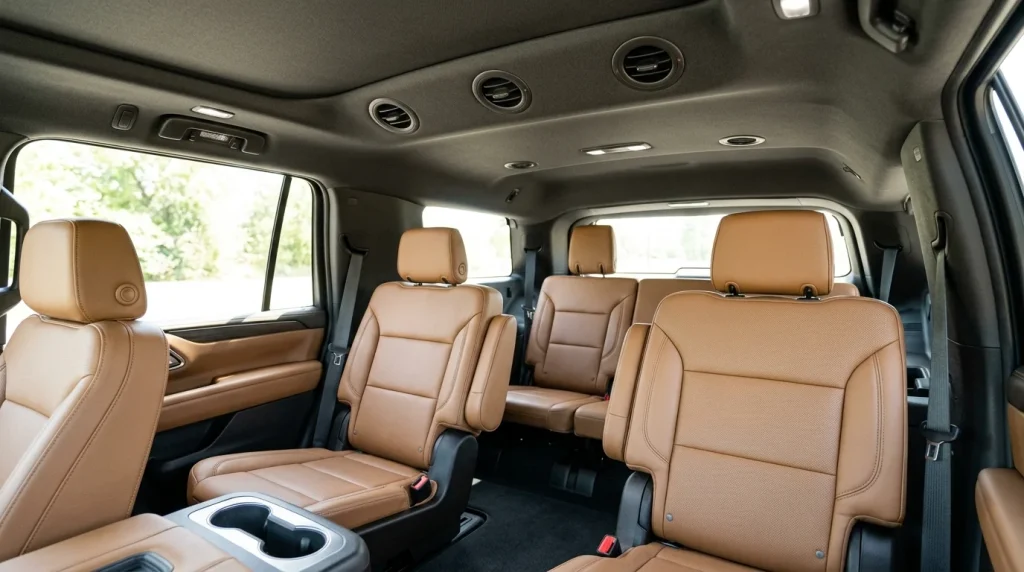
In contrast, vehicles engineered with dedicated rear evaporators and roof-integrated ducting cut the temperature differential across all rows to under 3 degrees Fahrenheit within eight minutes.
The table below summarizes key HVAC engineering specifications for top family models:
| Vehicle Model | Segment | Climate Zones | Rear Evaporator Architecture | Primary Rear Vent Locations | Unique Climate Technology |
|---|---|---|---|---|---|
| Toyota Grand Highlander | Midsize 3-Row SUV | Tri-Zone Standard | Dedicated Dual Evaporator | Headliner Ceiling (Rows 2 & 3) | Independent Digital Rear Controls |
| Kia Carnival | Multi-Purpose Vehicle | Tri-Zone (SX / SX-P) | Dedicated Rear Core Unit | Headliner Ceiling (Rows 2 & 3) | 3-Way Mode Direction Selector |
| Toyota Sienna | Hybrid Minivan | Tri-Zone / Quad-Zone | Dual Evaporator with Electric Pump | Headliner Ceiling (Rows 2 & 3) | High-Voltage Electric Compressor |
| Chrysler Pacifica | Minivan | Tri-Zone Standard | D-Pillar Mounted Evaporator | Headliner Ceiling (Rows 2 & 3) | Hybrid Remote Pre-Conditioning |
| Volvo XC90 | Luxury Midsize SUV | Quad-Zone Standard | High-Capacity Dual Unit | B-Pillars & Console | CleanZone PM 2.5 Electrostatic Filter |
| Audi Q7 | Luxury 3-Row SUV | Quad-Zone Available | Multi-Sensor Dual Evaporator | B-Pillars & Center Console | Sunlight Angle Heat Compensation |
| Jeep Grand Cherokee L | Full-Size 3-Row SUV | Quad-Zone Available | Dedicated Rear Quarter Core | B-Pillars & C-Pillars | Slimline High-Velocity Side Vents |
Replacing complex multi-zone parts down the road requires understanding long-term maintenance, especially when evaluating dual-zone car AC compressor replacement costs across different mechanical configurations. High-end platforms built under strict Audi luxury vehicle manufacturing standards use variable-displacement compressors that modulate displacement smoothly to prevent temperature cycling in the rear cabin.
Top vehicle contenders by segment
Every vehicle segment addresses rear passenger climate control through different packaging strategies. Minivans offer the largest physical interior volume, forcing engineers to install large-capacity auxiliary cooling units. Midsize and full-size three-row SUVs must balance third-row packaging against cargo capacity, leading to innovative vent routing.
Toyota Grand Highlander (Midsize SUV Winner)
The Toyota Grand Highlander stands out among family SUVs by making ceiling-mounted vents standard equipment for both the second and third rows. Rather than blowing air solely from the back of the center console, overhead vents direct chilled air straight down toward passenger seating positions.
The Grand Highlander features an independent digital control panel mounted on the rear of the front console. Second-row passengers can select target temperatures and adjust fan speed independently. Dual evaporator cores ensure that running the rear system at maximum fan speed does not rob air pressure or cooling capacity from the driver and front passenger.
Kia Carnival (Minivan Winner)
The Kia Carnival functions as a benchmark for multi-row passenger comfort. It packages an independent rear evaporator and dedicated blower motor in the passenger-side quarter panel. Chilled air travels through insulated roof ducts to four individually adjustable circular ceiling vents.
The Carnival climate interface includes a digital headliner panel with three selectable airflow distribution modes: ceiling-only, floor-only, or bi-level split airflow. In top trims equipped with reclining VIP Lounge Seats, second-row passengers can recline directly beneath the overhead air stream. The Carnival Hybrid variant pairs this setup with an electric compressor that keeps cooling active even when the gasoline engine shuts off at red lights.
Chrysler Pacifica (Versatile Family Pick)
The Chrysler Pacifica routes its rear climate ducting through the side pillars and headliner to preserve its signature Stow ‘n Go folding floor system. Because the seats fold flat into the floor, floor-level ductwork is minimized, pushing primary air delivery to overhead vents. Cabin ventilation packaging varies considerably across vehicle formats, and evaluating whether the BMW X5 has third-row seating illustrates how luxury crossover layouts differ from dedicated minivan ceiling duct networks.
The Pacifica Plug-in Hybrid adds another major advantage: remote cabin pre-conditioning. Owners can activate the climate system via a smartphone app while the vehicle is plugged into a charger, cooling the interior to 72 degrees Fahrenheit before passengers step inside without expending battery range.
Volvo XC90 and Audi Q7 (Luxury Champions)
In the luxury class, the Volvo XC90 and Audi Q7 prioritize air purity and draft-free thermal stability. The XC90 places its second-row vents directly in the B-pillars at torso level. This avoids blowing cold air onto the top of passenger heads while ensuring rapid heat extraction from the side window glass. Volvo incorporates its CleanZone filtration system, which uses an electrostatic filter to remove particulate matter before air reaches the cabin.
The Audi Q7 offers an available four-zone climate control setup with digital touch capacitive controls for rear occupants. Audi links the climate management unit to solar radiation sensors on the dashboard and roof, automatically increasing airflow to the side of the vehicle exposed to direct sun. Analyzing the interior dimensions and length of the Audi Q5 demonstrates why larger three-row platforms require dedicated multi-zone sensors rather than relying on standard two-row console registers.
Vent design and zoning details
Vent geometry plays a critical role in passenger comfort. Ceiling-mounted circular barrel vents allow occupants to rotate the air stream 360 degrees and throttle airflow volume. Pillar-mounted vents positioned along the B-pillar and C-pillar provide broad horizontal coverage that cools passenger chests and shoulders directly.
For parents travelling with infants, vent placement directly impacts child seat safety. When adjusting the car seat newborn insert in a rear-facing infant carrier, center console vents are almost completely blocked by the thick plastic seat shell. Ceiling vents bypass this obstruction entirely by directing air over the top of the carrier, keeping infants within safe temperature thresholds.
Thermal comfort is equally essential when following safety guidelines around the 2-hour car seat rule, as infants have limited ability to regulate their body temperature in stagnant rear cabins. Pillar-mounted vents offer the best balance between draft reduction and rapid cooling for adult passengers. Ceiling vents provide the absolute highest cooling efficiency for young children secured in high-backed child safety seats.
Controls, usability, and rear passenger experience
An advanced HVAC hardware setup is only as good as its control interface. Modern vehicles divide climate control systems into tri-zone and quad-zone layouts.
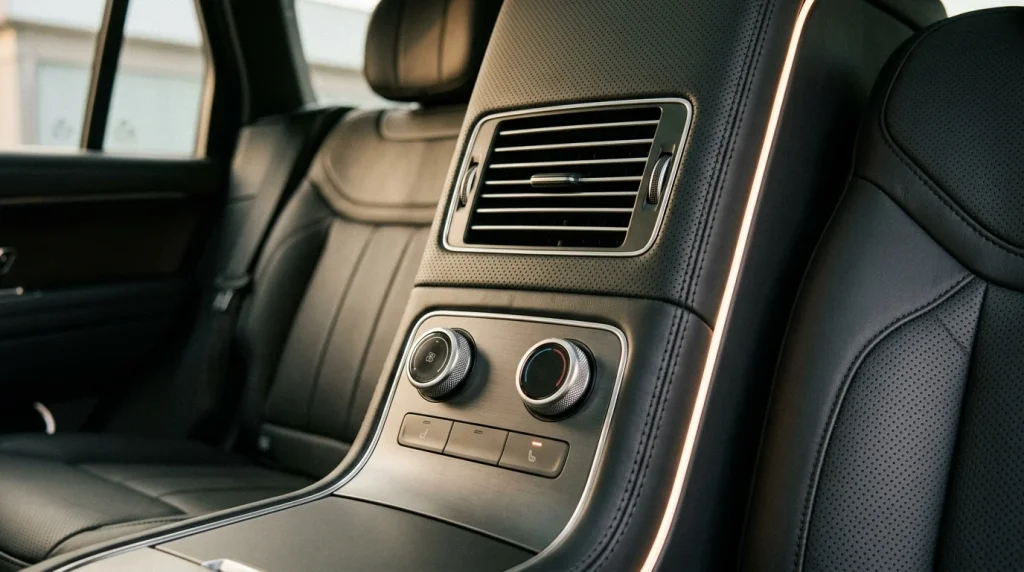
- Tri-zone systems: Provide separate temperature dials for the driver, front passenger, and a single shared temperature zone for all rear passengers.
- Quad-zone systems: Allow the second-row left and second-row right passengers to select distinct temperatures and fan speeds.
Usability issues often arise from front-infotainment lockouts. In models like the Toyota Grand Highlander and Kia Carnival, the front touchscreen includes a “Rear Climate Lock” function. Parents can disable the rear physical buttons to prevent toddlers from playing with fan settings. However, drivers must remember to unlock the system or enable the rear zone manually when adult passengers enter the back.
Driver awareness is critical during summer travel, particularly considering the severe health consequences and legal risks of leaving children unattended in a hot car. Modern rear-occupant alert systems combine ultrasonic cabin motion sensors with climate reminders to prevent heatstroke incidents.
If a vehicle climate system produces unpleasant odors upon startup, identifying why your vehicle HVAC smells like rotten eggs will help distinguish between decaying organic debris in the cabin filter and a leaking battery or catalytic converter issue.
Note: Many vehicles equipped with automatic stop-start technology shut down the AC compressor at traffic stops to save fuel, causing cabin humidity to rise. Switching the driving mode from Eco to Normal or Sport keeps the engine idling and ensures continuous cooling performance.
Energy impact and powertrain efficiency
Operating an auxiliary rear evaporator and secondary blower motor places an additional thermodynamic load on the vehicle powertrain. In traditional internal combustion engine (ICE) vehicles, running maximum dual-zone air conditioning increases fuel consumption by approximately 0.2 to 0.5 gallons per hour during hot weather idling.
In battery electric vehicles (EVs) and plug-in hybrids, climate control draws power directly from the high-voltage traction pack. On a 95 degree Fahrenheit day, running a multi-zone HVAC system at full capacity can reduce total driving range by 10 to 18 percent.
To mitigate this range penalty, manufacturers install smart efficiency algorithms. Toyota uses an automated “S-Flow” control mode across its hybrid lineup. S-Flow uses seat weight sensors to detect occupant presence, automatically closing motorized air flaps to empty rear seats to conserve energy. While efficient, S-Flow occasionally fails to register lightweight rear-facing baby seats, shutting off rear airflow unexpectedly. Disabling S-Flow in the infotainment vehicle settings menu restores full manual blower operation.
Electrical stability is essential for high-draw climate systems. Regularly replacing an aging 12V car battery ensures that auxiliary climate actuators and secondary blower relays receive steady voltage. In severe heat conditions with heavy AC draw, monitoring for signs that your engine is overheating prevents cooling system breakdown under high thermal stress.
Practical takeaways and vehicle recommendations
Selecting the ideal vehicle for backseat cooling depends on your passenger profile, cabin size requirements, and climate conditions:
- For families with infants and toddlers in car seats: Choose the Toyota Grand Highlander or Kia Carnival. Their standard ceiling-mounted air vents blow directly over rear-facing seats, providing immediate heat relief that console vents cannot match.
- For maximum passenger volume and cargo versatility: The Chrysler Pacifica offers powerful D-pillar auxiliary cooling combined with remote pre-conditioning on hybrid models.
- For adult passenger comfort and air filtration: The Volvo XC90 and Audi Q7 deliver draft-free B-pillar ventilation, multi-zone independent climate controls, and high-efficiency particulate filtration.
- For rugged three-row capability: The Jeep Grand Cherokee L provides high-velocity pillar vents across all three rows with optional quad-zone digital controls.
Maintenance directly dictates long-term HVAC performance. A clogged cabin air filter restricting airflow is the primary cause of weak rear ventilation. Inspecting and replacing the cabin air filter every 12,000 miles maintains high blower velocity.
When parking in open lots or leaving a vehicle sitting undriven in extreme heat, using windshield sunshades and ceramic window tint significantly reduces cabin thermal soak. Applying quality ceramic spray wax coatings to protect exterior paint also helps protect clear coat integrity against prolonged ultraviolet exposure.
Frequently Asked Questions
Which SUV has the best air conditioning for rear passengers?
The Toyota Grand Highlander offers the best rear air conditioning among mainstream SUVs due to its standard ceiling-mounted vents for rows two and three, dual-evaporator cooling architecture, and dedicated rear digital thermostat. In the luxury tier, the Volvo XC90 provides exceptional cooling through quad-zone climate controls and B-pillar face-level vents.
Do minivans provide better rear AC than three-row SUVs?
Yes, minivans generally outperform midsize three-row SUVs in rear cooling. Minivans like the Kia Carnival and Chrysler Pacifica feature large dedicated rear evaporator cores and blower motors mounted in the rear quarter panels, delivering high CFM airflow through ceiling vents across large interior spaces.
Why is the air conditioning in the back seat weak in some new cars?
Weak backseat air conditioning is frequently caused by active energy-saving settings. Features like Toyota’s S-Flow mode or generic Eco HVAC settings reduce or deactivate rear blower output when sensors do not register heavy occupant weight. Check the central infotainment climate settings and disable Eco mode to restore maximum rear airflow.
Are ceiling-mounted AC vents better than center console vents?
Ceiling-mounted vents are significantly more effective for passenger cooling than center console vents. Console vents blow air at knee level and are easily blocked by front seatbacks or child safety seats. Ceiling vents direct cold air downward over passenger faces and car seats, accelerating cabin heat extraction.
Which vehicles offer independent quad-zone climate control?
Quad-zone climate control is available on premium and luxury models including the Volvo XC90, Audi Q7, Jeep Grand Cherokee L (Overland and Summit trims), BMW X7, and Mercedes-Benz GLS. Quad-zone systems allow both second-row outboard passengers to adjust their own temperature settings independently.

