


Yes. You can service your Audi at any qualified independent mechanic without voiding your manufacturer warranty. Statutory consumer protection laws grant vehicle owners full legal freedom to choose independent repair shops over franchised dealerships. To preserve your warranty coverage, the independent workshop must strictly follow official Audi maintenance schedules, use factory-approved fluids meeting specifications like VW 504 00 or VW 508 00, and document every service in an accredited digital or physical logbook.
Key takeaways:
- Vehicle owners have full legal protection to select certified independent garages or franchised dealer centers for routine maintenance.
- Servicing an Audi outside an authorized dealership will not void the statutory warranty when factory schedules and fluid standards are met.
- In 2026, independent European auto specialists typically save owners 40% to 50% on labor and routine maintenance costs compared to main dealerships.
- Routine Audi service intervals follow either a 15,000 km (10,000 miles) fixed regime or a 30,000 km (20,000 miles) flexible regime.
- Audi transitioned to the central Digital Service Schedule in 2012, and qualified independent workshops can record maintenance updates online.
- Manufacturer safety recalls and warranty defect repairs must still be performed exclusively at authorized franchised Audi dealerships.
Can You Service Your Audi Anywhere Without Voiding the Warranty?
Car owners are entirely free to choose where to have their Audi serviced. You are not legally or contractually obligated to bring your vehicle to an authorized Audi dealer for routine maintenance, oil changes, brake inspections, or scheduled fluid renewals. Servicing your car at an independent garage will not void your factory warranty as long as the workshop performs the work in accordance with official manufacturer instructions and installs parts of original equipment manufacturer (OEM) matching quality.
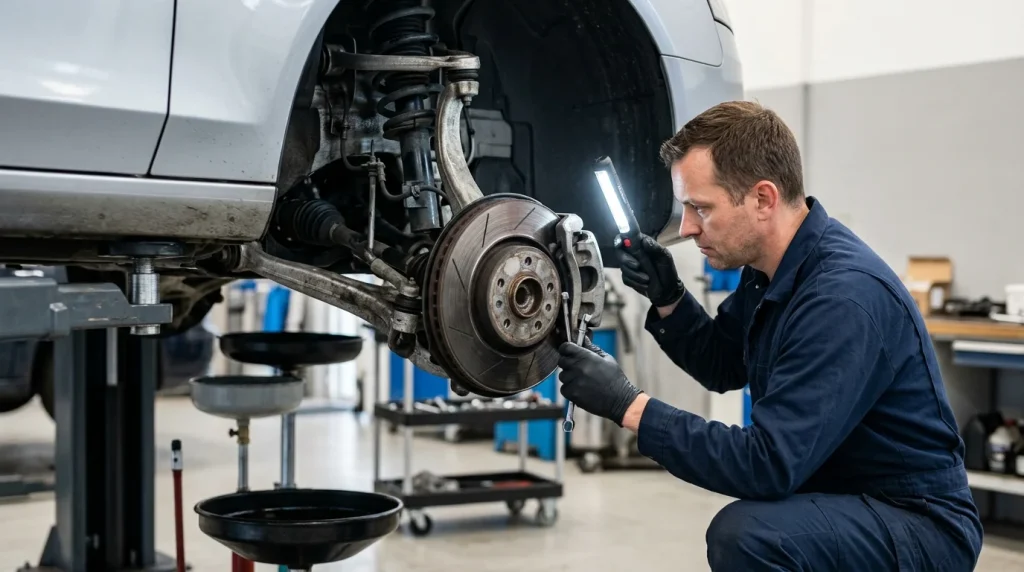
Consumer protection legislation in major global automotive markets explicitly safeguards driver choice:
- United States: The federal Magnuson-Moss Warranty Act of 1975 (15 U.S.C. § 2302(c)), enforced by the Federal Trade Commission (FTC), prohibits vehicle manufacturers from conditioning warranty coverage on the use of franchised dealer service or specific brand-name replacement parts. A manufacturer cannot deny a warranty claim unless they legally prove that an aftermarket component or improper independent workmanship directly caused the specific mechanical failure.
- European Union and United Kingdom: The Motor Vehicle Block Exemption Regulation (MVBER / EU Regulation 461/2010, retained in UK statutory law) prohibits automotive brands from restricting routine servicing to their authorized dealer networks. European vehicle owners maintain full warranty protection from day one when using independent workshops that follow factory service sheets.
For owners evaluating vehicle reliability and common maintenance demands across specific model generations, understanding long-term service profiles is essential. For instance, reviewing Audi Q5 model years with higher maintenance frequency demonstrates how adhering to structured service schedules prevents avoidable mechanical issues across both older and newer platforms. Similarly, cross-referencing documented Audi A4 reliability concerns across specific production runs shows that consistent oil servicing and timely timing chain inspections remain vital whether maintenance occurs at a dealership or an independent specialist.
Owner Rights to Choose Independent Garages
The freedom to choose an independent mechanic gives drivers significant flexibility in managing maintenance budgets, scheduling convenience, and establishing direct communication with technicians. Independent European automotive specialists frequently offer competitive labor rates compared to franchised dealer centers while executing identical routine maintenance procedures.
Independent repair facilities invest heavily in dealer-level diagnostic equipment and specialized tooling. Reputable shops utilize dedicated European diagnostic platforms such as ODIS (Offboard Diagnostic Information System, the factory Volkswagen Auto Group platform), VCDS (HEX-V2 by Ross-Tech), and Autel MaxiSYS scan tools. These systems allow independent technicians to perform complete electronic module scans, code component adaptations, reset service reminder indicators, and execute basic setting calibrations across all onboard electronic control units.
Independent workshops also maintain legal access to technical repair manuals, wiring diagrams, and factory Technical Service Bulletins (TSBs) directly through Audi’s official erWin (Electronic Repair and Workshop Information) technical portal. When diagnosing an Audi drive system malfunction, an independent technician can pinpoint sensor failures, evaluate powertrain live data parameters, and perform necessary module resets without requiring a dealership visit.
Maintaining Manufacturer Warranty Compliance
To preserve the vehicle warranty when using an independent workshop, the vehicle owner must satisfy three essential requirements during every maintenance visit:
- Adherence to factory schedules: The service must be performed within the designated mileage or time limits specified in the Audi owner’s handbook.
- Compliant parts and approved fluid specifications: All replacement components, engine oils, and hydraulic fluids must meet or exceed the exact engineering specifications required for your specific engine and transmission configuration:
- Engine oil: Modern turbocharged TFSI gasoline and TDI diesel engines require oils meeting VW 504 00 / VW 507 00 (low-SAPS 5W-30 formulation) or VW 508 00 / VW 509 00 (0W-20 low-viscosity specification for latest generation platforms). Selected older engines operate on VW 502 00 / VW 505 00 standards.
- Brake fluid: Low-viscosity DOT 4 fluid meeting ISO 4925 Class 6 standards, flushed every 24 months regardless of mileage.
- Engine coolant: OEM-specified ethylene glycol mixtures matching G12evo or G13 specifications to prevent cooling jacket corrosion.
- Accurate service book registration and invoice retention: Every maintenance event must be documented with an itemized invoice detailing labor procedures, part numbers, and fluid batch specifications, then recorded in a recognized service tracking system.
According to automotive service standards documented by Digital-Servicebook, regular servicing and accurate registration in a service book is directly recommended to maintain the car’s warranty without interruption. While independent workshops can handle all routine maintenance without affecting your warranty, statutory recall campaigns and manufacturer-funded warranty defect repairs must still be carried out exclusively at authorized Audi dealerships. Dealerships possess the administrative authorization to bill warranty claims directly to the manufacturer.
Maintaining meticulous service records directly influences long-term mechanical durability. Industry data regarding how many miles an Audi can last confirms that vehicles with documented maintenance histories routinely achieve high odometer readings while retaining their warranty protection during initial ownership years.
2026 Audi Servicing and Maintenance Costs: Independent vs Dealer Rates
Understanding the cost differences between independent European specialists and franchised dealerships is one of the main reasons Audi owners evaluate alternative service locations. In 2026, rising automotive labor rates and specialized diagnostic software subscriptions have widened the pricing gap across routine maintenance tiers.
In 2026, authorized Audi dealership service centers charge labor rates ranging between $220 and $320 per hour in the United States (and £160 to £240 per hour in the United Kingdom). In contrast, established independent European automotive specialists typically charge between $120 and $175 per hour (and £80 to £120 per hour in the UK). Because independent garages operate with lower corporate overhead and offer flexible parts sourcing options, vehicle owners routinely save between 40% and 50% on routine maintenance visits.
The table below provides a realistic cost comparison for standard Audi service procedures in 2026:
| Service Procedure | Independent Specialist Cost (2026) | Authorized Dealership Cost (2026) | Estimated Average Savings |
|---|---|---|---|
| Minor Oil Service (15,000 km / 10,000 mi) | $180 to $280 | $350 to $550 | 45% to 50% |
| Major Inspection (30,000 km / 20,000 mi) | $450 to $750 | $850 to $1,400 | 40% to 48% |
| S tronic / DSG Fluid Renewal (60,000 km) | $350 to $550 | $650 to $950 | 40% to 45% |
| Spark Plug Replacement (4-Cylinder TFSI) | $190 to $320 | $380 to $580 | 45% to 50% |
| Brake Fluid Exchange (Every 24 Months) | $120 to $180 | $240 to $380 | 50% to 55% |
| Front Brake Pads & Rotors Replacement | $550 to $850 | $1,100 to $1,600 | 45% to 50% |
While independent garages provide superior cost efficiency for scheduled wear-and-tear items, utilizing an authorized dealership remains necessary for factory recall campaigns, official software updates covered under warranty, or pre-paid maintenance plans such as Audi Care where service costs have already been settled upfront.
Audi Service Schedules and Recommended Regimes
Audi vehicles operate under defined maintenance schedules designed to preserve powertrain performance, electronic component reliability, and mechanical longevity. Understanding these schedules allows owners to plan service visits accurately and avoid skipped inspection milestones that could jeopardize warranty coverage or accelerate vehicle wear.
Maintenance requirements vary based on the specific model, engine displacement, drivetrain architecture, and driving habits. For example, vehicles fitted with specialized all-wheel-drive configurations require targeted fluid checks alongside standard chassis care, such as adhering to specific tire replacement rules for Audi Quattro vehicles to prevent drivetrain binding. Choosing the correct factory-approved fluid and fuel specifications is critical during routine upkeep. Using lower-grade fluids can degrade internal components prematurely, just as ignoring fuel grade requirements for Audi engines can trigger pre-ignition knock and reduce fuel efficiency over time.
The table below outlines standard Audi maintenance milestones and typical tasks performed during routine garage visits:
| Service Milestone | Typical Interval | Core Inspection and Maintenance Items |
|---|---|---|
| Minor Oil Service | 15,000 km (10,000 mi) or 12 months | Engine oil replacement, oil filter change, fluid level checks, brake pad thickness inspection, reset service indicator |
| Major Inspection Service | 30,000 km (20,000 mi) or 24 months | Cabin pollen filter replacement, air filter renewal, brake fluid flush, battery diagnostic health test, suspension inspection |
| Comprehensive Service | 60,000 km (40,000 mi) or 48 months | Spark plug replacement (gasoline engines), fuel filter renewal (diesel models), transmission fluid inspection, cooling system check |
| Drivetrain & Auxiliary Service | 60,000 to 90,000 km (40,000 to 60,000 mi) | Dual-clutch S tronic or Tiptronic fluid renewal, Quattro differential fluid service, serpentine belt inspection |
15,000 km vs 30,000 km Service Intervals
Audi engineers design vehicles for two primary servicing regimes: fixed interval servicing and flexible interval servicing. The appropriate regime depends on your annual driving distance and operating conditions.
- Fixed interval regime (15,000 km / 10,000 miles or 1 year): This regime requires an oil service every 15,000 km or 12 months, whichever comes first, alongside a major inspection every 30,000 km or 24 months. It is ideal for city driving, frequent short trips, cold-climate commuting, and aggressive driving cycles.
- Flexible interval regime (Up to 30,000 km / 20,000 miles or 2 years): Modern Audis equipped with long-life engine oil and onboard oil quality sensors can extend service intervals up to 30,000 km or 24 months. The vehicle’s engine management computer continuously monitors oil dielectric properties, engine operating temperatures, rev counts, and mileage to determine the exact date for your next service.
Adhering to fixed or flexible intervals directly determines powertrain longevity. Strict preventive maintenance is the single most important factor determining the overall lifespan of an Audi Q5 or executive sedan, enabling turbocharged engines and complex transmissions to operate reliably well beyond 200,000 kilometers.
How Audi Digital Service History Works for Independent Garages
For decades, vehicle maintenance was documented with ink stamps in a physical paper booklet stored in the glovebox. However, physical booklets were vulnerable to loss, water damage, and fraudulent falsification by dishonest sellers in the used car market. Modern Audi models use electronic service logging to maintain a secure, permanent maintenance trail.

If your vehicle experiences complex electronic alerts or powertrain warnings, such as when driving with an Audi transmission malfunction warning, having access to complete diagnostic and service records simplifies troubleshooting for both independent mechanics and dealership technicians.
Audi officially launched its Digital Service Schedule in 2012, replacing traditional paper service books with an electronic central database. Every scheduled service, brake replacement, inspection, and software campaign performed at an authorized workshop is logged digitally against the vehicle’s unique 17-character Vehicle Identification Number (VIN). This digital transition provides complete transparency across workshops, eliminating lost paperwork and recording configuration updates on advanced features like Audi advanced key electronic components calibration.
Recording Maintenance History Outside the Dealer Network
Many Audi owners assume that servicing their car at an independent garage creates a permanent gap in the digital service history. In reality, independent workshops have access to multiple pathways for recording maintenance:
- Audi official independent portal (erWin): Qualified independent garages can register with Audi’s official technical portal to upload maintenance records directly into the manufacturer’s central digital database.
- Accredited third-party digital service books: Independent garages can register service events on established digital platforms that interface with vehicle registries and insurance databases.
Research from FindServiceHistory notes that as of August 2026, 81% of checked Audi vehicles returned digital dealer service records based on a sample of 499 lookups. The data also highlights that older Audis are frequently maintained outside the franchised dealer network for several years without compromising mechanical reliability.
Furthermore, documentation confirms that it is not a mandatory requirement to use Audi’s proprietary digital service book to keep your manufacturer warranty valid. As long as the independent garage provides detailed invoices and logs the maintenance in an accredited digital book, your coverage remains fully protected.
Note: Cross-referencing digital service histories before completing a vehicle purchase helps buyers confirm that previous owners adhered to required maintenance schedules and performed factory-specified fluid renewals.
When assessing pre-owned vehicles, verifying comprehensive digital maintenance logs helps buyers steer clear of past neglect. For example, evaluating Audi A5 model years to evaluate carefully highlights how verifiable oil consumption records and timing chain service logs protect secondary buyers from expensive post-warranty repairs. Maintaining complete electronic documentation also preserves vehicle resale value, significantly reducing long-term Audi vehicle ownership costs by proving to prospective buyers that the car received thorough, professional care throughout its operating life.
Frequently Asked Questions About Audi Servicing
Do I have to use Audi’s official digital service book to keep my warranty?
No, you are not legally required to use Audi’s proprietary digital service book to maintain warranty protection. You are free to have your vehicle serviced at any qualified independent workshop, provided that the service follows official Audi maintenance schedules and is documented in an accredited digital or physical service record with detailed parts invoices.
Can independent workshops register my Audi service online?
Yes, independent workshops can log and register service events online. Independent garages can access Audi’s official erWin system to submit records directly or use recognized third-party digital service book platforms that provide verified, transparent maintenance histories for vehicle owners and future buyers.
How much do independent mechanics charge for Audi servicing compared to dealers in 2026?
In 2026, independent European auto repair shops typically charge between $120 and $175 per hour for labor, compared to $220 to $320 per hour at franchised Audi dealerships. On average, vehicle owners save between 40% and 50% on routine maintenance procedures such as minor oil services, major inspections, spark plug renewals, and dual-clutch transmission fluid changes by choosing certified independent specialists.

