

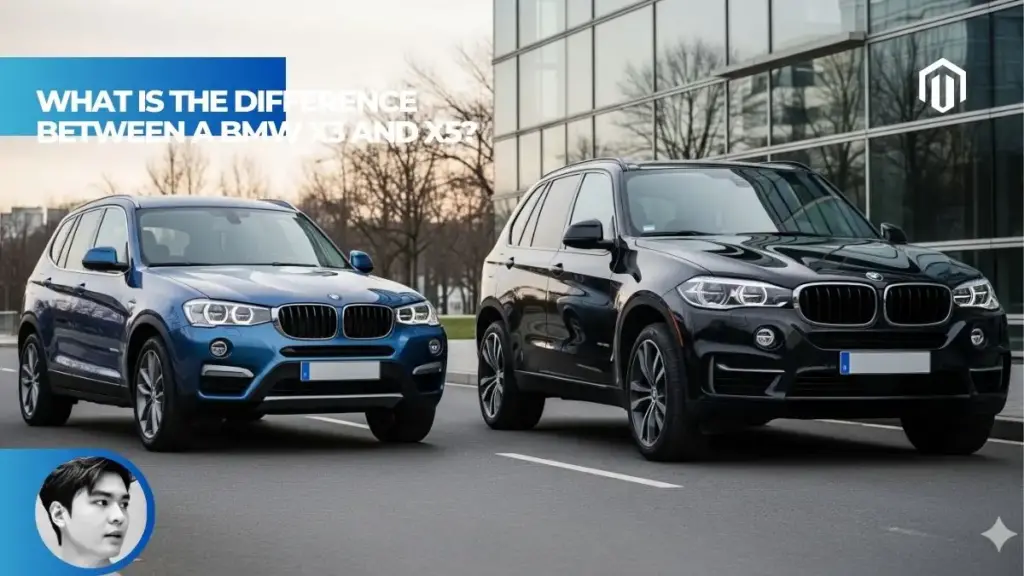
The BMW X5 is 7 inches longer, more powerful (375 hp vs. 255 hp), and roughly $17,000 more expensive than the X3[1]. Choose the X3 if you want better fuel economy (29 mpg combined vs. 25 mpg), easier maneuverability, and a lower price point starting around $50,900[1]. Choose the X5 if you need more cargo space (72.3 cu. ft. max), higher towing capacity (7,200 lbs), or V8 power options[2].
BMW X3 vs. X5: At a Glance
| Specification | 2025–2026 BMW X3 | 2025–2026 BMW X5 |
|---|---|---|
| Starting MSRP | $50,900 | $67,600 |
| Length | 187.2 in. | 194.2 in. |
| Base Engine | 2.0L turbo 4-cyl (255 hp) | 3.0L turbo 6-cyl (375 hp) |
| Top Engine | 3.0L turbo 6-cyl (393 hp) | 4.4L turbo V8 (523 hp) |
| 0–60 mph (Base) | 6.0 sec | 5.3 sec |
| Fuel Economy | 27/33/29 mpg | 23/27/25 mpg |
| Cargo (Max) | 67.1 cu. ft. | 72.3 cu. ft. |
| Towing Capacity | 4,850 lbs | 7,200 lbs |
| Standard AWD | Yes (xDrive) | No (sDrive, xDrive optional) |
Data from BMW of Devon and BMW of Lenox[1][2]
Size: How Much Bigger Is the X5?
The X5 is noticeably larger—7 inches longer and about 3 inches wider than the X3[2]. This size gap affects parking, garage fit, and overall maneuverability.
| Dimension | BMW X3 | BMW X5 | Difference |
|---|---|---|---|
| Overall Length | 187.2 in. | 194.2 in. | +7 in. |
| Width | 75.6 in. | 78.9 in. | +3.3 in. |
| Height | 65.4 in. | 69.5 in. | +4.1 in. |
| Wheelbase | 112 in. | 117.1 in. | +5.1 in. |
From BMW of Lenox comparison[2]
The X5’s longer wheelbase translates to a more planted highway feel, while the X3’s compact footprint makes city driving and tight parking lots less stressful. If you’re measuring your garage, the X3 at 15.6 feet leaves more breathing room than the X5 at just over 16 feet.
Interior Space and Cargo
Here’s the surprise: interior space isn’t dramatically different between the two.
| Interior Measurement | BMW X3 | BMW X5 |
|---|---|---|
| Front Legroom | 40.2 in. | 39.8 in. |
| Rear Legroom | 36.3 in. | 37.4 in. |
| Front Headroom | 40.5 in. | 40.7 in. |
| Rear Headroom | 38.2 in. | 39.4 in. |
| Cargo (Seats Up) | 31.5 cu. ft. | 33.9 cu. ft. |
| Cargo (Seats Down) | 67.1 cu. ft. | 72.3 cu. ft. |
From BMW of Lenox[2]
The X3 actually has more front legroom by 0.4 inches[2]. Rear passengers gain about an inch of legroom in the X5, which matters on longer road trips. The X5’s real advantage shows in cargo capacity—5 extra cubic feet when the seats are folded, plus a higher weight capacity of 1,653 lbs versus 1,000 lbs for the X3[3].
Neither SUV offers a third row in 2025–2026. If you need seven seats, look at the BMW X7 instead.
Performance: Engines and Power
This is where the difference between a BMW X3 and X5 gets significant.
BMW X3 Powertrains
| Variant | Engine | Power | 0–60 mph |
|---|---|---|---|
| X3 30 xDrive | 2.0L turbo 4-cyl | 255 hp / 295 lb-ft | 6.0 sec |
| X3 M50 xDrive | 3.0L turbo 6-cyl | 393 hp / 428 lb-ft | 4.4 sec |
From Tom Bush BMW and Newbold BMW[4][5]
BMW X5 Powertrains
| Variant | Engine | Power | 0–60 mph |
|---|---|---|---|
| X5 sDrive40i / xDrive40i | 3.0L turbo 6-cyl | 375 hp / 398 lb-ft | 5.3 sec |
| X5 xDrive50e (PHEV) | 3.0L turbo 6-cyl + electric | 483 hp combined | 4.6 sec |
| X5 M60i | 4.4L turbo V8 | 523 hp / 553 lb-ft | 4.3 sec |
From BMW of Fairfax and BMW of Chattanooga[6][7]
The X5 starts with more power (375 hp vs. 255 hp) and offers engine options the X3 simply can’t match—including the 523-hp V8 and a plug-in hybrid with 40 miles of electric range[6]. But the X3 M50 with its 393-hp inline-six actually out-muscles the base X5 40i, making it a compelling choice for enthusiasts on a budget.
One notable difference: the X3 comes standard with xDrive all-wheel drive. The X5 starts with rear-wheel-drive sDrive—you’ll pay extra to add xDrive[2].
Fuel Economy
Smaller size and a four-cylinder engine give the X3 a clear efficiency advantage.
| Model | City | Highway | Combined |
|---|---|---|---|
| X3 30 xDrive | 27 mpg | 33 mpg | 29 mpg |
| X5 xDrive40i | 23 mpg | 27 mpg | 25 mpg |
| X5 xDrive50e (PHEV) | 58 MPGe | — | — |
EPA estimates from BMW of Lenox[2]
Over 15,000 miles per year with $3.50/gallon gas, that 4-mpg combined difference costs roughly $350–$400 annually. But if you’re considering the X5 xDrive50e plug-in hybrid, its 40-mile electric range could dramatically reduce fuel costs for commuters[6].
Price Comparison
The X3’s lower starting price is its biggest selling point for budget-conscious buyers.
| Trim Level | BMW X3 | BMW X5 |
|---|---|---|
| Base | $50,900 (30 xDrive) | $67,600 (sDrive40i) |
| Performance | $64,100 (M50 xDrive) | $68,000 (xDrive40i) |
| Top Trim | ~$65,000 (M50 loaded) | ~$87,000+ (M60i) |
Pricing from BMW of Devon and Car Confections[1][8]
The price gap narrows when comparing similarly-equipped models. A loaded 2025 X3 M50 at around $70,000 competes directly with a base X5 xDrive40i[8]. At that point, the choice comes down to size preference versus engine power.
Towing Capacity
The X5 pulls significantly more weight.
| Model | Towing Capacity |
|---|---|
| BMW X3 (M50) | 4,850 lbs |
| BMW X5 | 7,200 lbs |
When properly equipped[1]
If you’re towing a mid-size boat, camper, or trailer regularly, the X5’s 7,200-lb capacity gives you flexibility the X3 can’t match. For light towing—jet skis, small utility trailers—the X3’s 4,850 lbs handles most tasks.
Features and Technology
Both SUVs share BMW’s core tech, including the BMW Curved Display, iDrive 8.5 infotainment, and wireless Apple CarPlay/Android Auto[2].
Standard on Both
- BMW Curved Display (12.3″ + 14.9″ screens)
- Veganza synthetic leather upholstery
- Wireless Apple CarPlay and Android Auto
- Active Driving Assistant
- 48V mild-hybrid system
X5 Exclusive Options
- Highway Assist (hands-free driving)
- Gesture control
- Plug-in hybrid powertrain (xDrive50e)
- V8 engine (M60i)
From BMW of Lenox[2]
The X5 gains access to Highway Assist for hands-free highway driving—a feature unavailable on the 2025 X3[2]. Both offer premium upgrades like Merino leather, Harman Kardon audio, and the Sky Lounge Panoramic Roof.
Maintenance Costs
Expect higher maintenance costs for the larger X5.
| Model | Annual Maintenance |
|---|---|
| BMW X3 | ~$1,034/year |
| BMW X5 | ~$1,166/year |
RepairPal estimates[2]
The $132 annual difference isn’t dramatic, but it compounds over 10 years of ownership. Both fall within typical luxury SUV maintenance ranges.
Pros and Cons
BMW X3
Pros
- $17,000+ lower starting price
- Better fuel economy (29 mpg combined)
- Standard xDrive AWD
- Easier to park and maneuver
- Lower maintenance costs
Cons
- Less rear legroom and cargo space
- Lower towing capacity (4,850 lbs)
- No plug-in hybrid option
- Missing Highway Assist feature
BMW X5
Pros
- More powerful engine options (up to 523 hp)
- Larger cargo area (72.3 cu. ft.)
- Higher towing capacity (7,200 lbs)
- Plug-in hybrid available (40-mile range)
- Highway Assist hands-free driving
Cons
- Starting price exceeds $67,000
- Rear-wheel drive standard (xDrive costs extra)
- Lower fuel economy (25 mpg combined)
- Higher maintenance costs
Which Should You Buy?
Choose the BMW X3 if:
- Budget matters—you want BMW luxury under $55,000
- City driving and parking are frequent
- Fuel economy is a priority
- You don’t need to tow more than 4,800 lbs
- Standard AWD appeals to you
Choose the BMW X5 if:
- You need maximum cargo space or towing capacity
- V8 power or plug-in hybrid efficiency interests you
- Highway Assist hands-free driving is important
- Rear passengers need extra legroom on road trips
- Budget extends beyond $67,000
For most buyers comparing equivalent trim levels, the X3 delivers 90% of the X5 experience at a significantly lower price. But if you’re hauling gear, towing toys, or simply want the most powerful BMW SUV this side of an X7, the X5 justifies its premium.
Key Takeaways
- The BMW X5 is 7 inches longer and costs approximately $17,000 more than the X3, starting at $67,600 versus $50,900[1].
- Engine power differs significantly—the X5 base (375 hp) outmuscles the X3 base (255 hp), though the X3 M50 at 393 hp competes with the X5 40i[4][6].
- The X3 wins on fuel economy at 29 mpg combined versus the X5’s 25 mpg, potentially saving $350–$400 annually[2].
- Interior space is surprisingly similar—the X3 actually has more front legroom, while the X5 gains about an inch of rear legroom[2].
- The X5’s 7,200-lb towing capacity versus the X3’s 4,850 lbs makes it the clear choice for boat or camper owners[1].
FAQs
Is the BMW X5 worth the extra money over the X3?
Which is more reliable, BMW X3 or X5?
Both models have similar reliability profiles. According to RepairPal, the X3 averages $1,034/year in maintenance while the X5 costs $1,166/year[2]. Neither stands out as significantly more problematic—choose based on your size and power needs.
Can the BMW X3 tow a camper?
The X3 M50 can tow up to 4,850 lbs when properly equipped[1]. This handles small-to-medium campers, pop-ups, and utility trailers. For larger campers exceeding 5,000 lbs, the X5’s 7,200-lb capacity is the better choice.
Does the BMW X5 have a third row?
No—the 2025–2026 X5 is strictly a two-row, five-passenger SUV[2]. BMW discontinued the optional third row; buyers needing seven seats should consider the BMW X7.
References
- BMW of Devon. (2025). 2026 BMW X3 vs. BMW X5 Comparison. https://www.bmwofdevon.com/compare/bmw-x3-to-bmw-x5.htm
- BMW of Lenox. (2025). What Is The Difference Between The BMW X3 Vs. BMW X5? https://www.bmwlenox.com/bmw-x3-vs-bmw-x5.htm
- RuffRug. BMW X3 Cargo Space vs X5. https://ruffrug.com/blogs/cargo-liner-articles/bmw-x3-cargo-space-vs-x5
- Tom Bush BMW. (2025). BMW X3 vs X5: A Comprehensive Comparison for 2025 Models. https://www.tombushbmw.com/blogs/3722/bmw-x3-vs-x5-a-comprehensive-comparison-for-2025-models/
- Newbold BMW. (2025). 2025 BMW X3 vs. 2026 BMW X5 Luxury SUV Comparison. https://www.newboldbmw.com/mm-2025-bmw-x3-vs-2026-bmw-x5-luxury-suv-comparison
- BMW of Fairfax. (2024). Compare 2025 BMW X3 vs 2025 BMW X5. https://www.bmwoffairfax.com/compare-2025-bmw-x3-vs-2025-bmw-x5-fairfax-va.htm
- BMW of Chattanooga. (2025). 2026 BMW X3 vs BMW X5 Comparison. https://www.bmwofchattanooga.com/compare-2026-bmw-x3-vs-2026-bmw-x5-chattanooga-tn.htm
-
Car Confections. (2024). Big Time Sibling Showdown! 2025 BMW X3 vs. 2025 BMW X5.
Big Time Sibling Showdown! 2025 BMW X3 vs. 2025 BMW X5

