

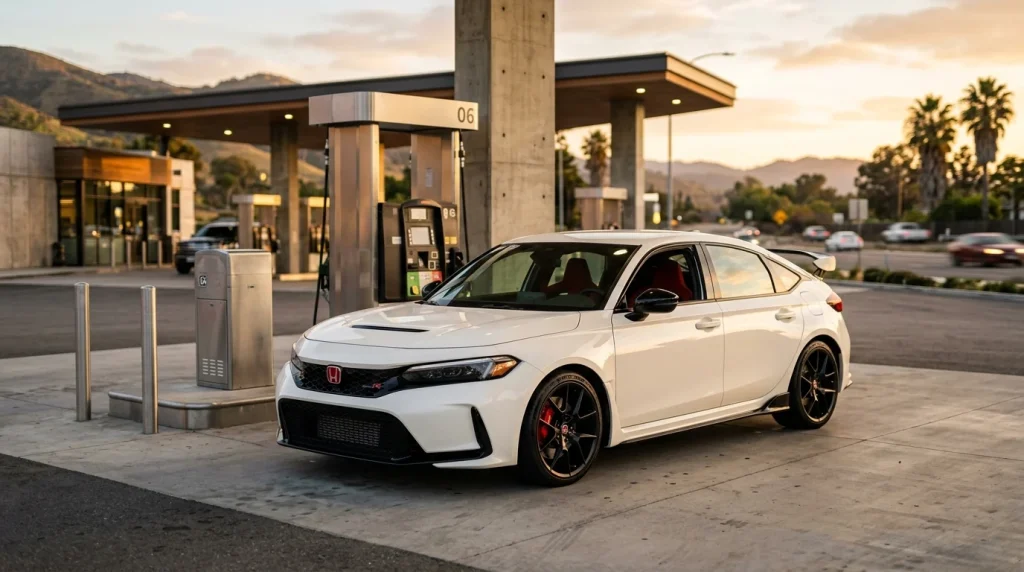
When determining what gas does the Civic Type R take, Honda specifies premium unleaded gasoline with a minimum pump octane rating of 91 (AKI) in North America or 95 (RON) in Europe and international markets. The factory 2.0-liter turbocharged K20C1 engine achieves its maximum rated output of 315 horsepower and 310 pound-feet of torque when fueled with 93 octane. Using regular 87 octane gasoline triggers the internal knock sensors, prompting the engine control unit to retard ignition timing and reduce boost pressure, which significantly decreases throttle response and engine power output.
Key takeaways:
- Honda mandates a minimum pump octane rating of 91 AKI (95 RON) for all FL5 and FK8 Civic Type R models.
- Optimal engine output of 315 horsepower requires 93 octane fuel to maximize ignition timing advance without knock intervention.
- Filling with 87 octane causes the ECU to pull ignition timing and lower turbo boost, reducing power by an estimated 30 to 50 horsepower.
- The factory fuel system is certified for ethanol blends up to 15 percent (E15); higher blends such as E85 require aftermarket hardware and ECU tuning.
- TOP TIER detergent gasoline is recommended by Honda to prevent carbon buildup on direct-injection fuel injector nozzles.
Fuel octane requirements for the Civic Type R
The Honda Civic Type R is engineered around a high-output powertrain that demands premium fuel to operate safely and effectively. At the center of the FL5 generation, as well as the preceding FK8 generation, is the K20C1 2.0-liter turbocharged direct-injected inline four-cylinder engine. Displacing 1,996 cc with an 86.0 mm bore and 85.9 mm stroke, this powerplant features a 9.8:1 static compression ratio and produces up to 25.2 pounds per square inch of peak turbocharger boost pressure from a low-inertia mono-scroll turbine wheel.
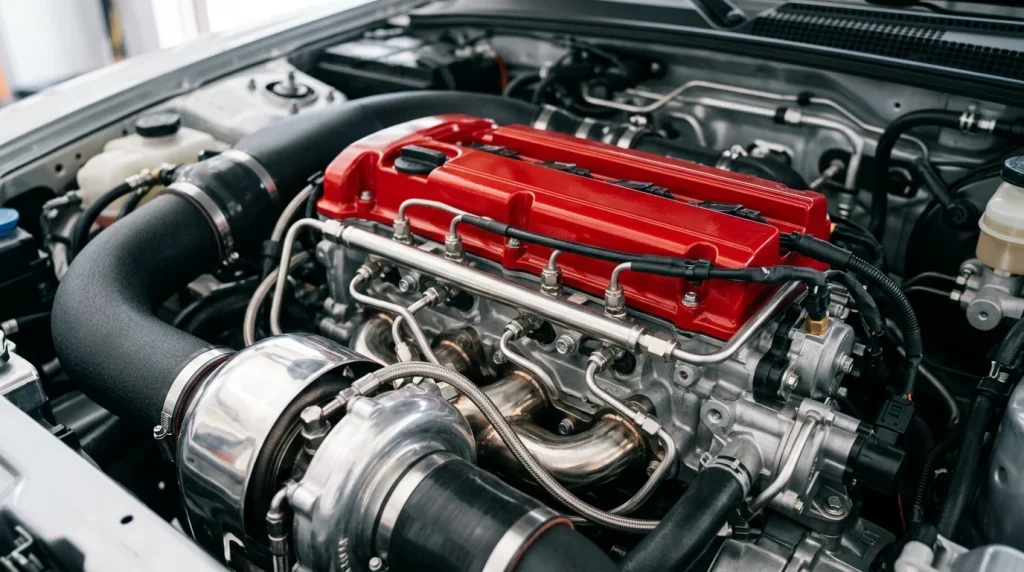
Direct fuel injection operates at fuel rail pressures reaching 200 bar (2,900 psi / 20 MPa), spraying atomized fuel straight into the combustion chambers. When air and fuel are compressed under 25.2 psi of forced induction, charge air temperatures inside the cylinders rise rapidly. Lower-octane fuels lack sufficient resistance to auto-ignition under these intense thermal and pressure loads, causing the unburned air-fuel mixture to spontaneously ignite and create uncontrolled pressure spikes known as engine knock or detonation. Premium gasoline, rated at 91 AKI or higher, contains refined hydrocarbons and branched alkanes that resist auto-ignition, allowing the spark plug to control the exact ignition event. Sodium-filled exhaust valves and dedicated under-piston oil jets further manage heat dissipation during sustained high-load operation.
According to engineering development documentation led by Hideki Kakinuma, Global Civic Type R Development Leader at Honda Motor Co., published via the Honda Newsroom, the vehicle is engineered as the pinnacle of factory performance for Honda, requiring strict precision in combustion, boost management, and thermal regulation to sustain high dynamic capabilities on both road and track. Official factory powertrain specifications confirm that the peak 315-horsepower rating at 6,500 rpm and 310 pound-feet of torque between 2,600 and 4,000 rpm are achieved with premium unleaded fuel.
When comparing how high-performance platforms manage forced induction, reviewing the BMW M4 twin-turbo engine architecture highlights similar dependencies on fuel quality to protect pistons and cylinder walls. Drivers evaluating fuel requirements across different performance segments can also examine fuel octane requirements for BMW performance engines to understand European octane conventions compared to North American standards.
Market-specific octane guidance
Fuel octane ratings are labeled differently depending on the geographic region where the vehicle is sold. Understanding these naming conventions prevents confusion when purchasing fuel abroad or reading international technical specifications.
In the United States and Canada, fuel pumps display the Anti-Knock Index (AKI), also referred to as the Pump Octane Number (PON). This rating is calculated as the average of the Research Octane Number (RON) and the Motor Octane Number (MON), expressed on pump decals as (R+M)/2. Under standard laboratory testing, ASTM D2699 measures RON at 600 rpm with unheated intake air to simulate low-speed knock resistance, while ASTM D2700 measures MON at 900 rpm with preheated intake mixture (149 degrees Celsius / 300 degrees Fahrenheit) to assess severe high-load knock resistance. In contrast, Europe, the United Kingdom, Japan, and Australia display the Research Octane Number (RON) exclusively. A 91 AKI fuel in North America corresponds directly to 95 RON in European markets, while North American 93 AKI corresponds to 98 RON.
| Market Region | Octane Rating Standard | Minimum Permissible Grade | Recommended Optimal Grade | Performance Impact |
|---|---|---|---|---|
| United States & Canada | Anti-Knock Index (AKI / PON) | 91 Octane | 93 Octane | Full 315 hp on 93; slight 3-5 hp reduction on 91 |
| Europe & United Kingdom | Research Octane Number (RON) | 95 RON | 98 RON | Full 329 PS (420 Nm) on 98 RON European calibration |
| Japan | Research Octane Number (RON) | Premium (96 RON) | High-Octane (98-100 RON) | Full 330 PS on 100 RON domestic market fuel |
| Australia & New Zealand | Research Octane Number (RON) | 95 RON | 98 RON | Standard factory calibration matches 98 RON |
In high-altitude Western US states such as Colorado, Utah, and Wyoming, standard regular gasoline is frequently sold at 85 AKI, while premium is sold at 89 or 90 AKI. Naturally aspirated engines lose air density at high elevations and require slightly less octane, but the turbocharged K20C1 electronically compensates for thin air by spinning the turbocharger faster to maintain target manifold pressure (25.2 psi). Consequently, cylinder pressures remain high at elevation, making 85 or 89 octane hazardous for the Type R.
For drivers operating standard turbocharged four-cylinder vehicles, comparing turbocharged four-cylinder engine specifications demonstrates why dedicated performance trims require stricter octane thresholds than entry-level passenger cars. Routine vehicle upkeep also involves engine cooling system maintenance to prevent thermal stress that exacerbates combustion knock during hot summer driving.
Ethanol content considerations and fuel safety
Modern pump gasoline contains varying percentages of denatured fuel ethanol. The factory fuel delivery system on the Honda Civic Type R is certified by Honda for fuel blends containing up to 15 percent ethanol by volume (E10 and E15). Standard E10 regular and premium fuels sold at retail stations across North America and Europe are fully compatible with all factory fuel lines, high-pressure pumps, and direct injectors.
Stoichiometric air-fuel ratios change with ethanol concentration: pure gasoline requires 14.7:1 air-to-fuel by mass, E10 operates at 14.1:1, and E15 operates at 13.8:1. The factory ECU adjusts closed-loop short-term and long-term fuel trims to compensate for these minor differences effortlessly. However, E85 contains 51 to 83 percent ethanol and requires an air-fuel ratio of 9.8:1, demanding roughly 30 to 35 percent more volumetric fuel flow under peak load. The factory cam-driven mechanical High-Pressure Fuel Pump (HPFP) and stock direct injectors cannot deliver this required volume at 20 MPa, causing injector duty cycles to exceed safe operating limits and inducing severe lean misfires under boost. Running E85 requires dedicated aftermarket flex-fuel sensors, upgraded high-flow fuel pumps, and custom ECU software calibration.
Ethanol is also hygroscopic, absorbing atmospheric moisture over time. When water concentration in the fuel tank exceeds 0.5 percent by volume at 15 degrees Celsius (60 degrees Fahrenheit), phase separation occurs: a dense ethanol-water blend drops to the bottom of the 12.4-gallon tank where the low-pressure lift pump ingests it directly, starving the engine of octane.
Furthermore, Honda owner documentation explicitly warns against using gasoline containing methanol or metallic octane-enhancing additives, specifically methylcyclopentadienyl manganese tricarbonyl (MMT). Methanol degrades nitrile rubber fuel seals, while metallic MMT combustion byproducts coat wideband oxygen sensors and catalytic converter substrates, accelerating exhaust component failure.
Fuel delivery anomalies related to poor fuel quality can trigger dashboard warning light indicators if misfires or lean conditions occur. Maintaining optimal airflow via maintaining clean engine air filters ensures precise air-to-fuel ratio calculations across varying engine speeds and throttle loads.
How octane affects performance and engine protection
The Engine Control Unit (ECU) in the Civic Type R continuously monitors combustion conditions using a piezo-electric knock sensor bolted directly to the engine block between cylinders 2 and 3. The ECU tracks a dynamic Knock Control parameter (indexed from a baseline of 0.55 on 93 octane up to 1.00 under high knock activity). When the sensor detects high-frequency acoustic vibrations characteristic of combustion knock, the ECU intervenes within milliseconds.
To protect the rotating assembly from structural damage, the ECU executes two primary defensive actions:
- Ignition Timing Retardation: The computer delays the spark event relative to top dead center (TDC), shifting spark timing from an optimal 18-22 degrees BTDC under boost back toward 0-5 degrees BTDC. This lowers peak combustion chamber temperatures and cylinder pressures, eliminating knock but reducing the mechanical force exerted on the piston crowns.
- Turbocharger Boost Reduction: If timing retardation is insufficient to control knock under sustained load, the ECU opens the electronic wastegate actuator to bleed off boost pressure from 25.2 psi down to 15-18 psi, directly capping engine torque output.
Real-world dynamometer testing reveals that filling a Civic Type R with 87 octane regular gasoline reduces engine output by approximately 30 to 50 horsepower and 35 to 45 pound-feet of torque. Throttle response becomes sluggish in the midrange, and top-end acceleration flattens out noticeably. When ignition timing is heavily retarded, combustion continues as the exhaust valves open, causing Exhaust Gas Temperatures (EGT) to exceed 950 degrees Celsius (1,742 degrees Fahrenheit). To protect the turbine wheel, the ECU enriches the mixture down to 0.75-0.78 Lambda (10.5:1 AFR).
Repeated reliance on 87 octane exposes the top piston ring land, located 3.0 mm below the piston crown, to localized pressure spikes exceeding 120 bar (1,740 psi). Over time, these micro-knock events cause fatigue fracturing of the ring lands or premature head gasket deterioration.
According to verified test figures published by the United States EPA, the 2026 Honda Civic Type R achieves an official fuel economy rating of 22 miles per gallon in city driving, 28 mpg on the highway, and 24 mpg combined. With its 12.4-gallon (46.9-liter) fuel tank, the vehicle provides a theoretical cruising range of approximately 290 to 310 miles under conservative driving. Running sub-optimal fuel forces the engine into less efficient timing maps. Operating on 93 octane keeps the Honda ECU knock control index at its lowest baseline, allowing the ignition map to run full advance during sustained high-load conditions such as track sessions or uphill acceleration.
Note: Fuel octane availability differs by geographic market; Western US states commonly supply 91 octane as the highest pump grade, which remains fully compliant with Honda factory requirements.
Electronic timing adjustments in the K20C1 work alongside variable valve timing mechanisms to optimize valve overlap and exhaust gas scavenging across the rev range. Performance driving demands careful budgeting for performance vehicle maintenance costs, including premium fuels, high-temperature brake fluids, and synthetic motor oils.
Practical fueling guidelines
To ensure the longevity of the high-pressure direct-injection fuel system, Civic Type R owners should follow established fueling best practices:
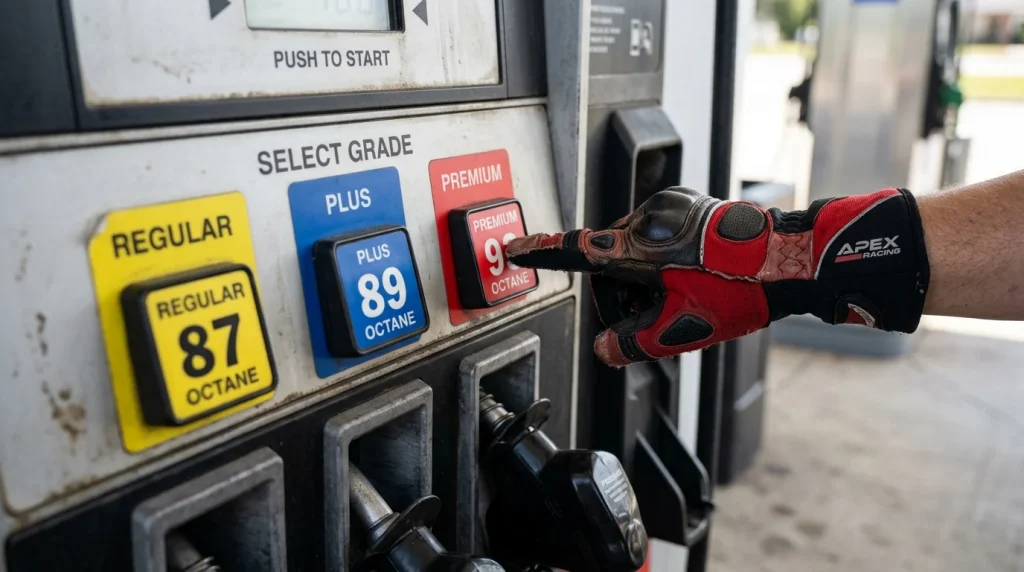
- Select TOP TIER Detergent Gasoline: Choose fuel retailers certified under the TOP TIER Gasoline standard. TOP TIER fuels contain significantly higher levels of detergent additives than the minimum regulatory standard, validated by ASTM D6201 intake deposit and ASTM D5500 injector fouling standards, preventing carbon and deposit accumulation on direct-injection nozzle tips.
- Avoid Low-Volume Stations: Purchase fuel from busy, well-maintained stations where underground storage tanks are replenished frequently. Stale fuel in low-turnover tanks can suffer from octane degradation and water contamination.
- Verify Pump Octane Labels: When traveling across state lines, confirm the pump octane number before selecting a nozzle. In high-altitude mountain states, regular gas is often sold at 85 octane and premium at 89 or 90 octane, both of which fall below Honda’s 91 octane minimum requirement.
- Operate the Capless Filler Correctly: The Civic Type R uses a capless fuel filler neck with an evaporative seal. If adding fuel or octane additives from a portable container, always use the factory emergency plastic funnel stored beneath the rear cargo floor tool tray to avoid damaging the internal spring-loaded flapper valve.
- Use MMT-Free Octane Concentrates: If 91 or 93 octane is unavailable in remote areas, choose MMT-free octane boosters containing active aromatic amines that raise fuel ratings by 2 to 3 whole AKI pump numbers, avoiding cheap additives that only raise octane by fractional tenths (0.1 to 0.3 AKI).
Maintaining long-term powertrain health also requires selecting the correct engine oil grade with full synthetic formulation to protect turbocharger bearings against extreme thermal cycles.
Recovery protocol for accidental low-octane fuel
If you accidentally pump 87 octane regular gasoline into an empty tank, do not panic or attempt to tow the vehicle. The factory ECU will adapt its calibration to prevent structural damage. To manage the situation safely, follow this practical recovery workflow:
- Drive Conservatively: Switch the drive mode selector to Comfort. Avoid rapid throttle application, heavy uphill loads, and aggressive acceleration. Keep manifold pressure below -2.0 psi vacuum and throttle opening below 25 percent.
- Limit Engine Speed: Keep engine revolutions below 3,500 rpm and shift early to minimize turbocharger boost generation and cylinder peak pressure.
-
Dilute the Fuel Tank Early: After driving approximately 40 to 50 miles and consuming 2 to 3 gallons of fuel, stop at a station and top off the tank with 93 or 94 octane premium fuel. Blended octane follows the standard volumetric formula:
Octane blend = ((Volume of regular * AKI of regular) + (Volume of premium * AKI of premium)) / Total volume
With 9.4 gallons of 87 octane remaining, adding 3.0 gallons of 93 octane yields 88.45 AKI across the 12.4-gallon capacity. -
Repeat Top-Offs: Continue topping off with 93 octane every 40 to 50 miles. Successive top-offs progressively raise the overall octane rating back toward factory operating thresholds until the original fuel is cycled out.
Ignoring severe combustion knock under heavy load can lead to drivetrain malfunction warnings or limp-mode engagement if cylinder knock thresholds are exceeded. Enthusiasts weighing track-capable hot hatches against dedicated sports coupes often examine track-focused performance comparisons to evaluate operating costs and consumable lifespans.
Common questions and myths
What octane does the Civic Type R require?
The Honda Civic Type R requires premium unleaded gasoline with a minimum pump octane rating of 91 AKI in North America or 95 RON in Europe and other international markets. Using 93 AKI (98 RON) is recommended by Honda engineers to achieve the full factory-rated 315 horsepower and 310 pound-feet of torque.
Can I use regular 87 octane in an emergency?
Yes, the Civic Type R can run on 87 octane in an emergency because the ECU knock sensors detect combustion knock and retard ignition timing to protect the engine. However, you will experience a significant drop in engine power (around 30 to 50 horsepower), reduced throttle sensitivity, and lower fuel efficiency until high-octane fuel is restored.
Does 93 octane produce more horsepower than 91 octane?
Under standard daily driving conditions, the power difference between 91 and 93 octane is modest, typically ranging from 3 to 5 horsepower. However, in high ambient temperatures or during demanding track driving, 93 octane provides a larger thermal safety buffer, allowing the ECU to maintain maximum ignition advance without pulling boost pressure.
Is E10 or E15 fuel safe for the Type R?
Yes, standard retail gasoline containing up to 15 percent ethanol (E10 and E15) is fully approved by Honda for the factory K20C1 engine. Higher ethanol blends, such as E85, cannot be used in a stock vehicle and require dedicated aftermarket fuel system upgrades and custom engine tuning.
Will using lower octane void the Honda factory warranty?
While an isolated accidental tank of 87 octane will not automatically void your warranty, sustained use of fuel below the mandated 91 octane rating that results in internal mechanical failure, such as piston crown damage or burned valves, can lead to warranty claim denials. Following the manufacturer’s octane mandate protects both engine performance and warranty coverage.

