

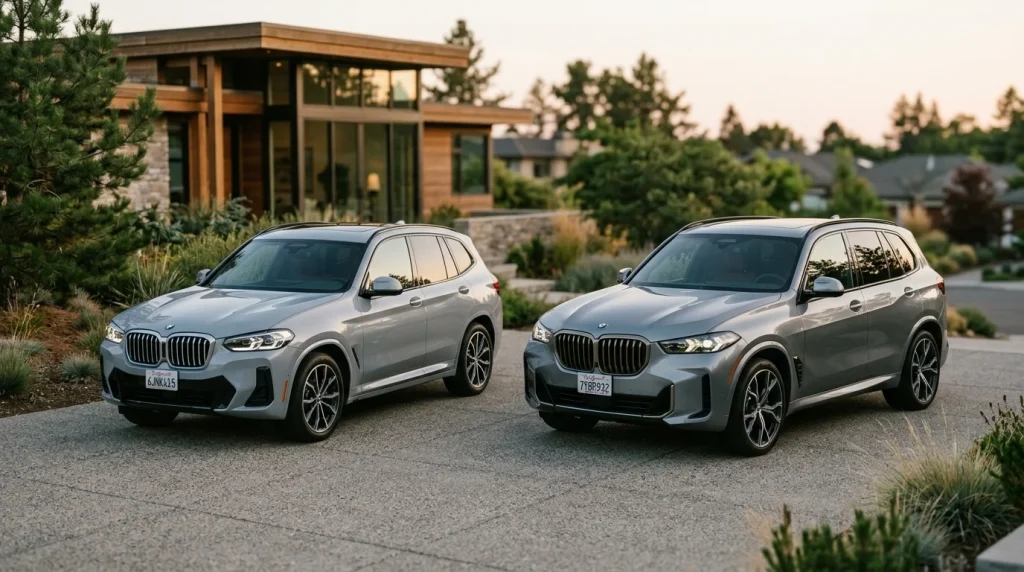
When comparing what is the difference between a BMW X3 and X5, the main factors are vehicle classification, physical dimensions, powertrain options, towing capacity, and starting price. The compact BMW X3 starts at $49,500 for 2025 and $51,300 for 2026 with standard all-wheel drive. The midsize BMW X5 starts at $65,700 for 2025 and $68,300 for 2026 in rear-wheel drive. The X5 delivers 7,200 pounds of maximum towing, 72.3 cubic feet of maximum cargo capacity, and available plug-in hybrid or V8 engines. The X3 provides 4,850 pounds of maximum towing, 67.1 cubic feet of maximum cargo, and superior city maneuverability.
Key takeaways:
- The BMW X5 is 7.0 inches longer and 3.3 inches wider than the BMW X3, requiring more space in parking stalls and garages.
- The base price gap between the two models is $17,000 for 2026, with the X3 including standard all-wheel drive while the base X5 uses rear-wheel drive.
- Maximum cargo capacity measures 72.3 cubic feet in the X5 compared to 67.1 cubic feet in the X3.
- Towing limits favor the X5 at up to 7,200 pounds compared to the X3 rating of 4,000 to 4,850 pounds.
- Fuel economy gives the advantage to the lighter X3 30 xDrive at 29 mpg combined versus 25 mpg combined for the X5 xDrive40i.
Design and dimensions
The physical size of an SUV dictates how it handles daily driving, parking, and garage storage. Understanding the structural differences between compact and midsize footprints helps buyers determine which chassis fits their daily routine.
Exterior size and footprint
The BMW X5 occupies the midsize luxury SUV segment with an overall length of 194.2 inches, an overall width of 78.9 inches excluding mirrors, a height of 69.5 inches, and a wheelbase of 117.1 inches. In comparison, the redesigned fourth-generation G45 BMW X3 sits in the compact luxury crossover category with an overall length of 187.2 inches, a width of 75.6 inches, a height of 65.4 inches, and a wheelbase of 112.8 inches.
These footprint differences directly alter maneuverability. The compact X3 has a turning circle of 38.6 feet, which allows drivers to execute tight U-turns and navigate crowded parking garages with minimal steering effort. The 2026 BMW X3 review details driving impressions for the redesigned chassis. The larger X5 requires a 41.3-foot turning circle, making tight urban maneuvers noticeably more demanding. For buyers seeking an even tighter footprint, the 2024 BMW X2 review outlines the subcompact end of the lineup.
Garage dimensions represent another practical checkpoint. A standard single-car suburban garage measures roughly 20 feet (240 inches) in depth and 8 to 9 feet in door width. The X3 measures 15.6 feet long, leaving about 4.4 feet of total clearance for walking around the front and rear bumpers. The X5 measures 16.2 feet long, leaving roughly 3.8 feet of walking clearance.
| Dimension Metric | 2025/2026 BMW X3 (G45) | 2025/2026 BMW X5 (G05 LCI) | Difference |
|---|---|---|---|
| Overall Length | 187.2 in | 194.2 in | X5 is +7.0 in longer |
| Overall Width (w/o mirrors) | 75.6 in | 78.9 in | X5 is +3.3 in wider |
| Overall Height | 65.4 in | 69.5 in | X5 is +4.1 in taller |
| Wheelbase | 112.8 in | 117.1 in | X5 is +4.3 in longer |
| Turning Circle | 38.6 ft | 41.3 ft | X3 is +2.7 ft tighter |
| Curb Weight (Base AWD) | 4,178 lbs | 4,998 lbs | X5 is +820 lbs heavier |
Interior space and seating
Cabin measurements show how effectively each vehicle uses its footprint. Front seat occupants will find nearly identical space in both models. The BMW X3 provides 40.2 inches of front legroom and 40.0 inches of front headroom. The BMW X5 offers 39.8 inches of front legroom and 40.7 inches of front headroom, giving the compact model a slight 0.4-inch advantage in front legroom.
Second-row passengers experience the true benefit of the X5 midsize platform. The X5 delivers 37.4 inches of rear legroom, 39.4 inches of rear headroom, and significantly broader shoulder room at 58.1 inches. The X3 provides 36.3 inches of rear legroom and 56.0 inches of rear shoulder room. While both vehicles seat five passengers, the X5 accommodates three adults across the rear bench with much less shoulder contact on long trips.
Performance and powertrain
Both vehicles share modular engine architectures, but their power outputs and weight classes create distinct driving dynamics.
Engine options and performance
The entry-level BMW X3 30 xDrive features a 2.0-liter turbocharged inline-four engine paired with a 48-volt mild-hybrid system, producing 255 horsepower and 295 pound-feet of torque. Power routes through an eight-speed automatic transmission to all four wheels as standard equipment. This base setup accelerates from 0 to 60 mph in 6.0 seconds.
The entry-level BMW X5 sDrive40i and xDrive40i use a 3.0-liter turbocharged inline-six engine (B58) with a 48-volt mild-hybrid setup, generating 375 horsepower and 398 pound-feet of torque. Despite its 4,998-pound curb weight, the X5 40i reaches 60 mph in 5.3 seconds. Buyers comparing dedicated high-output performance models can reference the 2024 BMW X3 M review.
Upper trims highlight further powertrain divergence. The performance-tuned X3 M50 xDrive uses a 3.0-liter inline-six generating 393 horsepower and 428 pound-feet of torque, achieving a 0 to 60 mph sprint in 4.4 seconds. The X5 lineup expands into high-output electrified and eight-cylinder options. The X5 xDrive50e plug-in hybrid produces 483 horsepower and 516 pound-feet of torque, hitting 60 mph in 4.6 seconds while offering pure electric commuting range. Historical context on electrified engineering appears in our breakdown of the BMW i8 hybrid setup. At the high end, the X5 M60i uses a 4.4-liter twin-turbocharged V8 producing 523 horsepower for a 4.2-second sprint.
| Model Trim | Engine Type | Horsepower | Torque (lb-ft) | 0-60 mph Time |
|---|---|---|---|---|
| X3 30 xDrive | 2.0L Turbo I4 Mild-Hybrid | 255 hp | 295 lb-ft | 6.0 sec |
| X3 M50 xDrive | 3.0L Turbo I6 Mild-Hybrid | 393 hp | 428 lb-ft | 4.4 sec |
| X5 sDrive40i / xDrive40i | 3.0L Turbo I6 Mild-Hybrid | 375 hp | 398 lb-ft | 5.3 sec |
| X5 xDrive50e (PHEV) | 3.0L Turbo I6 + Electric Motor | 483 hp | 516 lb-ft | 4.6 sec |
| X5 M60i xDrive | 4.4L Twin-Turbo V8 Mild-Hybrid | 523 hp | 553 lb-ft | 4.2 sec |
Handling and ride comfort
Chassis tuning reflects the intended mission of each vehicle. The X3 uses steel coil springs with sport-tuned damping, producing direct steering feedback and minimal body lean through sharp corners. Its lighter mass makes it eager to change direction, giving it the feel of a raised sport sedan.
The X5 emphasizes isolation and long-distance comfort. Base models feature adaptive dampers, while optional two-axle air suspension allows the vehicle to float over highway road joints. Road noise levels remain lower in the X5 cabin due to thicker acoustic glass and heavier insulation materials. Buyers choosing between an X3 M50 and a base X5 40i face an identical $66,000 to $70,000 price point. The X3 M50 delivers aggressive acceleration and firm road holding, whereas the X5 40i provides effortless high-speed cruising and a more relaxed ride.
Technology and features
Cabin electronics and active driver assistance packages differ in software generation and feature availability.
Infotainment and driver-assist tech
Both models feature the BMW Curved Display, which places a 12.3-inch digital instrument cluster and a 14.9-inch center infotainment touchscreen under a single glass surface. The redesigned X3 runs on BMW Operating System 9, which uses an Android-based software core optimized for touch interaction and third-party apps. The X5 operates on BMW Operating System 8.5, which includes the physical rotary iDrive controller on the center console alongside full touch capability. Operating system transition details are documented in the latest BMW software update guide.
Active safety equipment shows clear separation at the top tier. Both SUVs come standard with front collision warning, lane departure warning, and active blind-spot detection. However, the X5 offers the optional Driving Assistance Professional Package with Highway Assist. This system enables hands-free driving on mapped highways at speeds up to 85 mph, including automated lane changes triggered by the driver looking at the side mirror. The 2025/2026 X3 does not offer 85-mph hands-free highway capability.
Comfort and convenience
Seating upholstery and interior options distinguish entry-level luxury from midsize executive luxury. The X3 comes standard with Veganza synthetic leather, offering clean stitching and durable maintenance. Premium options on the X3 include heated front seats, a panoramic sunroof, and a head-up display.
The X5 offers higher grades of customization, including extended Merino leather, front massaging seats, heated armrests, and heated and cooled cupholders. Optional packaging structures are analyzed in the BMW Premium Package overview. The X5 also features a signature two-piece split tailgate. The lower tailgate folds down flat to serve as a 500-pound load-bearing bench for outdoor activities, while the X3 uses a conventional single-piece liftgate.
Practicality and ownership costs
Operating costs, utility ratings, and maintenance budgets determine long-term satisfaction for SUV owners.
Cargo capacity and practicality
Cargo volume measurements confirm the storage advantages of the midsize chassis. The BMW X5 provides 33.9 cubic feet of cargo room behind the second row of seats and expands to 72.3 cubic feet when the 40/20/40-split rear seats are folded down. The cargo floor is wider, easily accommodating full-size golf bags horizontally or large pet kennels.
The BMW X3 provides 31.5 cubic feet of storage behind the second row and up to 67.1 cubic feet with the rear seats folded. While the 5.2-cubic-foot gap with seats folded seems modest, the X3 cargo opening is narrower and the load floor is shorter.
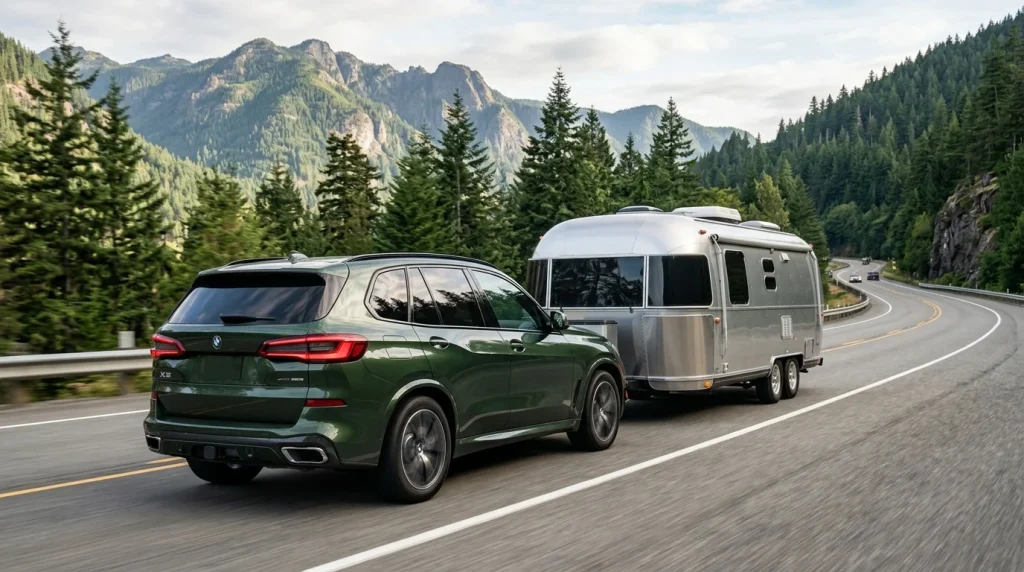
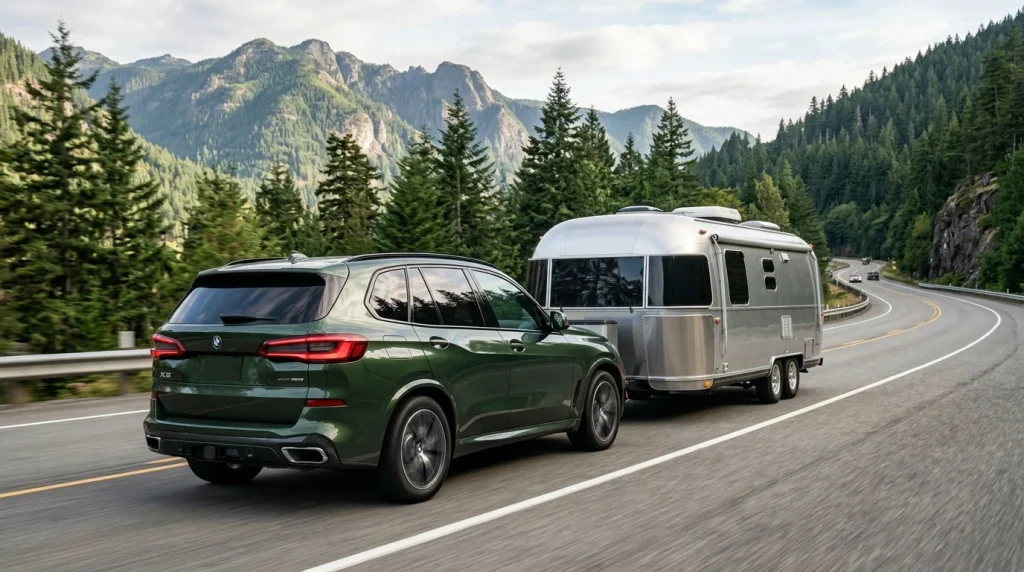
Towing specifications present a decisive gap between the two vehicle classes. The BMW X3 comes rated to tow 4,000 pounds standard, with an optional factory trailer hitch raising capacity to 4,850 pounds on the M50 trim. This is sufficient for lightweight teardrop campers, personal watercraft, or single-axle utility trailers. The BMW X5 features a maximum towing capacity of 7,200 pounds when equipped with the factory class III receiver hitch. This rating allows owners to pull double-axle travel trailers, ski boats, and enclosed car haulers safely.
| Practicality Metric | BMW X3 30 xDrive | BMW X5 xDrive40i | Advantage |
|---|---|---|---|
| Cargo Volume (Seats Up) | 31.5 cu ft | 33.9 cu ft | X5 (+2.4 cu ft) |
| Cargo Volume (Seats Folded) | 67.1 cu ft | 72.3 cu ft | X5 (+5.2 cu ft) |
| Maximum Towing Capacity | 4,850 lbs | 7,200 lbs | X5 (+2,350 lbs) |
| Maximum Payload Rating | 1,000 lbs | 1,653 lbs | X5 (+653 lbs) |
| Tailgate Configuration | Single-piece liftgate | Two-piece split tailgate | X5 (Integrated bench) |
Pricing, depreciation, and maintenance
The financial threshold between these vehicles spans initial purchase price, routine maintenance, and fuel consumption. Ownership budgets reflect both the upfront acquisition cost and the ongoing operational expenses across a multi-year ownership cycle. According to BMW USA, the 2026 BMW X3 starts at $51,300 MSRP with standard xDrive all-wheel drive, while the 2026 BMW X5 starts at $68,300 MSRP in rear-wheel drive. Fuel economy ratings from the official EPA database place the X3 30 xDrive at 27 mpg city, 33 mpg highway, and 29 mpg combined, whereas the X5 xDrive40i achieves 23 mpg city, 27 mpg highway, and 25 mpg combined.
Assuming an annual driving distance of 15,000 miles and a premium gasoline cost of $4.00 per gallon:
- The BMW X3 consumes roughly 517 gallons per year, totaling $2,068 in fuel.
- The BMW X5 consumes roughly 600 gallons per year, totaling $2,400 in fuel.
- The X3 saves approximately $332 per year in gasoline expenses.
Routine service requirements also scale with vehicle size and weight. Replacement brake pads, larger 20- to 22-inch tires, and suspension bushings cost more on the X5 chassis. Routine maintenance projections are outlined in the BMW maintenance cost guide, while recommended service fluids appear in the BMW coolant guide.
Note: Base manufacturer suggested retail prices do not include destination and handling fees, which add $1,175 to the final delivery total on both vehicle lines.
Competitive context and alternatives
Understanding where the X3 and X5 sit relative to rival luxury brands helps frame their price-to-feature value.
Direct rivals and market position
The BMW X3 competes in the luxury compact SUV class against the Mercedes-Benz GLC 300, Audi Q5, Porsche Macan, and Genesis GV70. In this bracket, the X3 stands out for its balanced handling dynamics and generous rear cargo area compared to the Macan and GLC.
The BMW X5 competes in the midsize luxury SUV segment against the Mercedes-Benz GLE 450, Audi Q7, Porsche Cayenne, and Genesis GV80. The X5 is widely regarded as the benchmark for on-road powertrain smoothness and chassis composure in this segment. Comparative ownership costs are explored in the BMW or Mercedes cost comparison, while brand longevity ratings are evaluated in the BMW or Mercedes reliability guide.
When to choose which
Choosing between these two models comes down to passenger needs, towing demands, and vehicle budget:
Choose the BMW X3 if:
- You primarily drive in urban environments where street parking and narrow garage bays require agile dimensions.
- You want a sporty driving experience with crisp steering response and lower curb weight.
- You want lower monthly payments, lower initial acquisition costs, and higher fuel efficiency.
- You do not need to tow loads exceeding 4,000 pounds.
Choose the BMW X5 if:
- You regularly transport three passengers across the rear seat or frequently carry bulky gear.
- You tow boats, horse trailers, or midsize travel trailers between 4,000 and 7,200 pounds.
- You prioritize highway ride isolation, lower ambient cabin noise, and optional hands-free highway driving.
- You want access to plug-in hybrid electric capability or high-output twin-turbo V8 engines.
Expert perspectives and sources
Automotive industry comparative analysis emphasizes that the choice between the X3 and X5 is an evaluation of practical utility rather than brand hierarchy. Testing benchmarks consistently show that the compact X3 delivers roughly 85 percent of the X5 passenger and cargo utility at a 25 percent lower acquisition cost.
However, road test evaluations indicate that the X5 remains the superior choice for high-speed highway cruising and heavy-duty towing, where increased chassis mass and air suspension enhance towing stability. Long-term durability considerations are detailed in our study of mileage points when BMWs break down, while routine air filtration maintenance is explained in our BMW microfilter replacement guide.
Summary and quick takeaways
The choice between a BMW X3 and BMW X5 represents a classic trade-off between compact agility and midsize capability. The X3 excels as a versatile, efficient luxury daily driver with modern software and strong cargo utility for small families. The X5 serves as an executive family cruiser with superior towing capacity, available plug-in hybrid powertrains, and whisper-quiet highway manners. Launch coverage and full specifications for the fourth-generation redesign appear in the 2025 BMW X3 review for shoppers researching the initial debut model year before visiting a local dealership showroom.
Frequently Asked Questions
Is the BMW X5 worth the extra money over the X3?
The BMW X5 is worth the $16,000 to $20,000 price premium for buyers who need to tow over 4,850 pounds, require wider rear seating for three adults, or desire advanced options like Highway Assist and air suspension. Buyers who only need comfortable seating for four and standard all-wheel drive will find excellent value in the X3.
Which is more reliable, BMW X3 or X5?
Both models demonstrate comparable reliability ratings because they share modular B48 four-cylinder and B58 six-cylinder engine architectures with ZF eight-speed transmissions. Routine maintenance costs average around $1,034 annually for the X3 and $1,166 annually for the X5 due to larger tires and heavier suspension components.
Can the BMW X3 tow a camper?
The BMW X3 can safely tow small travel trailers, teardrop campers, pop-up campers, and utility trailers weighing up to 4,000 pounds standard, or up to 4,850 pounds when equipped with the factory-installed trailer hitch. Campers exceeding 4,850 pounds require the 7,200-pound capacity of the BMW X5.
Does the BMW X5 have a third row?
The 2025 and 2026 BMW X5 is sold exclusively as a two-row, five-passenger SUV in the North American market. BMW discontinued the optional third-row jump seat during the recent mid-cycle refresh. Buyers needing seven-passenger capacity must step up to the larger three-row BMW X7.
Is the BMW X3 considered compact or midsize?
The BMW X3 is classified as a compact luxury crossover SUV measuring 187.2 inches in length. The BMW X5 is classified as a midsize luxury SUV measuring 194.2 inches in length. Both vehicles feature two rows of seating for up to five passengers.

