


When determining what is the towing capacity of an Audi Q7, the maximum rating reaches 7,700 pounds (3,500 kg) when equipped with the 3.0L turbocharged V6 engine (55 TFSI) or the 4.0L twin-turbo V8 (SQ7) and the factory-installed towing package. Models fitted with the 2.0L turbocharged 4-cylinder engine (45 TFSI) carry a maximum tow rating of 4,400 pounds (2,000 kg).
Key takeaways:
- 55 TFSI (3.0L Turbo V6) and SQ7 (4.0L Twin-Turbo V8) pull up to 7,700 lbs with factory equipment.
- 45 TFSI (2.0L Turbo I-4) is rated for up to 4,400 lbs.
- Maximum tongue weight is 770 lbs on V6/V8 models and 440 lbs on 4-cylinder models (10% of total trailer capacity).
- Factory towing package adds a 2-inch receiver, 7-pin electrical harness, high-capacity cooling, and electronic trailer stability software.
- Tongue weight subtracts pound-for-pound from the vehicle payload capacity (typically 1,200 to 1,350 lbs).
- Audi advises against using mechanical spring-bar weight distribution hitches on models with Adaptive Air Suspension.
Audi Q7 Towing Capacity by Engine and Powertrain
The engine configuration directly establishes the Audi Q7 towing rating. Six-cylinder and eight-cylinder models achieve the maximum 7,700-pound capacity, while four-cylinder variants are limited to 4,400 pounds.
All second-generation Audi Q7 models channel power through an 8-speed Tiptronic torque-converter automatic transmission and standard quattro permanent all-wheel drive. The mechanical differences across the three current powertrains center on low-end torque output, cooling capacity, and electrical architecture.
| Model Variant | Engine Configuration | Horsepower | Peak Torque | Max Towing Capacity | Max Tongue Weight |
|---|---|---|---|---|---|
| Q7 45 TFSI | 2.0L Turbocharged Inline-4 | 261 hp @ 5,000 rpm | 273 lb-ft @ 1,600-4,300 rpm | 4,400 lbs (2,000 kg) | 440 lbs (200 kg) |
| Q7 55 TFSI | 3.0L Turbocharged V6 | 335 hp @ 5,700 rpm | 369 lb-ft @ 1,370-4,500 rpm | 7,700 lbs (3,500 kg) | 770 lbs (350 kg) |
| SQ7 | 4.0L Twin-Turbo V8 | 500 hp @ 5,500 rpm | 568 lb-ft @ 1,500-5,000 rpm | 7,700 lbs (3,500 kg) | 770 lbs (350 kg) |
The 55 TFSI uses a 48-volt mild-hybrid electrical system (MHEV) that powers a belt-alternator starter. This setup provides instant torque fill off idle, smoothing the initial launch when pulling heavy trailers up boat ramps or steep highway grades. For drivers exploring electrified luxury options, understanding how Audi hybrid powertrains manage electrical assist under heavy mechanical load highlights the cooling demands of modern turbocharged engines.
Heavy trailering places sustained thermal load on the combustion chambers. Running premium 91 or 93 octane fuel is mandatory during towing to prevent the engine control unit from pulling ignition timing under high boost pressure. Exploring whether can Audi run on regular gas reveals that while low-octane fuel might operate under light highway cruising, hauling a 6,000-pound load on 87 octane triggers knock sensor intervention, reducing both power output and fuel efficiency. While the 55 TFSI V6 and SQ7 V8 share the same official 7,700-pound maximum tow rating, the SQ7 delivers 568 lb-ft of torque starting at 1,500 rpm. This surplus low-end grunt makes maintaining 65 mph on 6-percent mountain highway grades effortless, though both vehicles share the same chassis tongue weight and payload ceilings.
Audi Q7 Towing Capacity by Model Year (2007-2026)
The Audi Q7 has spanned two distinct vehicle platforms since its debut for the 2007 model year. The maximum tow rating expanded from 6,600 pounds on first-generation models to 7,700 pounds on the modern second-generation chassis.
The first-generation Q7 (2007-2015) was built on the PL71 platform shared with the original Porsche Cayenne and Volkswagen Touareg. These steel-intensive vehicles offered standard towing of 5,500 pounds, with optional factory tow packages raising V8 and 3.0L TDI diesel models to 6,600 pounds.
The second-generation Q7 arrived for the 2017 model year (skipping 2016 in North America) on the MLB Evo platform. By integrating high-strength aluminum stampings, the vehicle dropped roughly 700 pounds of curb weight while increasing chassis torsional rigidity. This weight reduction allowed Audi engineers to certify the V6 model for 7,700 pounds under the standardized SAE International J2807 trailering standard.
| Model Years | Generation / Platform | Base Engine Towing | Upgraded Engine Towing | Tow Rating Standard |
|---|---|---|---|---|
| 2020-2026 | Gen 2 Facelift (MLB Evo) | 4,400 lbs (2.0T I-4) | 7,700 lbs (3.0T V6 / 4.0T V8) | SAE J2807 Certified |
| 2017-2019 | Gen 2 Pre-Facelift (MLB Evo) | 4,400 lbs (2.0T I-4) | 7,700 lbs (3.0T Supercharged V6) | SAE J2807 Certified |
| 2011-2015 | Gen 1 Facelift (PL71) | 5,500 lbs (3.0T V6) | 6,600 lbs (3.0 TDI / 4.2 V8 with Tow Pkg) | DIN / Manufacturer Rating |
| 2007-2010 | Gen 1 Original (PL71) | 5,500 lbs (3.6 VR6) | 6,600 lbs (4.2 FSI V8 with Tow Pkg) | DIN / Manufacturer Rating |
Buyers looking at pre-owned luxury haulers must verify mechanical history carefully. Certain early model years experienced oil consumption and timing chain wear that can be exacerbated by the severe strain of towing. Reviewing Audi Q7 years to avoid helps identify which specific production runs provide the most reliable trailering foundation.
Both generations of the Q7 have been assembled at the Volkswagen Group multi-brand facility in Slovakia. The manufacturing precision of this facility is detailed in our guide on where Audi SUVs are built, showcasing the laser-welded unibody joints that give the MLB Evo chassis its high vertical hitch load capacity.
Audi Q7 Factory Towing Package vs. Aftermarket Hitches
Achieving the full 7,700-pound tow rating requires the complete factory towing package. Installing an aftermarket hitch receiver without the matching OEM cooling and electrical integration limits your practical towing safety.
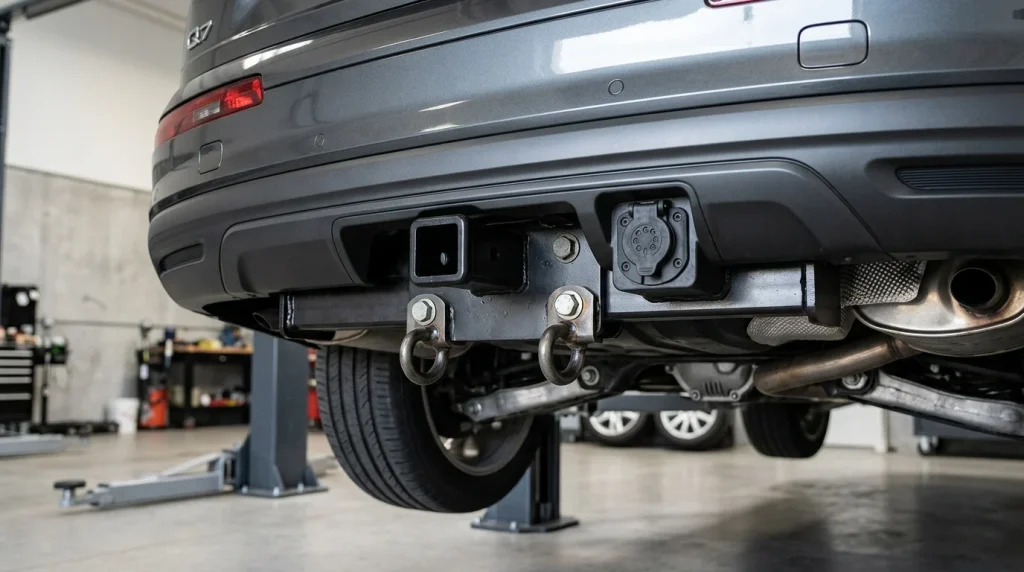
The Audi factory towing package is an integrated hardware and software suite. It includes:
- A reinforced Class III/IV 2-inch hitch receiver welded to the rear crossmember and bolted directly to the chassis longitudinal members.
- A 7-pin round RV-style electrical wiring harness connected to the vehicle central electrical control unit.
- Upgraded high-output engine cooling fan modules and high-capacity transmission fluid heat exchangers.
- Factory software coding that recalibrates the Electronic Stability Control (ESC) for Trailer Stability Assist.
When a trailer harness is plugged into the factory 7-pin socket, the Q7 automatically modifies vehicle dynamics. It disables rear parking sensors, widens the blind-spot monitoring field to account for trailer length, modifies Adaptive Cruise Control following distances, and recalibrates transmission shift points to hold lower gears on descents for engine braking.
| Feature / Component | Factory Towing Package (OEM) | Typical Aftermarket Installation |
|---|---|---|
| Max Towing Rating | 7,700 lbs (V6) / 4,400 lbs (I-4) | Often capped at 5,000-6,000 lbs |
| Max Tongue Weight | 770 lbs (V6) / 440 lbs (I-4) | Typically 500-600 lbs |
| Receiver Size | Standard 2-inch Class III/IV | 2-inch receiver (Curt, Stealth, Draw-Tite) |
| Cooling Upgrades | Upgraded auxiliary fan & transmission cooler | Standard factory cooling (no upgrades) |
| Stability Control (ESC) | Automatic Trailer Sway Assist active | Standard vehicle ESC (no trailer mode) |
| Parking Sensor Integration | Rear sensors automatically muted | Sensors remain active; false alarms in reverse |
| Electrical Connection | CAN-bus integrated 7-pin plug | T-connector tap or basic 4-pin flat plug |
Installing an aftermarket hitch without proper CAN-bus coding can cause electronic conflicts. Understanding Audi service and warranty requirements is essential before adding non-OEM electrical splices, as unapproved wiring taps can void drivetrain warranty coverage for transmission overheating.
Splicing directly into rear tail light wires instead of using a dedicated CAN-bus trailer module can trigger an Audi drive system malfunction warning on the virtual cockpit display due to detected voltage irregularities.
Payload, Tongue Weight, and GVWR: The Real Towing Math
The most critical safety calculation in towing is not pulling capacity, but carrying capacity. Trailer tongue weight directly consumes the vehicle available payload.
Gross Vehicle Weight Rating (GVWR) is the absolute maximum allowable total weight of the Audi Q7, including its curb weight, all passengers, cargo, fuel, and the trailer tongue weight. Gross Axle Weight Rating (GAWR) specifies the maximum load permitted on the rear axle.
Available Cabin Payload = Total Payload Capacity – Actual Trailer Tongue Weight
For a typical second-generation Audi Q7 55 TFSI, official weight ratings include:
- Curb Weight: ~5,004 to 5,082 lbs
- GVWR: ~6,581 lbs
- Maximum Payload Capacity: ~1,235 to 1,350 lbs (detailed on driver B-pillar tire placard)
- Maximum Towing Capacity: 7,700 lbs
- Maximum Tongue Weight (10% standard): 770 lbs
According to technical analysis from the Edmunds automotive research team, trailer tongue weight should stay strictly between 10 percent and 15 percent of total loaded trailer weight. If tongue weight drops below 10 percent, the trailer will sway violently at highway speeds. If it exceeds 15 percent, it will overload the vehicle rear axle.
| Loaded Trailer Weight | Tongue Weight (10%) | Q7 Base Payload | Remaining Payload for Cabin (Passengers + Cargo) | Feasibility Status |
|---|---|---|---|---|
| 3,500 lbs | 350 lbs | 1,300 lbs | 950 lbs | Excellent headroom |
| 5,000 lbs | 500 lbs | 1,300 lbs | 800 lbs | Ideal family travel balance |
| 6,500 lbs | 650 lbs | 1,300 lbs | 650 lbs | Requires mindful luggage packing |
| 7,700 lbs (Max) | 770 lbs | 1,300 lbs | 530 lbs | Tight; 2-3 adults with minimal gear |
When carrying heavy tongue loads, the rear tires bear substantial extra vertical force. Selecting the best tires for Audi with an extra-load (XL) rating and increasing cold tire pressure to the high-load specification listed on the door jamb ensures proper sidewall stability and avoids overheating.
Sustained heavy hauling also elevates transmission fluid temperature. If high transmission fluid heat occurs during steep ascents, the vehicle displays an Audi transmission malfunction warning, signaling the driver to pull over safely and idle the engine to let the auxiliary cooling circuits circulate fluid.
What Can You Actually Tow with an Audi Q7? (Real-World Guide)
Translating pound ratings into practical trailer types helps owners choose the right equipment for recreational and commercial hauling.
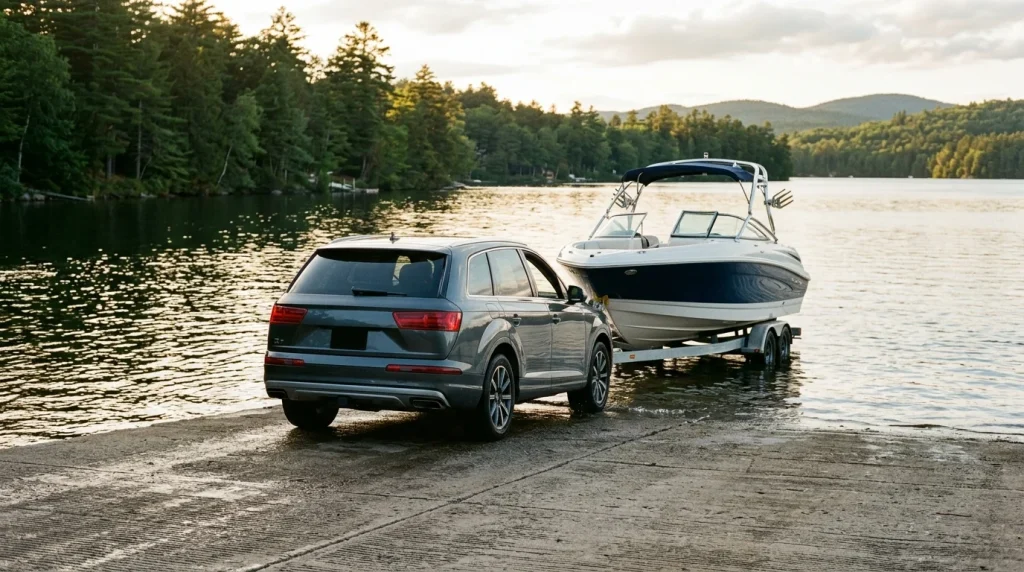
Always calculate Gross Trailer Weight (GTW) rather than dry weight. A travel trailer advertised with a 4,500-pound dry weight easily reaches 5,800 pounds once propane tanks, dual deep-cycle batteries, fresh water, food, and camping supplies are loaded.
Gross Trailer Weight (GTW) = Unloaded Vehicle Weight (Dry) + Water + Propane + Fuel + Cargo
| Trailer Category | Typical Loaded Weight Range | Required Q7 Powertrain | Real-World Towing Feasibility |
|---|---|---|---|
| Dual Personal Watercraft (Jet Skis) | 1,800-2,400 lbs | 45 TFSI (2.0T) or 55 TFSI (3.0T) | Effortless towing; excellent visibility |
| Small Teardrop / Pop-up Camper | 2,000-3,200 lbs | 45 TFSI (2.0T) or 55 TFSI (3.0T) | Minimal aerodynamic drag; easy handling |
| 20-24 ft Bowrider / Ski Boat | 3,800-5,500 lbs | 55 TFSI (3.0T V6) or SQ7 (V8) | Standard quattro handles slick boat launch ramps |
| 24-28 ft Tandem-Axle Travel Trailer | 5,200-6,800 lbs | 55 TFSI (3.0T V6) or SQ7 (V8) | High frontal area; requires trailer brake controller |
| Two-Horse Aluminum Trailer (Loaded) | 4,800-6,500 lbs | 55 TFSI (3.0T V6) or SQ7 (V8) | Long wheelbase ensures strong anti-sway stability |
| Open Car Hauler with Vehicle | 5,500-7,000 lbs | 55 TFSI (3.0T V6) or SQ7 (V8) | Excellent balance; requires tie-down weight balancing |
The Audi Q7 long 117.9-inch wheelbase provides substantial directional stability compared to compact crossovers. Evaluating how long is an Audi Q5 shows that the smaller Q5 has a 111.0-inch wheelbase and is capped at 4,400 pounds of towing. The extra seven inches of wheelbase on the Q7 significantly suppresses trailer yaw during highway passing maneuvers.
While smaller SUVs offer moderate towing utility, reviewing the Audi Q5 reliability history confirms that pushing a compact luxury crossover to its upper trailering limits accelerates dual-clutch transmission wear, making the Q7 heavy-duty ZF torque-converter transmission the preferred choice for regular towing.
Towing Technology, Air Suspension, and Weight Distribution Hitches
Audi chassis architecture pairs permanent mechanical all-wheel drive with optional Adaptive Air Suspension, providing sophisticated load-leveling capabilities.
The available Adaptive Air Suspension incorporates height sensors on all four control arms. When a heavy trailer coupler is lowered onto the ball hitch, the electronic control unit detects rear suspension compression. The onboard air compressor inflates the rear air bellows within seconds, restoring factory ride height and keeping the Matrix LED headlights properly aligned with the road.
When a trailer is connected to the factory electrical harness, Audi Drive Select automatically activates a dedicated Towing mode. This mode prevents the air suspension from lowering to high-speed aero mode at highway velocities, maintaining adequate suspension travel over road expansion joints.
Important Note: Audi explicitly advises against using mechanical spring-bar weight distribution hitches (WDH) on Q7 models equipped with Adaptive Air Suspension. The vehicle unibody chassis and active air suspension automatically manage load leveling electronically. Mechanical spring bars transfer high rotational torque into the unibody hitch mounts and fight the electronic leveling algorithms.
Trailers weighing more than 3,000 pounds (or lower depending on state laws) require operational electric trailer brakes. The Audi Q7 factory tow package includes a 4-pin pre-wired brake controller connector tucked beneath the dashboard above the brake pedal. Drivers can install a traditional proportional brake controller (such as a Tekonsha Prodigy) or use a modern wireless Bluetooth brake controller (such as a Curt Echo) plugged directly into the 7-pin bumper receptacle.
Audi Q7 vs. Luxury SUV Competitors Towing Comparison
In the mid-size luxury three-row SUV segment, the Audi Q7 matches or exceeds all primary German and Scandinavian competitors.
| Luxury SUV Model | Base Engine Towing | Max Available Towing | Max Tongue Weight | Standard 3rd Row | Towing Platform |
|---|---|---|---|---|---|
| Audi Q7 55 TFSI | 4,400 lbs (2.0T) | 7,700 lbs (3.0T V6) | 770 lbs | Yes (7 Passengers) | Unibody (MLB Evo) |
| Mercedes-Benz GLE 450 | 5,400 lbs (2.0T) | 7,700 lbs (3.0T I-6) | 770 lbs | No (Optional 2-seat 3rd row) | Unibody (MHA) |
| Porsche Cayenne | 7,700 lbs (3.0T) | 7,700 lbs (3.0T V6) | 770 lbs | No (2 Rows Only) | Unibody (MLB Evo) |
| BMW X5 xDrive40i | 5,400 lbs (Standard) | 7,200 lbs (Factory Hitch) | 720 lbs | No (2 Rows Only) | Unibody (CLAR) |
| Volvo XC90 B6 | 4,000 lbs (B5) | 5,000 lbs (B6 Mild Hybrid) | 500 lbs | Yes (7 Passengers) | Unibody (SPA) |
The Audi Q7 shares its structural MLB Evo platform with the Porsche Cayenne and Volkswagen Touareg. Both the Q7 and Cayenne achieve the identical 7,700-pound maximum tow rating. However, the Q7 offers standard three-row seating, providing greater family utility than the two-row Cayenne.
Compared to the BMW X5, the Audi Q7 holds a 500-pound maximum towing advantage (7,700 lbs vs. 7,200 lbs) and a 50-pound tongue weight advantage. The Volvo XC90 is limited to 5,000 pounds across all trims, leaving the Audi Q7 as the leading three-row European luxury SUV for heavy hauling.
Frequently Asked Questions About Audi Q7 Towing
Can an Audi Q7 tow 7,700 lbs safely on long highway trips?
Yes, an Audi Q7 equipped with the 3.0L turbocharged V6 (55 TFSI) or 4.0L twin-turbo V8 (SQ7) and the factory towing package can tow 7,700 pounds across long distances. The heavy-duty transmission fluid cooler, 48-volt mild-hybrid system, and standard quattro all-wheel drive maintain thermal stability and highway tracking, provided your tongue weight remains within the vehicle overall payload rating.
What is the difference between Audi Q7 45 TFSI and 55 TFSI towing capacity?
The difference is 3,300 pounds of towing capability. The 45 TFSI (2.0L turbocharged inline-4) is rated for up to 4,400 pounds due to its 273 lb-ft torque output and standard engine cooling setup. The 55 TFSI (3.0L turbocharged V6) produces 369 lb-ft of low-end torque and features high-capacity auxiliary cooling, enabling its 7,700-pound rating.
Does the Audi Q7 require a trailer brake controller?
Yes, any trailer weighing over 1,500 to 3,000 pounds requires trailer brakes under most state trailering laws. Models with the factory towing package include a pre-wired harness plug under the driver side dashboard for traditional proportional brake controllers, or owners can use a 7-pin wireless Bluetooth brake controller.
Can you use a weight distribution hitch on an Audi Q7?
Audi advises against using mechanical spring-bar weight distribution hitches on the Q7, particularly on models with Adaptive Air Suspension. The unibody chassis and electronic self-leveling air suspension automatically level rear-axle sag without mechanical spring bars, which can overstress the unibody hitch mounts.

