
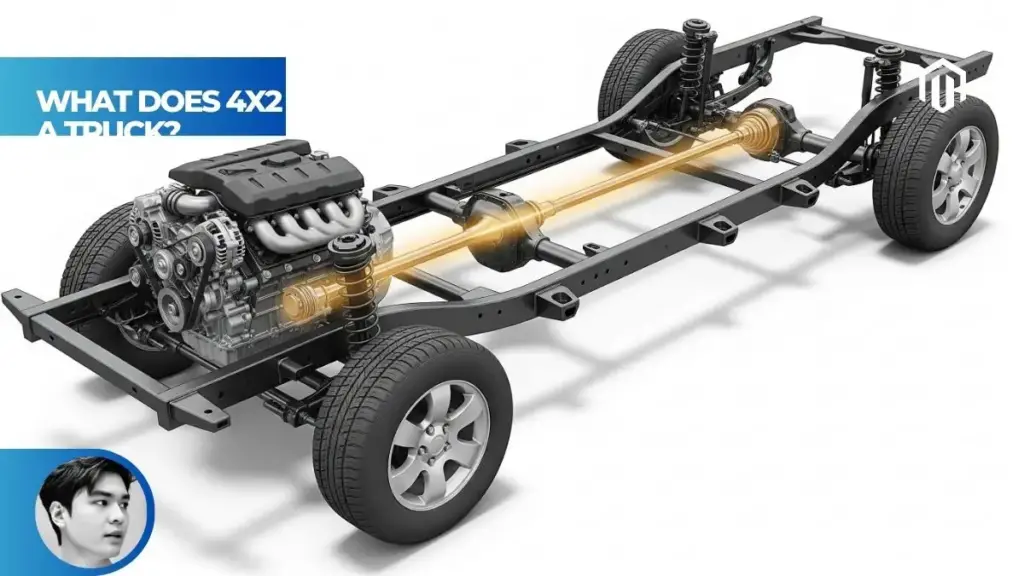
4×2 means the truck has four wheels but only two of them receive power from the engine—typically the rear wheels[1]. The first number represents total wheels, the second represents driven wheels. So a 4×2 truck is essentially a two-wheel-drive (2WD) vehicle with rear-wheel drive (RWD). It’s the simpler, lighter, and more fuel-efficient alternative to 4×4 trucks that power all four wheels[2].
How a 4×2 Drivetrain Works
The mechanics behind a 4×2 truck are straightforward. Power flows from the engine through the transmission to a single driveshaft, which connects to the rear differential[1]. That differential distributes torque to both rear wheels, pushing the truck forward. The front wheels? They only handle steering—no power delivery.
Most 4×2 trucks include a limited-slip differential that manages power distribution between the left and right rear tires[1]. When one wheel loses traction, the limited-slip system transfers more torque to the wheel with grip. It’s not as effective as 4×4 in severe conditions, but it helps prevent getting stuck in moderately slippery situations.
This configuration has been the standard for trucks for decades. Without the extra hardware required for four-wheel drive—no transfer case, no front driveshaft, no front differential—the 4×2 setup weighs less and has fewer components that can break[3].
4×2 vs 4×4: Understanding the Difference
The fundamental difference between 4×2 and 4×4 comes down to how many wheels receive engine power. This single distinction creates a cascade of practical differences for owners[2].
| Feature | 4×2 Truck | 4×4 Truck |
|---|---|---|
| Driven wheels | 2 (rear) | 4 (all) |
| Weight | Lighter | Heavier (200-400 lbs more) |
| Fuel economy | Better | Lower |
| Purchase price | Lower | $3,000-4,000 higher |
| Maintenance cost | Lower | Higher |
| Off-road capability | Limited | Superior |
| Towing capacity | Often higher | Often lower |
| Resale value | Lower | Higher |
Source: J.D. Power, CarParts.com, Tailored Trucks[1][2][4]
Understanding these distinctions is similar to knowing what Quattro means on an Audi—it’s about how power reaches the road surface and what that means for your driving experience.
Advantages of a 4×2 Truck
A 4×2 configuration delivers real benefits for drivers who don’t need all-terrain capability. The trade-offs favor practicality over versatility[3].
Better Fuel Economy
Without the extra weight of 4WD components, a 4×2 truck typically delivers 1-3 mpg better fuel economy than its 4×4 counterpart[5]. Over a 15,000-mile year at $3.50 per gallon, that translates to roughly $200-400 in annual savings. Multiply that over five years of ownership, and the fuel savings alone can exceed $1,500.
The lighter curb weight means the engine works less hard to move the vehicle. Less work equals less fuel consumption—simple physics.
Lower Purchase Price
The MSRP on 4×2 trucks runs approximately $3,200 to $3,900 lower than equivalent 4×4 models[6]. For budget-conscious buyers, that price gap represents real savings upfront. A Ram or F-150 in 4×2 configuration costs thousands less while delivering the same interior features and payload capacity.
Higher Towing and Payload Capacity
Here’s a detail that surprises many truck buyers: 4×2 trucks often tow more than 4×4 versions of the same model[7]. The reason? Gross Vehicle Weight Rating (GVWR) stays the same regardless of drivetrain, but 4×2 trucks weigh less. That weight savings translates directly into additional payload and towing capacity.
A 4×4 half-ton might offer 5,500 lb payload capacity, while the 4×2 version of that same truck could handle 6,000+ lbs[8]. For commercial users pulling trailers on paved roads, this difference matters. The best towing trucks are often 2WD dually configurations precisely because of this weight advantage[8].
If you’re evaluating towing capacity for specific models, always compare 4×2 and 4×4 variants separately.
Reduced Maintenance
Fewer parts mean fewer things that can fail. A 4×2 truck has no transfer case, no front differential, and no front CV joints to service or replace[9]. These components in 4×4 trucks require periodic maintenance (transfer case fluid changes, differential services) and can develop problems over time.
Fleet data shows 4×2 trucks averaging 28 cents per mile in operating costs versus 26 cents for 4×4 over a 10-year period—but the simpler maintenance schedule appeals to owners who prefer hassle-free ownership[10].
Smoother Ride Quality
The absence of front-drive components improves ride quality on paved roads. 4×2 trucks handle more predictably in daily driving, with better weight distribution and fewer mechanical intrusions into the cabin floor[3]. For commuters and highway drivers, this translates to a more comfortable daily experience.
Disadvantages of a 4×2 Truck
The 4×2 configuration isn’t for everyone. Its limitations become apparent in specific conditions[2].
Limited Off-Road Capability
With power only reaching two wheels, a 4×2 truck struggles on loose surfaces, steep inclines, and slippery terrain[11]. Mud, deep sand, and rocky trails can quickly overwhelm a two-wheel-drive system. The rear wheels spin while the front wheels sit idle—unable to pull the truck forward.
For occasional light off-roading, a 4×2 with good tires can manage. But serious trail use requires four-wheel drive.
Poor Performance in Snow and Ice
Winter driving presents challenges for 4×2 trucks. With the engine weight over the front wheels and power going to the rear, traction becomes problematic[3]. Adding weight to the bed helps, but it doesn’t fully compensate for the traction advantage of 4WD.
Drivers in snow belt states often regret choosing 4×2 after their first winter. If your driveway or commute involves unplowed roads, 4×4 provides a meaningful safety margin.
Lower Resale Value
The used truck market strongly favors 4×4 configurations. At three years old, a 4×4 truck retains roughly 64% of the original price premium over the 4×2 model[6]. That means when selling, 4×2 owners face steeper depreciation.
When evaluating how many miles is good for a used vehicle, 4×4 trucks tend to hold value better regardless of mileage. Buyers simply prefer the versatility.
Who Should Buy a 4×2 Truck?
A 4×2 truck makes sense for specific use cases[3][5]:
Choose 4×2 if you:
- Drive primarily on paved roads and highways
- Live in a mild climate without significant snow
- Prioritize fuel economy and lower operating costs
- Need maximum towing or payload capacity
- Operate a fleet and want simplified maintenance
- Plan to keep the truck rather than resell
Choose 4×4 if you:
- Regularly drive in snow, ice, or rain
- Need off-road capability for work or recreation
- Live in rural or mountainous areas
- Value higher resale value
- Prefer the security of all-wheel traction
For commercial fleets that operate mostly on pavement—delivery services, landscaping, construction on developed sites—4×2 trucks offer compelling economics. The lower upfront cost, better fuel economy, and reduced maintenance create measurable cost savings over the vehicle’s life[10].
4×2 Trucks in the Real World
Fleet adoption tells an interesting story. While consumer 4×4 popularity has grown, utility fleets continue using significant numbers of 4×2 trucks because the operational math favors them for predictable, paved-road duty[10].
Heavy-duty towing operations often specify 4×2 dually configurations for maximum payload and fuel efficiency[8]. These trucks pull heavy trailers thousands of miles annually on highways—they rarely need off-road capability but always need maximum capacity.
That said, the market is shifting. 4×4 light-duty trucks have grown steadily in popularity as the price gap narrows and buyers prioritize versatility over optimization[10]. Understanding how many gallons of gas your truck holds helps calculate the real-world fuel cost differences between configurations.
Key Takeaways
- 4×2 means four wheels total with two driven wheels (typically rear), making it synonymous with 2WD or RWD in trucks
- 4×2 trucks cost $3,200-$3,900 less than 4×4 equivalents and deliver 1-3 mpg better fuel economy due to reduced weight
- Towing and payload capacity often favor 4×2 configurations because the weight savings increases available capacity within the same GVWR
- 4×2 trucks struggle in snow, ice, mud, and off-road conditions where four-wheel traction provides a significant advantage
- Choose 4×2 for paved-road driving, mild climates, commercial fleets, and maximum towing—choose 4×4 for weather versatility and resale value
FAQs
Is a 4×2 truck the same as 2WD?
Yes. A 4×2 truck and a 2WD (two-wheel drive) truck refer to the same configuration—a vehicle with four total wheels where only two receive engine power[1]. In trucks, this typically means rear-wheel drive. The “4×2” notation is common in truck specifications, while “2WD” appears more often in general automotive terminology.
Can a 4×2 truck tow as much as a 4×4?
Often more. Because 4×2 trucks weigh less than 4×4 variants of the same model, they frequently have higher payload and towing capacities[7]. The GVWR remains constant, so the weight savings from eliminating 4WD components translates directly into additional hauling capacity.
Are 4×2 trucks good in rain?
Modern 4×2 trucks with decent tires handle normal rain adequately on paved roads. The issue arises with heavy rain, standing water, or wet unpaved surfaces where reduced traction becomes problematic[2]. If your region experiences frequent heavy rain, 4WD provides a safety margin.
How much cheaper is a 4×2 truck than 4×4?
New 4×2 trucks typically cost $3,200 to $3,900 less than equivalent 4×4 models[6]. The exact premium varies by manufacturer and trim level. Combined with better fuel economy and lower maintenance costs, total ownership savings can exceed $5,000-$7,000 over five years.
Can you convert a 4×2 truck to 4×4?
Technically yes, but it’s expensive and complex. A proper 4×2 to 4×4 conversion costs approximately $5,000+ for parts and labor, requiring a transfer case, front differential, front driveshaft, and associated suspension modifications[12]. In most cases, buying a factory 4×4 makes more financial sense.
References
- J.D. Power. (2021). What Is A 4×2 Truck? https://www.jdpower.com/cars/shopping-guides/what-is-a-4-x-2-truck
- CarParts.com. (2025). 4×2 vs 4×4: What’s the Difference and Which Is Better? https://www.carparts.com/blog/4×2-vs-4×4-whats-the-difference-and-which-is-better/
- GoodCar. (2025). When To Choose A 4×2 Truck. https://goodcar.com/blog/what-is-a-4×2-truck
-
Tailored Trucks. (2025). What Is The Difference Between 4×2 And 4×4 & Which Is Best?
What is the difference between 4×2 and 4×4 & which is best?
- Go Champion Dodge. (2025). 4×2 vs. 4×4: Which Drivetrain is Right for Your Next Ram Truck? https://www.gochampiondodge.com/2025/06/27/4×2-vs-4×4-which-drivetrain-is-right-for-your-next-ram-truck/
- Auto Concepts. (2018). Should I Pay Extra for a 4×4 Truck? https://myautoconcepts.com/bdp/3622/4×4-truck/should-i-pay-extra-for-a-4×4-truck
-
Summit Fleet. (2024). 4×2 or 4×4 Pickup Truck.
4×2 or 4×4 pickup truck
- Thorpe Automotive. (2023). 2 Wheel Drive Trucks Vs 4 Wheel Drive Trucks. https://thorpeautomotive.com/bdp/35299/truck-buying-tips/2-wheel-drive-trucks-vs-4-wheel-drive-trucks
- WheelsBingo. (2025). 4×2 vs 4×4: Drivetrain Meaning, Differences & Which Is Better. https://www.wheelsbingo.com/blog/4×2-or-4×4-understanding-the-difference-and-what-suits-your-needs
- Government Fleet. (2018). Light-Duty Service Trucks: 4×2 vs. 4×4. https://www.government-fleet.com/307108/light-duty-service-trucks-4×2-vs-4×4
- JMCG Global. (2024). 4×4 Pickup vs 4×2 Pickup: Which One You Need. https://www.jmcg-global.com/news/293.html
- Facebook Groups. (2025). Why 4×2 to 4×4 conversion cost difference? https://www.facebook.com/groups/699834556748975/posts/25230011243304632/

I am a senior automotive analyst at Autvex. Expert vehicle evaluations, in-depth reviews, and objective analysis helping readers make informed automotive decisions with years of industry experience.