You may also like:
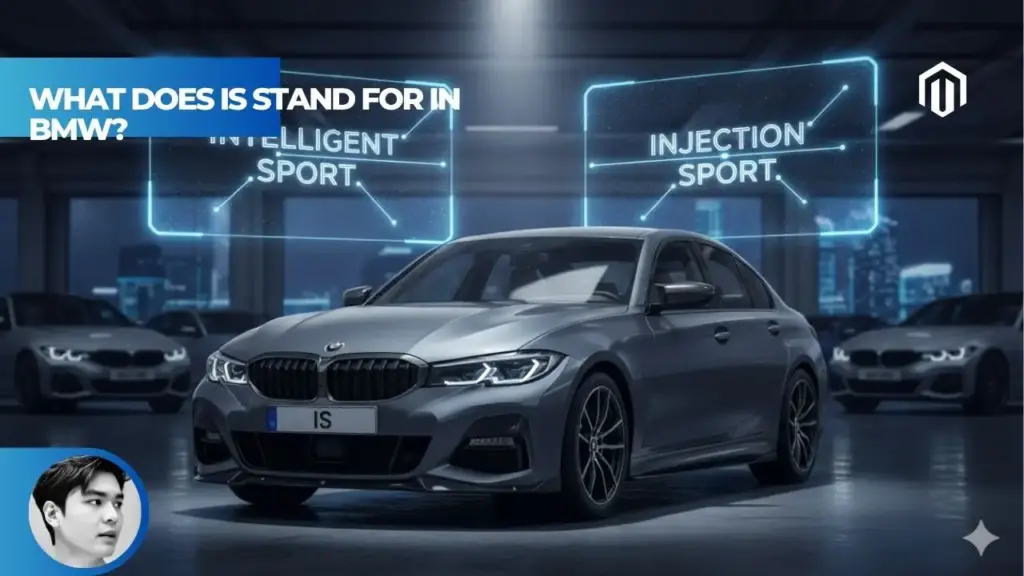
In BMW model names, “i” stands for fuel injection (petrol/gasoline engine) and “s” stands for sport. A model like “318is” means a 3 Series with a 1.8-liter fuel-injected petrol engine with sport options fitted[1]. But there’s a twist: BMW announced in 2024 that it’s dropping the “i” suffix from gas-powered cars entirely—going forward, only electric vehicles will carry the “i” designation as a prefix (like the i4 or i7)[2].
The Historical Meaning of “i” in BMW
The lowercase “i” at the end of BMW model names dates back to the late 1960s with models like the 2000tii[3]. At that time, fuel injection was genuinely innovative technology—most cars used carburetors.
BMW used “i” to differentiate between their fuel-injected and carbureted models. A “325i” had fuel injection; a standard “325” did not[4]. When fuel injection became universal across BMW’s lineup in the 1980s, the “i” designation stuck anyway as a tradition.
The “i” simply means the engine runs on gasoline (petrol) and uses electronic fuel injection[5]. Diesel BMWs use “d” instead—so “320d” indicates a 3 Series with a diesel engine.
What “s” Means in BMW Model Names
The lowercase “s” historically signifies a sport variant. Models like “318is” or “Z4 3.0si” had the sport package or higher-performance tuning compared to standard versions[1].
You’ll also see “s” combined with other letters:
- is — Injection + Sport (example: 318is)
- si — Sport + Injection (example: Z4 sDrive 35is)[1]
- ti — Turismo Internazionale (touring international)[5]
- tii — Turismo Internazionale Iniezione (touring international injection)[5]
The most recent use of “ti” appears on the BMW 128ti, a hot hatch competing with the Volkswagen Golf GTI.
BMW’s Complete Letter Code System
BMW’s naming convention follows a logical structure once you understand it[5]:
| Letter | Position | Meaning | Example |
|---|---|---|---|
| i | End (suffix) | Fuel injection (gasoline) | 330i |
| d | End (suffix) | Diesel engine | 320d |
| e | End (suffix) | Plug-in hybrid (PHEV) | 745e |
| L | End (suffix) | Long wheelbase | 760Li |
| i | Start (prefix) | All-electric (BMW i brand) | i4, i7 |
| M | Start or middle | BMW M performance | M3, M340i |
| X | Start (prefix) | SUV/crossover | X3, X5 |
| Z | Start (prefix) | Roadster | Z4 |
The first digit indicates the series size (1-8, larger numbers = larger cars). The following digits historically referenced engine displacement but now indicate relative performance level[5].
BMW i Sub-Brand: A Different Kind of “i”
Here’s where confusion enters. When “i” appears at the beginning of a BMW model name, it represents something completely different—BMW’s electric vehicle sub-brand launched in 2011[6].
| Position | Meaning | Examples |
|---|---|---|
| Suffix (end) | Fuel injection | 330i, M440i |
| Prefix (start) | Electric vehicle | i4, i7, iX |
In this context, “i” stands for “innovation” according to BMW[7]. The BMW i brand was conceived to represent the company’s commitment to electric mobility and sustainability. Current BMW i models include:
- BMW i3 — Compact electric (historic model)
- BMW i4 — Electric sedan starting at $57,900[8]
- BMW i5 — Electric 5 Series starting at $67,100[8]
- BMW i7 — Electric 7 Series starting at $105,700[8]
- BMW iX — Electric SUV flagship
Electric SUVs add an “X” between the “i” and series number (iX1, iX3, iX)[9].
BMW Is Dropping the “i” From Gas Cars
In 2024, BMW confirmed a major change: the “i” suffix will disappear from all gas-powered models[2]. Going forward, only electric vehicles will carry the “i” designation.
“We would like to keep ‘i’ as an asset, and we would like to keep it as a signature to indicate you’re driving an electric car,” explained Bernd Körber, BMW’s senior vice president of brand and product management[3].
The transition began with the 2025 BMW X3 M50, which replaced the X3 M40i—notice the dropped “i”[2]. The new BMW 1 Series and 2 Series Gran Coupe also adopted this naming change by end of 2024[10].
This means future gas BMW model names will simply end in numbers:
- Old naming: X3 M40i, 340i, 540i
- New naming: X3 M50, 340, 540
The reason? Customer confusion. When BMW sells both a 440i (gas) and an i4 (electric), the lowercase “i” appearing in different positions creates unnecessary complexity[11].
Other BMW Model Designations Explained
Beyond “i” and “s,” BMW uses several other identifiers[5]:
Drive System Codes
| Code | Meaning |
|---|---|
| xDrive | All-wheel drive (most models) |
| sDrive | Rear-wheel or front-wheel drive (X and Z models) |
Performance Badges
| Badge | Meaning |
|---|---|
| M | Full BMW Motorsport model (M3, M5, X5 M) |
| M Performance | Enhanced but not full M (M340i, M50) |
| Competition | Track-focused M variant |
Body Style Codes
| Code | Meaning |
|---|---|
| GT | Gran Turismo (hatchback) |
| Gran Coupe | Four-door coupe |
Understanding these codes helps decode any BMW. A “540i xDrive M Sport” tells you: 5 Series, 40-level performance, gasoline engine, all-wheel drive, with the M Sport package. (Though remember—new 5 Series models will drop that “i” going forward.)
Key Takeaways
- The “i” suffix historically meant fuel injection (gasoline/petrol engine), introduced in the 1960s when this technology was innovative[5]
- The “s” designation indicates sport variants, often combined as “is” or “si” on performance-oriented models[1]
- BMW i sub-brand uses “i” as a prefix (like i4, i7) to identify all-electric vehicles, where “i” stands for innovation[6]
- BMW is dropping the “i” suffix from all gas cars starting 2024, beginning with the X3 M50 (formerly M40i) and new 1 Series[2][10]
- Other key letters include “d” for diesel, “e” for plug-in hybrid, “L” for long wheelbase, and “M” for BMW Motorsport[5]
FAQs
What does “i” mean at the end of a BMW model name?
Historically, the lowercase “i” at the end of BMW model names stands for fuel injection, indicating a gasoline/petrol engine[5]. BMW introduced this designation in the late 1960s when fuel injection was cutting-edge technology worth highlighting. The term stuck even after fuel injection became standard across all models. Starting in 2024, BMW began removing the “i” suffix from new gas-powered models, reserving it exclusively for electric vehicles[2].
What’s the difference between “i” at the start vs end of BMW names?
When “i” appears at the end (like 330i), it historically meant fuel injection/gasoline engine[1]. When “i” appears at the start (like i4 or i7), it identifies a BMW i sub-brand all-electric vehicle[6]. This dual usage created confusion, which is why BMW decided to drop the suffix “i” from gas cars entirely—now only electric vehicles will use “i” in their names[3].
Does BMW still use “is” in model names?
BMW no longer actively produces models with the “is” designation. The combination appeared on classic models like the 318is and BMW Z4 sDrive 35is, where “i” meant injection and “s” meant sport[1]. With BMW dropping the “i” suffix from gasoline models starting in 2024[2], future sport variants will use different naming conventions—likely incorporating “M” performance badges instead.
What does BMW M stand for?
BMW M stands for Motorsport. The M division creates BMW’s highest-performance vehicles, from full M models like the M3 and M5 to M Performance variants like the M340i[5]. The M badge appears with three colored stripes (blue, violet, and red) representing the heritage of BMW Motorsport. M models feature enhanced engines, suspension, brakes, and aerodynamics compared to standard BMW vehicles.
What does “d” mean in BMW names?
The lowercase “d” in BMW model names indicates a diesel engine[5]. A “320d” is a 3 Series with a diesel powerplant, while a “320i” (or simply “320” going forward) has a gasoline engine. Diesel BMWs are more common in European and international markets than in the United States, where gasoline and electric options dominate sales.
References
- Wikipedia. (2025). List of BMW vehicles. https://en.wikipedia.org/wiki/List_of_BMW_vehicles
- Car and Driver. (2024). Confirmed: BMW Scraps the ‘i’ in Names of Its Gas-Powered Cars. https://www.caranddriver.com/news/a60721215/confirmed-bmw-scraps-the-i-in-names-of-its-gas-powered-cars/
- Kelley Blue Book. (2024). BMW Dropping the i from Gas-Powered Model Names. https://www.kbb.com/car-news/bmw-dropping-the-i-from-gas-powered-model-names/
-
Reddit r/BMW. (2018). Can someone please explain the naming system for BMW’s?
Can someone please explain the naming system for BMW’s?
byu/hillaryandbilldid911 inBMW - BMW. (2025). How to decipher the BMW naming system. https://www.bmw.com/en/automotive-life/BMW-naming-system.html
- Wikipedia. (2025). BMW i. https://en.wikipedia.org/wiki/BMW_i
- Oreate AI Blog. (2025). What Does the ‘I’ in BMW Stand For? https://www.oreateai.com/blog/what-does-the-i-in-bmw-stand-for/
- BMW USA. (2025). BMW All-Electric Vehicles. https://www.bmwusa.com/all-electric.html
- The Autopian. (2023). BMW Model Names. https://www.theautopian.com/bmw-model-names/
- BMWBlog. (2024). BMW Deletes ‘i’ From The Names Of Its Gasoline 1 Series Models. https://www.bmwblog.com/2024/06/04/bmw-deletes-letter-i-gasoline-1-series/
-
Carscoops. (2024). BMW To Ditch ‘i’ On Gas Cars, Keep It Only For EVs.
BMW To Ditch ‘i’ On Gas Cars, Keep It Only For EVs

I am a senior automotive analyst at Autvex. Expert vehicle evaluations, in-depth reviews, and objective analysis helping readers make informed automotive decisions with years of industry experience.