You may also like:
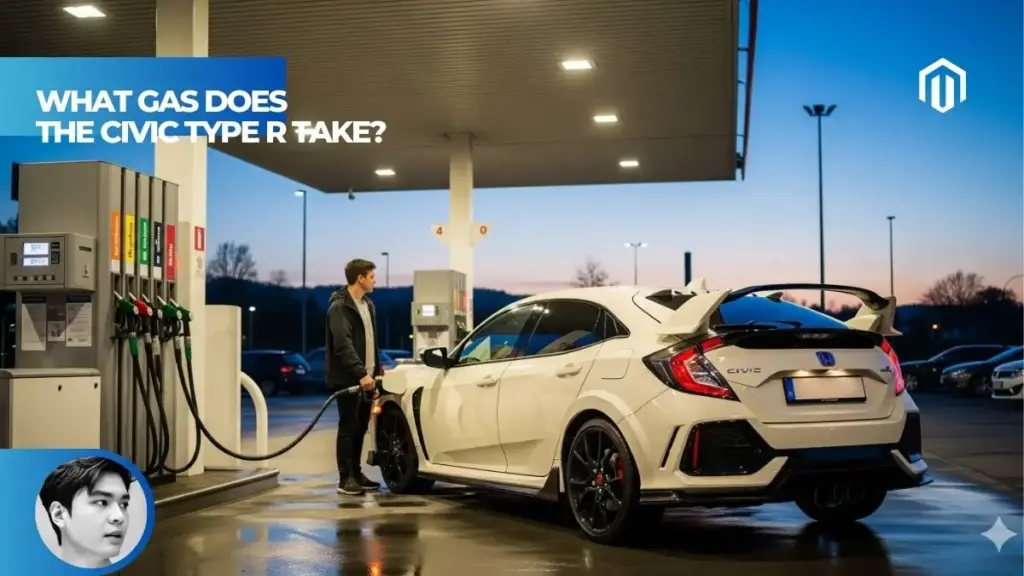
The Honda Civic Type R requires premium unleaded gasoline with a minimum 91 octane rating[1]. Honda’s official website lists the fuel requirement as “Regular Unleaded (Premium Recommended),” but the owner’s manual specifies premium 91 or higher for optimal performance[2]. Using 93 octane delivers the full 315 horsepower the K20C1 engine was designed to produce[3].
Why the Type R Needs Premium Fuel
The answer lies in the K20C1 engine’s high-performance design. This 2.0-liter turbocharged four-cylinder runs a 9.8:1 compression ratio—high for a turbocharged engine[4]. That combination creates significant cylinder pressure, which demands fuel that resists premature ignition.
Premium gasoline (91+ octane) has greater resistance to “knock”—uncontrolled combustion events that can damage internal components[5]. The Type R’s ECU expects this knock resistance to safely run aggressive ignition timing and boost pressure. Lower octane fuel simply can’t keep up.
Honda’s engineers tuned this engine specifically for premium fuel. The official crate engine specification lists “Fuel – Minimum 91 Octane” as a requirement[6]. While Honda’s marketing materials suggest regular is technically acceptable, treating 91 octane as your baseline protects both performance and reliability.
Honda’s Confusing Fuel Recommendation Explained
Here’s where things get murky. Honda’s official website states “Regular Unleaded (Premium Recommended)” for the 2025 Civic Type R[1]. But crack open the owner’s manual, and you’ll find it specifies premium 91 or higher[2].
What gives? The website listing covers Honda legally—the car can run on regular without immediate catastrophic failure. The ECU detects knock and compensates by reducing timing and boost. You won’t blow the engine on a single tank of 87 octane.
But “can run” differs vastly from “should run.” Type R owners on forums consistently treat 91 octane as the true minimum requirement, with many opting for 93 where available[3]. The consensus: follow the owner’s manual, not the website.
What Happens If You Use Regular Gas?
Using 87 octane in a Type R triggers an immediate chain of protective measures. The knock sensors detect early combustion and signal the ECU to pull timing and reduce boost pressure[7]. Your engine stays safe—but performance suffers dramatically.
Owner reports and testing suggest 87 octane causes approximately 30-50 horsepower loss[8]. Real-world symptoms include:
- Noticeably sluggish acceleration from stops
- Reduced passing power on highways
- Longer 0-60 times (roughly 0.5-1.0 seconds slower)
- Diminished throttle response, especially above 5,000 RPM
- The ECU operating in a protective, de-tuned mode
The catch? If you bought a 315-hp hot hatch to drive conservatively on low-octane fuel, you grabbed the wrong keys. The whole point of a Type R is that intoxicating VTEC pull to redline—something you’ll never experience on regular gas.
91 vs 93 Octane: Does It Matter?
Most Type R owners debate whether to run 91 or 93 octane. Both meet Honda’s minimum specification, but 93 delivers marginally better results.
| Metric | 91 Octane | 93 Octane |
|---|---|---|
| Estimated Peak HP | 310-312 | 315-320 |
| ECU Behavior | Full performance | Optimal timing maps |
| Real-World Feel | Excellent | Slightly sharper response |
| Price Premium | Baseline | +$0.20-0.40/gallon |
Source: Owner reports and dyno testing[8]
The differences are measurable but modest. Some owners report the ECU “learns” higher octane fuel over time and adjusts timing accordingly[3]. If 93 octane is available in your area, it extracts every last bit of performance Honda intended. But 91 octane delivers the full Type R experience for most drivers.
Running consistently on 91 won’t harm the engine or leave significant power on the table. The decision comes down to whether that extra 5-8 horsepower justifies the cost difference at your local pump.
Fuel Economy and Tank Size
Understanding the Type R’s gas mileage helps you budget for premium fuel costs. The EPA rates the 2025 Civic Type R at 22 mpg city, 28 mpg highway, and 24 mpg combined[1].
The 12.4-gallon fuel tank represents one common owner complaint[9]. With aggressive driving, expect roughly 250-300 miles between fill-ups. Highway cruisers report up to 347 miles per tank, but spirited driving drops that significantly.
Owner experiences vary based on driving style:
- Conservative driving (Comfort mode): 26-30 mpg[10]
- Mixed driving: 23-27 mpg[10]
- Aggressive driving (R+ mode): 18-22 mpg[10]
At current premium fuel prices, Edmunds estimates monthly fuel costs around $183, translating to roughly $2,200 annually. For a $45,895 performance car, fuel represents a relatively small ownership expense.
Accidentally Used Regular Gas?
Mistakes happen. If you accidentally pumped 87 octane into your Type R, don’t panic.
The ECU’s knock detection system protects the engine by pulling timing and reducing boost[7]. You’ll notice reduced performance, but no immediate damage occurs. One owner reported accidentally filling half a tank with 87 octane, and forum responses confirmed the car would simply operate in a protected, de-tuned state until proper fuel returns[11].
Your recovery plan is simple: drive gently until you can refuel. Top off with 93 octane at your next stop to raise the overall octane level in your tank. Avoid wide-open throttle runs until you’ve burned through the mixed fuel. Within a tank or two, you’re back to normal.
What you shouldn’t do: make a habit of running regular. Repeated use of 87 octane increases wear on engine components over time, even with ECU compensation. The knock sensors and timing retardation protect against catastrophic failure, not accelerated wear from operating outside design parameters.
How the Type R Compares to Other Hondas
Not all Hondas share the Type R’s strict fuel requirements. Understanding where your model falls helps avoid confusion.
| Model | Fuel Requirement | Notes |
|---|---|---|
| Civic Type R | Premium 91+ required | K20C1 turbo, 315 hp |
| Civic Si | 91 recommended, 87 minimum | 1.5T, 200 hp, more tolerant |
| Standard Civic | Regular 87 | NA or mild turbo variants |
| Accord 2.0T | Premium recommended | Similar turbo architecture |
Source: Honda owner’s manuals and specifications[2][12]
The Civic Si represents an interesting middle ground. Honda recommends 91 octane but allows 87 as a minimum[12]. Owners report the Si tolerates regular fuel better than the Type R due to its less aggressive tuning and lower output. Some Si owners have run 87 octane for 80,000+ miles without issues[12].
The Type R offers no such flexibility. Its performance-focused calibration leaves minimal margin for lower-quality fuel.
Best Fuel Practices for Type R Owners
Maximize your Type R’s performance and longevity with these fuel strategies:
- Use 91 octane minimum, 93 preferred – Follow the owner’s manual, not the website
- Choose TOP TIER detergent gasoline – Honda specifically recommends TOP TIER brands for their additive quality[2]
- Avoid ethanol blends above E15 – Honda warns against fuel containing more than 15% ethanol[2]
- Never use fuel containing methanol or MMT – These additives can damage fuel system components[2]
- Fill up before dropping below quarter tank – Consistent fuel quality matters for turbocharged engines
When traveling to areas with limited premium availability, plan your fill-ups accordingly. Running low and being forced to use 87 octane occasionally won’t destroy your engine, but treating it as routine defeats the purpose of owning a Type R.
Key Takeaways
- The Civic Type R requires premium unleaded gasoline with 91+ octane—the owner’s manual specifies this despite the website’s softer wording
- The K20C1 engine’s 9.8:1 compression ratio and turbocharging demand premium fuel’s knock resistance for safe, full-power operation
- Using 87 octane causes 30-50 horsepower loss as the ECU protects the engine by reducing timing and boost pressure
- Running 93 octane extracts marginally more power than 91, but both meet Honda’s minimum specification for full performance
- Accidental regular gas use won’t cause immediate damage—drive gently and refill with premium at your next opportunity
FAQs
Does the Civic Type R require premium gas?
Yes. Honda’s owner’s manual specifies premium unleaded gasoline with 91 octane or higher[2]. While the website lists “Regular Unleaded (Premium Recommended),” this represents the absolute minimum for emergency situations only—not everyday use.
Can I use 87 octane in my Type R occasionally?
The car will run on 87 octane without immediate damage, but expect significant power loss (30-50 hp) as the ECU compensates to prevent knock[8]. Occasional emergency use won’t cause catastrophic failure, but routine use accelerates wear and eliminates the performance you paid for.
What’s the difference between 91 and 93 octane in a Type R?
Both meet Honda’s requirements, but 93 octane extracts marginally more power (approximately 5-8 additional horsepower) and allows slightly more aggressive timing[8]. Most owners won’t notice the difference in daily driving, but track-focused drivers often prefer 93.
Why does Honda’s website say regular gas is acceptable?
Legal and marketing reasons. The ECU can compensate for lower octane fuel without immediate engine damage, making “regular unleaded acceptable” technically accurate[7]. But acceptable for survival differs from optimal for performance. The owner’s manual—your definitive guide—specifies premium.
Will using regular gas void my warranty?
Using 87 octane alone likely won’t void your warranty, as Honda acknowledges the car can operate on regular fuel. That said, damage caused by consistent sub-optimal fuel use may face scrutiny. Following the owner’s manual recommendation (premium 91+) eliminates any potential warranty disputes.
References
- Honda. (2025). 2025 Civic Type R Features & Specs. https://automobiles.honda.com/civic-type-r/specs-features-trim-comparison
- Honda. (2023). Civic Owner’s Manual – Fuel Information. https://owners.honda.com/utility/download?path=%2Fstatic%2Fpdfs%2F2019%2FCivic+Sedan%2F2019_Civic_4D_Capless_Fuel_Filler.pdf
-
Reddit r/cars. (2019). 18 Months with a Civic Type R – My thoughts.
18 Months with a Civic Type R – My thoughts
byu/MattTheTypeRDriver incars - CivicX Forum. (2018). K20C1: The Power of Dreams? https://www.civicx.com/forum/threads/k20c1-the-power-of-dreams.3283/
- YouTube. (2025). Does Regular Gas Lead To Engine Knocking Sounds?
- Mountune USA. (2025). Honda K20C1 Crate Engine Specifications. Honda K20C1 Crate Engine
- CivicXI Forum. (2023). Accidentally put half a tank of 87 octane in my Type R. https://www.civicxi.com/forum/threads/accidentally-put-half-a-tank-of-87-octane-in-my-type-r-anything-to-worry-about.54237/
- Autvex. (2025). What Gas Does the Civic Type R Take? https://autvex.com/what-gas-does-the-civic-type-r-take/
-
Reddit r/Civic_Type_R. (2019). Type R Owners – Let’s Hear Your Reviews.
Type R Owners – Let's Hear Your Reviews
byu/shodashakshari inCivic_Type_R -
Reddit r/Honda. (2025). I’ve owned the 2025 Type R for 1 month now.
I’ve owned the 2025 Type R for 1 month now. Here’s my thoughts.
byu/iShootLife inHonda - CivicX Forum. (2022). So who is using regular gas in these cars? https://www.civicx.com/forum/threads/so-who-is-using-regular-gas-in-these-cars.47482/
-
Reddit r/CivicSi. (2024). Using regular on 2025 SI.
Using regular on 2025 SI
byu/Independent-Camera53 inCivicSi

I am a senior automotive analyst at Autvex. Expert vehicle evaluations, in-depth reviews, and objective analysis helping readers make informed automotive decisions with years of industry experience.