You may also like:
Finding a tracking device on your car requires a systematic inspection of common hiding spots: the undercarriage, wheel wells, OBD-II port, bumpers, and interior compartments[1]. Most trackers are magnetic or hardwired, so you’ll need a flashlight and—for hidden cellular transmitters—an RF detector[2]. The whole process takes 30–60 minutes if you’re thorough, and you don’t need any special skills to do it yourself.
Warning Signs Your Car May Have a Tracker
Before crawling under your vehicle, consider whether certain red flags point to a hidden device[3].
Unexplained battery drain is one of the most common indicators. GPS trackers—especially hardwired ones—draw power constantly, which can leave your battery weaker than usual, particularly if the car sits for a few days[3]. If your battery suddenly can’t hold a charge and there’s no obvious mechanical reason, a parasitic draw from a hidden tracker could be the cause. Understanding how long a car battery lasts without driving helps you establish a baseline.
Strange radio interference is another tell. Active transmitters can disrupt AM radio signals or cause persistent static on your audio system[3]. If you notice unusual buzzing, clicking, or signal disruptions that weren’t there before, something may be broadcasting from your vehicle.
The most concerning sign? Someone seems to know your movements without explanation[3]. If an ex-partner, estranged family member, or anyone else repeatedly shows up at your locations or mentions details about your whereabouts they shouldn’t know, trust your instincts. That’s not coincidence—that’s surveillance.
Step 1: Inspect the Exterior
Start outside the car where quick-placement trackers are most common[1].
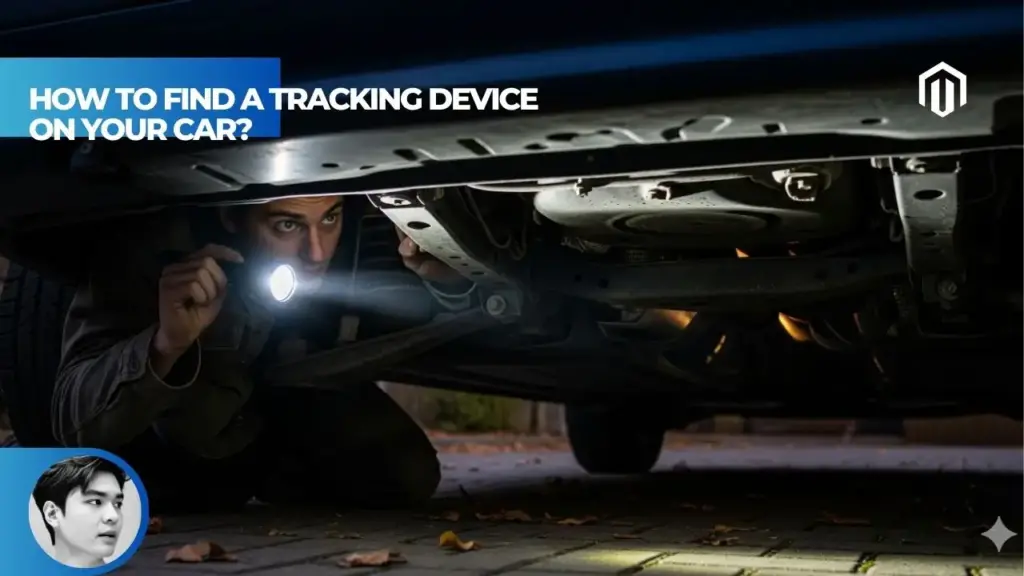
Grab a flashlight and get underneath the vehicle. Magnetic, battery-powered trackers stick to any accessible metal surface—the frame rails, suspension components, or the underside of the trunk are all prime spots[2]. These devices are usually small black boxes, often weatherproofed and covered in road grime after extended use. Run your hand along flat metal surfaces, feeling for anything that doesn’t belong.
Next, check the wheel wells[1]. Pull back the plastic fender liners if you can—trackers are often tucked up high where they’re invisible from a casual glance but still receive GPS signals[4]. They might be held in place by magnets, zip ties, or heavy-duty tape.
The bumpers deserve attention too. Front and rear bumpers have hollow cavities that make excellent hiding spots[3]. Listen for rattling sounds when you tap the bumper—a loose tracker inside may shift. Some devices require partial disassembly to find, so if you suspect something’s there but can’t see it, a mechanic can help.
Here’s a checklist of exterior hiding spots:
| Location | Why It’s Common | What to Look For |
|---|---|---|
| Undercarriage/frame | Easy magnetic placement, lots of flat metal | Small weatherproof box attached to frame rails |
| Wheel wells | Hidden from view but good GPS signal | Device tucked behind plastic liner, often grimy |
| Front/rear bumpers | Hollow cavities, rarely inspected | Listen for rattling; may require disassembly |
| Engine bay | Access to vehicle power, complex wiring | Add-a-fuse taps, unfamiliar wiring near battery |
Don’t rush this part. The exterior inspection takes 15–20 minutes if done properly[1].
Step 2: Check the Interior
Interior trackers are harder to place without access to your vehicle, but they’re also harder to find[1].
The OBD-II port is the first place to look. This diagnostic port—located under the dashboard near the steering column—provides direct power, making it ideal for plug-in trackers[1]. Some devices plug in and look almost like legitimate equipment. If you find anything in this port that you didn’t install (or that your mechanic didn’t mention), it’s worth investigating. Any unfamiliar dongle should raise suspicion[3].
Under the seats is another common spot[4]. Slide your front seats all the way forward, then all the way back. Use your flashlight to inspect the seat tracks, the floor, and the underside of the seat itself. Feel for small boxes attached with tape, Velcro, or zip ties[2]. A determined person could even slip a tiny tracker inside a zippered seat cover, though that’s rare[4].
Check behind the dashboard and glove compartment[1]. Remove the glove box entirely if possible—most pop out with a squeeze of the sides. Look behind it for anything that shouldn’t be there. The dashboard itself may require more disassembly, which can get complicated on modern vehicles.
The trunk is often overlooked[4]. Pull back the carpet lining, check the spare tire well, and look in all the small storage compartments. Trackers placed here can go unnoticed for months. If your car was recently purchased from a dealership, this is a particularly important area—some dealers install trackers for lot management that remain active after the sale[5].
Step 3: Use Detection Tools
Visual inspection won’t find everything. Some trackers are well-concealed or installed in areas you can’t easily access[2].
An RF (radio frequency) detector scans for active transmissions from cellular, Wi-Fi, or Bluetooth emitters[3]. Move the detector slowly around your vehicle—a spike in signal strength indicates a possible transmitter. Popular models include the Jammer Detector RD1 and PRO-SDR1 Spectrum Analyzer[3]. Prices range from $30 for basic handheld units to several hundred for professional-grade equipment.
The catch? RF detectors only find trackers that are actively transmitting[3]. Passive GPS loggers—which store location data instead of sending it in real-time—won’t emit signals and require physical discovery.
A magnet detector helps locate magnetically-attached devices[6]. These simple tools alert you when you pass over a strong magnetic field, which can reveal trackers hidden behind panels or in hard-to-see spots.
Your smartphone can assist too. Use a Wi-Fi analyzer app to scan for unknown networks near your car[6]. Some trackers create their own Wi-Fi hotspots with generic or suspicious SSIDs. If you see a network name that doesn’t belong to any nearby device, it might be coming from your vehicle.
For deeper investigation, a multimeter helps identify unfamiliar wiring in your car’s electrical system[6]. Look for spliced wires or devices connected directly to the vehicle’s battery—these indicate hardwired trackers that draw power continuously.
Where Dealership Trackers Hide
This deserves its own section because it’s more common than most people realize[5].
Many dealerships partner with companies like IKON Technologies, Spireon, or similar telematics providers to install GPS trackers for “theft protection” or lot management[5]. The problem? These devices often stay active long after the sale, sometimes without the buyer’s knowledge. If you recently bought a new or used car from a dealership, there’s a reasonable chance one of these trackers is still on your vehicle.
Dealership trackers are typically hardwired rather than magnetic[5]. They draw power from your vehicle’s electrical system using “add-a-fuse” taps—a piggyback-style adapter that sits in your fuse box[5]. Check your fuse box (both under the hood and in the cabin) for any fuse that looks out of place or has an unusual adapter.
Common dealership tracker locations include[5]:
- Behind the driver or passenger-side kick panels
- Zip-tied to wiring harnesses near existing modules
- Under the dashboard near the OBD-II port
- In the engine bay, around the battery tray or fuse box area
If you find one of these units and you’re not using any associated subscription service, you can safely disconnect and remove it[5]. Just be cautious not to interfere with critical vehicle systems—when in doubt, consult a mechanic or auto electrician.
DIY Detection: What Actually Works
Not every tracker-finding method you’ll see online is effective. Here’s what’s worth your time[6].
- Physical inspection remains the most reliable approach. Most trackers—especially consumer-grade and dealership units—are designed for quick installation, not deep concealment[2]. Someone placing a tracker illicitly usually has limited time and will choose an accessible spot. A thorough visual and tactile search catches the majority of devices.
- RF detectors work—with limitations. They’re useful for finding actively transmitting trackers but miss passive loggers entirely[3]. If you’re going this route, scan with the detector at different times of day. Some trackers only transmit periodically to conserve battery, so you might need multiple sweeps.
- Smartphone apps are unreliable for GPS detection. Despite marketing claims, most “tracker finder” apps simply scan for Bluetooth or Wi-Fi signals—they won’t detect cellular-based GPS trackers, which are the most common type[6]. A dedicated RF detector is far more effective if you’re serious about finding hidden devices.
- Professional sweeps exist for high-stakes situations. If you believe you’re being tracked by someone with resources (a stalker, private investigator, or someone with law enforcement connections), consider hiring a professional counter-surveillance service[2]. They have equipment and expertise beyond consumer-grade tools. If your situation involves potential vehicle theft concerns, learning whether Audi can track a stolen car provides helpful context on manufacturer tracking capabilities.
What to Do If You Find a Tracker
Finding a device raises immediate questions: Remove it? Leave it? Call the police?[2]
If you’re being stalked or tracked without consent, document everything before removing the device[7]. Take photos showing exactly where it was located. Note the device’s make, model, and any serial numbers visible. This evidence may be critical if you pursue legal action or need police involvement.
In many jurisdictions, placing a GPS tracker on someone’s vehicle without consent is illegal[7]. The laws vary by state—some require victim awareness for criminal prosecution, others don’t. Contact local law enforcement if you believe you’re being stalked or if the tracking is part of harassment.
For dealership trackers with no associated threat, removal is straightforward[5]. Disconnect the device’s power source (usually an add-a-fuse tap) and remove the unit. If you’re uncomfortable doing this yourself, any auto shop can handle it in minutes.
One nuance: if your vehicle is financed or leased, the lender may have contractual rights to install tracking devices[2]. Removing these could violate your loan agreement. Check your financing paperwork before disconnecting anything if you’re not the outright owner.
Key Takeaways
- Start with a visual inspection of the undercarriage, wheel wells, OBD-II port, and trunk—most trackers are placed in easily accessible spots that don’t require deep concealment[1][2].
- Warning signs like unexplained battery drain, radio interference, or someone knowing your whereabouts without explanation suggest a hidden tracker may be present[3].
- RF detectors help find actively transmitting devices but miss passive GPS loggers that store data instead of broadcasting—physical inspection remains the most reliable method[3][6].
- Dealership trackers are more common than most buyers realize; check your fuse box for “add-a-fuse” taps and inspect kick panels and wiring harnesses if you recently purchased a vehicle[5].
- If you find a tracker and suspect stalking or harassment, document everything with photos before removal and contact law enforcement—placing a GPS tracker without consent is illegal in many jurisdictions[7].
FAQs
Can a GPS tracker drain my car battery?
Yes, particularly hardwired trackers that draw power continuously[3]. Magnetic, battery-powered trackers use their own power source and won’t affect your car battery directly. That said, if you notice unusual battery drain—especially after the car sits for a few days—a hidden tracker could be the cause. Before assuming it’s a tracker, rule out other common issues like alternator problems or a car that won’t start in cold weather despite a good battery.
How long does it take to find a tracking device?
A thorough inspection takes 30–60 minutes for someone doing it for the first time[1]. Experienced technicians can sweep a vehicle in 15–20 minutes using professional equipment. The time depends on how accessible your vehicle’s hidden areas are and whether you’re using detection tools. Magnetic trackers in obvious spots (undercarriage, wheel wells) can be found in minutes; hardwired devices behind panels take longer.
Will my phone detect a GPS tracker on my car?
Smartphone apps have limited effectiveness[6]. Most tracker-finder apps only scan for Bluetooth or Wi-Fi signals, which won’t detect the cellular-based GPS trackers most commonly used for vehicle surveillance. A dedicated RF detector is more reliable for finding active transmitters. Your phone’s Wi-Fi scanner might identify unusual networks near your car, but this is hit-or-miss and shouldn’t be your primary detection method.
Is it legal to remove a GPS tracker from my car?
Generally yes, if it’s your vehicle and you didn’t consent to the tracking[7]. If someone placed a tracker without your knowledge or permission, removing it is within your rights in most jurisdictions. The exception: if your car is financed or leased, the lender may have contractual rights to track the vehicle—check your loan paperwork. For stalking situations, document the device before removing it and consider involving law enforcement.
References
- Tracki. (2025). How to Find a GPS Tracker on Your Car? https://tracki.com/blogs/post/how-to-find-a-gps-tracker-on-your-car
- LandAirSea. (2022). Find a Hidden GPS Tracker on Your Car. https://landairsea.com/blogs/consumers/how-to-find-a-hidden-gps-tracker-on-your-car
- Alibaba Car Interior. (2025). How to Tell If Your Car Is Being Tracked: Signs and Solutions. https://carinterior.alibaba.com/question/how-to-tell-if-your-car-is-being-tracked
- Dawarich. (2025). How to Find a Hidden GPS Tracker On Your Car. https://dawarich.app/blog/how-to-find-a-hidden-gps-tracker-on-your-car/
- Gears and Gadgets. (2025). How to Find the Hidden GPS Tracker in Your Car and Remove It! [Video].
- SZMIDJAMMER. (2024). 8 Steps to DIY GPS Tracker Detector. https://www.szmidjammer.com/blog/diy-gps-tracker-detector/
- wikiHow. (2024). How to Tell If Your Car is Bugged. https://www.wikihow.com/Tell-if-Your-Car-Is-Bugged

I am a senior automotive analyst at Autvex. Expert vehicle evaluations, in-depth reviews, and objective analysis helping readers make informed automotive decisions with years of industry experience.