You may also like:
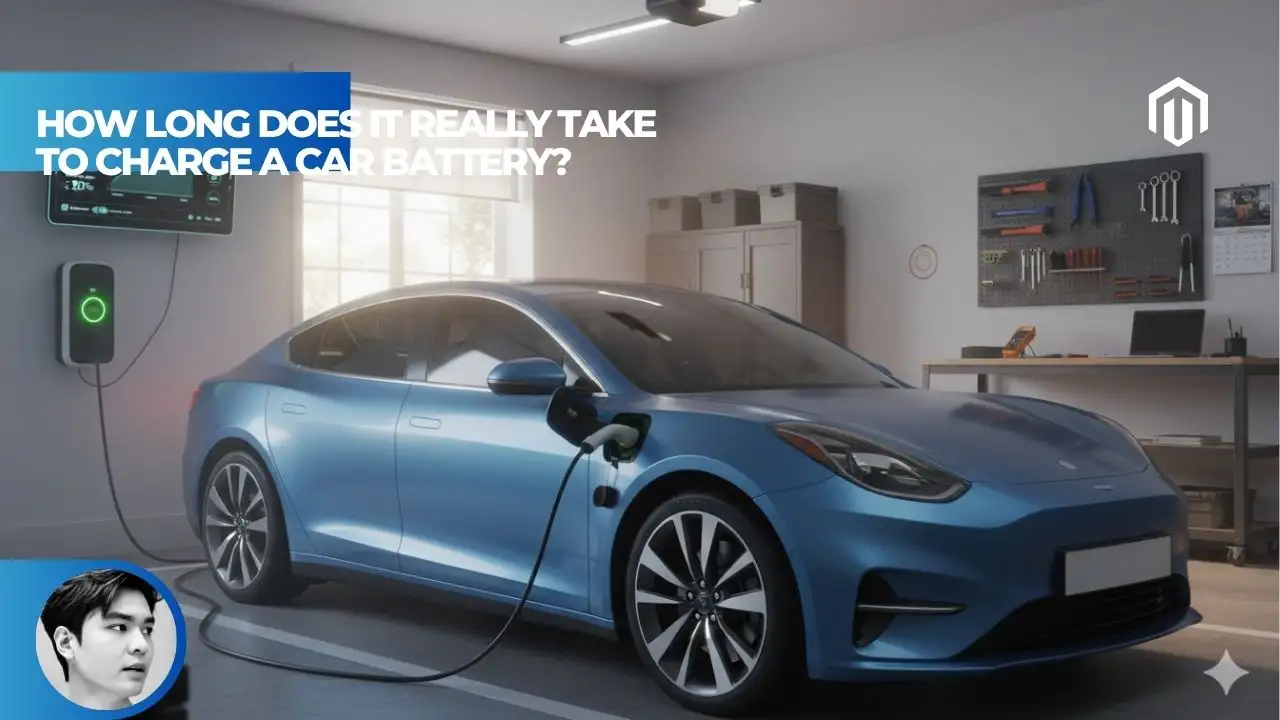
Charging a car battery takes anywhere from 30 minutes to 48 hours depending on your method[1]. A standard 2-amp trickle charger needs 24–48 hours for a full charge, while a 10-amp charger cuts that down to 3–8 hours[2]. Driving alone? Forget the 30-minute myth—you’ll need 4–8 hours of continuous highway driving just to reach 75–80% charge, and even then, a dedicated charger does the job better[3].
Why Charging Times Vary So Much
The answer to “how long” depends entirely on how you’re charging and what condition your battery is in[1].
A car battery’s capacity is measured in amp-hours (Ah). Most standard vehicle batteries fall between 40–80 Ah[4]. Simple math tells you how long charging takes: divide the battery capacity by the charger’s amperage output. A 50 Ah battery on a 2-amp charger? About 25 hours, assuming the battery was completely dead[4].
But real-world charging isn’t pure math. Battery age, temperature, and depth of discharge all play a role[2]. An older battery with degraded cells might never reach full capacity no matter how long you charge it. Cold weather slows the chemical reactions inside the battery, extending charge times[2]. And a battery that’s been deeply discharged multiple times holds less charge overall—permanent damage accumulates with each cycle[3].
Here’s the breakdown by charging method:
| Method | Time to Full Charge | Best For |
|---|---|---|
| Trickle charger (1–2 amps) | 24–48 hours | Long-term storage, battery health |
| Standard charger (4–8 amps) | 6–12 hours | Overnight charging |
| Fast charger (10–15 amps) | 3–8 hours | Quick turnaround |
| Driving (alternator) | 4–8+ hours | Maintenance only (not for dead batteries) |
| Jump start + driving | Emergency only | Gets you moving, not full recharge |
Each method has trade-offs[4]. Faster isn’t always better—we’ll get into why.
Trickle Chargers: Slow But Battery-Friendly
Trickle chargers operate at 1–3 amps, delivering a slow, steady current over 24–48 hours[4].
Why would anyone choose the slowest option? Because it’s the gentlest on your battery. Low-amperage charging minimizes heat buildup and reduces stress on battery cells[1]. Heat is the enemy of battery longevity—every degree above optimal operating temperature accelerates chemical degradation inside the cells[4].
Modern trickle chargers often include automatic shut-off features that stop charging once the battery reaches optimal voltage, preventing overcharging[4]. Some use two-stage charging: a faster initial phase until the battery reaches 80%, followed by a slower trickle to top off the remaining capacity without stressing the cells[4].
The catch? Time. If you need your car tomorrow morning, a trickle charger started at 10 PM won’t get you there. But for seasonal vehicles, motorcycles, boats, or any battery sitting unused for weeks, trickle charging is the gold standard for maintaining battery health[1]. If you’re storing your vehicle long-term, understanding how long a battery lasts without driving helps you plan maintenance.
Fast Chargers: Quicker, But Watch the Trade-Offs
Fast chargers push 8–15 amps, slashing charge time to 3–8 hours[5].
Speed comes at a cost. Higher amperage generates more heat, which can stress battery cells and shorten overall lifespan[5]. Repeated fast charging doesn’t immediately destroy a battery, but it accelerates wear over time. Think of it like sprinting versus walking—you’ll get there faster, but the toll on your body adds up.
That said, occasional fast charging won’t ruin a healthy battery[2]. If you’re in a time crunch and need a functional battery in a few hours, a 10-amp charger is a reasonable choice. Just don’t make it your default method if battery longevity matters to you.
One scenario where fast chargers shine: recovering a battery that’s not completely dead. If your battery still has some charge (above 11 volts), a fast charger can top it off efficiently without the same stress as charging from zero[1]. The deeper the discharge, the more the battery benefits from slower charging.
The Driving Myth: Why 30 Minutes Isn’t Enough
This is the misconception that refuses to die. “Just drive for 30 minutes after a jump start, and your battery will be fine.” It sounds logical. It’s also wrong[3].
Your alternator is designed to maintain a charged battery, not restore a dead one[3]. During normal operation, the alternator outputs 13–14.5 volts—enough to keep a healthy battery topped off while powering your car’s electrical systems[3]. But after a jump start? Most of that output goes to running your headlights, climate control, infotainment system, and the dozens of computer modules in modern vehicles[6]. Little is left over for charging.
Realistically, charging a depleted battery while driving requires 4–8 hours of continuous highway driving[3]. And here’s the kicker: even after that marathon, your battery will only reach 75–80% capacity[3]. Why? Automotive charging systems are designed to stop before reaching 100% to protect sensitive onboard electronics from voltage spikes[3].
To put this in perspective: eight hours at 65 mph equals roughly 520 miles[3]. That’s like driving from Los Angeles to Las Vegas and back—just to get an incomplete charge.
Short trips are even worse. Stop-and-go traffic, frequent restarts, and low-RPM idling mean the alternator barely generates surplus power[3]. If your typical driving involves 15-minute commutes, you’re actually draining the battery faster than charging it over time[6]. Understanding how jumpstarting works with alternator issues clarifies why driving alone often isn’t enough.
Jump Starts: Emergency Solution, Not a Charge
Jump starting gets your engine running. Period. It’s not a charging strategy[2].
When you connect jumper cables, you’re borrowing enough power from another battery to crank your starter motor. The moment your engine fires, your battery has contributed almost nothing—it’s still nearly dead[6]. The alternator now takes over powering the vehicle, but as we’ve covered, it won’t efficiently recharge a depleted battery.
After a jump start, the standard advice is to drive for at least 20–30 minutes without stopping[3]. But this isn’t to fully recharge—it’s to build enough reserve that your battery can restart the car once[3]. Turn off the engine too soon, and you’ll need another jump.
If your battery required a jump start, there’s a good chance it’s already damaged[3]. Deep discharges cause sulfation—crystal buildup on the lead plates inside—that permanently reduces capacity[6]. A jumped battery might limp along for weeks or months, but it’s living on borrowed time. Have it tested, and consider replacement if it’s more than 3–4 years old. Before you do, check out how long battery replacement takes to plan your time.
Idling: The Worst Charging Method
Some drivers assume idling with the engine running will charge the battery over time. Technically true. Practically useless[3].
At idle, your engine runs at low RPM—often just 600–800 revolutions per minute[3]. The alternator produces minimal output at these speeds, barely enough to power your vehicle’s electronics with nothing left for charging[3]. You’d need to idle for days to achieve meaningful charge, wasting fuel and producing emissions the entire time.
Worse, idling a recently jumped car can actually drain the battery further[3]. Each startup consumes a large burst of power, and if you’re idling in short intervals with multiple restarts, you’re depleting faster than replenishing[3].
If you can’t drive, use a charger. If you don’t have a charger and can’t drive, call for a tow or roadside assistance rather than sitting with the engine idling.
What Actually Affects Charging Time
Beyond the charger itself, several factors influence how quickly your battery recovers[2]:
- Battery age and condition matters most. A new battery accepts charge efficiently; an old one with degraded cells may never reach full capacity regardless of charging method[3]. Batteries typically last 3–5 years before capacity noticeably declines[1].
- Depth of discharge affects recovery time. A battery at 50% charge reaches full faster than one completely dead[4]. Deeply discharged batteries also sustain more damage per cycle, compounding the problem over time.
- Ambient temperature plays a significant role. Cold weather slows the chemical reactions inside lead-acid batteries, extending charge times substantially[2]. Charging below freezing can take 50% longer than at room temperature. Extreme heat, conversely, can cause overcharging and accelerate electrolyte evaporation[1].
- Charger quality varies more than you’d expect. Smart chargers monitor battery voltage and adjust output automatically, preventing overcharging and optimizing charge speed[2]. Older, simpler chargers require manual monitoring to avoid damage.
If your car has been sitting unused, check our guide on how long a car can sit without being driven to prevent battery issues before they start.
Best Practices for Battery Charging
Charging doesn’t have to be complicated, but doing it right extends battery life significantly[1]:
- Match the charger to your situation. Overnight availability? Use a 4–6 amp charger. Long-term storage? Trickle charger or maintainer. Emergency? Fast charger, understanding the trade-offs.
- Don’t skip the cables. Connect positive first, then negative to a ground point—not directly to the negative terminal[2]. This reduces spark risk near the battery, where hydrogen gas can accumulate.
- Monitor during charging. Check periodically for excessive heat, swelling, or unusual odors[4]. Any of these indicate a problem—disconnect immediately.
- Charge in ventilated areas. Lead-acid batteries emit hydrogen gas during charging, which is flammable in concentrated amounts[4]. Garages with open doors or outdoor spaces are ideal.
- Consider a battery maintainer for seasonal vehicles. If your motorcycle, boat, or classic car sits for weeks at a time, a maintainer keeps the battery at optimal charge without overcharging[1]. It’s a small investment that prevents premature replacement.
Key Takeaways
- Trickle chargers (1–2 amps) take 24–48 hours but are gentlest on battery health; fast chargers (10+ amps) cut time to 3–8 hours but accelerate long-term wear[4][5].
- The “30-minute drive after a jump start” myth is false—realistically, you need 4–8 hours of continuous highway driving to reach only 75–80% charge[3].
- Alternators are designed to maintain charged batteries, not restore dead ones; a dedicated charger is always more effective for depleted batteries[3][6].
- Idling does almost nothing for charging; low RPM means minimal alternator output, and frequent restarts can actually drain the battery faster[3].
- Battery age, depth of discharge, and ambient temperature all significantly affect charging time—older or deeply discharged batteries take longer and may never reach full capacity[2].
FAQs
Can I use my car while the battery is charging?
No, you cannot drive while a charger is connected[2]. External chargers require the vehicle to be stationary with the engine off. The only way to “charge while using” is through the alternator during driving, which as we’ve covered, is inefficient for depleted batteries. If you need mobility while your battery charges, you’ll need to wait or arrange alternative transportation.
How do I know when my car battery is fully charged?
Most modern chargers indicate full charge through LED lights or digital displays[2]. Without a smart charger, use a multimeter: a fully charged 12V battery should read 12.6–12.8 volts with the engine off[3]. Below 12.4 volts indicates a partial charge; below 12.0 volts means significant discharge. If your battery won’t hold above 12.4 volts after extended charging, it may be time for replacement.
Is it bad to leave a battery charger on overnight?
With a smart charger or maintainer, leaving it connected overnight is perfectly safe[4]. These devices automatically reduce or stop output once the battery reaches full charge. Older manual chargers without this feature can overcharge and damage the battery, so they require monitoring. When in doubt, check your charger’s specifications or invest in a modern automatic model.
Why does my battery keep dying even after charging?
Recurring dead batteries usually indicate one of three problems[6]: the battery itself is failing and can no longer hold charge, there’s a parasitic draw from an electrical component draining the battery when the car is off, or the alternator isn’t recharging properly during driving. Have all three tested—most auto parts stores offer free battery and alternator testing. If you’ve recently needed a jump, learn more about what it means when lights work but the car won’t start.
References
- EcoFlow. (2025). How Long to Charge a Car Battery? Factors, Methods & Costs. https://www.ecoflow.com/uk/blog/how-long-to-charge-a-car-battery
- Battery Tender. (2025). How Long Does It Take to Charge a Car Battery? https://www.batterytender.com/blogs/battery-tender-blog/how-long-does-it-take-to-charge-a-car-battery
- Renogy. (2026). How Long to Drive to Charge Car Battery. https://www.renogy.com/blogs/off-grid-power/how-long-to-charge-car-battery-while-driving
-
Powering Autos. (2025). Trickle Charger Guide: How Long Does It Take To Charge A 12V Battery?
Trickle Charger Guide: How Long Does It Take to Charge a 12V Battery?
- Oreate AI. (2026). How Long to Charge Car Battery. https://www.oreateai.com/blog/how-long-to-charge-car-battery/
- AutoZone. (2025). Will an Alternator Charge a Dead Battery? https://www.autozone.com/diy/qa/will-an-alternator-charge-a-dead-battery

I am a senior automotive analyst at Autvex. Expert vehicle evaluations, in-depth reviews, and objective analysis helping readers make informed automotive decisions with years of industry experience.