You may also like:
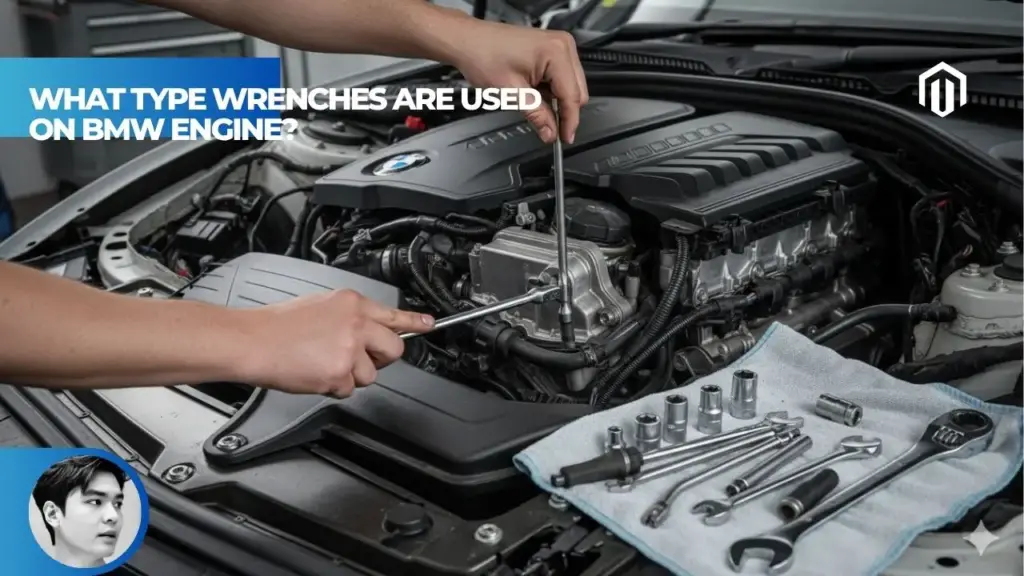
BMW engines primarily require metric wrenches and sockets in sizes ranging from 8mm to 21mm, plus specialty fastener tools including E-Torx (external Torx), triple-square (XZN), and hex/Allen sockets[1]. Standard SAE wrenches won’t work—every fastener on a BMW is metric, and many critical engine bolts use non-hex head designs that require specific tooling[2].
Why BMW Uses Different Fastener Types
Working on a BMW without the right tools is a recipe for stripped bolts and scraped knuckles. Unlike American vehicles that mix SAE and metric, BMWs are exclusively metric—but that’s only part of the challenge[1].
German engineers love specialty fasteners. Where a Honda might use a standard hex bolt, BMW often specifies an E-Torx or triple-square. The reasoning? These multi-lobe designs allow higher torque application without stripping, and they discourage owners from attempting repairs that BMW thinks should stay at the dealership[3].
Here’s the thing: once you own the specialty tools, BMW maintenance becomes surprisingly straightforward. Most DIY jobs require the same handful of sizes repeatedly. The initial investment pays off quickly if you’re doing your own oil changes, brake jobs, or routine maintenance.
Essential Metric Socket and Wrench Sizes
Every BMW owner tackling engine work needs a complete metric socket set. The good news? You probably won’t need anything larger than 21mm for most engine-related tasks[1].
| Size | Common BMW Uses |
|---|---|
| 8mm | Trim fasteners, plastic covers, small brackets |
| 10mm | The universal size—oil drain plugs, engine covers, sensors, brackets (buy extras, you’ll lose them) |
| 12mm | Intake components, accessory mounting |
| 13mm | Oil filter housing, various engine accessories |
| 14mm | Engine mounts, some intake components |
| 16mm | Wheel bolts (some models), larger engine brackets |
| 17mm | Lug bolts (most models), brake calipers |
| 19mm | Lug bolts (some models), axle nuts |
| 21mm | Suspension components, some transmission bolts |
The 10mm socket deserves special mention. It’s the most frequently used size on any BMW, and these sockets have a supernatural ability to disappear[1]. Buy at least three. Keep one in the toolbox, one in your pocket, and one as a spare for when the others inevitably vanish.
Extra-deep sockets in 8mm, 10mm, and 12mm are extremely useful for reaching recessed fasteners on intake manifolds and valve covers[1].
E-Torx Sockets: The BMW Essential
E-Torx (external Torx) fasteners are everywhere on BMW engines. These star-shaped bolt heads appear on engine-to-transmission mounts, accessory brackets, and critical drivetrain components[3].
| E-Torx Size | Common BMW Applications |
|---|---|
| E10 | Intake manifold, various engine brackets |
| E12 | Transmission-to-engine bolts, subframe mounting |
| E14 | Starter motor, larger accessory mounts |
| E16 | Some exhaust manifold studs |
| E18 | Flywheel/flexplate bolts (some models) |
| E20 | Drive plate bolts, larger drivetrain fasteners |
A complete E-Torx set runs about $20-$40 and covers sizes E5 through E24[4]. Get flat-cut sockets if possible—they engage flush-mounted fasteners better than standard tapered designs and reduce the risk of rounding off bolt heads[4].
I’ve seen DIYers try to use internal Torx bits on E-Torx bolts. Don’t. The external Torx fits around the bolt head like a socket; internal Torx fits inside a recess. They’re completely different tools.
Internal Torx (T-Type) Requirements
Internal Torx fasteners—the kind with a star-shaped recess in the bolt head—appear throughout BMW vehicles, particularly on body panels, interior trim, and some engine covers[3].
The sizes T10 through T60 cover nearly all BMW applications[1]. Common uses include:
- T20/T25: Plastic engine covers and air intake components
- T30: Door hinges, some brake components
- T40/T45: Larger bracket mounting
- T50/T55: High-torque applications
Watch out for tamper-resistant versions—these have a small pin in the center of the star pattern. Security Torx bits with a corresponding hole are required for these fasteners[3].
Triple-Square (XZN) and Hex/Allen Sockets
Triple-square fasteners—also called XZN or 12-point spline—appear on high-torque applications where BMW engineers wanted extra resistance to cam-out[3]. The 90-degree corners of the triple-square design (three overlapping squares) provide more contact area than standard hex heads.
On BMW engines, you’ll encounter triple-square fasteners on:
- Cylinder head bolts (some models)
- Transmission pan bolts
- Transfer case bolts (xDrive models)
- Some valve cover bolts
The most common sizes are M6, M8, M10, and M12[3]. A basic triple-square set costs under $20 and eliminates frustration on specific jobs that absolutely require them.
Hex sockets (Allen keys) are used on brake disc mounting screws, brake caliper guide bolts, and drive axles[3]. Sizes 5mm through 10mm cover most BMW hex applications. Get sockets rather than L-keys—the extra leverage helps with stubborn fasteners that haven’t been removed in years.
Specialty Tools for Specific BMW Jobs
Certain BMW maintenance tasks require purpose-built tools beyond standard wrenches and sockets.
- Oil filter cap wrench. BMW’s cartridge-style oil filters use a large plastic cap that requires a specific socket. The 86mm 16-flute design fits most modern BMWs, and a 3/8″ drive version with good teeth engagement prevents cap damage[2]. Generic multi-size oil filter wrenches rarely fit properly.
- 17mm deep socket. Lug bolt removal requires a 17mm socket deep enough to clear the bolt shaft[2]. Standard sockets bottom out before engaging the hex head. Get a quality impact-rated version if you’re using an impact gun.
- Flex-head ratchets. BMW engines sit in cramped engine bays with limited swing room for standard ratchets. Flex-head ratchets with 8/10mm and 12/13mm combinations save enormous time on plastic panel removal and tight-clearance work[1].
Understanding battery replacement procedures on BMWs often requires basic metric tools plus BMW-specific software for battery registration on newer models.
Building Your BMW Tool Set
Start with a quality metric socket set that includes 1/4″, 3/8″, and 1/2″ drive ratchets[2]. A comprehensive Craftsman or similar brand set with a lifetime warranty provides the foundation. Budget around $100-$150 for a decent starter set.
Add these specialty items as needed:
| Tool | Approximate Cost | Priority |
|---|---|---|
| E-Torx socket set (E5-E24) | $20-$40 | Essential |
| Internal Torx bit set (T10-T60) | $15-$30 | Essential |
| Triple-square set (M6-M12) | $15-$25 | High (specific jobs) |
| Hex socket set (5mm-10mm) | $15-$25 | Essential |
| Oil filter cap wrench (86mm) | $15-$25 | Essential for oil changes |
| Torque wrench (3/8″ drive) | $40-$80 | Essential |
| Extra 10mm sockets (3-pack) | $10-$15 | Sanity preservation |
Buy quality over quantity. Cheap Torx and triple-square bits round off fastener heads, creating problems that far exceed the few dollars saved[4]. Chrome vanadium steel construction and precision-machined fit matter when you’re dealing with high-torque German engineering.
For brake work specifically, having the right tools for brake replacement prevents damage to expensive calipers and rotors.
Common Mistakes When Working on BMW Engines
Using SAE Tools on Metric Fasteners
SAE sizes are close to metric but not exact. A 1/2″ wrench on a 13mm bolt might feel like it fits, but under torque it’ll round the head. Every BMW fastener is metric—leave the SAE tools for American cars[1].
Skipping the Torque Wrench
BMW specifies torque values for a reason. Over-torquing an oil drain plug cracks the aluminum oil pan. Under-torquing a valve cover bolt causes oil leaks. A $50 torque wrench prevents hundreds in repairs[5].
Using the Wrong Torx Type
Internal Torx (T-type) bits don’t fit external Torx (E-type) bolts. Attempting to force the wrong tool strips the fastener head. Know which type you’re dealing with before grabbing a tool[3].
Key Takeaways
- BMW engines use exclusively metric fasteners—sizes 8mm through 21mm handle most jobs, with 10mm being the single most common size you’ll encounter[1].
- E-Torx (external Torx) sockets in sizes E10 through E20 are essential for engine-to-transmission bolts, accessory brackets, and drivetrain components that standard hex sockets can’t fit[3].
- Triple-square (XZN) fasteners appear on high-torque applications like cylinder head bolts and transmission pans—the M6, M8, M10, and M12 sizes cover most BMW applications[3].
- A quality torque wrench prevents over-tightening aluminum components and under-tightening critical fasteners—BMW specifies torque values for good reason[5].
- Buying quality tools with precision fit prevents rounded fastener heads—cheap Torx and triple-square bits cause more problems than they’re worth[4].
- The complete BMW tool setup costs $200-$300 initially but pays for itself after just a few DIY maintenance jobs that would otherwise require dealer visits[5].
FAQs
Are BMW bolts metric or standard?
All BMW fasteners are metric—there are no SAE/standard bolts anywhere on the vehicle[1]. You’ll need metric sockets ranging from 8mm to 21mm for most engine work, plus specialty tools like E-Torx, internal Torx, and triple-square for specific applications. Standard SAE tools should never be used, as the slight size difference can round off bolt heads.
What size Torx do I need for BMW?
BMW vehicles use both internal Torx (T-type) and external Torx (E-type) in various sizes[3]. For internal Torx, sizes T10 through T60 cover most applications including door hinges, body panels, and trim. For external Torx, E10 through E20 handles the majority of engine and drivetrain fasteners. A complete set of both types ensures you’re prepared for any BMW job.
Why does BMW use E-Torx instead of regular bolts?
E-Torx fasteners allow higher torque application without stripping compared to traditional hex bolts[3]. The six-lobe star pattern distributes force more evenly across the fastener head, reducing the risk of cam-out under high torque. BMW uses them on critical components like engine-to-transmission mounts where bolt failure would be catastrophic.
Can I use Torx bits on E-Torx bolts?
No—internal Torx (T-type) bits fit into a star-shaped recess in the bolt head, while E-Torx fasteners have a star-shaped head that requires an external socket[3]. They’re completely different tools. Attempting to use the wrong type will either not fit at all or damage the fastener. Always verify whether you’re dealing with internal or external Torx before selecting a tool.
References
-
Reddit r/BmwTech. (2024). Metric Wrench Sizes Discussion.
Metric wrench sizes
by inBmwTech -
Reddit r/BmwTech. (2021). Absolutely Necessary Tools.
Absolutely necessary tools
byu/sk01_654 inBmwTech - Exx.se. (2023). BMW Bolt Heads Reference Guide. https://www.exx.se/techinfo/bolt_heads/index.html
- BimmerWorld. (2024). Flat-Cut 11-Piece E-Torx Socket Set. https://www.bimmerworld.com/Tools/BMW-Handtools-Screwdrivers-Wrenches-Sockets-Pliers/CTA-1469-Flat-Cut-11-Piece-E-Torx-Socket-Set.html
- BMW Blog. (2023). The Essential BMW DIY Toolbox. https://www.bmwblog.com/2023/09/26/the-essential-bmw-diy-toolbox/

I am a senior automotive analyst at Autvex. Expert vehicle evaluations, in-depth reviews, and objective analysis helping readers make informed automotive decisions with years of industry experience.