You may also like:
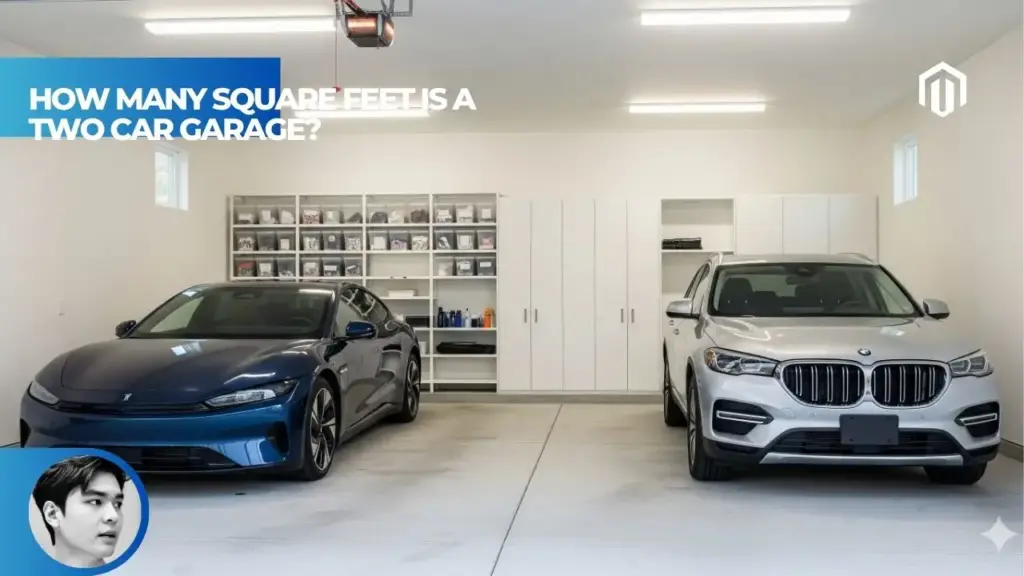
A standard 2 car garage is 400 to 576 square feet, with dimensions typically ranging from 20×20 feet to 24×24 feet[1]. The most common configurations are 20×22 feet (440 sq ft) and 24×24 feet (576 sq ft)[2]. Your ideal size depends on your vehicles, storage needs, and whether you want workspace beyond basic parking.
Standard 2 Car Garage Dimensions
Most American homes feature 2 car garages that fall within a predictable size range. The width typically spans 20 to 26 feet, while depth runs 20 to 24 feet[3]. Here’s how the common sizes break down:
| Size Category | Dimensions | Square Footage | Best For |
|---|---|---|---|
| Minimum | 20×20 ft | 400 sq ft | Two compact cars, no storage |
| Standard | 20×22 ft | 440 sq ft | Two midsize cars, light storage |
| Average | 22×22 ft | 484 sq ft | Two cars with moderate storage |
| Recommended | 24×24 ft | 576 sq ft | Larger vehicles, workspace |
| Spacious | 24×30 ft | 720 sq ft | SUVs/trucks + workshop area |
The 20×20 configuration represents the bare minimum for parking two vehicles side by side[4]. You’ll have limited clearance for opening doors and virtually no room for storage. That said, this size meets building code requirements in most jurisdictions[5].
For practical daily use, most experts recommend the 24×24 configuration[1]. This size gives you breathing room for larger vehicles and leaves space for shelving, a small workbench, or seasonal storage like lawn equipment.
Why Garage Sizes Vary
Vehicle Types Matter
Today’s vehicles are substantially larger than those from previous decades. A garage designed for two 1990s sedans won’t comfortably fit two modern SUVs. If you drive larger vehicles like a 2025 Audi Q8 or similar full-size SUV, you’ll need at least 24 feet of depth—possibly 26 feet for crew cab trucks[6].
Compact cars typically measure 14-16 feet long, midsize sedans run 16-18 feet, and full-size SUVs stretch 17-20 feet. Add the space needed for walking around vehicles and opening doors, and you can see why minimum dimensions quickly become cramped.
Storage and Work Space Needs
Few homeowners use their garage solely for parking. Lawn equipment, bicycles, seasonal decorations, and tools all compete for floor space. If you plan to include EV charging equipment, a workbench, or even a small home gym area, sizing up makes sense.
The 24×30 configuration (720 sq ft) has become popular among homeowners who want genuine multi-purpose space[2]. That extra 6 feet of depth provides room for a dedicated workshop zone along the back wall while still fitting two full-size vehicles.
Building Code Requirements
Local building codes typically specify minimum garage dimensions. Most require at least 20×20 feet for a 2-car garage and 8-foot ceiling height[5]. Some municipalities cap maximum dimensions relative to your lot size or require larger garages to sit farther from property lines.
One locality in Ohio specifies that interior finish size for 2-car garages must have a maximum depth of 25 feet, minimum depth of 22 feet, and maximum area of 550 square feet[7]. Your mileage will vary—always check local zoning before construction.
Size Requirements by Vehicle Type
What fits comfortably depends entirely on what you’re parking. Here’s a realistic breakdown based on vehicle categories:
| Vehicle Type | Minimum Garage Width | Minimum Depth | Recommended Size |
|---|---|---|---|
| Two compact cars | 18-20 ft | 20 ft | 20×20 (400 sq ft) |
| Two midsize sedans | 20-22 ft | 20-22 ft | 22×22 (484 sq ft) |
| Two crossovers/SUVs | 22-24 ft | 22-24 ft | 24×24 (576 sq ft) |
| Two full-size trucks | 24-26 ft | 24-26 ft | 26×26 (676 sq ft) |
For SUVs like the BMW X3 or Audi Q5, you’ll want at least 22 feet of width to open doors without dings[8]. Full-size pickups and Suburbans demand even more clearance. One user on a home planning forum noted that fitting a Chevy Suburban or crew cab truck comfortably requires a minimum 24-foot depth, with 26 feet being ideal for maneuvering[6].
Attached vs. Detached: Does Size Differ?
The standard dimensions apply equally to both attached and detached garages[2]. What changes is the flexibility in placement and potential size.
Attached garages often face tighter constraints because they must integrate with your home’s footprint and meet fire separation requirements. Detached garages, by contrast, can be sized more freely based on your lot—though setback rules and lot coverage limits still apply.
If you’re considering coating your garage floor with epoxy, the process and cost remain similar regardless of attachment style.
Cost to Build a 2 Car Garage
Understanding square footage helps you estimate construction costs. Building a 2-car garage costs $35 to $70 per square foot depending on materials, location, and finishes[9][10].
| Garage Size | Square Footage | Estimated Cost |
|---|---|---|
| 20×20 | 400 sq ft | $14,000 – $28,000 |
| 22×22 | 484 sq ft | $17,000 – $34,000 |
| 24×24 | 576 sq ft | $20,000 – $40,000 |
| 24×30 | 720 sq ft | $25,000 – $50,000 |
The average 2-car garage costs between $19,600 and $40,300 to build, with most homeowners spending around $20,000 for a basic 20×20 structure[9]. Upgrades like insulation, electrical circuits, and premium garage doors push costs toward the higher end.
One 2025 estimate puts the average 2-car garage build at roughly $40,000, with costs starting at $12,300 for basic construction[10]. Regional labor rates and material costs create significant variation.
How to Measure Your Garage
Not sure how your existing garage stacks up? Measuring is straightforward:
- Measure the interior width from wall to wall at the widest point
- Measure the interior depth from the back wall to the garage door opening
- Multiply width × depth for total square footage
Interior dimensions matter more than exterior measurements since that’s your usable space. Account for any intrusions like water heaters, HVAC equipment, or built-in shelving that reduce functional floor area.
If your garage is a weird shape, divide it into rectangular sections, calculate each area, then add them together.
Key Takeaways
- A standard 2-car garage ranges from 400 to 576 square feet, with the most common sizes being 20×20, 22×22, and 24×24 feet
- The 24×24 configuration (576 sq ft) is recommended for larger vehicles and light storage needs
- Modern SUVs and trucks require at least 24 feet of depth for comfortable maneuvering—26 feet is better for crew cabs
- Building costs run $35-$70 per square foot, putting a typical 2-car garage between $19,600 and $40,300
- Local building codes typically mandate minimum dimensions of 20×20 feet with 8-foot ceiling height
- If you want workshop space or significant storage alongside two vehicles, consider the 24×30 (720 sq ft) configuration
FAQs
Is a 20×20 garage big enough for two cars?
Technically yes, but barely. A 20×20 (400 sq ft) garage fits two compact or midsize vehicles with minimal clearance for opening doors[4]. You’ll have virtually no storage space and will feel cramped. For daily comfort, 22×22 or larger works better for most households.
What is the ideal size for a 2-car garage with storage?
A 24×24 (576 sq ft) or 24×30 (720 sq ft) garage provides comfortable parking plus meaningful storage space[1]. The 24×30 configuration is ideal if you want dedicated workshop or storage zones without sacrificing vehicle clearance.
How much does it cost to build a 576 sq ft garage?
Building a 24×24 (576 sq ft) 2-car garage costs approximately $20,000 to $40,000 depending on materials, location, and finishes[9]. Basic stick-built construction falls at the lower end, while attached garages with electrical, insulation, and drywall push costs higher.
Can a 2-car garage fit a truck and an SUV?
Yes, but you need adequate dimensions. For a full-size truck and SUV, aim for at least 24 feet wide and 24 feet deep[8]. If either vehicle is crew cab or long-bed, extend the depth to 26 feet. The 24×30 configuration (720 sq ft) handles these combinations comfortably.
What is the minimum ceiling height for a 2-car garage?
Most building codes require a minimum 8-foot ceiling height for garages[5]. Standard construction ranges from 8 to 10 feet. If you plan to install a car lift or storage mezzanine, you’ll need 12-14 foot ceilings.
References
- Sheds Unlimited. (2025). 2-Car Garage Dimensions | Your Complete Guide. https://shedsunlimited.net/blog/two-car-garage-dimensions/
- Alan’s Factory Outlet. (2025). Two-Car Garage Costs. https://alansfactoryoutlet.com/blog/2-car-garage-dimensions/
-
Garage Transformed. (n.d.). Standard Garage Sizes.
Homeowner’s Guide to Standard Garage Sizes & Dimensions
-
Eagle Carports. (2025). Dimensions of a 2-Car Garage.
Designing Your Dream Garage: Exploring the Dimensions of a 2-Car Garage
- Duramax Sheds Direct. (2025). What is the Standard Garage Size: Complete Guide 1-4 Cars. https://www.duramaxshedsdirect.com/blogs/the-barn-blog/what-is-the-standard-garage-size-1-2-3-4-cars
-
Reddit r/floorplan. (2025). Dimensions of a comfortable 2 car garage for 2 SUVs + storage?
Dimensions of a "comfortable" 2 – Car garage for 2 SUVs + storage?
byu/karluvmost infloorplan - American Legal Publishing. (n.d.). Highland Heights, OH Municipal Code – 1123.091 Size of Garages. https://codelibrary.amlegal.com/codes/highlandhts/latest/highlandhts_oh/0-0-0-35705
-
Plan7 Architect. (2025). How Big Should a Garage/Double Garage Be? – Size Guide.
How Big Should a Garage/Double Garage Be? – Size Guide
- HomeGuide. (2025). 2025 Cost To Build A Garage | 1, 2, and 3 Car Prices Per Square Foot. https://homeguide.com/costs/cost-to-build-a-garage
- Alan’s Factory Outlet. (2025). Cost to Build a Garage. https://alansfactoryoutlet.com/blog/cost-to-build-a-garage/

I am a senior automotive analyst at Autvex. Expert vehicle evaluations, in-depth reviews, and objective analysis helping readers make informed automotive decisions with years of industry experience.