You may also like:
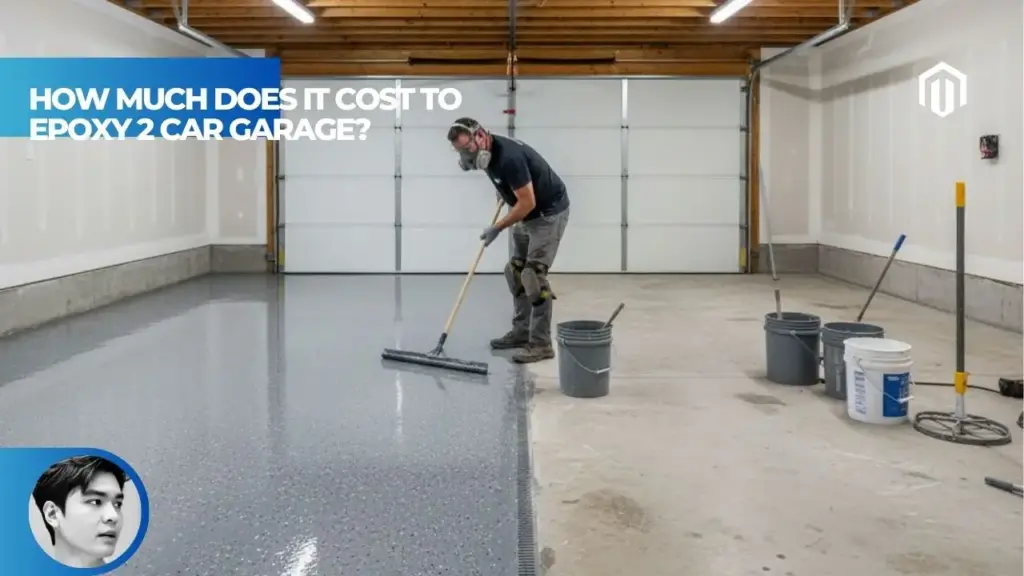
Epoxy coating for a 2-car garage costs $1,600 to $5,800 for professional installation, while DIY kits run $300 to $800 for materials only[1]. The final price depends on your garage’s square footage, the type of epoxy you choose, and how much concrete prep work your floor requires[2].
What You’ll Pay for Professional Epoxy Installation
Professional epoxy garage floor installation runs $4 to $10 per square foot on average[1]. For a standard 2-car garage measuring 400 to 576 square feet, that translates to $1,600 to $5,800 all-in. The wide range exists because “epoxy” covers everything from basic water-based coatings to high-end polyaspartic systems with decorative flakes.
Here’s the breakdown of what drives that cost. Labor accounts for roughly 33% to 60% of the total, working out to $3 to $5 per square foot[1]. Materials—including the epoxy resin, primer, and topcoat—add another $1 to $5 per square foot[1]. Most contractors charge more for complex prep work, which we’ll cover below.
One thing that surprised me when researching local quotes: the difference between entry-level and premium systems is significant. A basic solid-color epoxy might cost $2,000 for a 2-car garage, while a metallic or quartz-aggregate finish can easily push past $5,000[3].
| Coating Type | Cost per Sq Ft | 2-Car Garage (400 sq ft) |
|---|---|---|
| Water-based epoxy | $3 – $5 | $1,200 – $2,000 |
| 100% solids epoxy with flakes | $6 – $9 | $2,400 – $3,600 |
| Metallic or quartz epoxy | $8 – $12+ | $3,200 – $4,800+ |
Premium coatings command higher prices because they use 100% solids epoxy, polyurethane, or polyaspartic materials not readily available to homeowners[4]. These professional-grade systems resist chemical spills from vehicle fluids, won’t transfer onto hot tires, and last 15 to 20 years with minimal maintenance[5].
DIY Epoxy Garage Floor Costs
Going the DIY route cuts your upfront investment to $300 to $800 for a 2-car garage[2]. Big-box stores sell epoxy kits from brands like Rust-Oleum and Epoxy-Coat that include primer, epoxy, decorative flakes, and a clear topcoat. Sounds like a bargain, right?
The catch? DIY kits use water-based or partially solid epoxies that don’t perform like professional systems[5]. Most homeowners report peeling, bubbling, or hot-tire pickup within 1 to 3 years[3]. In climates with extreme heat—like Arizona or Texas—cheap DIY floors often fail within 12 to 24 months[5].
| Cost Factor | DIY | Professional |
|---|---|---|
| Materials | $250 – $800 | Included |
| Tools (grinder, rollers, gear) | $100 – $300 | Included |
| Prep method | Acid etching only | Mechanical grinding or shot-blasting |
| Lifespan | 1 – 3 years | 10 – 20 years |
| Finish quality | May peel, bubble, or stain | Smooth, glossy, seamless |
When you factor in the cost of recoating every few years, DIY often becomes the more expensive long-term choice[5]. A $500 DIY floor that fails three times over a decade costs $1,500—plus your weekends—while a $3,000 professional job stays pristine for 15+ years.
What Affects the Cost to Epoxy Your Garage?
Concrete Condition and Prep Work
Your concrete’s current state is the single biggest variable after square footage. Clean, crack-free floors require minimal prep. Damaged floors? That’s where costs climb fast.
Basic surface prep—cleaning, degreasing, and acid etching—typically runs $50 to $100 and is often included in professional quotes[2]. But if your concrete has cracks, spalling, or moisture problems, expect to pay $1 to $5 per square foot extra for repairs[6]. Severe damage requiring full concrete resurfacing adds $1,000 to $5,000 to the project[2].
Professional installers typically use diamond grinders or shot-blasters to create the “tooth” epoxy needs to bond properly[3]. DIY kits rely on acid etching, which doesn’t penetrate as deeply and contributes to premature failure.
Epoxy Type and Quality
Not all epoxies are created equal. The type you choose directly impacts both price and longevity.
- Water-based epoxy costs $40 to $100 per gallon and is the easiest to apply[2]. It’s low in VOCs and dries quickly, but it’s the least durable option. Expect to recoat every 3 to 5 years.
- Solvent-based epoxy runs $50 to $100 per gallon and offers better durability[2]. The downside? High VOCs make it dangerous to apply without proper ventilation, and some states have banned it entirely.
- 100% solids epoxy costs $70 to $150 per gallon and delivers commercial-grade durability lasting 10 to 20 years[1]. This is what most professional installers use. The application is tricky—it cures fast and requires precise mixing—which is why pros charge more for it.
Decorative Options
Want more than a plain gray floor? Decorative finishes add visual appeal but increase costs.
Adding color flakes runs just $0.04 per square foot—practically nothing[2]. Metallic pigments that create swirling, three-dimensional effects cost considerably more, pushing total project costs into the $8 to $12+ per square foot range[3]. Quartz aggregate floors, which embed colored quartz granules for texture and slip resistance, fall in a similar price range.
Epoxy vs. Other Garage Floor Coatings
Epoxy isn’t your only option. If you’re wondering how your garage measures up, understanding your 2-car garage’s square footage helps when comparing coating costs.
| Coating Type | Cost per Sq Ft | Durability | Best For |
|---|---|---|---|
| Epoxy | $4 – $10 | 10 – 20 years | Most homeowners |
| Polyurea/Polyaspartic | $5 – $12 | 15 – 25 years | One-day installs, UV resistance |
| Acrylic sealer | $1 – $2 | 1 – 3 years | Budget option |
| Polyurethane | $1.25 – $3 | 5 – 10 years | Outdoor use |
| Polished concrete | $3 – $15 | 20+ years | Modern aesthetic |
Polyaspartic coatings have gained popularity because they cure in hours rather than days, allowing same-day return to service[4]. They’re also more UV-stable than traditional epoxy, which can yellow in sunlit garages. The trade-off is a slightly higher price point.
Is Professional Epoxy Worth the Cost?
The math favors professional installation for most homeowners. And here’s why: a professionally installed epoxy floor costs $2,500 to $5,000 but lasts 15 to 20 years with proper care[5]. That works out to roughly $125 to $333 per year of use.
A DIY kit costing $500 that fails in 2 years runs $250 per year—and you’ll spend another weekend prepping and recoating. Over a decade, three DIY applications plus your labor easily exceeds what you’d pay once for a professional system[5].
Professional installers also bring warranties. Many reputable companies offer lifetime adhesion guarantees, covering peeling or delamination[5]. Good luck getting that from a hardware store kit.
That said, DIY makes sense in specific situations. If you’re selling the house soon, a fresh DIY floor can boost curb appeal without the investment in a premium system. Or if you enjoy garage projects and accept the shorter lifespan, the hands-on experience might be worth it for you.
Key Takeaways
- Professional epoxy installation for a 2-car garage costs $1,600 to $5,800, with most homeowners paying around $2,500 to $4,000 for quality work with decorative flakes and a clear topcoat[1].
- DIY epoxy kits cost $300 to $800 but typically last only 1 to 3 years compared to 10 to 20 years for professional systems, making them less cost-effective long-term[5].
- Concrete prep work can add $1 to $5 per square foot if your floor has cracks, damage, or moisture issues—always factor this into your budget[6].
- 100% solids epoxy and polyaspartic coatings deliver the best durability but require professional application and cost $6 to $12 per square foot[3].
- Get 2 to 3 quotes from local contractors, and don’t automatically choose the cheapest option—material quality and proper prep work matter more than upfront savings[3].
FAQs
How long does it take to epoxy a 2-car garage?
Professional installation typically takes 1 to 2 days, with full cure time of 5 to 7 days before you can park vehicles on it[1]. Polyaspartic coatings cure faster—often allowing light foot traffic within hours and vehicle parking the next day. DIY projects usually span a weekend for application, plus the same 5 to 7 day cure time.
Can you epoxy over old paint or existing coatings?
Yes, but only if the existing coating is well-bonded and properly prepped. Most installers recommend removing old coatings entirely through grinding or shot-blasting for the best adhesion[3]. Applying new epoxy over failing or peeling old coatings will cause the new layer to fail as well. When in doubt, strip it first.
Does epoxy flooring increase home value?
Epoxy flooring won’t dramatically increase your home’s appraised value, but it can make your property more attractive to buyers and speed up the sale process[1]. A clean, professional-looking garage floor signals that the home has been well-maintained. For car enthusiasts, a pristine garage floor is a genuine selling point.
What temperature is best for applying epoxy?
Epoxy requires temperatures between 60°F and 85°F with humidity below 85% for proper curing[1]. Applying in colder conditions prevents proper bonding, while high humidity causes moisture problems that lead to peeling. This is why many professionals in northern climates schedule garage floor projects for spring or early fall.
References
- HomeGuide. (2025). How Much Does Epoxy Flooring Cost? https://homeguide.com/costs/epoxy-flooring-cost
- Angi. (2025). How Much Does Epoxy Flooring Cost? https://www.angi.com/articles/epoxy-flooring-costs-advantages-and-installation.htm
-
Knoxville Concrete Flooring. (2025). Epoxy Garage Floor Cost: What You Need to Know in 2025.
Epoxy Garage Floor Cost: What You Need to Know in 2025
-
Craftsman Concrete Floors. (2025). Epoxy Flooring Cost Guide.
Epoxy Garage Floor Cost Guide
- Garage Floor Crew. (2025). How Much Does a Professional Epoxy Garage Floor Cost vs DIY? https://garagefloorcrew.com/how-much-does-a-professional-epoxy-garage-floor-cost-vs-diy/
-
Lifetime Green Coatings. (2025). Epoxy Garage Floor Cost: Affordable Transformation Guide.
Understanding Epoxy Garage Floor Cost: A Complete Guide to Affordable Floor Transformations

I am a senior automotive analyst at Autvex. Expert vehicle evaluations, in-depth reviews, and objective analysis helping readers make informed automotive decisions with years of industry experience.