You may also like:
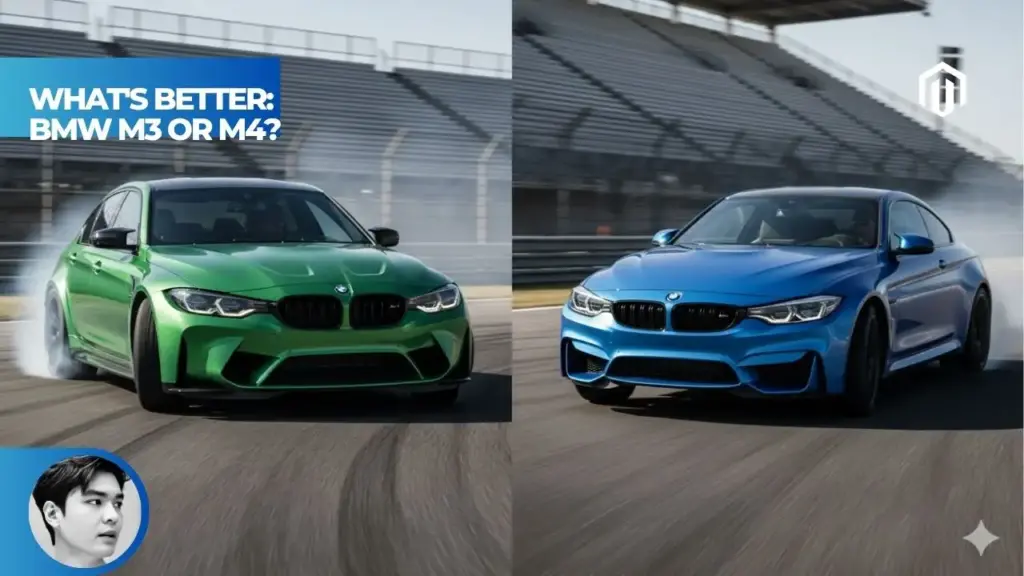
The BMW M3 wins for most buyers because it delivers identical performance with better practicality at a lower price—starting at $77,175 versus the M4’s $80,875[1]. But if you prioritize sharper handling, sportier aesthetics, and don’t need rear passenger access, the M4 coupe edges ahead. Both share the same twin-turbo inline-six engine pushing up to 523 horsepower in xDrive trim, so the real choice comes down to doors, not speed[1].
Why This M3 vs M4 Comparison Matters
BMW’s M division builds both cars on the same platform with identical powertrains, suspensions, and technology. That makes this comparison unusual—you’re essentially choosing body style and use case rather than fundamentally different vehicles.
The price gap matters too. The M4 costs roughly $3,700 more than the M3 at each trim level[1]. You’re paying extra for coupe styling, not additional performance. Understanding exactly what you get (and don’t get) for that premium helps make a smarter decision.
Here’s the thing: both cars will smoke most competitors on a track. The question isn’t which is faster—it’s which fits your life.
Comparison at a Glance
| Spec | BMW M3 | BMW M4 |
|---|---|---|
| Starting MSRP | $77,175 | $80,875 |
| Body Style | 4-door sedan | 2-door coupe |
| Engine | 3.0L twin-turbo I6 | 3.0L twin-turbo I6 |
| Base HP/Torque | 473 hp / 406 lb-ft | 473 hp / 406 lb-ft |
| Competition HP | 503 hp / 479 lb-ft | 503 hp / 479 lb-ft |
| xDrive HP | 523 hp / 479 lb-ft | 523 hp / 479 lb-ft |
| 0-60 mph (xDrive) | 3.4 seconds | 3.4 seconds |
| 0-60 mph (manual) | 4.1 seconds | 4.1 seconds |
| Rear Seat Access | Full 4-door | Limited 2-door |
| Trunk Opening | Wider sedan opening | Standard coupe opening |
The numbers tell the story: mechanical parity across the lineup[1]. The differences live in body structure, practicality, and driving feel.
Performance: Nearly Identical Muscle
Under the hood, the M3 and M4 are twins. The 3.0-liter twin-turbocharged inline-six engine comes in three power configurations[1]:
The base M3 and M4 produce 473 horsepower and 406 lb-ft of torque, paired with a six-speed manual transmission and rear-wheel drive. This setup rewards driver engagement—you’re rowing your own gears in a car that genuinely wants to play.
Step up to Competition trim and power climbs to 503 horsepower with 479 lb-ft of torque[1]. The manual disappears here, replaced by BMW’s eight-speed automatic. Quick shifts and consistent performance make this the track-day choice for many buyers.
The Competition xDrive models push output to 523 horsepower while adding all-wheel drive[1]. The xDrive system improves traction in all conditions, particularly in wet or cold weather, and delivers the quickest acceleration—3.4 seconds to 60 mph for both M3 and M4.
So where do they differ? The M4’s coupe chassis sits slightly lower and weighs marginally less[2]. In aggressive cornering, this translates to fractionally sharper turn-in response. During a back-to-back test on twisty mountain roads, the M4 felt more eager to change direction. Not dramatically so—we’re talking subtle differences that enthusiast drivers notice and casual drivers might not.
The M3’s longer wheelbase provides better high-speed stability[1]. On highway pulls and fast sweepers, the sedan feels more planted. If your driving includes extended highway stretches or high-speed track sections, that stability matters.
Fuel economy? Both return 16-19 mpg city and 22-26 mpg highway depending on drivetrain[1]. Real-world results typically land closer to 18 mpg combined in spirited driving. Neither qualifies as fuel-efficient, but that’s not why anyone buys an M car.
Design: Four Doors vs Two
The exterior design debate centers on one thing: presence. The M4’s coupe silhouette sits lower, looks more aggressive, and turns more heads[2]. Its proportions feel more traditionally “sports car”—long hood, short rear deck, muscular haunches.
The M3 trades some visual drama for functionality. It’s still unmistakably an M car with the flared fenders, aggressive front fascia, and that controversial oversized kidney grille. But the four-door profile reads as “fast sedan” rather than “dedicated sports car.”
Both received styling updates including redesigned LED headlights with new daytime running light signatures and laser-enhanced taillights[2]. The grille? Still polarizing. BMW hasn’t backed down from the look that split enthusiast opinion when this generation launched.
Inside, the cabins are virtually identical[1]. You get the same 14.9-inch curved touchscreen with iDrive 8.5, the same 12.3-inch digital instrument cluster, and the same M-specific displays. The steering wheel, controls, and materials match across both models.
The difference? Getting into and out of the rear seats. The M3’s four doors make this trivial. The M4 requires the typical coupe gymnastics—tilt the front seat forward, squeeze through, hope you didn’t strain something. If you regularly carry rear passengers, this distinction alone might make your decision. Those curious about deeper styling details can explore the design philosophy further.
Practicality: Where the M3 Pulls Ahead
Day-to-day livability is where the M3 justifies its existence alongside the M4. The four-door layout transforms this from a dedicated performance machine into a daily driver that happens to have 523 horsepower available[1].
Rear seat space favors the M3 significantly[1]. Adults can actually sit back there on regular trips without knee-against-seatback complaints. The M4’s rear accommodates two people in a pinch, but you wouldn’t want to commute that way.
Trunk capacity is nearly identical between both models—roughly 12 cubic feet[2]. The catch? The M3’s wider trunk opening makes loading and unloading far easier[1]. Golf bags, luggage, grocery runs—the sedan body doesn’t fight you.
Visibility is another M3 advantage. The coupe’s sloping roofline compromises rear sightlines[1]. The parking sensors and backup camera help, but the sedan provides better natural awareness of your surroundings.
Here’s my real-world observation: the M3 works as an only car. The M4 almost demands you own something else for practical errands. If you’re consolidating to one vehicle, the sedan makes that decision easier.
Technology and Features
Both models share the same technology suite—BMW doesn’t differentiate here based on body style[1].
The iDrive 8.5 system handles infotainment duties well. Wireless Apple CarPlay and Android Auto work seamlessly, navigation updates in real-time, and voice commands actually understand what you’re asking. The curved display looks modern without going overboard on screens-for-screens’-sake.
Driver assistance features include adaptive cruise control, lane departure warning, and front collision warning with automatic braking as standard[1]. The optional Driving Assistance Professional Package adds active lane-keeping and extended traffic jam assist—useful for commuting, less relevant for weekend canyon runs.
Performance technology is where things get interesting for M buyers[1]. The M Drive system lets you configure steering weight, throttle response, and suspension stiffness independently. The M-specific traction control offers multiple levels of slip control—from full intervention to “I know what I’m doing” settings.
The head-up display (optional) projects speed, navigation, and M-specific data onto the windshield[1]. (Full disclosure: I’m a sucker for a good heads-up display. Once you use one, going back feels like a step backward.)
For owners curious about BMW’s latest software updates, both M3 and M4 receive identical over-the-air updates when available.
Pricing and Value
The M3 offers better value at every comparable trim level[1].
| Trim Level | M3 Price | M4 Price | Difference |
|---|---|---|---|
| Base (Manual, RWD) | $77,175 | $80,875 | +$3,700 |
| Competition (Auto, RWD) | $81,375 | $85,075 | +$3,700 |
| Competition xDrive (Auto, AWD) | $86,475 | $90,175 | +$3,700 |
That $3,700 gap buys you coupe styling—nothing else mechanically[1]. Some buyers happily pay that premium for the look. Others recognize the M3’s better practicality at lower cost makes it the smarter purchase.
Resale value tends to favor the M3[1]. The sedan’s broader appeal—families, daily commuters, people who need four doors—creates more potential buyers when you sell. The M4’s audience is narrower: enthusiasts specifically seeking a coupe.
BMW’s optional packages can push both models well into six figures. The Carbon Package adds fiber accents and lightweight bucket seats. The Executive Package includes head-up display, heated steering wheel, and remote start. Choose carefully—these add up fast.
For context on how these prices compare to BMW maintenance costs over time, factor in typical M-car service expenses when budgeting.
Pros and Cons
BMW M3
- The four-door layout provides genuine daily usability—rear passengers enter and exit without contortions, trunk access is easier, and visibility is better for normal driving[1].
- Starting price runs $3,700 lower than the equivalent M4 trim while delivering identical performance, engine options, and technology features[1].
- Better resale value comes from broader market appeal—more buyers want four doors than two when shopping used, which supports stronger residuals[1].
- Slightly longer wheelbase provides improved high-speed stability on highways and fast track sections, though the difference is subtle[1].
BMW M4
- Lower, sleeker coupe profile delivers more visual drama and turns more heads—this is the sports car silhouette enthusiasts typically prefer[2].
- Marginally lighter weight and lower center of gravity create slightly sharper handling response in aggressive cornering situations[2].
- Two-door design appeals to buyers specifically seeking coupe aesthetics who don’t need regular rear-seat access for passengers[1].
- Track-focused drivers may prefer the M4’s chassis dynamics, though differences from the M3 are measured in fractions rather than dramatic gaps[2].
Final Verdict: Choose Based on Your Life
Choose the BMW M3 if:
- You carry rear passengers more than occasionally
- You want the better value proposition at identical performance
- Practicality and resale matter in your decision
- You need this car to work as a daily driver
Choose the BMW M4 if:
- Coupe styling is non-negotiable for you
- You rarely use rear seats and don’t mind limited access
- Slightly sharper handling response matters more than practicality
- You’re willing to pay the premium for the look you want
The M3 is the objectively better choice for most buyers[1]. You get the same engine, same transmission options, same technology, and same acceleration—just with four doors and a lower price. The M4 only makes sense when you specifically value coupe aesthetics enough to pay more for less practicality.
And honestly? There’s no wrong choice here. Both are exceptional performance machines that will thrill you every time you turn the key. The M4’s looks might make your heart beat faster in the parking lot. The M3’s utility might make your life easier everywhere else.
If you’re cross-shopping with competitors, consider how BMW stacks up against rivals in the broader luxury performance segment.
Key Takeaways
- The BMW M3 and M4 share identical powertrains offering 473-523 horsepower depending on trim, with the same 0-60 times and performance capabilities—the only differences are body style and resulting dynamics[1].
- The M3 starts at $77,175 versus the M4’s $80,875, meaning you pay a $3,700 premium for coupe styling with no additional mechanical content[1].
- Practicality clearly favors the M3 with easier rear-seat access, better visibility, and a wider trunk opening—making it viable as an only car while the M4 works best as a second vehicle[1].
- The M4’s coupe chassis sits lower with marginally less weight, providing slightly sharper handling response in aggressive cornering, though differences are subtle enough that casual drivers may not notice[2].
- Both models receive identical technology including iDrive 8.5, wireless Apple CarPlay/Android Auto, and the same M-specific performance settings—BMW doesn’t differentiate features based on body style[1].
- The M3 wins for most buyers seeking the best combination of performance, practicality, and value; the M4 wins only when coupe aesthetics are your top priority[1].
FAQs
Is the BMW M4 faster than the M3?
No—they’re identical in straight-line performance[1]. Both share the same engine options (473 hp base, 503 hp Competition, 523 hp Competition xDrive) and produce the same acceleration times. The M3 Competition xDrive and M4 Competition xDrive both hit 60 mph in 3.4 seconds. The M4’s slightly lower weight provides marginally sharper handling feel in corners, but it won’t win a drag race against an equivalent M3.
Why does the M4 cost more than the M3?
The M4’s higher price ($3,700 more at each trim level) reflects the premium BMW places on coupe styling rather than any additional mechanical content[1]. Coupes traditionally command price premiums in the luxury segment because of their sportier image and design appeal. You’re paying for aesthetics and exclusivity, not performance differences.
Can you get a manual transmission in both the M3 and M4?
Yes—both the base M3 and base M4 offer a six-speed manual transmission with rear-wheel drive[1]. This configuration produces 473 horsepower and reaches 60 mph in 4.1 seconds. The manual is only available on base trims; Competition and Competition xDrive models come exclusively with the eight-speed automatic transmission.
Which has better resale value, M3 or M4?
The M3 typically holds value better due to broader market appeal[1]. More buyers shop for four-door vehicles than two-door coupes, which creates stronger demand when you sell. The M3’s practicality makes it attractive to families and commuters who still want M performance, expanding the potential buyer pool compared to the M4’s more niche audience.
References
- BMW Cleveland. (2025). 2025 BMW M3 Vs. M4: Key Differences In Power, Style, And Features. https://www.bmwcleveland.com/blog/2025/february/25/2025-bmw-m3-vs-m4-key-differences-in-power-style-and-features.htm
- Edmunds. (2025). 2025 BMW M4 Prices, Reviews, and Pictures. https://www.edmunds.com/bmw/m4/2025/
- TrueCar. (2025). BMW M3 vs. BMW M4 Comparison. https://www.truecar.com/compare/bmw-m3-vs-bmw-m4/
- Car and Driver. (2025). 2026 BMW M3 vs. 2026 BMW M4. https://www.caranddriver.com/compare/bmw-m3-vs-bmw-m4

I am a senior automotive analyst at Autvex. Expert vehicle evaluations, in-depth reviews, and objective analysis helping readers make informed automotive decisions with years of industry experience.