You may also like:
Yes, police can search your car without a warrant under several legally recognized exceptions to the Fourth Amendment. The most common exceptions include probable cause (the “automobile exception”), your consent, search incident to arrest, plain view doctrine, and inventory searches after impoundment[1]. Courts grant police more authority to search vehicles than homes because drivers have a reduced expectation of privacy on public roads[2]. That said, a routine traffic stop alone doesn’t give officers the right to search your trunk, glove box, or anywhere else without one of these exceptions applying.
The Automobile Exception Explained
The automobile exception is the primary legal basis for warrantless vehicle searches. It dates back to the 1925 Supreme Court case Carroll v. United States[3].
Under this exception, police can search your vehicle without a warrant if they have probable cause to believe it contains contraband or evidence of a crime[1]. The rationale is simple: vehicles are mobile and can quickly leave the jurisdiction or have their contents destroyed before officers could obtain a warrant[3].
Here’s what triggers probable cause:
| Trigger | Example |
|---|---|
| Sight | Officer sees drugs, weapons, or stolen items in plain view |
| Smell | Odor of marijuana, alcohol, or chemical substances |
| Admission | Driver or passenger admits to having contraband |
| Behavior | Suspicious movements, hiding objects |
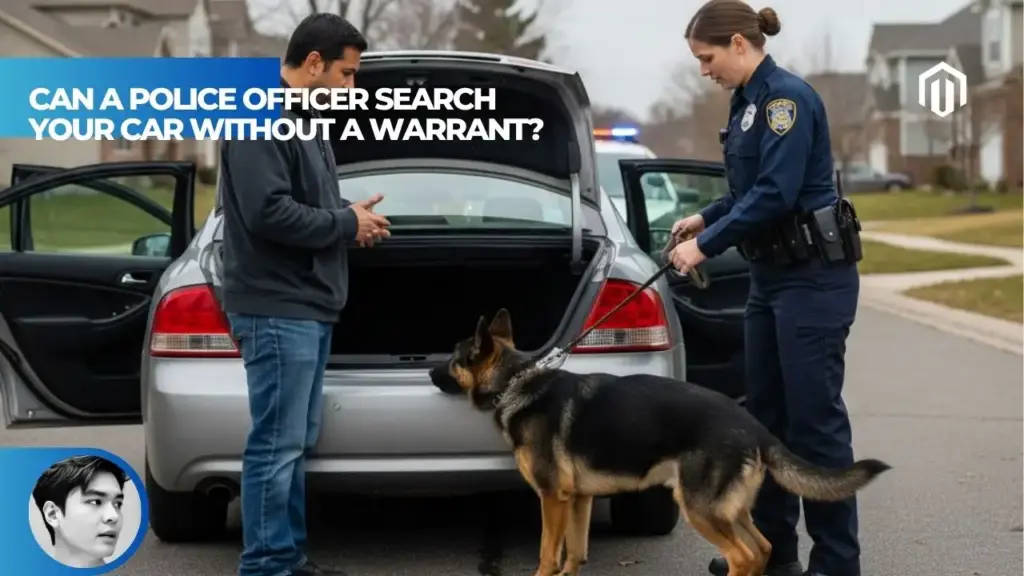
| K-9 alert | Drug dog indicates presence of narcotics |
If officers have probable cause, they can search the entire vehicle—passenger compartment, trunk, glove box, and any containers that could hold the suspected evidence[1]. And here’s the key: the Supreme Court has ruled that police can conduct this search immediately at the scene or after moving the vehicle to the station house, even after the vehicle has been immobilized[1].
Knowing how to remove marijuana smell from your car matters in states where cannabis is still illegal—that odor alone can constitute probable cause.
When You Consent to a Search
If you give permission, police can search your vehicle regardless of whether they have probable cause[4].
Consent is the easiest way for officers to legally search your car. An officer might ask: “Do you mind if I take a look in your vehicle?” If you say yes, you’ve waived your Fourth Amendment protection.
The catch? Consent must be “freely and voluntarily given”[4]. Courts examine all circumstances to determine whether consent was coerced. But officers aren’t required to inform you that you have the right to refuse. Many drivers don’t realize saying “no” is an option.
How to Handle a Consent Request
- You can politely decline: “I don’t consent to searches.”
- You can limit consent: “You can look in the trunk but not the glove box.”
- You can revoke consent at any time during the search.
Declining a search request is not probable cause for arrest. An officer cannot detain you longer simply because you refused[4]. But refusing won’t stop a search if they already have probable cause or another legal justification.
Search Incident to Arrest
When police arrest you, they gain limited authority to search your vehicle[4].
Officers can search the passenger compartment of your car incident to arrest, but only under specific conditions[1]:
- You’re unsecured and could reasonably access the vehicle’s interior, OR
- There’s reason to believe the vehicle contains evidence of the crime for which you’re arrested
This rule changed significantly after the Supreme Court’s 2009 decision in Arizona v. Gant. If you’ve been handcuffed and placed in a patrol car, officers can’t use “search incident to arrest” as justification to rummage through your vehicle—you’re no longer able to access it or destroy evidence[4].
For example: If you’re arrested for driving on a suspended license, handcuffed, and placed in a police cruiser, officers cannot then search your car under this exception. There’s no evidence of “driving on a suspended license” to find in your vehicle, and you can’t access anything while secured.
Understanding how car accidents stay on your record and other legal implications helps you navigate the broader consequences of traffic stops.
Plain View Doctrine
If officers can see evidence of a crime from a lawful vantage point, they can seize it without a warrant[2].
During a traffic stop, anything visible through your windows is fair game. If an officer shines a flashlight into your car and sees a bag of pills on the passenger seat, they can seize it and search further based on the resulting probable cause.
The plain view doctrine requires three elements:
- The officer must be in a location they’re legally allowed to be
- The incriminating nature of the item must be immediately apparent
- The officer must have lawful access to the object
So if you’re pulled over for speeding and the officer sees a gun under your seat while checking your license, that observation is legal. They didn’t need a warrant to look through your window—they were already there lawfully.
Inventory Searches After Impoundment
When police impound your vehicle, they can conduct an inventory search to catalog its contents[1].
This type of search isn’t technically looking for evidence—it’s ostensibly to protect your property and shield police from false claims of theft or damage. But anything illegal discovered during a properly conducted inventory search is admissible in court.
Inventory searches must follow the department’s standard procedures. Officers can’t use “inventory” as a pretext to search a car they couldn’t otherwise legally search. If the inventory procedure seems arbitrary or unusually thorough, it may be challenged in court.
What Police CANNOT Do During a Traffic Stop
Not every traffic stop justifies a search. Here’s what officers cannot do[4][2]:
| Prohibited Action | Legal Reason |
|---|---|
| Search based solely on a traffic violation | Speeding ticket doesn’t equal probable cause |
| Extend the stop to wait for a drug dog | Supreme Court ruled this unconstitutional in Rodriguez v. United States (2015) |
| Search because you refused consent | Refusal is not probable cause |
| Search a rental car solely because driver isn’t on the agreement | Byrd v. United States (2018) |
| Conduct a full search during a Terry stop | Limited to pat-down for weapons if reasonable suspicion of danger |
A traffic stop is supposed to be temporary. Once the officer has issued your citation or warning, the stop is over. They cannot detain you longer to fish for evidence unless new probable cause develops during the stop.
Your Rights During a Traffic Stop
Knowing your rights helps you protect them without escalating the situation[2]:
You Have the Right To:
- Remain silent beyond providing license, registration, and insurance
- Decline consent to search your vehicle
- Know whether you’re being detained or free to go
- Record the interaction in most states
- Request a supervisor
Best Practices:
- Keep hands visible on the steering wheel
- Be polite and calm—escalation rarely helps
- Clearly state: “I do not consent to searches” if asked
- Don’t physically resist even if you believe the search is unlawful
- Document everything afterward for potential legal challenges
If an unlawful search occurs, the remedy is in court, not on the roadside. Evidence obtained through an illegal search can be suppressed, meaning it can’t be used against you at trial[2].
If you’re involved in any legal matter related to your vehicle, knowing how long it takes to settle a car accident gives you realistic expectations about legal timelines.
When Evidence Can Be Thrown Out
Evidence obtained through an unconstitutional search is generally inadmissible under the “exclusionary rule”[2].
If police searched your car without probable cause, consent, or another valid exception, your attorney can file a motion to suppress the evidence. If the motion succeeds, the prosecution cannot use whatever was found.
Grounds for suppression include:
- No probable cause for the initial stop
- Search exceeded the scope of consent you provided
- Search incident to arrest occurred after you were secured and unable to access the vehicle
- Inventory search didn’t follow standard department procedures
- Stop was prolonged unreasonably to conduct the search
This is why documentation matters. Note the time of the stop, what questions were asked, whether consent was requested, and how officers conducted themselves. These details become critical if you need to challenge the search later.
Key Takeaways
- Police can search your car without a warrant under several exceptions, including probable cause (automobile exception), consent, search incident to arrest, plain view doctrine, and inventory searches after impoundment[1]
- Probable cause is the most common justification—if officers have reasonable belief your car contains contraband or evidence, they can search the entire vehicle including trunk and containers[3]
- You have the right to refuse consent, and refusal cannot be used as probable cause to search; clearly state “I do not consent to searches” without physically resisting[2]
- A routine traffic violation alone doesn’t justify a search—speeding tickets, broken taillights, and similar infractions don’t give officers the right to search your vehicle[4]
- Police cannot extend a traffic stop to wait for a drug dog without reasonable suspicion of criminal activity beyond the original violation, per Rodriguez v. United States (2015)[4]
- Evidence from unlawful searches can be suppressed—if your Fourth Amendment rights were violated, an attorney can file a motion to exclude the evidence from trial[2]
FAQs
Can police search my car during a routine traffic stop?
Not automatically[4]. A routine traffic stop for speeding, running a red light, or similar violations doesn’t give police the right to search your vehicle. They need additional justification: probable cause to believe your car contains evidence of a crime, your consent, or another recognized exception. Simply being pulled over isn’t enough—if it were, every traffic stop would become a fishing expedition.
What happens if I refuse to let police search my car?
Refusing a search is your constitutional right, and it cannot be used as probable cause to search anyway[2]. The officer may continue the stop to issue your citation, but they cannot extend the stop or detain you simply because you declined. That said, if they already have independent probable cause—like smelling drugs or seeing contraband—your refusal won’t stop the search. Stay calm and clearly state: “I do not consent to searches.”
Can police bring a drug dog to sniff my car?
Yes, but with limits. Police can use a drug dog during a lawful traffic stop, but they cannot extend the stop beyond the time needed to complete its original purpose[4]. The Supreme Court ruled in Rodriguez v. United States (2015) that even a few extra minutes to wait for a K-9 unit violates the Fourth Amendment unless officers have reasonable suspicion of drug activity. If a dog is already at the scene and alerts while you’re being cited, that’s typically valid probable cause.
Can police search my trunk without a warrant?
Yes, if they have probable cause[1]. Under the automobile exception, officers with probable cause to believe your vehicle contains contraband or evidence can search the entire vehicle—including the trunk, glove box, and any containers where the suspected items might be hidden. The scope of the search is defined by what they’re looking for. If they’re searching for a rifle, they can open the trunk; if searching for drugs, they can open small containers.
Does the Fourth Amendment protect my car the same as my home?
No[2]. Courts have consistently held that people have a reduced expectation of privacy in vehicles compared to their homes. Cars travel on public roads, are subject to extensive regulation, and can be moved quickly. Because of this, police have significantly more authority to conduct warrantless searches of vehicles than of residences. A warrant is almost always required to search a home, while multiple exceptions allow warrantless vehicle searches.
References
- Justia Law. (2025). Vehicular Searches: Fourth Amendment. https://law.justia.com/constitution/us/amendment-04/16-vehicular-searches.html
- Neal Davis Law Firm. (2025). Can Police Search My Car Without a Warrant? https://www.nealdavislaw.com/criminal-defense-guides/police-search-without-warrant/
- Shepard Law. (2023). What is the Automobile Exception? https://spslawoffice.com/maryland-criminal-procedure/what-is-the-automobile-exception/
- Nolo. (2025). Can Police Search a Car After a Traffic Stop? https://www.nolo.com/legal-encyclopedia/can-the-police-automatically-search-car-after-traffic-stop.html
- Pharr Law Group. (2024). When Can Police Search Your Car Without a Warrant? https://www.pharrlawgroup.com/blog/2024/11/when-can-police-search-your-car-without-a-warrant/
- U.S. Courts. (2025). What Does the Fourth Amendment Mean? https://www.uscourts.gov/about-federal-courts/educational-resources/about-educational-outreach/activity-resources/what-does-fourth

I am a senior automotive analyst at Autvex. Expert vehicle evaluations, in-depth reviews, and objective analysis helping readers make informed automotive decisions with years of industry experience.