You may also like:
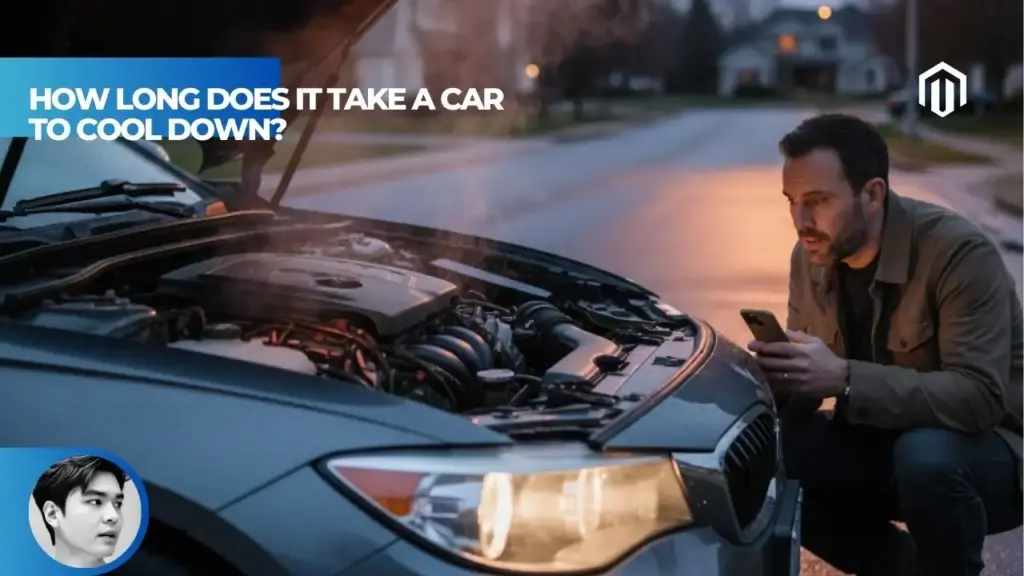
A car engine typically cools down enough for safe inspection within 30 to 45 minutes after driving. Complete cooling to ambient temperature takes 1-2 hours under normal conditions, though hot summer days can extend this to 4+ hours[1]. The exact wait time depends on what you’re planning to do—checking oil requires less cooling than opening a radiator cap. An overheated engine needs at least 30 minutes before you even think about popping the hood[2].
Cool Down Times by Task
Different maintenance jobs require different cooling periods[1][3]:
| Task | Minimum Wait Time | Why |
|---|---|---|
| Check or add oil | 10-15 minutes | Oil needs to settle in pan for accurate reading |
| Change engine oil | 15-30 minutes | Hot oil burns skin; needs to drain fully |
| Check coolant level | 30-60 minutes | Pressurized system can spray boiling liquid |
| Open radiator cap | 1-2 hours | Steam and scalding coolant risk |
| Replace spark plugs | 30-45 minutes | Aluminum heads expand when hot |
| Work on brakes | 20-30 minutes | Rotors and calipers retain heat |
| Work on exhaust | 45-60 minutes | Catalytic converters reach 800°F+ |
These times assume normal driving conditions. If you’ve been pushing the engine hard—towing, climbing hills, or sitting in traffic—add 15-20 minutes to each estimate.
How Long After Overheating Is It Safe to Inspect?
Wait at least 30 minutes after an overheating event before opening the hood or touching anything[2].
During overheating, coolant temperatures can spike well above 260°F. The cooling system is pressurized at 15-16 psi, which means the radiator cap is essentially a pressure cooker. Opening it too soon releases scalding steam and boiling coolant—a recipe for severe burns[4].
Here’s what to do if your car overheats:
- Pull over safely and turn off the engine
- Pop the hood latch but don’t open it fully—let heat escape
- Wait a minimum of 30 minutes (longer in hot weather)
- Check the temperature gauge—it should be at the bottom of its range
- Place a rag over the radiator cap and turn it slowly to release any remaining pressure
If you spot signs your car is overheating while driving, pulling over immediately is more important than worrying about the cooling timeline.
Factors That Affect Cooling Time
Ambient Temperature
Hot summer days slow cooling dramatically. In 95°F weather, an engine may need 2-3 hours to fully cool, while the same engine in 50°F conditions might reach ambient temperature in under an hour[1]. Winter cold accelerates heat dissipation—you’ll notice your temp gauge drops much faster in January than July.
Engine Size and Type
Larger engines retain more heat. A V8 truck engine holds more coolant, has greater thermal mass, and takes longer to cool than a 4-cylinder compact. Diesel engines run slightly cooler (180-210°F) than gasoline engines (195-220°F) but can take just as long to cool due to their larger displacement[5].
Turbocharged engines add another wrinkle. The turbo itself gets extremely hot during operation, and residual heat continues radiating into the engine bay even after shutdown.
Recent Driving Conditions
How you drove matters as much as how long you drove[1]:
| Driving Condition | Heat Level | Added Cooling Time |
|---|---|---|
| Highway cruising | Moderate | Standard wait times |
| Stop-and-go traffic | High | +15-20 minutes |
| Towing or hauling | Very high | +20-30 minutes |
| Mountain climbing | Very high | +25-30 minutes |
| Spirited driving | High | +15-20 minutes |
Heavy loads generate more heat because the engine works harder, and reduced airflow in traffic limits natural cooling.
Cooling System Efficiency
A well-maintained cooling system dissipates heat faster. Clogged radiator fins, low coolant levels, and failing water pumps all slow the cooling process[6]. If your car seems to take forever to cool down, that might signal a cooling system issue worth investigating.
Normal Engine Operating Temperatures
Understanding what’s “normal” helps you gauge cooling progress[5][7]:
| Component | Normal Operating Temp | Notes |
|---|---|---|
| Coolant (gasoline) | 195-220°F | Thermostat opens at ~195°F |
| Coolant (diesel) | 180-210°F | Slightly lower for efficiency |
| Engine oil | 195-250°F | Should be warm but not scalding |
| Exhaust manifold | 400-600°F | Extremely hot during operation |
| Catalytic converter | 600-800°F | Can reach 1,000°F under load |
| Brake rotors | 200-400°F | After heavy braking |
Your temperature gauge reads coolant temperature, not the hottest components. When the gauge shows normal, the exhaust and catalytic converter are still dangerously hot.
How to Cool Your Engine Down Faster
Sometimes you can’t wait an hour. Here are legitimate ways to speed up cooling[8]:
Turn On the Heater
Sounds counterintuitive, but the heater core acts as a secondary radiator. Running the heater on high with windows down pulls heat away from the engine and disperses it into the cabin. It’s uncomfortable in summer, but effective.
Pop the Hood (Carefully)
Opening the hood allows trapped heat to escape rather than recirculating in the engine bay. Just don’t stick your face or hands near any components—hot air rises quickly.
Park in the Shade
Direct sunlight adds radiant heat. Moving to shade can reduce ambient temperature around the car by 20-30°F.
Avoid These Mistakes
- Don’t pour cold water on the engine: Thermal shock can crack blocks and heads
- Don’t remove the radiator cap early: Steam burns are serious injuries
- Don’t run the engine to “speed up” cooling: You’re just adding more heat
- Don’t spray water on hot brake rotors: They can warp from rapid cooling
Why Oil Change Timing Matters
The sweet spot for oil changes is 10-15 minutes after shutdown[3][9].
Why not ice cold? Cold oil is thick and clings to engine surfaces. Waiting a few minutes lets it warm enough to flow freely while draining. But you don’t want it hot—scalding oil dripping onto your arm while you fumble with a drain plug is no fun.
That 10-15 minute window gives you:
- Warm (not hot) oil that drains completely
- Settled oil for accurate dipstick readings
- Safe temperatures for handling the filter and drain plug
If you’re checking how many quarts of oil your car needs, let the engine cool first so the dipstick reading is accurate.
When to Check Coolant Safely
Never open a radiator cap on a hot engine[4][10].
Coolant systems operate under 15-16 psi of pressure. This pressure raises the boiling point above 265°F, preventing boilover during normal operation. But it also means stored pressure can blow scalding liquid in your face if you open the cap prematurely.
Safe coolant check procedure:
- Wait at least 30-60 minutes (1-2 hours is safer)
- Check the overflow reservoir first—no cap removal needed
- If you must open the cap, place a thick rag over it
- Turn the cap slowly to the first stop—listen for pressure release
- Wait until hissing stops completely before removing
The temperature gauge can help. When it’s all the way at the bottom, coolant has cooled significantly—but pressure may still exist[10].
If you’re dealing with a cooling issue, knowing how much power steering fluid your car needs helps you distinguish between different fluid leaks under the hood.
Working on Hot Brake Components
Brakes generate serious heat, especially after highway driving or descending steep hills[1].
Rotors can reach 200-400°F during normal driving and 600°F+ during aggressive braking. Pads, calipers, and brake fluid all retain heat. Give brakes 20-30 minutes to cool before:
- Replacing brake pads
- Inspecting rotors
- Bleeding brake fluid
- Removing wheels
You can test readiness by carefully hovering your hand near (not touching) the wheel. If you feel significant heat radiating through the wheel, the brakes need more time.
Key Takeaways
- The average engine cools enough for safe work in 30-45 minutes, with complete cooling to ambient temperature taking 1-2 hours in moderate conditions and up to 4+ hours in hot weather[1]
- Oil checks need only 10-15 minutes of cooling so oil settles for accurate readings, while radiator cap work requires 1-2 hours to ensure the pressurized system is safe[3][4]
- Overheated engines require at least 30 minutes before inspection—and never open the radiator cap until the temperature gauge reads at the very bottom and no hissing occurs[2]
- Driving conditions dramatically affect cool-down time—towing, stop-and-go traffic, and mountain driving add 15-30 minutes to standard cooling periods[1]
- Ambient temperature matters: engines cool much faster in winter than summer because greater temperature differential increases heat transfer rate[1]
- The heater trick works—running your heater on high with windows open pulls heat away from the engine faster than passive cooling alone[8]
FAQs
How long does it take for an engine to cool completely?
Complete cooling to ambient temperature takes 1-2 hours under moderate conditions[1]. On hot summer days, this extends to 3-4+ hours since the surrounding air temperature limits how cool the engine can get. In winter, complete cooling happens much faster—sometimes within 30-45 minutes in freezing conditions. Most maintenance tasks don’t require complete cooling, just enough cooling to work safely.
Can I add coolant to a hot engine?
No—adding coolant to a hot engine is dangerous and can cause damage[4]. Opening the radiator cap on a hot, pressurized system can result in boiling coolant spraying out. Even if you manage to open it safely, pouring cold coolant into a hot engine can cause thermal shock, potentially cracking the engine block or cylinder head. Always wait at least 30-60 minutes and check the overflow reservoir first.
How long should I wait to check oil after driving?
Wait 10-15 minutes after shutting off the engine[3]. This allows oil circulating through the engine to drain back into the oil pan, giving you an accurate reading. Check too soon and you’ll see artificially low levels. Check on a cold engine that’s been sitting overnight and you’ll get an accurate but thicker reading. The 10-15 minute window hits the sweet spot—warm enough to flow, settled enough to read correctly.
Why does my car take longer to cool down in summer?
Heat transfer depends on the temperature difference between the engine and surrounding air[1]. In 95°F weather, your engine (at 210°F operating temp) only has a 115-degree differential to work with. In 50°F weather, that differential jumps to 160 degrees. Greater differential means faster heat transfer. Summer air also tends to be more humid, which slightly reduces convective cooling efficiency.
Is it bad to let a car idle to cool down?
For normal driving, idling to cool down isn’t necessary—modern engines handle shutdown just fine[8]. But if you’ve been pushing the engine hard (towing, racing, mountain driving), idling for 30-60 seconds lets the cooling system circulate and prevents heat soak. Turbocharged cars especially benefit from brief idle periods after hard driving—the turbo bearings rely on oil circulation to cool, and abrupt shutdown can cause premature wear.
References
- CarParts.com. (2025). How Long Does It Take a Car to Cool Down? https://www.carparts.com/blog/how-long-does-it-take-a-car-to-cool-down/
- J.D. Power. (2025). How Long Does It Take for a Car to Cool Down? https://www.jdpower.com/cars/shopping-guides/how-long-does-it-take-for-a-car-to-cool-down
- Paul’s Auto Repair. (2023). How Long To Let Engine Cool Before Adding Oil. https://www.paulsautorepair.com/blog/how-long-engine-cool-adding-oil/
-
Pike Transit. (2021). How Long to Wait Before Opening Radiator Cap?
How Long to Wait Before Opening Radiator Cap? (Explained!)
- Kevin’s Autos. (2022). What is the Acceptable Engine Temperature Range? https://kevinsautos.com/faq/what-is-the-acceptable-engine-temperature-range.html
-
Car Fluid Guide. (2024). How Long Before Coolant Cools Down.
How Long Before Coolant Cools Down: Tips for Ensuring Your Engine Stays Safe
-
Useful Car Stuff. (2023). Normal Operating Temperature for a Car Engine.
Normal Operating Temperature for a Car Engine
-
JS Auto RI. (2025). Temporary Fixes to Cool Down an Overheating Engine Fast.
Temporary Fixes to Cool Down an Overheating Engine Fast
- Engines World. (2025). How Long to Let Engine Cool Before Adding Oil? https://enginesworld.com/how-long-should-an-engine-cool-before-adding-oil-the-critical-role-of-oil-coolers
-
Vehicle Freak. (2022). How Long Should You Wait Before Opening The Radiator Cap?
How Long Should You Wait Before Opening the Radiator Cap?

I am a senior automotive analyst at Autvex. Expert vehicle evaluations, in-depth reviews, and objective analysis helping readers make informed automotive decisions with years of industry experience.