You may also like:
A professional car paint job takes 3 to 10 days for most vehicles, requiring approximately 40 to 80 labor hours[1]. Simple resprays on well-maintained cars can be completed in 2-4 days, while full restorations involving extensive bodywork may stretch to 2-3 weeks[2]. DIY projects in a home garage typically take longer—often 40-80 hours spread across multiple weekends—due to limited equipment and experience[3].
Time Breakdown by Paint Job Type
The scope of work determines your timeline more than anything else[2][4]:
| Job Type | Time Required | Labor Hours | Best For |
|---|---|---|---|
| Minor touch-up | 1-2 hours | 1-2 | Small chips and scratches |
| Single panel repaint | 1-3 days | 4-12 | Fender, door, or bumper |
| Basic full respray | 3-5 days | 30-40 | Same color, minimal bodywork |
| Standard full repaint | 5-10 days | 40-60 | Color change, moderate prep |
| Full restoration | 1-3 weeks | 60-100+ | Extensive bodywork, custom work |
| Custom/show quality | 3-6 weeks | 100+ | Multi-stage finishes, perfection |
A compact car with minimal bodywork needs around 30-35 labor hours for a complete repaint[5]. Larger vehicles like trucks and SUVs naturally take longer due to increased surface area.
The Paint Job Process: Stage by Stage
Understanding each phase helps explain why quality paint work can’t be rushed. Here’s how professional shops break down the timeline[1][6]:
Stage 1: Damage Assessment and Bodywork (1-5 Days)
Before any paint touches your car, technicians inspect for dents, rust, previous repairs, and surface imperfections. This stage is the most variable—a car in good condition might need just a few hours of assessment and minor sanding, while one with significant damage could require days of metalwork[1].
Bodywork includes pulling dents, filling low spots with body filler, and sanding everything smooth. Rushing this stage guarantees visible flaws in the final paint job. There’s no hiding imperfect bodywork under paint—it actually makes problems more obvious.
For minor body damage, this stage might take just a few hours. Extensive collision repair can stretch to a week or more.
Stage 2: Surface Preparation and Masking (4-8 Hours)
Once bodywork is complete, the car gets a thorough cleaning. Technicians sand the entire surface to create texture for paint adhesion, typically progressing through several grit levels[7]. Every window, trim piece, rubber seal, and light that shouldn’t receive paint gets carefully masked.
This prep work usually takes a full day. Cutting corners here leads to paint adhesion failures, overspray on glass, or visible imperfections. The old saying in body shops is true: 90% of a good paint job is preparation.
Stage 3: Priming (4-8 Hours)
Primer creates a uniform base layer that helps paint adhere and provides additional protection against corrosion. Shops typically apply 1-2 coats of primer with 15-30 minutes of dry time between coats[8].
After primer dries, it gets block-sanded to perfect the surface contours. This stage catches any remaining bodywork imperfections that weren’t visible before. Areas that need attention go back for more work before proceeding.
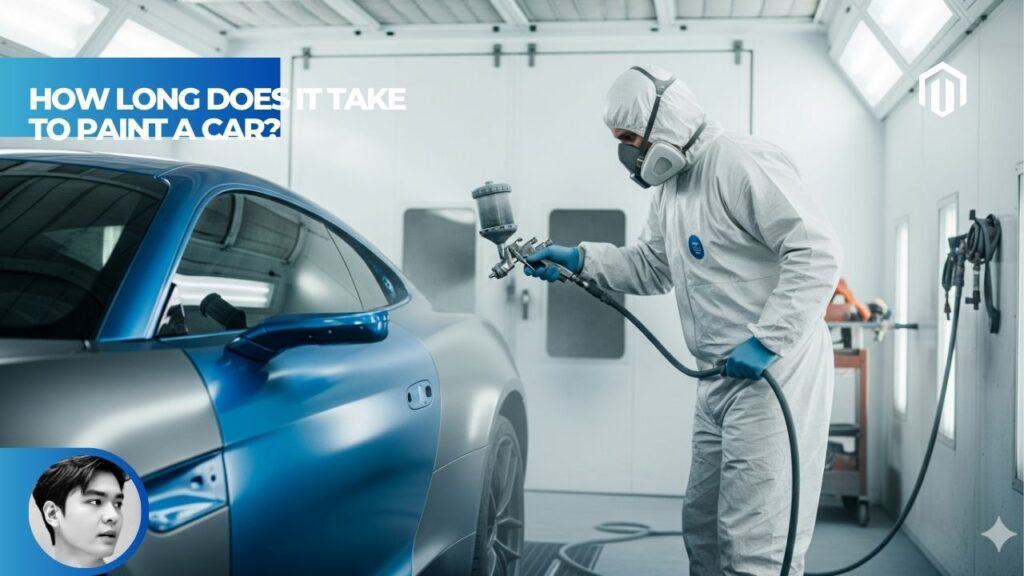
Stage 4: Paint Application (4-8 Hours)
The actual painting is surprisingly quick compared to preparation. Technicians first apply a sealer coat, then spray 2-4 layers of basecoat (color) with 10-15 minute flash times between each coat[9]. Once color coats are complete and properly flashed, 2-3 layers of clear coat follow.
Most professional spray work wraps up in half a day to a full day. The paint itself dries quickly—becoming dust-free within 10-15 minutes and tack-free within an hour at 70°F[10].
Stage 5: Drying and Curing (1-3 Days)
Here’s where patience matters most. While paint becomes touch-dry fairly quickly, full chemical curing takes much longer[11]:
| Stage | Time Required |
|---|---|
| Dust-free | 10-15 minutes |
| Tack-free | 30-60 minutes |
| Handle carefully | 4-6 hours |
| Light use | 24 hours |
| Initial cure | 24-48 hours |
| Full cure | 30-90 days |
Professional shops use heated spray booths to accelerate drying between coats and speed initial cure times. Shops often let vehicles sit overnight before the final refinishing stage to ensure the clear coat has sufficiently hardened.
Stage 6: Refinishing and Final Inspection (4-16 Hours)
The last stage separates good paint jobs from great ones. Technicians color-sand the clear coat with very fine grit (typically 1500-2000) to remove any texture or “orange peel” effect[1]. Buffing and polishing follow to achieve a mirror-like finish.
Masked parts get carefully removed, the vehicle is reassembled, and a final inspection catches any flaws. Quality shops won’t release a vehicle until this inspection passes.
Professional vs DIY: Realistic Time Comparisons
Thinking about painting your car yourself? Here’s what the timelines actually look like[3][12]:
| Factor | Professional Shop | DIY Garage |
|---|---|---|
| Total time | 3-10 days | 2-6 weeks |
| Labor hours | 40-80 | 40-80+ |
| Daily commitment | 8-10 hours | 2-4 hours (evenings/weekends) |
| Equipment quality | Professional booths, guns | Consumer-grade tools |
| Experience level | Years of training | Learning as you go |
The catch with DIY? You’ll spend similar labor hours, but spread across weekends and evenings. A project that takes a shop one week might take a home hobbyist 4-6 weekends to complete properly[3].
One YouTuber documented painting a BMW in their garage—the goal was 24 hours of actual work time, but it took three 8-hour days just for disassembly and painting, plus another 6 hours for compounding and polishing[12]. And that’s from someone with experience.
If things go wrong during DIY—uneven paint, runs, overspray, or poor color matching—fixing mistakes can cost $1,500-$3,000 at a professional shop[13]. Sometimes more than just having the pros do it from the start.
What Extends Paint Job Timelines?
Extensive Bodywork Requirements
Rust repair, dent removal, and previous repair correction add significant time. A car that’s been in a collision or has body rot could need an extra week of prep work before anyone touches a spray gun[1].
Custom or Multi-Stage Finishes
Metallic, pearl, and multi-stage paints require more coats for consistent color and proper flake distribution[4]. Custom colors, matte finishes, and special effects can add days to the painting phase alone.
Color Changes
Painting a dark car light (or vice versa) requires extra coats to achieve full coverage. Door jambs, under-hood areas, and trunk interiors all need paint too—adding significant time compared to same-color resprays.
Vehicle Size
Larger surface areas mean more prep, more paint, and more finishing work. An SUV or truck takes longer than a compact car simply due to scale[4].
Shop Backlog
Busy shops may have your car sitting in queue before work even begins. Collision repair facilities especially can have weeks-long backlogs during certain seasons. Getting a realistic timeline upfront helps you plan around transportation needs.
Paint Drying vs Curing: Why You Can’t Rush
Many car owners confuse “dry” with “cured”—and the difference matters for how soon you can wash or wax your freshly painted car[11].
Drying is when solvents evaporate and the paint becomes solid enough to touch. This happens within hours.
Curing is when the chemical reaction in the paint completes, making it truly hard and resistant. This takes weeks to months for full cure.
During the initial curing period:
- Wait 24-48 hours before any light handling
- Wait 7-14 days before washing
- Wait 30-60 days before waxing
- Avoid parking under trees or near sprinklers
- Keep away from harsh chemicals
Washing too early can damage the finish. Waxing before full cure traps solvents and causes cloudiness or adhesion problems.
What Does a Professional Paint Job Cost?
Since paint jobs represent significant investment, here’s what to expect in 2025[13][14]:
| Paint Job Level | Price Range | What’s Included |
|---|---|---|
| Basic respray | $1,000-$1,500 | Single-stage paint, minimal prep |
| Mid-tier quality | $2,000-$5,000 | Basecoat/clearcoat, proper prep |
| High-quality | $5,000-$10,000 | Premium paint, extensive prep |
| Custom/show | $10,000-$20,000+ | Multi-stage, custom colors |
Labor accounts for 40-60% of the total cost[15]. Paint and material costs have risen about 7.4% this year, pushing even basic jobs higher than previous years.
The cheapest quotes usually mean shortcuts—thin paint, skipped prep steps, or inexperienced painters. If preserving your car’s value matters, budget for quality work.
Key Takeaways
- Professional paint jobs take 3-10 days for most vehicles, with approximately 40-80 labor hours required depending on the scope of work
- Simple resprays on well-maintained cars can be completed in 2-4 days, while full restorations with extensive bodywork may take 2-3 weeks or longer
- Preparation accounts for roughly 90% of a quality paint job—surface prep, bodywork, and masking typically take more time than actual painting
- Paint becomes touch-dry within hours but requires 30-90 days for full chemical cure; avoid washing for 7-14 days and waxing for 30-60 days after painting
- DIY projects require similar labor hours to professional work but spread across weeks or months due to equipment limitations and learning curve
- Budget $1,000-$5,000 for quality professional work; custom or show-quality jobs can exceed $10,000
FAQs
How long does it take to paint a car at Maaco or similar budget shops?
Budget paint shops typically complete jobs in 2-3 days for basic resprays[2]. They achieve faster turnarounds through streamlined processes and less extensive prep work. Results vary—some budget jobs look great for years, while others show problems quickly. The $300-$500 price range usually means minimal surface prep and fewer paint coats than premium shops.
Can I drive my car right after it’s painted?
Technically yes, but with caution. Paint is typically safe for light driving 24 hours after application[11]. Avoid car washes for at least 7-14 days, skip waxing for 30-60 days, and be careful around sprinklers, tree sap, and bird droppings during the initial cure period. The paint continues hardening for up to 90 days.
How long does it take to repaint just one panel?
Single panel work—like a door, fender, or bumper—typically takes 1-3 days at a professional shop[4]. This includes removing the panel (if needed), prep work, color matching, painting, blending into adjacent panels, and reassembly. Simpler repairs on bumper covers can sometimes be completed same-day.
Why do some paint jobs take weeks while others take days?
The difference comes down to bodywork, paint type, and quality expectations[1]. A simple same-color respray on a well-maintained car can finish in 3-5 days. A restoration project with extensive rust repair, color change, and show-quality finish expectations might take 3-6 weeks. Custom work requiring hand-rubbed finishes or special effects adds even more time.
How long does DIY car painting take in a garage?
Expect 40-80 hours of actual work spread across several weekends[3]. Without professional equipment, drying times extend and work must stop between coats. Weather limitations (temperature, humidity) can add delays. Most first-time DIY painters underestimate the project and end up spending 2-3 times their initial time estimate.
References
- Brentwood Auto Body. (2025). Understanding the Timeline for Full Vehicle Paint Jobs. https://brentwood-autobody.com/full-vehicle-paint-jobs-timeline/
-
Dallas Auto Paint. (2026). How long does a full car paint job take in Dallas.
How long does a full car paint job take in Dallas
- Learn Auto Body and Paint. How Long Should a Auto Body Paint Job Take You?
-
Auto Detail STL. (2025). How Long Does A Professional Car Paint Job Usually Take?
How Long Does A Professional Car Paint Job Usually Take?
- Central Collision Repair Dayton. (2025). How Long Does Auto Paint Repair Service Take? https://www.centralcollisionrepairdayton.com/how-long-does-auto-paint-repair-service-take-what-you-should-know
- Eli’s Collision Repair. How Long Does It Take to Paint a Car? https://elisautobody.com/how-long-does-it-take-to-paint-a-car/
- Victory Auto Body. (2024). How Long Does It Take to Repaint a Car? https://www.victoryautobody.com/blog/how-long-does-it-take-to-repaint-a-car
- TouchUpDirect. (2025). Paint Order and Dry Time Guide. https://help.touchupdirect.com/en-US/paint-order-and-dry-time-guide-1542625
- Auto Paint HQ. (2025). Paint Coat Drying Times: When to Recoat for Best Results. https://autopainthq.com/blogs/news/paint-coat-drying-times
- Eastwood. (2025). How to Paint Your Car With Single Stage Paint. https://www.eastwood.com/garage/how-to-paint-your-car-with-single-stage-paint/
- Bliss Car Wash. (2025). How Long Should Car Paint Dry Before Washing? https://blisscarwash.com/how-long-should-car-paint-dry-before-washing/
- SFD Garage. (2025). 24-Hour DIY Car Paint Job Challenge.
- Automotive Globe Specialist. (2025). How Much Does It Cost to Paint a Car in 2025? https://www.automotiveglobespecialist.com/post/how-much-does-it-cost-to-paint-a-car
- Kelley Blue Book. (2025). How Much Does It Cost to Paint a Car? https://www.kbb.com/car-advice/cost-to-paint-car/
-
The Auto Clinique. (2025). 2025 Market Trends for Car Body Paint Repair.
How Much for Car Body Paint Repair in 2025?

I am a senior automotive analyst at Autvex. Expert vehicle evaluations, in-depth reviews, and objective analysis helping readers make informed automotive decisions with years of industry experience.