You may also like:
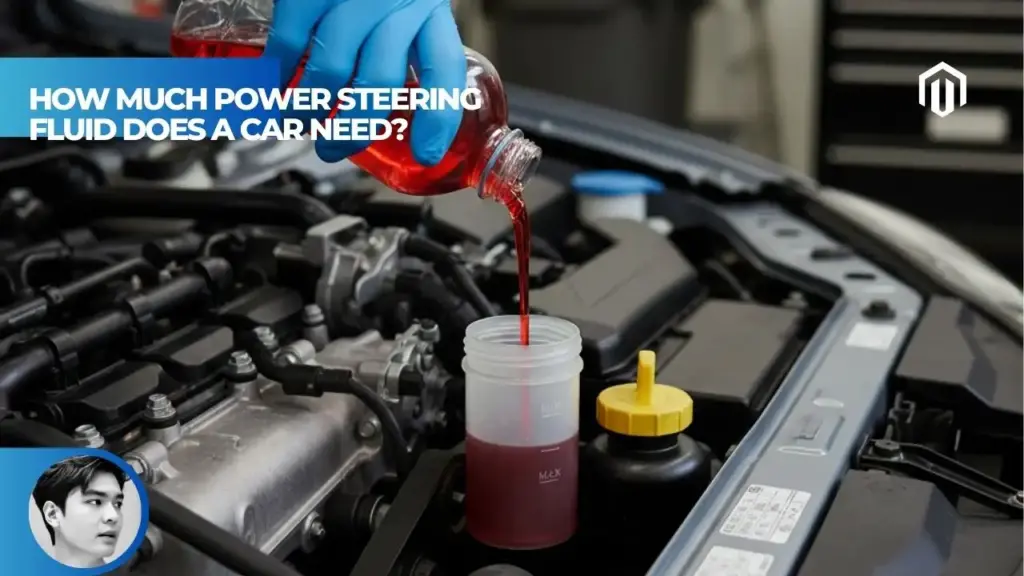
Most cars require 1 to 2 quarts (0.95 to 1.9 liters) for total power steering system capacity[1]. For a simple top-off, you’ll typically need just a few ounces to reach the MAX line—rarely more than half a quart[2]. A complete system flush requires approximately 2 quarts to properly clean and refill the entire system[3]. Your exact amount depends on vehicle size, whether you’re topping off or flushing, and the current fluid level.
Power Steering Fluid Capacity by Vehicle Type
Different vehicles have different fluid requirements based on their steering system design and overall size[1].
| Vehicle Type | Total System Capacity | Top-Off Estimate |
|---|---|---|
| Compact/Sedan | 0.8–1.2 quarts | 4–8 oz |
| Midsize Sedan | 0.9–1.4 quarts | 4–12 oz |
| Full-Size Sedan | 1.0–1.5 quarts | 6–12 oz |
| Compact SUV | 1.0–1.4 quarts | 6–10 oz |
| Full-Size SUV | 1.5–2.0 quarts | 8–16 oz |
| Pickup Truck | 1.5–2.5 quarts | 8–16 oz |
| Heavy-Duty Truck | 2.0–6.0+ quarts | 12–24 oz[4] |
Japanese vehicles like Toyota and Honda typically use less fluid (0.8–1.2 quarts total), while American trucks often require more (1.5–2.5 quarts)[1]. European luxury vehicles may specify synthetic fluids with precise fill quantities.
Popular Vehicle Capacities
Ford F-150
The Ford F-150 requires 1.5 to 2 quarts for a complete system fill, depending on engine and model year[1]. 2020-2025 models with the 3.5L EcoBoost need approximately 1.7 quarts, while older V8 models may require up to 2.1 quarts. Ford specifies Mercon V or Mercon LV fluid for most F-150 applications.
Honda Civic
Honda Civics require approximately 1 quart (32 ounces) for complete system capacity, with the reservoir holding about 13 ounces[1]. Honda specifically requires Honda PSF or Honda-compatible fluid—the manufacturer warns against generic power steering fluids that can damage seals.
Chevy Silverado
The Chevy Silverado’s power steering system holds 1.8 to 2.3 quarts depending on configuration[1]. The 1500 series typically needs 1.8 quarts, while 2500HD and 3500HD models with hydroboost brake systems require additional fluid. GM recommends their specific power steering fluid (GM Part No. 89021184) or equivalent.
How to Check Power Steering Fluid Level
Checking your power steering fluid takes less than a minute and can prevent expensive repairs. Here’s the process[5]:
- Locate the reservoir: Look for a small tank with a steering wheel symbol on the cap. It’s usually near the engine, often transparent or semi-transparent[3].
- Check cold vs. hot markings: Many reservoirs have separate MIN/MAX lines for cold and hot readings. The level rises as fluid warms up[3].
- Read the level: If using a dipstick cap, wipe it clean, reinsert, then remove to check. If the reservoir is clear, visually inspect the level against the markings[5].
- Assess the fluid condition: Power steering fluid should be red or amber. If it’s brown, black, or smells burnt, a full flush may be needed[6].
If you’re unsure about fluid conditions, similar checking principles apply to checking your engine oil—consistency in method matters.
How to Add Power Steering Fluid
If the fluid level sits below the MIN line, follow these steps[5]:
- Use the correct fluid type: Check your owner’s manual. Using the wrong fluid can damage seals and components[6].
- Add fluid incrementally: Pour in small amounts—about 2–4 ounces at a time. Overfilling causes problems[5].
- Check after each addition: Replace the cap or dipstick and verify the level before adding more[5].
- Turn the wheel lock-to-lock: After adding fluid, start the engine and turn the steering wheel fully left, then fully right. This circulates new fluid throughout the system[3].
- Recheck the level: The fluid may drop slightly after circulation. Add more if needed to reach proper level.
Don’t exceed the MAX line. Overfilled systems can cause fluid to foam, leak, or damage seals when heated[3].
Types of Power Steering Fluid
Not all power steering fluids are interchangeable. Using the wrong type can cause seal damage, pump failure, or steering issues[6].
| Fluid Type | Common Applications | Notes |
|---|---|---|
| Dexron III ATF | GM, many Asian vehicles | Most widely compatible[6] |
| Mercon V/LV | Ford vehicles | Specific to Ford systems[6] |
| Honda PSF | Honda/Acura | Manufacturer-specific[1] |
| Pentosin CHF 11S | European (BMW, Audi, VW) | Synthetic, brand-specific[7] |
| ATF+4 | Chrysler/Stellantis | Required for newer models[1] |
| Universal PSF | Generic option | Check compatibility first |
European vehicles like BMW X3 or Audi Q5 often require synthetic fluids meeting strict OEM specifications—using generic fluid can void warranties and damage components[7].
Signs You Need to Add Power Steering Fluid
Low fluid levels often announce themselves before you check the reservoir. Watch for these symptoms[2]:
- Whining or groaning noise when turning: The pump struggles without adequate fluid. If you notice unusual noises when turning, low fluid is a common culprit.
- Stiff steering: The wheel becomes harder to turn, especially at low speeds or when parking.
- Jerky steering feel: The wheel doesn’t move smoothly through its range.
- Visible fluid leak: Red or brown puddles under the front of the vehicle suggest a leak that’s draining your reservoir.
- Fluid level dropping repeatedly: If you’re adding fluid frequently, you have a leak that needs repair—topping off won’t solve the underlying problem.
Is One Quart Enough for Most Jobs?
For routine maintenance, one quart is sufficient for top-offs and minor servicing[1]. A single quart bottle covers routine top-offs for several years under normal conditions.
But if you’re performing a complete flush, addressing a leak repair, or replacing steering components like a rack or pump, you’ll need 2 quarts or more[2]. The total capacity includes fluid held in the pump, lines, and steering gear—not just the reservoir.
Think of it like how many quarts of oil your car takes—the dipstick might show full after adding one quart, but a complete change requires the full system capacity.
When Power Steering Fluid Doesn’t Apply
Many newer vehicles—particularly those built after 2010—use Electric Power Assist Steering (EPAS) instead of hydraulic systems[5]. These vehicles have no power steering fluid to check or add.
Electric steering systems use an electric motor to assist steering, eliminating the pump, fluid, and associated maintenance. If your vehicle has EPAS, the owner’s manual won’t mention power steering fluid, and you won’t find a reservoir under the hood.
Most EVs and many recent conventional vehicles use EPAS exclusively. When in doubt, check your owner’s manual or look under the hood—no steering wheel symbol cap means no fluid system.
Key Takeaways
- Most vehicles require 1 to 2 quarts total system capacity, but simple top-offs typically need just a few ounces—rarely more than half a quart[1][2].
- Japanese vehicles generally need less fluid (0.8–1.2 quarts) while American trucks may require 1.5–2.5 quarts[1].
- Using the wrong fluid type can damage seals and components—always check your owner’s manual for specifications[6].
- After adding fluid, turn the steering wheel lock-to-lock with the engine running to circulate new fluid throughout the entire system[3].
- Newer vehicles with Electric Power Assist Steering (EPAS) have no power steering fluid—check if your car even has a hydraulic system before shopping[5].
- Fluid levels that drop repeatedly indicate a leak that needs professional diagnosis; topping off only delays inevitable failure.
FAQs
How much power steering fluid should I buy?
Can I use ATF instead of power steering fluid?
Many vehicles accept Dexron III or Mercon ATF as power steering fluid, but not all do[6]. Some manufacturers require proprietary fluids that differ significantly from standard ATF. Check your owner’s manual—using the wrong fluid can damage seals and void warranties. European vehicles in particular often require specific synthetic fluids.
How often should I check power steering fluid?
Check your power steering fluid every oil change or every 3,000–5,000 miles[2]. A properly functioning system shouldn’t lose significant fluid between checks. If the level drops noticeably, you likely have a leak that needs diagnosis. Most manufacturers recommend flushing the entire system every 50,000–100,000 miles.
What happens if I overfill power steering fluid?
Overfilled systems can cause the fluid to foam when heated, reducing its effectiveness[3]. Excess pressure may also damage seals or cause leaks. If you’ve overfilled, use a turkey baster or syringe to remove excess fluid until the level sits between MIN and MAX. The same principle applies when your car overheats—fluid expansion must have room to go.
Why does my power steering fluid keep getting low?
Fluid doesn’t evaporate or burn off like engine oil—if levels keep dropping, you have a leak[2]. Common leak points include the pump seals, rack and pinion, high-pressure lines, and connection fittings. A small leak may only require occasional topping off, but all leaks eventually worsen. Get the source diagnosed before major components fail.
References
- Autvex. (2025). How Much Power Steering Fluid Does a Car Need? https://autvex.com/how-much-power-steering-fluid-does-a-car-need/
-
Reddit r/MechanicAdvice. (n.d.). Power steering fluid capacity.
Power steering fluid capacity
byu/Raidenjstsrk inMechanicAdvice - YMF Car Parts. (n.d.). How Much Power Steering Fluid Do I Need? https://www.ymfcarparts.co.uk/blog/how-much-power-steering-fluid-do-i-need/
- Ford Service Content. (n.d.). Hydraulic Power Steering Fluid Capacity and Specification. https://www.fordservicecontent.com/Ford_Content/vdirsnet/OwnerManual/Home/Content
- Ford. (n.d.). How to add Power Steering Fluid. https://www.ford.com/support/how-tos/more-vehicle-topics/steering-and-suspension/how-to-add-power-steering-fluid/
- Belmont Lubricants. (2025). Which ATF Grade Is Suitable for Power Steering? https://belmontlubricants.com/which-atf-grade-is-suitable-for-power-steering/
- Penrite Oil. (n.d.). ATF & Power Steering Fluids. https://penriteoil.com.au/assets/flyers/PEN_ATF_TRAIN_FLY_SCA.pdf
- UTI. (2025). What Is Power Steering Fluid? https://www.uti.edu/blog/automotive/power-steering-fluid

I am a senior automotive analyst at Autvex. Expert vehicle evaluations, in-depth reviews, and objective analysis helping readers make informed automotive decisions with years of industry experience.