You may also like:
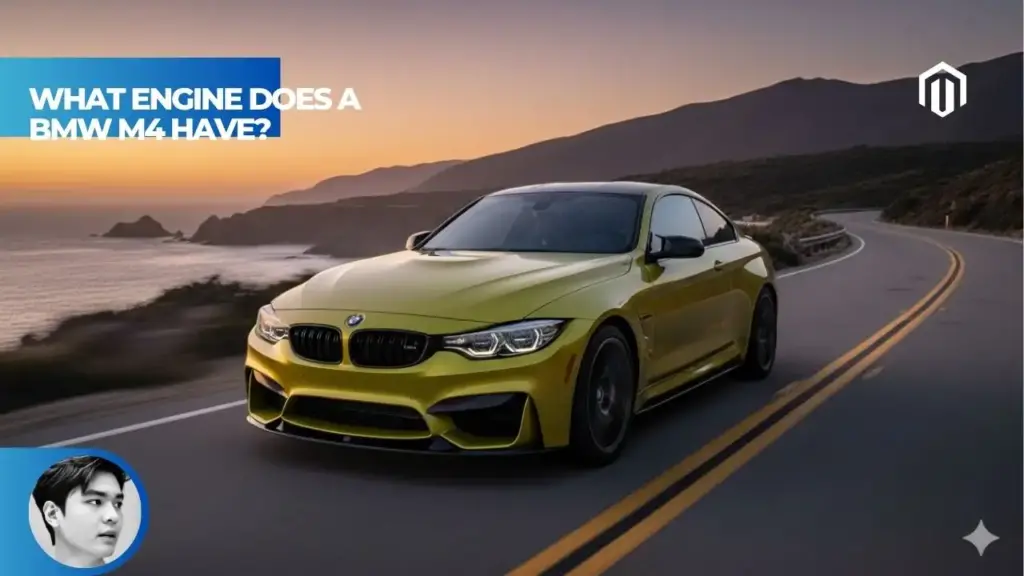
The BMW M4 uses the S58 engine—a 3.0-liter twin-turbocharged inline-six producing 473 to 543 horsepower depending on variant.[1] The base M4 generates 473 hp with a 6-speed manual, while the M4 Competition delivers 503 hp and the range-topping M4 CS pushes 543 hp.[2] This engine represents BMW M’s most advanced inline-six ever built.
The S58 Engine: BMW M4’s Powerhouse
BMW’s S58 engine debuted in 2019 and has powered every M4 since the current G82 generation launched in 2021. It replaced the S55 engine from the previous-generation M4, delivering significant upgrades in power, efficiency, and responsiveness.
At its core, the S58 displaces 2,993cc with a bore of 84.0mm and stroke of 90.0mm.[3] Twin mono-scroll turbochargers force air into the combustion chambers, working with a 9.3:1 compression ratio to extract maximum power from premium fuel. The result? A flat torque curve that delivers massive thrust from low RPM all the way to the 7,200 rpm redline.
What makes the S58 different from its predecessor is the attention to airflow and cooling. BMW’s engineers redesigned the cylinder head with larger intake and exhaust ports, revised the turbocharger placement for reduced lag, and implemented a more robust cooling system to handle sustained high-performance driving.[4]
Here’s how the S58 compares across M4 variants:
| M4 Variant | Horsepower | Torque | 0-60 mph | Drivetrain |
|---|---|---|---|---|
| M4 (manual) | 473 hp @ 6,250 rpm | 406 lb-ft @ 2,650 rpm | 4.1 sec | RWD |
| M4 Competition (RWD) | 503 hp @ 6,250 rpm | 479 lb-ft @ 2,750 rpm | 3.8 sec | RWD |
| M4 Competition xDrive | 523 hp @ 6,250 rpm | 479 lb-ft @ 2,750 rpm | 3.4 sec | AWD |
| M4 CS | 543 hp @ 6,250–7,200 rpm | 479 lb-ft @ 2,750 rpm | 3.4 sec | AWD |
| M4 CSL | 543 hp @ 6,250 rpm | 479 lb-ft @ 2,750 rpm | 3.6 sec | RWD |
Source: BMW USA, Car and Driver, CarBuzz[1][2][5]
The power difference between variants comes down to boost pressure and calibration. The base M4 runs lower boost for a more manageable (and manual-transmission-friendly) power delivery. Competition models turn up the boost for 30 additional horsepower. The CS and CSL variants crank boost from 24.7 psi to 30.5 psi, extracting every bit of performance the S58 can reliably deliver.[5]
S58 vs S55: What Changed?
The jump from S55 to S58 represents more than a power bump. BMW fundamentally redesigned the engine architecture.
The S55 powered the previous-generation F82 M4 from 2014-2020, producing 425 horsepower in standard form and up to 493 horsepower in the limited M4 GTS.[4] It was a strong engine but had known issues—most notably crank hub problems and carbon buildup on intake valves that plagued some owners.
BMW addressed these concerns with the S58. The crankcase features reinforced main bearings designed to handle higher cylinder pressures. A closed-deck block construction adds rigidity. And the cooling system includes a larger oil cooler and more efficient intercooler setup to maintain consistent performance during track sessions.[4]
| Specification | S55 (F82 M4) | S58 (G82 M4) |
|---|---|---|
| Displacement | 2,979cc | 2,993cc |
| Max Power (base) | 425 hp | 473 hp |
| Max Power (Competition) | 425 hp | 503 hp |
| Max Power (special editions) | 493 hp (GTS) | 543 hp (CS/CSL) |
| Turbocharger Type | Twin-scroll | Mono-scroll |
| Redline | 7,600 rpm | 7,200 rpm |
Source: BMW Tuning, CarBuzz[4][5]
The numbers tell part of the story. Base power jumped 48 horsepower—a substantial increase without resorting to larger displacement or more cylinders. Peak torque arrives earlier and stays flatter across the rev range. And real-world acceleration improved dramatically thanks to better power delivery and the option of all-wheel drive.
The one tradeoff? Redline dropped 400 rpm, from 7,600 to 7,200. BMW’s engineers traded a sliver of top-end revs for broader, more usable midrange power. Most drivers will never notice—the S58 pulls hard enough that you rarely need to wind it past 6,500 rpm anyway.
Performance: What the Numbers Mean
Raw horsepower figures are one thing. How does the S58 actually perform?
The M4 Competition xDrive hits 60 mph in 3.4 seconds according to BMW, with independent testing from Car and Driver confirming times as quick as 3.3 seconds.[6] That’s hypercar-adjacent acceleration from a four-seat coupe you can daily drive. The quarter mile falls in approximately 11.6 seconds at 123 mph.
Here’s what the spec sheet doesn’t tell you: the S58 delivers its power in a way that feels almost effortless. There’s minimal turbo lag thanks to the mono-scroll design—plant your foot and thrust arrives within a heartbeat. The 8-speed M Steptronic transmission (standard on Competition models) snaps off shifts in milliseconds, keeping the engine in its sweet spot.
The rear-wheel-drive M4 Competition requires 3.8 seconds to 60 mph—a half-second slower than the xDrive version.[7] But that’s not a weakness. The RWD car rewards skilled drivers with more adjustable handling and a purer connection to the road. Plus, it weighs less.
For drivers who want maximum engagement, the base M4 with its 6-speed manual and 473 horsepower hits 60 in 4.1 seconds.[7] That’s quick by any reasonable standard, and the manual’s slightly lower power output actually makes the car more usable on public roads—you can explore more of the rev range without immediately exceeding speed limits.
The M4 CS: Peak S58 Performance
The 2025 BMW M4 CS represents the S58’s most potent street-legal tune. This limited-production model takes everything BMW learned from the M4 CSL and makes it (slightly) more livable.
Power climbs to 543 horsepower—a 20 hp increase over the M4 Competition xDrive.[3] BMW achieved this through higher boost pressure, revised engine mapping, and optimized airflow through the intake and exhaust systems. Torque remains at 479 lb-ft, available from 2,750 to 5,950 rpm.[3]
The CS also sheds weight. Carbon fiber components throughout the car trim 77 pounds compared to the M4 Competition xDrive.[8] Combined with standard all-wheel drive, the result is a 3.4-second 0-60 time and a car that feels noticeably sharper than standard M4 variants.
Pricing starts at $123,500—a significant premium over the $90,175 M4 Competition xDrive.[8] Whether that delta makes sense depends on how much you value those final percentages of performance and exclusivity.
For comparisons within the BMW M lineup, see our guides on M3 vs M4 differences and the fastest BMW M cars.
S58 Reliability: What Owners Report
The S58 has proven more durable than its predecessor, but it’s not without concerns. Understanding potential issues helps with long-term ownership planning.
Oil filter housing problems represent the most discussed S58 issue. The filter element can disintegrate if left too long between changes, restricting oil flow to critical engine components.[9] The fix is simple: change oil at 5,000-7,500 mile intervals (shorter than BMW’s recommended intervals) and inspect the filter housing during each service.
Rod bearing wear—a notorious problem on older BMW M engines—still occurs on the S58, though less frequently than on the S55.[9] Cold-start hard driving is the primary culprit. Let the engine warm up before aggressive acceleration, and most owners report no bearing issues through 50,000+ miles.
The turbochargers can fail from oil starvation, typically linked to the same oil filter housing issues mentioned above.[9] Regular maintenance prevents most cases. The 8-speed automatic transmission may exhibit rough shifting if the fluid isn’t changed according to schedule—BMW claims “lifetime” fluid, but M owners generally recommend changes every 50,000-60,000 miles.
For broader context on BMW maintenance, check our guide on BMW ownership costs and when BMWs typically need major repairs.
M4 vs M3: Same Engine, Different Experience
The BMW M3 sedan uses the identical S58 engine as the M4 coupe. Every variant—base, Competition, xDrive, CS, CSL—shares the same powertrain specifications between the two models.[7]
So what’s different? Body style and weight, primarily. The M4 coupe weighs approximately 50-100 pounds less than the equivalent M3 sedan, depending on options.[7] This translates to marginally quicker acceleration and slightly sharper handling response.
The M3’s four-door layout offers practical advantages—easier rear seat access, a wider trunk opening, and better outward visibility.[7] The M4’s coupe silhouette sacrifices some convenience for a sportier aesthetic and slightly improved dynamics.
Both cars receive identical performance technology: the same adaptive M suspension, electronically controlled limited-slip differential, and M Drive Professional system for customizing throttle, steering, and traction control settings.[7] The choice between them is purely about how you want to live with the car.
2025 BMW M4 Pricing and Variants
As of January 2026, the BMW M4 lineup spans from approximately $80,000 to over $120,000 depending on variant and options.
| Model | Base MSRP | Drivetrain | Transmission |
|---|---|---|---|
| M4 Coupe | ~$80,875 | RWD | 6-speed manual |
| M4 Competition Coupe | ~$84,500 | RWD | 8-speed auto |
| M4 Competition xDrive Coupe | ~$90,175 | AWD | 8-speed auto |
| M4 Competition xDrive Convertible | ~$99,000 | AWD | 8-speed auto |
| M4 CS | ~$123,500 | AWD | 8-speed auto |
Source: BMW USA, Edmunds, KBB[10][11]
Popular options add up quickly. The M Carbon Ceramic Brakes cost $8,500. The Carbon Package runs $14,300. M Carbon Bucket Seats add $4,500.[10] A fully loaded M4 Competition xDrive can easily exceed $115,000 before taxes and destination.
Fuel economy ranges from 16 mpg city to 23 mpg highway for the Competition xDrive—reasonable for a 500+ horsepower performance car, though nowhere near economical.[10] Plan on premium fuel exclusively; the S58 requires 91 octane minimum.
For details on BMW fuel requirements, see our guide on what gas BMWs need.
Key Takeaways
- The BMW M4 uses the S58 engine—a 3.0-liter twin-turbocharged inline-six producing 473 to 543 horsepower depending on variant, representing BMW M’s most advanced inline-six ever built.[1]
- The M4 Competition xDrive delivers 523 horsepower and reaches 60 mph in just 3.4 seconds, while the base M4 with 6-speed manual offers 473 horsepower for enthusiasts who prefer three pedals.[7]
- The S58 replaced the S55 engine with a 48-horsepower increase in base form, improved cooling, reinforced internals, and better turbo response—addressing many reliability concerns from the previous generation.[5]
- Maintenance is critical for S58 longevity: owners should change oil every 5,000-7,500 miles, inspect oil filter housings regularly, and allow warm-up time before aggressive driving to prevent rod bearing wear.[9]
- Pricing ranges from approximately $80,875 for the base M4 to $123,500 for the track-focused M4 CS, with popular options easily adding $20,000+ to any configuration.[10][8]
FAQs
Is the BMW M4 engine the same as the M3?
Yes. The BMW M4 and M3 share the identical S58 3.0-liter twin-turbocharged inline-six engine across all variants.[7] Power outputs match exactly—473 hp for the base manual models, 503 hp for Competition RWD, 523 hp for Competition xDrive, and 543 hp for CS/CSL versions. The only differences between M3 and M4 relate to body style, weight distribution, and practical considerations.
How much horsepower does a BMW M4 Competition have?
The M4 Competition produces 503 horsepower in rear-wheel-drive form and 523 horsepower with xDrive all-wheel drive.[1] Both versions generate 479 lb-ft of torque. The xDrive model’s additional 20 horsepower comes from revised engine calibration that takes advantage of the AWD system’s improved traction capability.
Is the S58 engine reliable?
The S58 has proven more reliable than its S55 predecessor, but it requires attentive maintenance. Critical practices include changing oil every 5,000-7,500 miles (shorter than BMW’s official intervals), inspecting the oil filter housing during each service, and allowing the engine to warm up before spirited driving.[9] Most owners who follow these guidelines report trouble-free ownership through 50,000+ miles.
Does the BMW M4 come with a manual transmission?
Only the base M4 (non-Competition) offers a 6-speed manual transmission, paired exclusively with rear-wheel drive and 473 horsepower.[7] All M4 Competition and higher variants use the 8-speed M Steptronic automatic. BMW has confirmed the manual will remain available through the current generation, making the M4 one of the few remaining performance cars offering three pedals.
References
- BMW USA. (n.d.). BMW 4 Series Coupe M Models. https://www.bmwusa.com/vehicles/m-series/bmw-4-series-m-models/bmw-m4-coupe.html
- BMWBlog. (2024). 2025 BMW M4 Competition (G82) Review. https://www.bmwblog.com/2024/10/09/2025-bmw-m4-competition-review/
- BMW Group Press. (2024). The New 2025 BMW M4 CS. https://www.press.bmwgroup.com/usa/article/detail/T0441789EN_US/the-new-2025-bmw-m4-cs
-
BMW Tuning. (2024). S55 vs S58: Performance, Reliability & Tuning.
BMW S55 vs S58: Performance, Reliability & Tuning
- CarBuzz. (2024). Straight-Six Perfection: Unpacking The BMW M4’s Potent Engine. https://carbuzz.com/straight-six-perfection-unpacking-the-bmw-m4s-potent-engine/
- Car and Driver. (2022). Tested: 2022 BMW M4 Competition xDrive. https://www.caranddriver.com/reviews/a40368599/2022-bmw-m4-competition-awd-by-the-numbers/
- BMW Cleveland. (2025). 2025 BMW M3 vs M4: Key Differences. https://www.bmwcleveland.com/blog/2025/february/25/2025-bmw-m3-vs-m4-key-differences-in-power-style-and-features.htm
- Wikipedia. (n.d.). BMW M4. https://en.wikipedia.org/wiki/BMW_M4
- YouTube – S58 Engine Reliability. (2025). BMW S58 Engine Reliability, Common Problems.
- Edmunds. (2025). 2025 BMW M4 Competition xDrive Specs & Features. https://www.edmunds.com/bmw/m4/2025/st-402028378/features-specs/
- KBB. (2025). 2025 BMW M4 Competition xDrive Prices. https://www.kbb.com/bmw/m4/2025/competition-xdrive/

I am a senior automotive analyst at Autvex. Expert vehicle evaluations, in-depth reviews, and objective analysis helping readers make informed automotive decisions with years of industry experience.