You may also like:
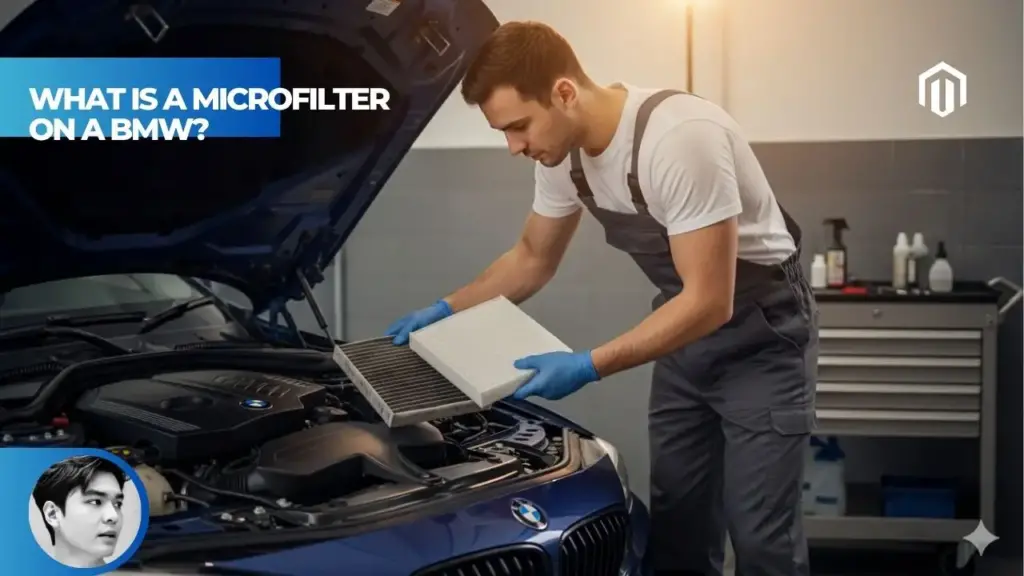
A BMW microfilter is the cabin air filter—it cleans air entering the passenger compartment through the heating, ventilation, and air conditioning (HVAC) system[1]. This filter traps dust, pollen, mold spores, and exhaust fumes before they reach you and your passengers. Up to 80% of airborne pollutants are captured before entering the cabin, making interior air significantly cleaner than outside air in urban environments[2]. BMW recommends replacement every 15,000–20,000 miles, though the Condition Based Service (CBS) system monitors actual filter condition[1].
Microfilter vs Engine Air Filter: Key Differences
The terms often cause confusion. They’re completely different components with separate functions.
| Feature | Microfilter (Cabin) | Engine Air Filter |
|---|---|---|
| Location | Behind glovebox or cowl | Engine air intake |
| Purpose | Cleans air for passengers | Cleans air for combustion |
| What it filters | Pollen, dust, odors, fumes | Dirt, debris entering engine |
| Replacement | 15,000–20,000 miles | 30,000–45,000 miles |
| DIY Difficulty | Easy (5–10 min) | Moderate |
Based on BMW service recommendations[1][3]
The microfilter solely protects cabin air quality. The engine air filter serves a different function—ensuring clean air reaches the engine for optimal combustion. Neglecting either affects your BMW differently: a clogged microfilter impacts your comfort, while a dirty engine filter reduces performance.
What Does a BMW Microfilter Do?
The microfilter performs multiple critical functions beyond simple dust removal[1].
Primary Filtration Functions
It creates a barrier that traps various airborne particles:
- Pollen and allergens – Essential for allergy sufferers
- Dust and dirt – Prevents interior surfaces from coating with grime
- Diesel soot – Blocks fine particulate matter in urban traffic
- Tire wear particles – Captures rubber debris from road surfaces
In urban environments, the air inside your BMW cabin can be up to eight times cleaner than outside air—thanks to this filter[1].
Activated Charcoal Versions
Premium microfilters include an activated charcoal layer. These versions also neutralize odors and absorb exhaust fumes[2]. If you frequently drive in heavy traffic or deal with unpleasant cabin odors, the charcoal-activated version is worth the upgrade.
HVAC Protection
Beyond passenger comfort, the microfilter protects expensive HVAC components. Without filtration, particles coat the evaporator core and heater core, reducing efficiency and potentially causing costly damage[1]. A $30 filter replacement prevents hundreds in potential repairs.
Signs Your BMW Microfilter Needs Replacement
Your BMW will tell you when the filter is failing—if you know what to look for.
Common Symptoms
Reduced airflow from vents – Even at maximum fan speed, air output feels weak[4]. This happens because a clogged filter restricts air passage through the HVAC system.
Persistent musty or unpleasant odors – A saturated filter can harbor mold and bacteria, producing a stale smell when the climate control runs[4]. If your AC is blowing strange-smelling air, the microfilter is often the culprit.
Increased dust on interior surfaces – When filtration efficiency drops, more particles bypass the filter and settle on your dashboard and seats[4].
Allergy symptoms while driving – Sneezing, coughing, or watery eyes during drives suggest the filter can no longer trap allergens effectively[4].
Whistling from vents – A severely clogged filter can cause air to whistle as it forces through restricted passages[5].
When BMW CBS Alerts You
BMW’s Condition Based Service system monitors microfilter status. When replacement is needed, the indicator appears in your iDrive display[3]. That said, some dealers link oil changes with mandatory microfilter replacement—even when CBS doesn’t call for it[3]. This remains a point of debate among owners.
BMW Microfilter Replacement Intervals
How often you replace the microfilter depends on driving conditions and BMW’s service schedule.
| Driving Conditions | Recommended Interval |
|---|---|
| Normal driving | 15,000–20,000 miles |
| Urban/heavy traffic | 10,000–15,000 miles |
| Dusty/pollen-heavy areas | 10,000 miles |
| Per BMW CBS system | Varies by actual condition |
Based on industry recommendations[5][1]
BMW’s official position ties microfilter replacement to oil service intervals in some models[3]. The user manual states that microfilters are changed with every oil service, while engine air filters and fuel filters get replaced every second oil service[3].
If you drive your BMW X3 or 3 Series primarily in clean suburban or rural environments, you may be able to stretch intervals slightly. But in polluted cities? Stick to 10,000–15,000 miles.
BMW Microfilter Replacement Cost
Replacement costs vary dramatically between dealer service and DIY.
| Service Option | Parts Cost | Labor | Total |
|---|---|---|---|
| BMW Dealer | $80–$120 | $100–$200 | $180–$320 |
| Independent BMW Shop | $40–$80 | $50–$100 | $90–$180 |
| DIY with OEM Filter | $50–$80 | $0 | $50–$80 |
| DIY with Aftermarket | $15–$40 | $0 | $15–$40 |
US market pricing estimates[6][7]
Dealer pricing shocks many owners. One Reddit user reported a $1,000 quote for an oil change plus microfilter and engine air filter replacement—while a local BMW specialist offered the same work for $270 total[6].
OEM cabin air filters run around $80 at dealerships, but you can find them online for $50–$60[7]. The replacement takes only 5–10 minutes on most BMW models, making it one of the easiest DIY maintenance tasks.
How to Replace a BMW Microfilter (DIY)
Most BMW microfilters are accessible behind the glovebox. Here’s the general process.
Tools Needed
- T20 Torx screwdriver (some models)
- Flathead screwdriver
- New microfilter
- 5–10 minutes
Basic Steps
- Locate the filter housing – Usually behind the glovebox or under the hood near the windshield cowl
- Remove the glovebox – On many models, squeeze the sides and pull down to release
- Access the filter housing – Remove any clips or covers protecting the compartment
- Slide out the old filter – Note the airflow direction arrow
- Insert the new filter – Match arrow direction (typically pointing down toward floor)
- Reassemble – Reverse the removal steps
The exact procedure varies by model. BMW iX and other electric models may have different access points than traditional vehicles.
DIY Tips
- Take a photo before removal to remember orientation
- Vacuum out any debris in the housing before inserting the new filter
- Wear a mask if the old filter is heavily contaminated
- Consider activated charcoal versions for better odor control
Types of BMW Microfilters
Not all microfilters are created equal. You have options.
Standard Paper Filters
Basic particulate filtration. Traps dust, pollen, and larger particles effectively. Most affordable option at $15–$30 for aftermarket versions.
Activated Charcoal Filters
Include a carbon layer that absorbs gases and odors[2]. Ideal for urban driving where exhaust fumes are constant. Costs $25–$50 more than standard filters.
HEPA-Style Filters
Premium aftermarket options with finer filtration. May capture smaller particles than OEM filters but can slightly restrict airflow.
OEM vs Aftermarket
| Factor | OEM | Quality Aftermarket |
|---|---|---|
| Fit | Perfect | Usually good |
| Filtration | BMW spec | Varies by brand |
| Price | $50–$80 | $15–$40 |
| Warranty | May affect | Typically no issue |
For models like the BMW 5 Series, reputable aftermarket brands like Mann, Bosch, and Mahle offer OEM-equivalent quality at lower prices. Avoid no-name filters—poor fitment causes bypass leaks that defeat the filter’s purpose.
BMW Microfilter Locations by Model
Filter location varies across BMW’s lineup.
| Model | Location |
|---|---|
| 3 Series (F30, G20) | Behind glovebox |
| 5 Series (F10, G30) | Under hood cowl or behind glovebox |
| X3 (G01) | Behind glovebox |
| X5 (G05) | Under hood cowl |
| 7 Series | Under hood cowl |
| iX / i4 | Behind glovebox |
General locations—verify for your specific model year
Under-hood cowl locations require removing plastic covers and wiper arms on some models, making the job slightly more involved than glovebox-access filters.
Should You Replace It at the Dealer?
For most owners, DIY or an independent shop makes more sense.
Go to the dealer if:
- Your BMW is under warranty and service records matter
- You want CBS reset included
- You’re bundling with other service work
DIY or independent shop if:
- Your vehicle is out of warranty
- You’re comfortable with basic maintenance
- Saving $100–$200 matters to you
Many owners on BMW forums report dealers insisting on microfilter replacement with every oil change—even when CBS doesn’t indicate need[3]. One user noted the dealer wouldn’t reset the oil service light without also changing the filter, which they found “not convincing”[3].
For perspective: resetting the CBS indicator yourself takes less than two minutes with the right procedure. The filter itself takes 5–10 minutes.
Key Takeaways
- The BMW microfilter is the cabin air filter that cleans air entering through the HVAC system, trapping up to 80% of pollen, dust, and exhaust fumes[1][2].
- It’s completely different from the engine air filter—the microfilter protects passengers while the engine filter ensures clean air for combustion[1].
- BMW recommends replacement every 15,000–20,000 miles, though the CBS system may indicate different intervals based on actual condition[3][5].
- Symptoms of a clogged microfilter include reduced airflow, musty odors, increased interior dust, and allergy symptoms while driving[4].
- Dealer replacement costs $180–$320, while DIY with OEM parts runs $50–$80 and takes 5–10 minutes on most models[6][7].
- Activated charcoal microfilters cost more but offer superior odor neutralization for urban driving[2].
FAQs
Is a microfilter the same as a cabin air filter?
Yes. “Microfilter” is BMW’s specific terminology for the cabin air filter[1]. Other manufacturers call it a cabin filter, pollen filter, or HVAC filter—they all serve the same purpose.
How often should I change my BMW microfilter?
What happens if I don’t change my BMW microfilter?
Can I drive without a microfilter?
Technically yes, but it’s not recommended. Unfiltered air brings dust, pollen, and pollutants directly into your cabin and can damage HVAC components over time.
How much does BMW charge for microfilter replacement?
Does microfilter replacement affect BMW warranty?
Replacing the cabin air filter yourself with a quality part shouldn’t affect your warranty. The Magnuson-Moss Warranty Act protects your right to perform routine maintenance.
References
- Autvex. (2025). What Is a Microfilter on a BMW? https://autvex.com/what-is-a-microfilter-on-a-bmw/
- GearShifters. (2022). What Is A Microfilter On BMW? https://gearshifters.org/bmw/what-is-a-microfilter-on-bmw/
- 5Post Forums. (2015). Does Every Oil Service Include Changing Microfilter? https://f10.5post.com/forums/showthread.php?t=1096590
- BMW Cleveland. (2025). Clean Air Filter Services for Your Comfort. https://www.bmwcleveland.com/blog/2025/february/24/bmw-cabin-air-filters-in-cleveland-clean-air-filter-services-for-your-comfort
- Carolinas BMW MOA. (2024). How Often Should You Change BMW Cabin Air Filter? https://carolinasbmwmoa.org/how-often-should-you-change-bmw-cabin-air-filter/
- Reddit r/BmwTech. (2026). Dealership Price for Oil Change, Microfilter+Air Filter Replacement. https://www.reddit.com/r/BmwTech/comments/1q2a55c/dealership_price_for_oil_change_microfilterair/
- BimmerPost F15 Forum. (2015). Shocked on Filter Prices. https://f15.bimmerpost.com/forums/showthread.php?t=1808004

I am a senior automotive analyst at Autvex. Expert vehicle evaluations, in-depth reviews, and objective analysis helping readers make informed automotive decisions with years of industry experience.