You may also like:
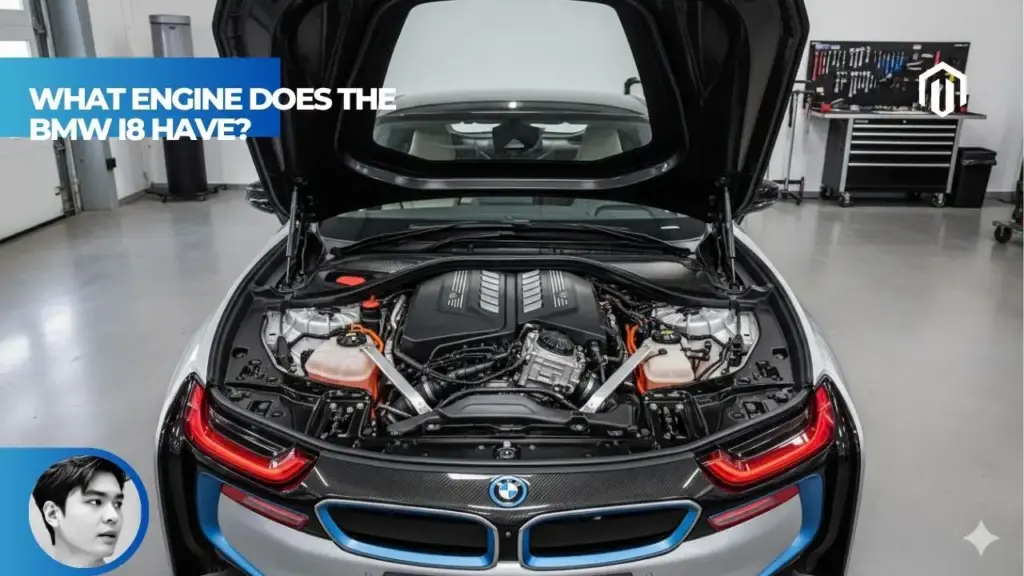
The BMW i8 uses a 1.5-liter turbocharged three-cylinder gasoline engine producing 228 horsepower and 236 lb-ft of torque, paired with an electric motor generating 131 horsepower and 184 lb-ft.[1] Combined system output reaches 369 horsepower and 420 lb-ft of torque, propelling the i8 from 0-60 mph in 4.4 seconds.[2]
Understanding the BMW i8’s Hybrid Powertrain
The i8’s powertrain defied convention. BMW didn’t simply add an electric motor to an existing engine—they engineered a purpose-built system where each power source drives different axles.
At the rear sits a 1.5-liter turbocharged three-cylinder engine connected to a 6-speed automatic gearbox.[1] This compact powerplant—essentially half of a BMW inline-six—punches well above its displacement class. With 228 horsepower and 320 Nm of torque available at just 3,700 rpm, the tiny turbo three delivers performance that rivals engines twice its size.[3]
Up front, an electric motor handles the other axle entirely. This unit produces 131 horsepower and 250 Nm of instant torque, powering the front wheels independently from the gasoline engine.[1] The result? All-wheel drive without a physical connection between the two axles—no transfer case, no center differential, just software coordinating two completely separate drivetrains.
When both systems work together, the i8 delivers a combined 369 horsepower and 420 lb-ft (570 Nm) of torque.[2] That’s supercar-adjacent performance from a powertrain that can also cruise silently on electricity alone.
BMW i8 Engine Specifications
Here’s the complete technical breakdown of the i8’s powertrain components.
| Component | Specification |
|---|---|
| Gasoline Engine | 1.5L turbocharged 3-cylinder |
| Engine Power | 228 hp @ 5,800 rpm |
| Engine Torque | 236 lb-ft (320 Nm) @ 3,700 rpm |
| Electric Motor Power | 131 hp (96 kW) |
| Electric Motor Torque | 184 lb-ft (250 Nm) |
| Combined System Output | 369 hp / 420 lb-ft |
| Transmission | 6-speed automatic |
| Drive Type | AWD (electric front, gas rear) |
| Battery Capacity | 11.6 kWh lithium-ion |
| Electric-Only Range | 18-23 miles |
Source: BMW, Car and Driver, Acceleration Times[2][3]
The turbocharged three-cylinder uses BMW’s TwinPower Turbo technology with direct injection and Valvetronic variable valve timing.[4] Despite its small size, this engine won multiple International Engine of the Year awards during the i8’s production run.
Performance: What the Numbers Mean on the Road
Raw specs tell only part of the story. The i8’s real magic happens in how the powertrain delivers its performance.
The 0-60 mph sprint takes 4.4 seconds according to BMW, though independent testing has recorded times as quick as 4.1 seconds.[2] Top speed hits 155 mph—electronically limited, as with most German performance cars. Quarter-mile runs complete in approximately 13.1 seconds at 118 mph.[2]
Here’s what the spec sheet doesn’t tell you: the electric motor’s instant torque transforms low-speed response. There’s no turbo lag, no waiting for boost to build. Mash the throttle from a standstill and both powertrains hit simultaneously—the electric motor providing immediate thrust while the turbo three spools up. The sensation is unlike traditional sports cars, which need engine revs to build before the real acceleration kicks in.
The flip side? At sustained high speeds, you’re running primarily on that 228-horsepower three-cylinder once the battery depletes. The i8 feels rapid in real-world driving but can’t match the outright pace of similarly-priced Porsche 911s or Audi R8s on track.[5]
Electric-Only Capability
The i8 wasn’t designed as a pure EV, but its electric mode works remarkably well for short trips.
With a fully charged 11.6 kWh battery, the i8 can travel 18-23 miles on electricity alone at speeds up to 75 mph.[6] That’s enough for most daily commutes—silent, emissions-free, and dramatically cheaper than burning premium fuel. For deeper insights on BMW’s electric technology, see our coverage of the BMW i4 and iX full-electric models.
Charging times depend on your equipment. A standard 120V outlet takes 4-5 hours for a full charge. A Level 2 240V charger cuts that to under 3 hours.[4] No DC fast charging was available—the i8 predated widespread fast-charging infrastructure.
The hybrid system also recuperates energy during braking, feeding charge back to the battery automatically. Aggressive driving depletes the battery faster, but normal commuting often keeps it topped up through regeneration alone.
Why BMW Used a Three-Cylinder Engine
A three-cylinder in a $150,000 sports car seems counterintuitive. BMW had specific reasons for this choice.
Weight distribution was paramount. The i8 uses a carbon-fiber-reinforced plastic (CFRP) passenger cell bonded to an aluminum chassis—exotic materials borrowed from Formula 1.[4] A compact, lightweight engine allowed BMW to achieve near-perfect 50/50 weight distribution despite carrying a heavy lithium-ion battery pack.
The engine itself weighs roughly 330 pounds—far lighter than any conventional V8 or even an inline-six.[4] Positioned low and behind the passenger cabin, it keeps mass centralized for better handling dynamics.
And honestly? The three-cylinder sounds good. BMW tuned the exhaust to amplify the engine note through the cabin, and the naturally uneven firing order creates a distinctive growl under acceleration. It’s not a V8 rumble, but it has character.
The i8’s Production History
BMW built the i8 from 2014 through June 2020, selling more than 20,000 units worldwide—making it the best-selling hybrid sports car ever produced.[7]
The original coupe launched in 2014, followed by a roadster variant in 2018. A mid-cycle refresh that same year added 12 horsepower to both the gasoline engine and electric motor, bumping combined output from 357 to 369 horsepower.[5]
BMW announced the end of i8 production on March 11, 2020—coincidentally the same day the NBA suspended its season due to COVID-19.[8] The final 18 units rolled off the Leipzig assembly line in June 2020, each a unique Roadster with custom specifications.[9]
Why discontinue it? Several factors converged: the i8’s plug-in hybrid tech felt dated as fully electric vehicles gained traction, sales had plateaued, and BMW was redirecting resources toward pure EVs like the [i4] and [iX].[8]
Buying a Used BMW i8: What to Know
With no new i8s available, used examples are the only option. Prices have dropped significantly from the original $147,500+ MSRP.
As of January 2026, used i8s range from approximately $38,000 to over $80,000 depending on year, mileage, and condition.[10] The average price sits around $47,800, with pre-LCI models (2014-2017) available under $50,000 and post-refresh examples (2018-2020) commanding premiums.[11]
Common issues to check include high-voltage battery degradation, 12V auxiliary battery failures, AC compressor problems affecting battery cooling, and premature engine mount wear.[12] The butterfly doors are known for wiring harness issues—each side takes roughly three days to repair properly.[13]
Pre-LCI models built before 2017 had a radiator issue that should be addressed proactively if not already serviced.[13] Three recalls affected the i8 during production: a 2014 fuel leak concern, a 2015 stability control sensor issue, and a 2016 airbag problem.[14]
For context on BMW ownership costs, check our guides on BMW maintenance expenses and BMW reliability by mileage.
Key Takeaways
- The BMW i8 combines a 1.5-liter turbocharged three-cylinder engine (228 hp) with an electric motor (131 hp) for a combined system output of 369 horsepower and 420 lb-ft of torque.[2]
- The unique all-wheel-drive system operates without physical connection—the gas engine powers the rear wheels while the electric motor drives the front axle independently.[1]
- Performance reaches 0-60 mph in 4.4 seconds with electric-only capability of 18-23 miles at speeds up to 75 mph, blending sports car dynamics with hybrid efficiency.[6]
- BMW produced the i8 from 2014 to June 2020, selling over 20,000 units—making it the best-selling hybrid sports car ever manufactured.[7]
- Used prices now range from approximately $38,000 to $80,000+, with common concerns including battery degradation, electrical issues, and costly specialized repairs.[10][12]
FAQs
Is the BMW i8 fast compared to other sports cars?
The i8 accelerates from 0-60 mph in 4.4 seconds with a top speed of 155 mph—quick by any standard, but not supercar-fast.[2] It matches or beats many Porsche Caymans and Audi TTs, but falls short of the Porsche 911 Turbo or McLaren models that were similarly priced when new. The i8 prioritizes efficiency and futuristic tech over outright speed.
Can you still buy a new BMW i8?
No. BMW discontinued the i8 in June 2020 after six years of production.[7] Only used examples are available now, with prices ranging from around $38,000 to $80,000+ depending on model year and condition.
What gas does a BMW i8 take?
The BMW i8 requires premium unleaded gasoline with a minimum octane rating of 91.[4] Like other turbocharged BMW engines, using lower-octane fuel can cause knock sensor intervention, reducing performance. For more details, see our guide on what gas BMWs require.
How reliable is the BMW i8 long-term?
Reliability is mixed. The complex hybrid system creates potential failure points including battery degradation, electrical issues, and specialized component failures that can cost thousands to repair.[12] Well-maintained examples with complete service histories fare better. Budget for higher-than-average maintenance costs and seek a BMW-certified pre-purchase inspection before buying.
References
- Drive i8. (2022). BMW i8 Performance and Power. https://drivei8.com/bmw-i8-performance-and-power/
- Acceleration Times. BMW i8 0-60, Quarter Mile, Specs. https://accelerationtimes.com/models/bmw-i8
- CarDekho. BMW i8 Specifications. https://www.cardekho.com/bmw/bmw-i8-specifications.htm
- BMW Mongolia. BMW i8: Drive. https://www.bmw.mn/en/all-models/bmw-i/i8/2014/drivingdynamics.html
- Choose My Car. (2025). BMW i8 Used Car Review. https://choosemycar.com/resources/car-reviews/bmw/i8
- Top Speed. (2024). BMW i8 Performance: 0-60 MPH And Top Speed. https://www.topspeed.com/bmw-i8-0-60-mph-top-speed/
- Business Insider. (2020). A Look Back at the Futuristic BMW i8. https://www.businessinsider.com/a-look-back-at-the-futuristic-bmw-i8-which-ends-production-in-april-2020-3
- Slashgear. (2024). Here’s Why The BMW i8 Was Discontinued. https://www.slashgear.com/1605576/why-bmw-i8-discontinued-what-happened/
- BMW Group Press. Final 18 BMW i8 Cars Leave Plant Leipzig. https://www.press.bmwgroup.com/global/article/detail/T0309945EN/final-18-bmw-i8-cars-leave-plant-leipzig
- Edmunds. (2026). Used BMW i8 for Sale Near Me. https://www.edmunds.com/used-bmw-i8/
- CarGurus. (2026). Used BMW i8 for Sale Nationwide. https://www.cargurus.com/Cars/l-Used-BMW-i8-d2274
- My EV Discussion. Here’s Everything That’s Wrong With My Cheap BMW i8. https://myevdiscussion.com/threads/heres-everything-thats-wrong-with-my-cheap-bmw-i8.204/
- Reddit r/BMW. (2025). Is the BMW i8 as Unreliable as the Reputation. https://www.reddit.com/r/BMW/comments/1j2gvpz/is_the_bmw_i8_as_unreliable_as_the_reputation/
- What Car. (2022). BMW i8 2014-2020 Reliability. https://www.whatcar.com/bmw/i8/coupe/used-review/n876/reliability

I am a senior automotive analyst at Autvex. Expert vehicle evaluations, in-depth reviews, and objective analysis helping readers make informed automotive decisions with years of industry experience.